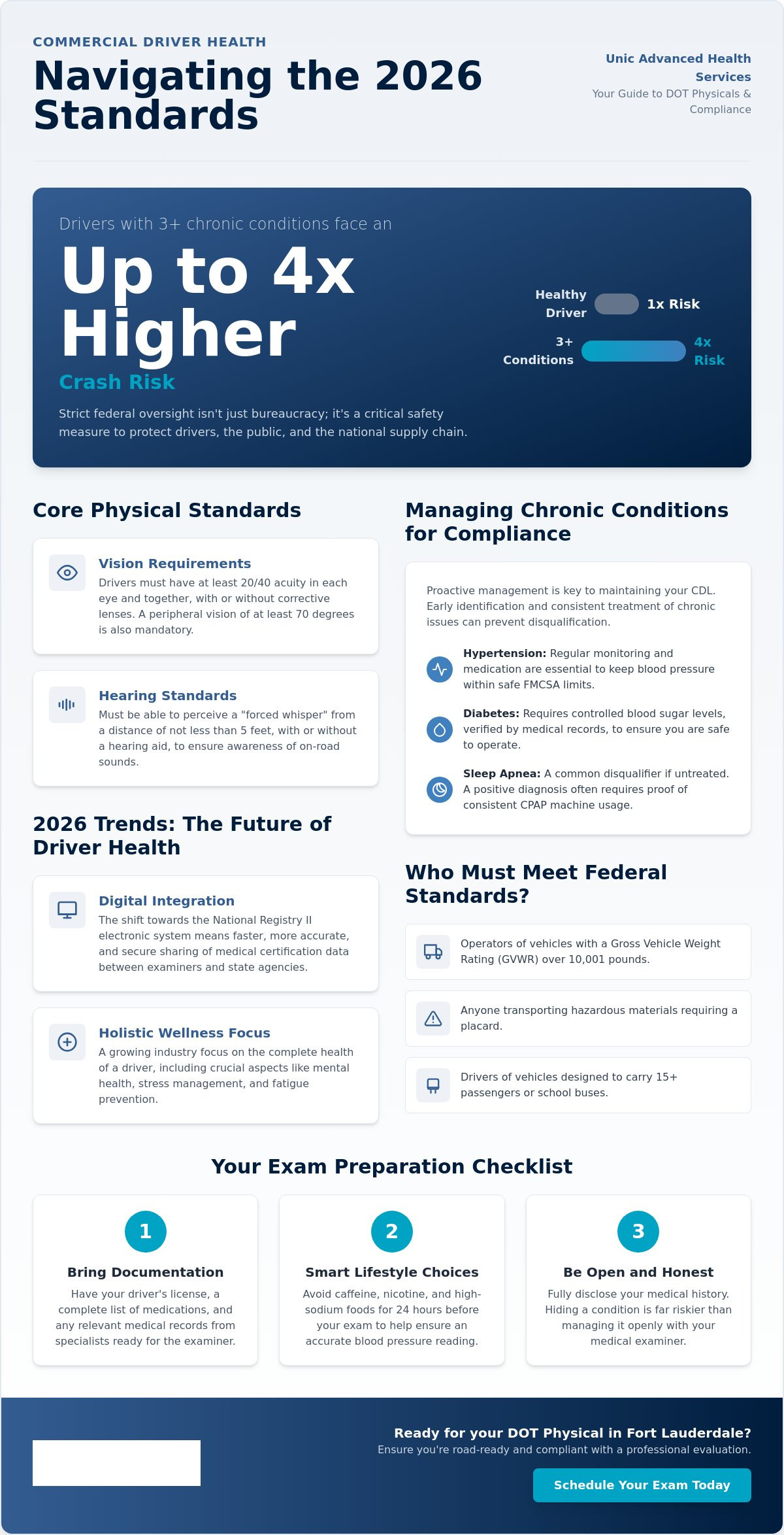
Did you know that commercial drivers with three or more chronic medical conditions face a crash risk up to four times higher than those in peak health? It’s a sobering statistic that underscores why federal regulators have tightened oversight. Understanding the latest commercial driver health requirements is no longer just about passing a test; it’s about protecting your career and your safety on the road.
We understand the anxiety that comes with a looming DOT physical, especially when concerns about high blood pressure or sleep apnea regulations feel like they’re putting your livelihood at risk. You’ve worked hard for your CDL, and the last thing you need is a surprise disqualification during a routine exam. This guide provides a clear analysis of the 2026 medical standards and the shift toward the National Registry II electronic system. You’ll learn how to manage chronic conditions effectively and what to expect during your next evaluation. We’ll explore everything from vision and hearing benchmarks to actionable steps for maintaining compliance, ensuring you find a steady hand to guide you through the process in Fort Lauderdale.
Key Takeaways
- Understand the foundational FMCSA safety standards for 2026 and why commercial regulations are more stringent than those for private drivers.
- Master the specific vision and hearing benchmarks required for certification, including the “forced whisper” test and visual acuity standards.
- Learn proactive management strategies for chronic conditions like hypertension and diabetes to remain compliant with commercial driver health requirements.
- Stay informed on the latest trends in digital record integration and the growing industry focus on holistic wellness and mental health.
- Access a professional preparation guide for your next exam, ensuring you have the correct documentation and lifestyle tips for a successful visit.
Understanding the 2026 Federal Commercial Driver Health Requirements
The Federal Motor Carrier Safety Administration (FMCSA) serves as the primary architect of safety on American highways. They establish the commercial driver health requirements that keep millions of tons of freight moving safely across state lines. While a standard driver’s license focuses mostly on operating skills, obtaining a Commercial driver’s license demands a high level of physical fitness. This ensures that the person behind the wheel of an 80,000-pound vehicle is physically capable of handling the rigors of the job without becoming a danger to themselves or the public.
The distinction between private and commercial health standards exists because of the sheer scale of the equipment involved. A medical emergency behind the wheel of a sedan is tragic, but the same event in a tractor-trailer can be catastrophic. Consequently, federal law requires a periodic medical evaluation to verify that drivers don’t have conditions that could cause a sudden loss of consciousness or physical control. This rigorous oversight isn’t just about red tape; it’s a proactive strategy to maintain the integrity of our national supply chain.
To better understand what happens during these evaluations, watch this helpful breakdown of the medical exam process:
Compliance also depends on where you drive. Interstate drivers must meet all federal standards because they cross state lines. Intrastate drivers stay within one state and generally follow the same rules, though some states offer specific waivers for certain medical conditions. Regardless of your route, the Medical Examiner’s Certificate (MEC) acts as your official “license to drive” in the eyes of the law. Without a valid MEC on file, your CDL can be downgraded or suspended, halting your ability to earn a living.
The Purpose of Strict Medical Oversight
The oversight system aims to reduce road accidents caused by sudden medical events like heart attacks, seizures, or fainting spells. Beyond public safety, these exams help protect your long-term health in an industry known for high stress and sedentary routines. By identifying health issues early, we can work together to manage them before they become disqualifying. The Medical Examiner’s Certificate serves as the vital link between a driver’s physical health and their legal authority to operate a commercial vehicle.
Who Must Meet These Standards?
Federal regulations apply to anyone operating a vehicle with a gross weight rating over 10,001 pounds or those transporting hazardous materials. You also fall under these commercial driver health requirements if you operate a vehicle designed to carry 15 or more passengers or a school bus. In Florida, drivers must navigate specific self-certification categories through the Department of Highway Safety and Motor Vehicles. It’s essential to update your state record whenever you receive a new medical certificate to ensure your driving status remains “certified” in the state database.
Core Physical Standards: Vision, Hearing, and Physical Agility
To maintain safety on our national highways, the FMCSA establishes specific physical benchmarks that every driver must meet. These commercial driver health requirements focus on the sensory and physical capabilities needed to react to split-second changes in traffic. Meeting these standards ensures that you can safely manage the demands of long-haul driving while protecting the public. The Federal Medical Requirements serve as a baseline for these evaluations, providing a standardized framework for examiners across the country.
A professional evaluation doesn’t just check boxes; it provides a clear picture of your current health status. Utilizing diagnostic testing in a primary care clinic allows for a more precise verification of these physical standards. This data-driven approach helps eliminate guesswork, giving you confidence in your ability to stay road-legal and healthy.
Vision and Hearing Benchmarks
Visual acuity is a cornerstone of safe operation. You must have at least 20/40 acuity in each eye and both eyes together. This standard applies whether you use corrective lenses or not. If you wear glasses or contacts to meet this requirement, you must wear them whenever you’re behind the wheel. We also measure peripheral vision, requiring at least 70 degrees in the horizontal meridian of each eye. This wide field of view is essential for spotting merging traffic and hazards. Additionally, you must be able to distinguish among the colors of traffic signals: red, green, and amber.
Hearing standards are equally precise to ensure you can hear sirens, horns, and equipment changes. We typically perform a “forced whisper” test from a distance of five feet. If you can’t perceive the whisper in at least one ear, we’ll move to audiometric testing to measure your hearing loss across specific frequencies. Drivers who use hearing aids are welcome to use them during the exam, provided they use them while operating their vehicle.
Musculoskeletal and Neurological Integrity
Operating a heavy vehicle requires significant physical agility. You must have the strength and range of motion to enter and exit the cab, secure cargo, and perform emergency maneuvers if necessary. During the exam, we assess your grip strength and limb functionality to ensure you can maintain control of the steering wheel and pedals under pressure. If you’ve had a previous injury, we’ll look at how well you’ve recovered and whether it impacts your safe operation.
Neurological health is a critical safety factor. We screen for seizure disorders and assess reflex integrity because any condition that might cause a sudden loss of consciousness is generally disqualifying. A thorough physical history is our best tool for identifying these hidden risks early. If you’re concerned about how a specific condition might affect your certification, our team can guide you through a DOT physical examination with a supportive and steady hand.
Managing Chronic Conditions for Long-Term Compliance
Living with a chronic condition doesn’t mean your career on the road has to end. In fact, research indicates that over 80% of truck drivers manage at least one serious health condition, proving that longevity in this industry is possible with the right strategy. The key to meeting commercial driver health requirements lies in proactive management rather than reactive fixes. By identifying risks early through preventive health screenings in Florida, you can address potential issues before they lead to a shortened or denied medical certificate.
Cardiovascular Health and Blood Pressure
Blood pressure is often the most significant hurdle for drivers during their DOT physical. If your reading is under 140/90, we can typically issue a certificate for the full two years. However, once those numbers climb, the certification period begins to shrink. Stage 1 hypertension, which ranges from 140/90 to 159/99, results in a one year certificate. If your reading reaches Stage 2 levels of 160/100 to 179/109, you may only receive a three month temporary certificate to allow time for lifestyle adjustments or medication. Hypertension is the leading cause of short-term medical certificates. We understand that “white coat syndrome” can cause a spike in pressure due to exam room anxiety. To manage this, we recommend arriving early for your Fort Lauderdale exam, avoiding caffeine for at least two hours prior, and practicing steady, deep breathing before the cuff is applied.
Diabetes and Respiratory Compliance
Managing diabetes requires precision and thorough documentation to maintain your CDL status. For drivers with Insulin-Treated Diabetes Mellitus (ITDM), the 2026 standards require the completion of the ITDM Assessment Form (MCSA-5870) by your treating clinician. This form must be provided to your certified medical examiner to verify that your condition is stable and well controlled. We look for consistent glucose monitoring and stable A1c levels to ensure you aren’t at risk for hypoglycemic episodes while driving. Control is everything. It’s a collaborative effort between you and your healthcare team.
Respiratory health, specifically Obstructive Sleep Apnea (OSA), has also seen increased focus. While there are no specific federal regulations requiring universal screening, the 2024 Medical Examiner’s Handbook provides clear guidance for identifying at-risk drivers. If you’ve been prescribed a CPAP machine, you must bring your compliance logs to the exam to show you’re using the device as directed. Partnering with a chronic care management nurse practitioner in Fort Lauderdale provides the ongoing stability you need to navigate these complex requirements. This steady partnership ensures your health data is organized and your conditions are managed, keeping you road-legal and healthy for years to come.
2026 Trends: The Shift Toward Digital and Holistic Health
The landscape for commercial driver health requirements is evolving rapidly in 2026. This shift isn’t just about stricter rules; it’s about a more streamlined and holistic approach to safety. We’re seeing a transition from paper-heavy processes to real-time digital oversight. This modernization helps reduce fraud and ensures that every driver on the road meets necessary medical benchmarks without the delay of traditional mail or manual entry. By integrating health data more effectively, the industry is moving toward a model that supports the driver as a whole person—an approach championed by organizations like Hope Therapy Center—rather than just a set of physical metrics.
Digital Integration and Real-Time Reporting
The implementation of the National Registry II (NRII) system represents a major milestone in digital compliance. As of 2026, the FMCSA requires that all medical examiners submit results electronically. This means your federal medical certificate Florida data is now shared instantly with federal authorities and state licensing agencies. This digital record serves as the official proof of your medical certification. To help with this transition, the FMCSA has issued a temporary waiver. From April 11, 2026, through October 11, 2026, drivers may use a paper copy of their Medical Examiner’s Certificate as valid proof for up to 60 days after their exam. This ensures you stay road-legal while the digital systems synchronize across state lines. Working with a qualified FMCSA medical examiner in Fort Lauderdale who is already integrated with the NRII system can make this transition seamless and stress-free.
Mental Health and Cognitive Awareness
There’s also a rising focus on mental health and stress management within the commercial transport sector. The concept of “Total Worker Health” recognizes that anxiety, depression, and PTSD can impact road safety just as much as physical ailments. New screening tools are being used to evaluate cognitive awareness and emotional stability during the exam process. If you’re taking medications for these conditions, we evaluate them carefully to ensure they don’t cause drowsiness or impaired judgment. This empathetic, patient-first approach aims to keep you in the cab while providing the support you need to manage the unique pressures of the driving lifestyle. For female drivers seeking specialized support, you can visit Women’s Mental Health Specialist for virtual, hormone-informed care tailored to your specific needs.
Technology is playing a supportive role in this holistic shift. Many drivers now use wearable tech data to verify sleep patterns and activity levels, providing a clearer picture of their health between exams. Telehealth services have also become a vital tool for pre-exam consultations and follow-up care, allowing you to address health concerns without the need for an in-person visit for every minor update. If you’re ready to experience a modern and efficient approach to your certification, you can schedule your DOT physical examination with our expert team to ensure you meet all current commercial driver health requirements with confidence.
Preparing for Your Occupational Health Exam in Fort Lauderdale
Success during your medical evaluation isn’t just about your physical state; it’s about your preparation. Arriving organized reduces stress and prevents administrative delays that could keep you off the road. When you understand the commercial driver health requirements and bring the necessary documentation, you demonstrate that you’re a proactive professional who takes safety seriously. This final step in your compliance journey should be handled with a steady hand and clear expectations.
Your Pre-Exam Checklist
To ensure a smooth process, gather all relevant medical records before you arrive. If you manage chronic conditions, having your paperwork in order is the best way to avoid a “pending” status. Please include the following in your preparation:
- Medication List: Provide a complete list of all prescription and over-the-counter medications, including dosages and the name of the prescribing physician.
- CPAP Compliance: If you use a CPAP machine, you must bring a report showing at least 90 days of recent usage data to verify treatment efficacy.
- Specialist Clearances: If you’ve had recent surgeries, hospitalizations, or a history of cardiac events, bring a release letter from your specialist stating you’re cleared to drive.
- Corrective Aids: Bring your most recent vision prescription, glasses, or hearing aids if you use them to meet federal standards.
On the day of your visit, avoid caffeine and nicotine for at least two hours before your appointment. These substances are known to elevate blood pressure and heart rate, which can lead to a reading that doesn’t accurately reflect your baseline health.
Why Unic Advanced Health Services?
Choosing the right provider makes a significant difference in your experience. At Unic Advanced Health Services, we offer a DOT physical exam in Fort Lauderdale led by Marc Joseph, an experienced autonomous nurse practitioner. We prioritize a compassionate, patient-first perspective that views you as a partner in safety. We also offer convenient Saturday appointments because we know that a driver’s schedule doesn’t always fit into a standard work week.
Sometimes, an exam results in a temporary or conditional certificate. This isn’t a failure; it’s often a request for more information, such as a follow-up lab test or a specialist’s opinion. We’ll guide you through the exact steps needed to resolve these conditions. Our goal is always to help you meet the commercial driver health requirements while maintaining your long-term well-being and professional stability.
Securing Your Career and Well-Being on the Road
Staying ahead of evolving federal regulations is the most effective way to protect your livelihood and your safety. We’ve explored how the transition to digital reporting and the proactive management of chronic conditions are reshaping the industry. Meeting commercial driver health requirements doesn’t have to be a source of anxiety when you have a clear plan and the right documentation in hand. By focusing on long-term wellness rather than just a passing grade, you ensure a long and successful career behind the wheel.
You deserve a healthcare partner who understands the unique demands of your profession and provides a steady hand through the certification process. Schedule your DOT or USCG physical at Unic Advanced Health Services today to benefit from the expertise of Marc Joseph, an autonomous nurse practitioner specializing in federal compliance and chronic disease management. We offer convenient Saturday office hours designed specifically for busy drivers who need reliable, individualized care. Your health is your most valuable asset; let’s work together to keep you road-legal and healthy for the miles ahead.
Frequently Asked Questions
What are the disqualifying medical conditions for a CDL in 2026?
Conditions like epilepsy, uncontrolled diabetes, and vision or hearing loss that falls below federal benchmarks are generally disqualifying. The FMCSA also lists Stage 3 hypertension, defined as a reading of 180/110 or higher, as a disqualifying factor until the condition is brought under control. Our goal is to work with you to manage these risks before they impact your ability to earn a living.
How long is a DOT medical certificate valid for a driver with high blood pressure?
The duration of your certificate depends on your blood pressure reading on the day of the exam. Readings under 140/90 typically result in a full two-year certificate, while Stage 1 hypertension (140/90 to 159/99) results in a one-year certificate. Stage 2 readings may lead to a three-month temporary certificate to allow time for treatment and lifestyle adjustments.
Can I pass a DOT physical if I am taking medication for anxiety or depression?
Yes, you can pass the exam while taking mental health medications as long as the treatment is stable and doesn’t cause impairment. We evaluate these medications to ensure they don’t cause side effects like drowsiness or slowed reaction times. Bringing a clearance letter from your prescribing physician helps us verify that your condition is well-managed and safe for the road.
What happens if I fail my commercial driver health assessment?
If you don’t meet the commercial driver health requirements, your status may be marked as “pending” or you may be disqualified. A “pending” status gives you a window of time to address specific issues, such as obtaining a new vision prescription or adjusting blood pressure medication. If you’re disqualified, we can discuss a long-term management plan to help you meet the necessary standards in the future.
Do I need a sleep study to get my medical certificate in Florida?
A sleep study isn’t mandatory for every driver, but it may be required if you show specific risk factors for obstructive sleep apnea. We use the 2024 Medical Examiner’s Handbook guidelines to assess factors like BMI and neck circumference during your exam. If a study is necessary, we’ll guide you through the process to ensure you meet all commercial driver health requirements for 2026.
How much does a DOT physical exam cost in Fort Lauderdale?
Prices for a DOT physical in the Fort Lauderdale area vary depending on the provider and the complexity of the evaluation. Some clinics offer flat rates for the exam, while others may include additional fees for lab work or specialized screenings. It’s best to contact local providers directly to confirm their current rates and what services are included in the visit.
Can a nurse practitioner perform a DOT physical exam?
Yes, an autonomous nurse practitioner can perform your exam as long as they are listed on the FMCSA National Registry. Many drivers prefer working with a nurse practitioner because they often provide a more personalized and holistic approach to health management. This ensures that your exam is both thorough and supportive of your long-term career goals and physical well-being.
How do I self-certify my medical card with the Florida HSMV?
You can self-certify your medical status through the Florida Department of Highway Safety and Motor Vehicles (FLHSMV) online portal. You’ll need to submit your Medical Examiner’s Certificate data to ensure your CDL remains in “certified” status in the state database. This process can also be completed by mail or in person at a local driver license office, though the digital portal is typically the fastest method.