
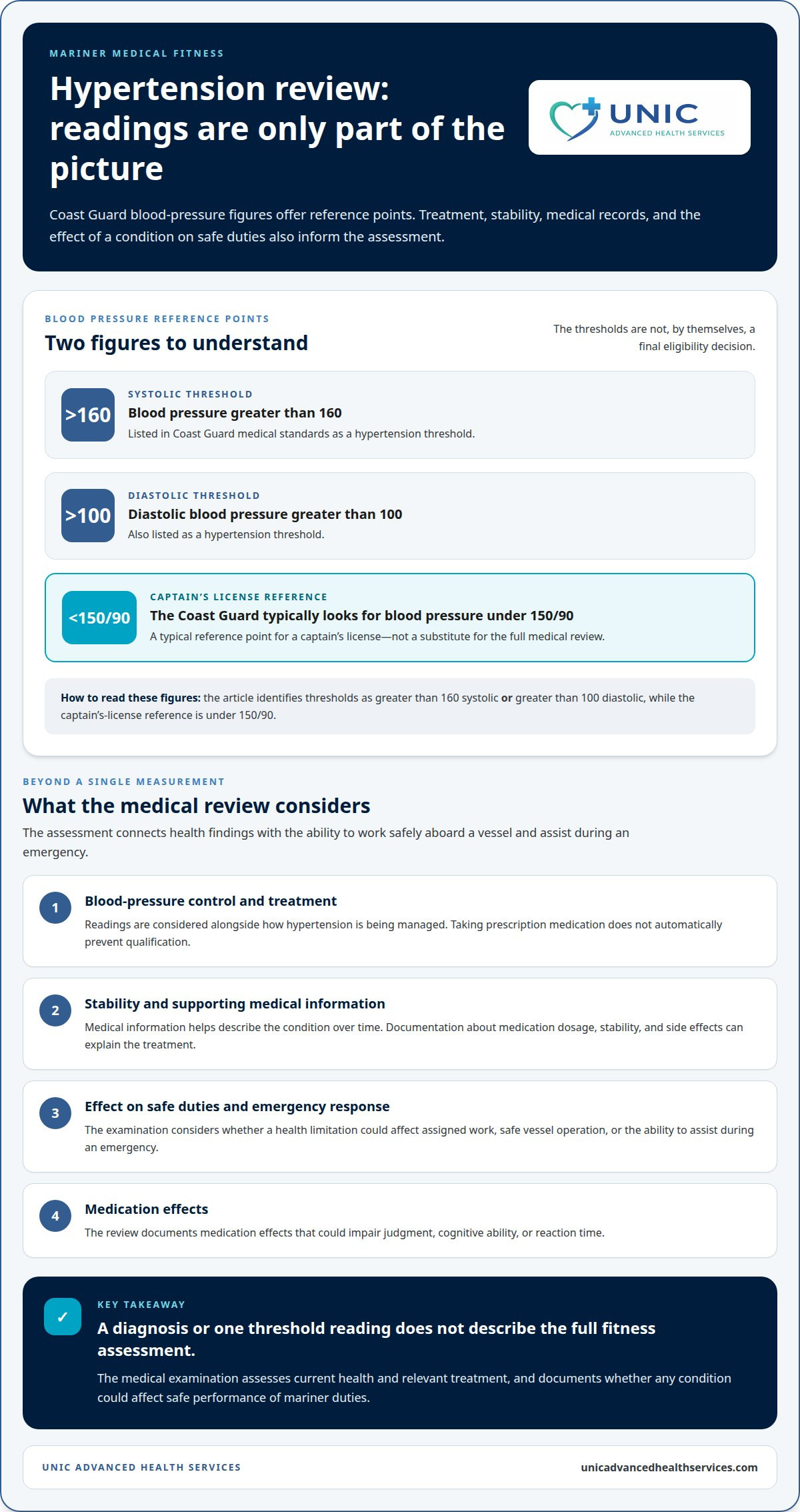
A medical certificate for mariners with hypertension may still be possible: mariners taking prescription medication for high blood pressure can qualify. Coast Guard medical standards list blood pressure greater than 160 or diastolic blood pressure greater than 100 as a hypertension threshold, while the Coast Guard typically looks for blood pressure under 150/90 for a captain’s license.
It’s understandable to wonder whether a diagnosis, medication, or high reading could affect your eligibility for a medical certificate for mariners with hypertension. The assessment considers more than a single reading: blood pressure control, treatment, stability, and supporting medical information all help describe your health.
This article explains what merchant mariner physicals assess, how blood pressure thresholds relate to eligibility, and what records can support your application. You’ll also learn how medication may factor into the review and how a U.S. Coast Guard boat captain physical can document your current health.
Key Takeaways
- A mariner physical evaluates whether health conditions or physical limitations could affect duties or emergency response, not just whether a person has a diagnosis.
- Blood pressure thresholds are useful reference points, but treatment, control, and medical documentation also inform the eligibility review.
- Prescription medication for high blood pressure doesn’t automatically prevent qualification; records about dosage, stability, and side effects can help explain treatment.
- Use Form CG-719K for a U.S. merchant mariner medical certificate application, and prepare relevant provider statements and recent test results to support the health history.
- A U.S. Coast Guard boat captain physical can document health as part of the examination process.
What Are Merchant Mariner Physicals?
A merchant mariner physical evaluates whether health and physical ability meet certification requirements. Under 46 CFR 10.302, U.S. Coast Guard medical fitness requirements govern required examinations and physical-ability demonstrations.
Medical Fitness and Physical Limitations
Medical fitness means being able to perform required duties without a disqualifying health limitation. The examination considers whether a condition could cause sudden incapacitation or a debilitating complication. Under 46 CFR 10.304(a), the general medical examination must document conditions relevant to those risks. A diagnosis alone doesn’t describe its functional effect; the assessment considers how it affects the applicant’s ability to work safely.
For hypertension, blood pressure and its management are relevant to this evaluation. Coast Guard medical standards identify blood pressure greater than 160 or diastolic pressure greater than 100 as a hypertension threshold. Eligibility for a medical certificate for mariners with hypertension therefore involves both the readings and the medical information describing the condition.
Fitness for Shipboard Duties
Fitness for shipboard duties means being able to perform assigned work and assist during vessel emergencies. A physical considers limitations that could prevent you from carrying out duties or affect safe operation. Emergency response matters even if you don’t directly operate the vessel. For example, a limitation that affects your ability to assist in an emergency may be relevant to the fitness assessment.
Medical fitness also includes medication effects that could impair judgment, cognitive ability, or reaction time. Under 46 CFR 10.304(a), required examinations must document conditions requiring medication with those effects. The medical review connects health findings with the work expected aboard a vessel, rather than treating a job title as the only measure of ability.
USCG Medical Standards for Hypertension
USCG medical standards are requirements used to assess a mariner’s fitness for certification. They list blood pressure greater than 160 or diastolic blood pressure greater than 100 as a hypertension threshold. For a captain’s license, the Coast Guard typically looks for blood pressure under 150/90. These figures provide relevant reference points, while treatment and clinical stability help explain the applicant’s health status.
The physical examination must assess you, not rely only on records or patient history. A medical provider documents findings and relevant conditions on the application. Hypertension may prompt review of your readings, treatment, and any effects on safe duties. These factors are considered within the broader assessment of whether you meet the applicable medical requirements.
Waivers and Certificate Restrictions
A waiver is an authorization the National Maritime Center may issue for a condition that doesn’t pose a real safety risk. Under 46 CFR 10.303, the Center can issue medical waivers for qualifying conditions. Hypertension may lead to further review, but a diagnosis or threshold reading alone doesn’t establish that a waiver will be issued.
A medical certificate may also carry restrictions tailored to the medical evaluation. Examples include limiting service to certain vessel types or routes, or requiring periodic medical review. The Coast Guard’s decision relates to documented health and fitness, including possible effects on emergency response. Requirements can differ according to whether a credential requires a general medical examination or physical-ability demonstration under 46 CFR 10.302.
Credential and service context matter: a medical certificate is generally required to serve under a Merchant Mariner Credential. However, the Coast Guard doesn’t require one when a mariner isn’t required to have a general medical examination or demonstrate physical ability under 46 CFR 10.302. Vessel type, route, and job duties may also relate to certificate limitations.
What Is a USCG Medical Certificate?
A U.S. Coast Guard medical certificate documents that a mariner meets required medical and physical standards. It supports service under a Merchant Mariner Credential when medical certification is required. The certificate reflects an examination, not just a review of past records. If you manage hypertension, the evaluation helps document your current health and relevant treatment.
A required examination must include a physical assessment. A review based only on medical documents or patient history isn’t acceptable for U.S. mariner credential exams. Both you and the medical provider must sign and date the medical evaluation form. Complete every section, including those marked “N/A,” to ensure the evaluation is complete.
Provider qualifications also matter. A physician, physician assistant, or nurse practitioner licensed in a U.S. state, possession, or territory must perform, witness, or review exams, tests, and physical-ability demonstrations. The Coast Guard doesn’t accept work reviewed by foreign medical license holders, chiropractors, or naturopathic doctors. This requirement applies to examinations and related testing for U.S. mariner credentials.
Medical examinations are required for admission to the U.S. Coast Guard. For merchant mariner applicants, the general examination must document conditions that could pose a significant risk of sudden incapacitation or debilitating complication. This includes relevant conditions requiring medication that could impair cognitive ability, judgment, or reaction time. The provider records findings needed to assess these risks.
The medical certificate requirement depends on the credential’s applicable examination rules. Under 46 CFR 15.401(c), a certificate is generally required to serve under a Merchant Mariner Credential. However, the Coast Guard doesn’t require one when the mariner isn’t required to have a general medical exam or demonstrate physical ability under 46 CFR 10.302. That distinction helps explain why credential requirements can differ.
Certified Hypertension Specialist (CHS) redesignation has separate professional requirements. In the United States and Canada, CHS applicants must be currently licensed physicians certified by a relevant primary care board. Examples include internal medicine, family practice, pediatrics, or obstetrics-gynecology. Applicants from other countries must hold current physician licensure and certification from a relevant national or U.S. primary board, or an equivalent board.
For a mariner’s examination, a USCG Boat Captain Physical provides an appropriate setting to document medical fitness. The provider’s examination and completed form support the medical review, while the Coast Guard determines certificate issuance and any applicable conditions.
Supporting documentation for medical conditions
Supporting records give the Coast Guard clinical details that an examination alone may not show. For hypertension, useful materials can describe treatment, blood pressure control, stability, and medication effects.
Additional Supporting Documentation
Supporting documentation is medical evidence that explains a condition and its management. U.S. merchant mariner applicants use Form CG-719K for medical certificate applications. For hypertension, a treating physician’s statement can describe treatment and control, while recent test results can add clinical context.
The Coast Guard may request a physician’s statement, medication dosage information, and confirmation of stability and side effects. Records can also document effective management or adherence to treatment. For example, a provider’s statement can explain how your prescribed regimen relates to your current blood pressure and daily functioning.
When submitting additional information for an existing application, combine the documents into a single PDF file. This gives the National Maritime Center one consolidated file to review. Include relevant records together, such as the provider statement, dosage details, and recent test results, rather than sending supporting pages in separate files.
Vision and Hearing Records
Vision and hearing records document sensory ability through required examination results. A USCG medical exam must document distance vision, near vision, and color vision testing when required. Evidence of color vision must be objective and verifiable, and color-sensing lenses cannot establish the result.
Acceptable color-vision documentation includes results from an approved USCG color-vision test. A statement from a mariner or examiner describing colors seen, without a documented test, isn’t accepted. Hearing ability must be documented with a forced-whisper test or an audiogram when required. These records document examination findings, not simply an opinion about ability.
Application timing depends in part on whether the file contains the medical details needed for review. For hypertension, a complete provider statement, dosage information, details about stability, and relevant test results help explain the condition. If the National Maritime Center requests more information, submitting the requested records gives it additional material to review.
After a denial, the Coast Guard explains the reason for its decision. You can submit additional medical documentation, and reconsideration or appeal options are available in some cases. For a hypertension-related decision, relevant records can address the concern identified, such as treatment control, medication dosage, or documented side effects.
Blood pressure medication and eligibility
Taking prescribed blood pressure medication doesn’t automatically prevent you from qualifying as a mariner. The evaluation considers your condition, treatment, and medication effects in relation to medical fitness and vessel duties.
Medication and Medical Eligibility
Medication eligibility depends on whether the treatment and its effects are compatible with safe maritime service. Mariners taking prescription medication for high blood pressure can still qualify for a U.S. Coast Guard medical certificate. The medication itself isn’t the only consideration. The review also considers stability, dosage, side effects, and whether treatment affects cognitive ability, judgment, or reaction time.
For example, a stable treatment plan and medication that doesn’t impair alertness provide different information from treatment accompanied by disruptive side effects. The Coast Guard may request a physician’s statement describing stability and medication effects. This helps relate treatment details to your ability to perform duties aboard a vessel and assist in an emergency.
A credential application should describe relevant health conditions and medication accurately. U.S. mariner medical examinations must document conditions requiring medication that impairs cognitive ability, judgment, or reaction time under 46 CFR 10.304(a). That requirement makes the medication’s functional effects important. A prescription alone doesn’t establish that those effects are present.
Disclosing Blood Pressure Medication
Medication disclosure is the application record of prescribed treatment and its relevant medical effects. On Form CG-719K, provide complete, accurate information about hypertension and prescribed medication as part of the medical evaluation. The form must have every section completed, even when an answer is “N/A.” The applicant and medical provider must both sign and date it.
Medication review may involve a physician’s statement, dosage information, and confirmation of stability and side effects. These details explain how treatment is managed, rather than leaving the Coast Guard to interpret a medication name alone. Recent provider records can also describe blood pressure control and any effects relevant to safe work.
If the National Maritime Center needs more information, submit relevant medical documentation with your application. For an existing application, combine additional information into a single PDF file. Keep the material focused on the stated medical concern, such as dosage, stability, or a reported side effect. This gives the reviewer a connected account of your condition and treatment.
If you have questions about how a specific medication affects your application, contact the National Maritime Center. Identify the medication and the credential application in your inquiry. The medical review still considers your individual health information and documented effects. Clear disclosure supports an accurate assessment of treatment and fitness for service.
Blood pressure thresholds for mariners
A blood pressure threshold is a reading used to flag hypertension during medical evaluation. Coast Guard medical standards list blood pressure greater than 160 or diastolic pressure greater than 100 as a hypertension threshold. For a captain’s license, the Coast Guard typically looks for blood pressure under 150/90. These values serve different roles in the review, so they shouldn’t be treated as interchangeable.
The first number in a blood pressure reading is systolic; the second is diastolic. In the 150/90 reference, 150 is the systolic value and 90 is the diastolic value. The hypertension thresholds identify readings above 160 systolic or 100 diastolic. A reading at either level can be relevant to the medical evaluation, but the thresholds alone don’t describe the full clinical picture.
For a merchant mariner, the practical question is how blood pressure relates to medical fitness and safe service. The Coast Guard evaluates conditions that could create a significant risk of sudden incapacitation or debilitating complication. Present your condition clearly in the application, including treatment and relevant medical records. A single reading does not show how hypertension is managed or whether medication has relevant effects.
The captain’s-license reference is more specific to that credential: the Coast Guard typically looks for a reading under 150/90. By contrast, the medical standards list greater than 160 systolic or greater than 100 diastolic as a hypertension threshold. A mariner comparing these values should note the purpose attached to each. One describes a typical captain’s-license expectation; the other identifies hypertension in the medical standards.
The Department of Transportation and the U.S. Coast Guard oversee aspects of U.S. merchant mariner credentialing. Medical fitness review considers documented health information alongside the requirements applicable to the credential. For example, a captain’s-license applicant may need medical information that explains a reading above the typical 150/90 reference. A provider note about hypertension treatment and control can help describe that context.
Prepare your application with a clear account of the diagnosis, current treatment, and supporting clinical information. If readings meet or exceed the listed thresholds, records describing control and medication can help explain your situation. Relevant factors include measured blood pressure, treatment, stability, and any medication effects that could affect your duties aboard a vessel.
A USCG Boat Captain Physical can document health findings relevant to the captain’s-license examination. Use this examination when you need a provider to assess and record your current medical status for the application.
Unic Advanced Health Services
Unic Advanced Health Services in Fort Lauderdale offers a U.S. Coast Guard (USCG) Boat Captain Physical for mariners who need a medical examination documented for their credential application. The physical can help assess and record health findings, including information relevant to hypertension and treatment. It does not determine whether the Coast Guard will issue a certificate; the National Maritime Center reviews the application and supporting records.
For ongoing blood pressure care, Chronic Condition Management can support continued attention to hypertension beyond the examination. This may be useful when you’re working to manage the condition and keep your medical information current. Contact Unic Advanced Health Services to discuss a USCG Boat Captain Physical or chronic condition management.
Prepare for your next credential step
Before submitting your application, consider whether your medical record gives a clear picture of your current health and treatment. An organized account can connect your examination findings with your ability to work safely at sea. The Coast Guard makes the certification decision after reviewing your application and supporting information, so keep your records current as your care changes.
If you’re preparing for a medical certificate for mariners with hypertension, a focused physical examination can help document your health status and provide a useful starting point for your application. Ongoing care can also support blood pressure management beyond the examination.
Unic Advanced Health Services offers a U.S. Coast Guard (USCG) Boat Captain Physical and Chronic Condition Management. For help with your next step, contact Unic Advanced Health Services. You can move forward with a clearer understanding of your health documentation and the examination process.
Frequently Asked Questions
What Counts as a Medical Disqualifier for a Captain’s License?
A condition may affect eligibility if it creates a significant risk of sudden incapacitation, a debilitating complication, or a physical limitation that prevents safe duties. The review considers the condition’s effects, treatment, and medication-related impairment of judgment, cognitive ability, or reaction time. For example, hypertension is evaluated in context, not treated as an automatic disqualifier based on diagnosis alone.
What blood pressure do I need for a captain’s license?
The Coast Guard typically looks for blood pressure under 150/90 for a captain’s license. This reference is not the same as the medical-standard hypertension thresholds. A provider’s note about treatment and control can help explain a reading above the typical captain’s-license reference. Include relevant clinical information with your application so the reading can be considered alongside your health status.
What medical certificate do U.S. mariners need to work aboard a vessel?
Mariners serving under a Merchant Mariner Credential generally need a U.S. Coast Guard medical certificate. It documents that the mariner meets medical and physical standards. Under 46 CFR 15.401(c), the certificate isn’t required when the mariner doesn’t need a general medical examination or physical-ability demonstration under 46 CFR 10.302. The credential and its examination requirements determine whether certification applies.
What blood pressure readings disqualify a mariner from a Coast Guard medical certificate?
Coast Guard medical standards identify systolic blood pressure greater than 160 or diastolic blood pressure greater than 100 as a hypertension threshold. These readings do not automatically mean a mariner is disqualified. The medical review also considers treatment, stability, effects on function, and supporting information. A provider statement can explain the health context behind readings that exceed either threshold.
Can mariners with controlled hypertension qualify for a medical certificate?
Yes. Mariners taking prescription medication for high blood pressure can still qualify for a Coast Guard medical certificate. For a medical certificate for mariners with hypertension, useful context includes how treatment controls the condition and whether medication causes side effects relevant to your duties. A provider’s statement and medication details can describe your current status for application review.
What documentation and medical tests are required for hypertension on the CG-719K medical form?
Use Form CG-719K and provide relevant information about hypertension and its treatment. Supporting records may include a treating physician’s statement, medication dosage, recent test results, and details about stability, side effects, or treatment compliance. The Coast Guard may request additional information during medication review. There isn’t a hypertension-specific test identified here; the submitted records should explain the condition and its management.
How can a mariner appeal a medical certificate denial for hypertension?
The Coast Guard will explain the reason for a denial. You may submit additional medical documentation, and reconsideration or appeal options may be available in some cases.