
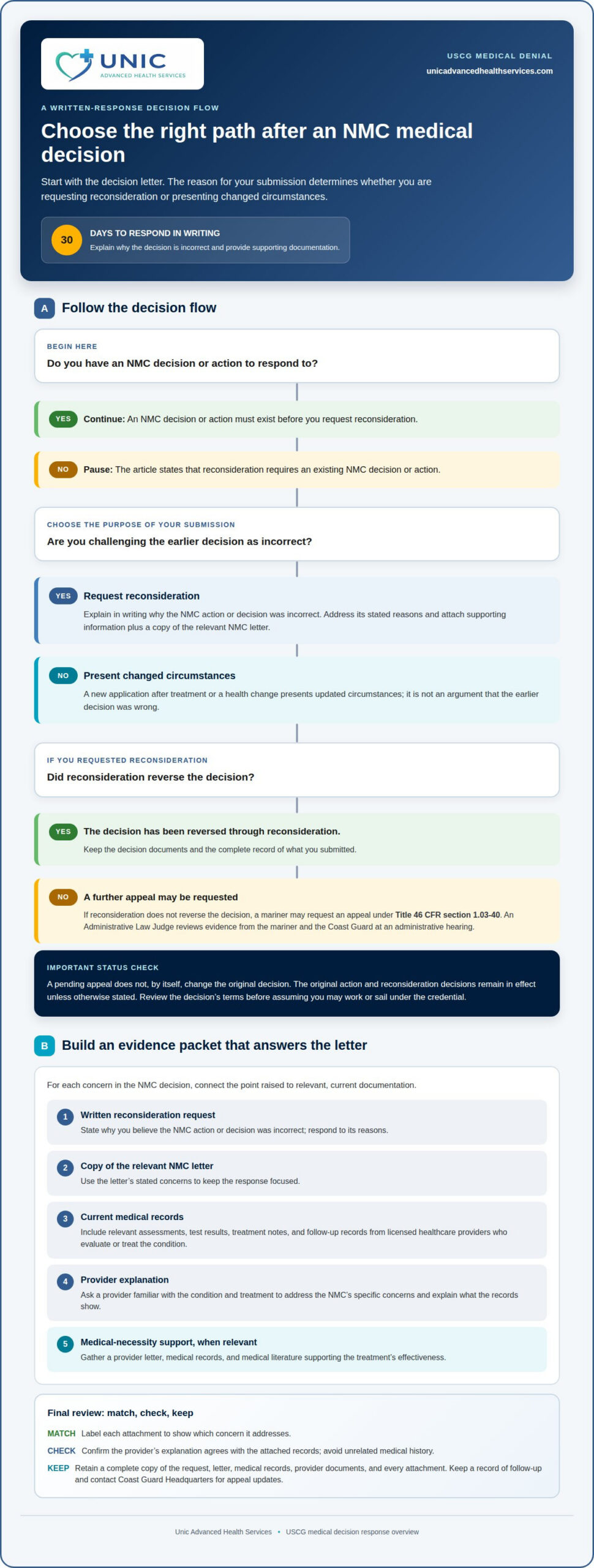
A mariner who receives a USCG medical denial letter has 30 days to respond in writing, explain why the decision is incorrect, and provide supporting documentation. To understand how to appeal a USCG medical denial, review the letter’s concerns, request reconsideration in writing, and build your response around relevant medical evidence. Include a copy of the NMC letter with your request.
A USCG medical denial can feel discouraging, especially when you believe your condition is controlled and you’re ready to work. A clear, organized response can explain your medical status and address the specific reasons for the decision.
To appeal a USCG medical denial, read the decision letter, gather current records and provider documentation, and explain how the evidence addresses the stated concerns. After submitting your appeal, contact Coast Guard Headquarters directly for updates. Keep a copy of your submission and a record of follow-up as you move through the process.
Key Takeaways
- Match each document to the concern raised in the decision letter so your response directly addresses the reason for the denial.
- Use current medical records and provider documentation to describe your condition, treatment plan, and progress clearly.
- Keep copies of everything you submit, then contact Coast Guard Headquarters directly for appeal updates.
- Show how you follow recommended care and how your condition is managed, using relevant records and provider explanations.
- Understand what a medical denial means and organize your next steps around the specific decision you received.
Collecting medical records and provider documentation
For a USCG medical appeal, prepare a written reconsideration request, a copy of the relevant National Maritime Center (NMC) letter, current medical records, and supporting information. Ask your healthcare provider to address the specific concerns in the NMC decision.
Gather Medical Records
- Collect current records from licensed healthcare providers who evaluate or treat the condition named in the NMC letter. Include relevant assessments, test results, treatment notes, and follow-up records that explain your current medical status. Match each document to a concern in the decision. For example, if the letter raises a question about treatment, include records describing the treatment and your response.
- Review the records for gaps before sending them. Check that they identify the condition and explain the care you received, rather than providing unrelated history without context. When applicable, include records showing compliance with recommended treatment, therapy, or rehabilitation. Consistent follow-up records can clarify how your care has been managed. Keep a complete copy of every medical record you plan to submit.
Assemble Supporting Evidence
- Request supporting documentation from a provider who understands the condition and its treatment. Ask the provider to explain the medical information relevant to the NMC’s stated concerns, including how the condition is managed and what the records show. Keep the explanation specific and consistent with the attached medical records. A general statement that you are healthy will not address the decision without supporting evidence.
- Organize your evidence with a written reconsideration request explaining why you believe the NMC action or decision was incorrect. Attach a copy of the relevant NMC letter and supporting information. If the appeal concerns medical necessity, gather a provider letter, medical records, and medical literature supporting the treatment’s effectiveness. Label each attachment to show how it relates to a concern, then retain a complete copy of the submission.
Before sending, compare your request with the NMC letter point by point. Confirm that each stated concern has relevant supporting documentation and that the provider’s explanation agrees with the attached records. Keep the request focused on the medical evidence and the decision being reconsidered. An organized packet presents the information clearly without relying on unrelated records.
Prioritize records that reflect your current medical status and documentation from licensed healthcare providers familiar with your care. The provider’s explanation should show how the medical information relates to the concerns identified by the National Maritime Center. Keep supporting documents focused on those concerns and make sure they correspond to the records included in your appeal. This makes the evidence easier to connect to your reconsideration request.
Before sending the appeal, set aside a complete copy of everything included. Retain copies of all submitted material, including medical records and provider documentation. Keeping the full set together lets you review exactly what was sent. Check that your copy includes every supporting document, not just the written request.
Reviewing the medical decision letter
Read the NMC letter closely before choosing your response. Identify the decision, its reasons, and the medical information needed to challenge it.
Review the Denial Letter
1. Mark each reason for the decision and note any specific medical concern. Check the letter’s date, the action taken, and any response instructions. A mariner who receives a USCG denial letter has 30 days to respond in writing, explain why the decision is incorrect, and provide supporting documentation. Use the letter itself to keep your response focused.
To request reconsideration, explain in writing why the NMC action or decision was incorrect, include supporting information, and attach the relevant NMC letter. An NMC decision or action must exist before you request reconsideration.
Choose Between Appeal and Reapplication
2. Decide whether you’re challenging the decision based on its stated reasons or presenting a later change in your health. Reconsideration addresses why the NMC action was incorrect. A new application after treatment or a health change presents updated circumstances, rather than arguing that the earlier decision was wrong. Keep the purpose of your submission clear.
3. Write a concise appeal letter that responds to each reason in the decision. Refer to supporting records by name, explain what each document shows, and avoid adding unrelated medical history. Keep a copy of the letter and every attachment for your records.
If reconsideration is denied, a mariner may request an appeal under Title 46 CFR section 1.03-40. The U.S. Coast Guard states that an Administrative Law Judge reviews evidence from the mariner and the Coast Guard at an administrative hearing when reconsideration does not reverse the decision.
A pending appeal does not, by itself, change the original decision. The original action and reconsideration decisions remain in effect unless otherwise stated. Review the decision’s terms before assuming you may work or sail under the credential.
A waiver or medical exemption is different from appealing a decision. A reconsideration request challenges the NMC action. Include medical evidence relevant to the concern, rather than treating the request as an automatic waiver.
The available appeal steps describe written submissions and evidence, not a fee schedule or free legal assistance. Don’t assume legal representation is required or that filing or assistance is free. Keep any cost question separate from the medical evidence in your letter.
4. If treatment or a change in health is part of your updated evidence, keep the provider’s explanation consistent with your records. A USCG Boat Captain Physical can support a current medical evaluation, but it does not replace the written reconsideration or appeal process.
Contacting Coast Guard Headquarters about an appeal
After submitting an appeal, contact Coast Guard Headquarters directly for updates. Knowing how to appeal a USCG medical denial includes keeping a clear record of your follow-up.
- Record your submission details. Save the complete appeal and supporting documents, along with the submission date. Note how you sent the packet and retain any delivery or submission confirmation. These details can help identify your appeal when contacting Coast Guard Headquarters. Keep the NMC decision letter nearby so you can refer to the action under review.
- Contact Headquarters about its status. Identify yourself and describe the NMC decision or action under review. Ask whether your submission was received and whether there is an update on the appeal process. Keep each inquiry focused on your case. Don’t assume you’ll automatically receive progress updates after sending the appeal.
- Maintain an inquiry log. Record the date of each contact, the office contacted, and any response or next step. If you receive new instructions, write them down and save related correspondence with your appeal copy. A dated log helps track communications and explain previous follow-up. Keep your notes factual, including any stated deadline or requested document.
- Respond carefully to requests. If Coast Guard Headquarters or the NMC requests additional information, compare the request with your records before replying. Submit material that addresses the stated issue, and keep a copy of your response. If a request is unclear, seek clarification through the same official communication channel. Avoid sending unrelated records that could make your response harder to review.
If reconsideration doesn’t reverse the NMC decision, a mariner may request an appeal under Title 46 CFR section 1.03-40. The U.S. Coast Guard states that an Administrative Law Judge reviews evidence from the mariner and the Coast Guard at an administrative hearing. Keep your submission, medical evidence, and Headquarters correspondence organized for that review.
For court review questions, distinguish that process from the administrative appeal. The described appeal route includes an Administrative Law Judge hearing; court review depends on the decision and applicable procedure. Read the written decision and follow its review instructions. Knowing how to appeal a USCG medical denial also means tracking the next procedural step without assuming the appeal changes the original decision.
Use each contact to clarify status or procedure, not to replace the written appeal. Keep your NMC letter, submission record, appeal copy, and inquiry log together. This file provides a clear timeline if Coast Guard Headquarters asks about earlier correspondence or submitted documents.
Evidence of condition management and stable health
Organize your evidence around the NMC’s stated concerns. The goal is to show what your records and treating provider document about your condition and its management.
- Map each concern to evidence. Make a separate note for every medical issue named in the NMC decision. Beside each concern, list the record or provider explanation that addresses it. For example, if the letter asks about ongoing treatment, identify the treatment notes and follow-up records that explain your care. This map keeps your response focused and shows where you may need additional documentation.
- Ask your provider to explain your current status. Request a factual letter from a healthcare provider familiar with your condition and treatment. The letter should address the NMC’s specific concerns and explain what the medical records show about management and stability. Ask the provider to connect conclusions to documented visits, test results, or treatment decisions. A broad statement that your health is “fine” is not a substitute for supporting medical context.
- Show the care plan and your participation. Collect records describing recommended treatment, therapies, or rehabilitation and, when applicable, documenting your compliance. Include relevant follow-up notes showing how the plan has been managed over time. If a record describes a treatment change, include the provider’s explanation and related documentation. Present the information accurately; don’t omit a change simply because it complicates the timeline.
- Explain changes without overstating them. If your health or treatment has changed since the NMC reviewed your case, ask your provider to describe the change and its medical context. Attach supporting records, such as a relevant assessment or follow-up note. Make clear which information is new and which was already available to the NMC. A precise timeline distinguishes documented progress from an unsupported claim.
- Check consistency before submitting. Compare the provider letter with your medical records, treatment history, and written explanation. Confirm that names, dates, and descriptions agree across the documents, and that each attachment relates to an NMC concern. Remove unrelated paperwork that does not clarify your case. Keep a complete copy of the final evidence package, including the provider letter and every record you submit, for your own files.
Strong documentation does not depend on making a medical claim sound more certain. It depends on relevant records, clear provider explanations, and treatment information that accurately reflects your care. Use the NMC letter as your organizing reference and make each document’s purpose easy to identify.
What does a USCG medical denial mean, and what reasons can Coast Guard medical certification be denied?
A denial is an NMC medical decision or action affecting a mariner’s credential process. The National Maritime Center evaluates whether mariners can safely perform job-related duties, so read the decision itself to identify the stated concern.
- Identify the exact NMC action. Check whether you received a denial letter or another NMC decision. Examples of actions that may lead to reconsideration include an Awaiting Information letter, an Approval to Test letter, or credential issuance. These documents are not interchangeable. Note what action the NMC took and what the letter says to do next.
- Read the stated medical concern. Use the decision letter to identify the reason for the NMC action. Not every denial has the same cause. The concern may relate to information the NMC considered when evaluating safe job-related performance. Don’t assume a condition is automatically disqualifying in every case. Address the specific explanation in your letter.
- Separate a denial from a request for information. An Awaiting Information letter identifies an information request, while a denial letter communicates a denial decision. Read the wording carefully before choosing your response. If the NMC requests records, focus on providing the requested information. If the NMC has denied your application or taken another action, follow the reconsideration process for that decision.
- Use the decision to define your evidence. Make a short list of the medical concerns named in the NMC letter. For each item, identify records or provider explanations that directly address it. For example, if the letter asks about treatment history, organize relevant documentation around that issue. Don’t assume unrelated records will explain the NMC’s concern.
- Decide whether the action needs reconsideration. You must have received an NMC decision or action before requesting reconsideration. The written request should explain why that action was incorrect and include supporting information and a copy of the relevant NMC letter. Tie your response to the decision rather than treating a denial as a general request for a new examination.
- Keep the process status clear. A denial does not by itself describe every later step or outcome. Reconsideration addresses the NMC action; a separate appeal may follow if reconsideration is denied. While a formal appeal is pending, the original decision and reconsideration decisions remain in effect unless otherwise stated. Refer to the written decision when assessing your current status.
In short, the reason for a denial is the concern stated in the NMC decision, not a universal list of conditions. Use that reason to guide your records, provider documentation, and written response.
Unic Advanced Health Services: DOT Physical Examination
Unic Advanced Health Services in Fort Lauderdale provides DOT Physical Examination and U.S. Coast Guard (USCG) Boat Captain Physical services. If you need a current medical evaluation related to your mariner health, the USCG physical can document your health status. It does not replace a written appeal or determine the National Maritime Center’s decision.
For a condition that needs ongoing care, Chronic Condition Management can support consistent follow-up and care planning. Clear medical documentation can help explain your health history and treatment to the NMC as part of your appeal materials.
Contact Unic Advanced Health Services in Fort Lauderdale to discuss a USCG Boat Captain Physical or chronic condition management.
Take the Next Step With a Clear Plan
Turn your appeal preparation into a practical plan: keep your medical file organized, note any response you receive, and identify the next action required. Knowing how to appeal a USCG medical denial can help you approach the process with purpose while keeping your care focused on your health.
Unic Advanced Health Services offers DOT Physical Examination, U.S. Coast Guard (USCG) Boat Captain Physical, and Chronic Condition Management in Fort Lauderdale. These services can support a medical evaluation or ongoing care, but they don’t replace the Coast Guard’s appeal process or decide its outcome.
If you need care related to a USCG physical or ongoing condition management, contact Unic Advanced Health Services to discuss your next step. Continue with a clear record and a steady focus on your health.
Frequently Asked Questions
What is the deadline to appeal a Coast Guard medical denial, and where must the appeal be sent?
A mariner has 30 days after receiving a USCG denial letter to respond in writing. Send the reconsideration request to the National Maritime Center, and include the relevant NMC letter with your explanation and supporting information. Use the submission instructions in your decision correspondence, and retain a copy of the complete packet and its delivery record for your files.
Can you submit new medical evidence or get an independent medical evaluation during a USCG appeal?
Yes, you can submit relevant medical evidence that addresses the NMC’s stated concerns. Current records and documentation from licensed healthcare providers can explain treatment, follow-up, or a change in your condition. An evaluation from another licensed provider may be useful if it gives specific information related to the decision. Keep its conclusions consistent with your existing records and identify which concern it addresses.
How long do USCG medical appeals take, and how can you check the status?
The appeal process has no standard timeline stated here, so avoid assuming a decision date. After submitting, contact Coast Guard Headquarters directly for updates. Keep a simple log of the date of each inquiry, the appeal details you provided, and any response or next step. Save new correspondence with your submission copy so the case history stays organized.
How do you request a waiver or medical exemption from Coast Guard merchant mariner medical standards?
A waiver or medical exemption is different from reconsideration, which challenges an NMC decision. The material gives no procedure for requesting a waiver or exemption. For reconsideration, submit a written request explaining why the NMC decision was incorrect, with supporting medical evidence and a copy of the NMC letter.