As of 2026, the paper medical card you’ve carried in your wallet for years is no longer the official proof of your fitness to drive. Securing your federal medical certificate Florida now requires a digital-first approach that integrates directly with the National Registry. You might feel a bit overwhelmed by the shift to electronic reporting or worry that a health hurdle like high blood pressure could pause your career. It’s a common concern, especially when the rules for maintaining your CDL seem to change every year.
We understand the weight of these requirements and are here to help you navigate them with confidence. This guide provides a clear roadmap for the updated 2026 certification process, ensuring you meet every federal standard without the guesswork. You’ll learn exactly how the new electronic filing system works, what to expect during your physical in Fort Lauderdale, and how to prepare your body to pass the exam. By the end of this article, you’ll know how to secure your Form MCSA-5876 and ensure your Florida driver record updates automatically, keeping you legal and on the road.
Key Takeaways
- Learn why the National Registry II mandate means you can no longer rely on paper records for license updates.
- Understand the specific vision and hearing benchmarks you must meet to qualify for your medical card.
- Discover what documentation you’ll need to bring to ensure your exam proceeds without unnecessary delays.
- Navigate the updated 2026 requirements for a federal medical certificate Florida to ensure your driver record remains compliant.
- Find out how choosing a certified medical examiner in Fort Lauderdale provides both regulatory compliance and personalized health care.
What is a Federal Medical Certificate in Florida?
A federal medical certificate Florida serves as a vital health credential for anyone operating commercial machinery or vehicles. This document, technically called the Medical Examiner’s Certificate (Form MCSA-5876), confirms that a driver meets the physical standards set by federal safety authorities. It’s not just a formality; it’s a clinical assessment designed to ensure that those behind the wheel of heavy or high-occupancy vehicles don’t have medical conditions that could lead to sudden incapacitation. By prioritizing these exams, the state maintains a higher standard of safety for everyone on the road. Just as safety is paramount for drivers, efficiency is vital for their cargo; to streamline your shipping operations, you can check out Parcel International for comprehensive logistics solutions across 220 countries.
Certification becomes mandatory when a vehicle’s gross combination weight rating exceeds 10,000 pounds for interstate commerce. It’s also required for any driver transporting hazardous materials in quantities that require placarding. Familiarizing yourself with Commercial Driver’s License requirements helps you determine which specific health standards apply to your career path. Whether you’re hauling freight across state lines or operating a local delivery truck, your medical status is a key component of your professional standing.
To better understand how the reporting of these certificates has changed, watch this helpful video:
CDL vs. Non-CDL Requirements
Many drivers are surprised to learn that a CDL isn’t always the trigger for needing a federal medical certificate Florida. Operators of livery vehicles, certain school buses, and even some construction equipment must maintain medical clearance. The Florida Department of Highway Safety and Motor Vehicles (FLHSMV) manages this through a self-certification process. Drivers must choose from four tiers, with Tier 1 (Non-excepted interstate) and Tier 3 (Non-excepted intrastate) being the most common categories requiring a valid medical certificate. This system ensures that even drivers who never leave the state stay within safe physical parameters.
Maritime Federal Medical Certificates
For those working on the water, the U.S. Coast Guard (USCG) requires a Merchant Mariner Credential (MMC) physical. This evaluation differs from the DOT exam in its focus on sea-service suitability. While a DOT exam looks at road safety, a maritime medical certificate evaluates your ability to handle the physical demands of a vessel, such as climbing ladders or managing emergency equipment. Captains and crew members must use specific forms like the CG-719K. Receiving this care from a provider who understands both road and maritime standards provides a more comprehensive view of your long-term wellness and professional longevity.
The 2026 Reporting Shift: How Your Certificate Links to Your License
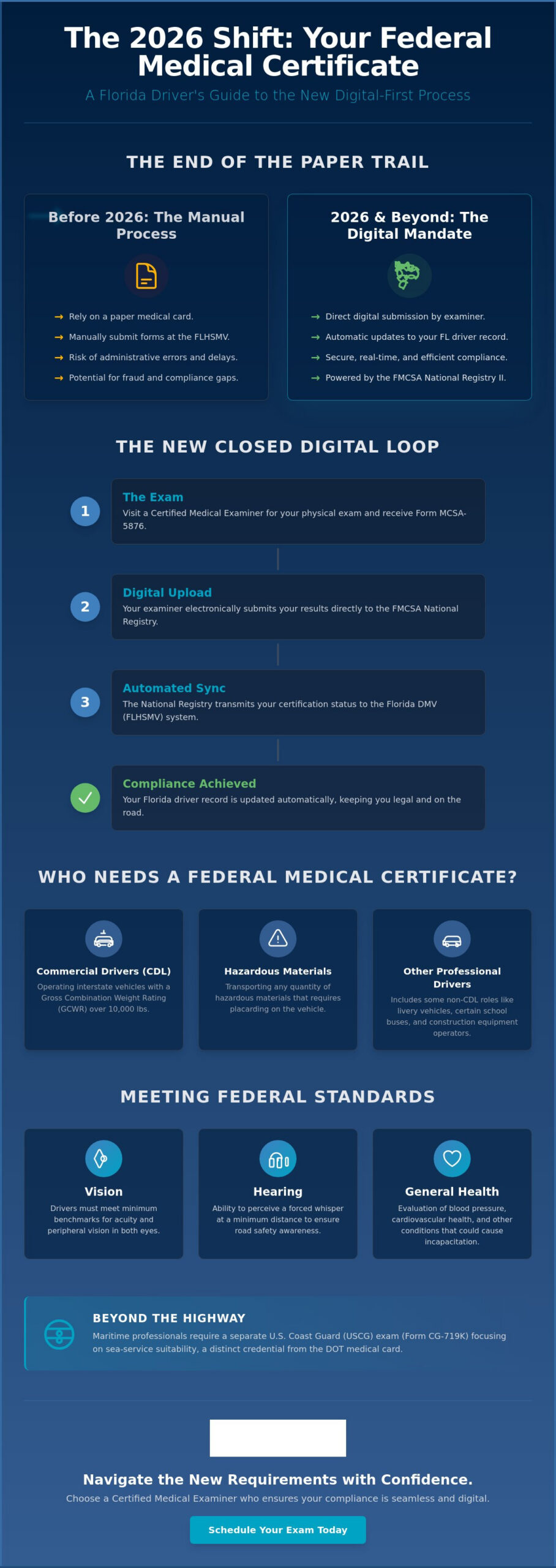
The landscape of commercial driving changed significantly when the electronic reporting mandate took full effect. By 2026, the transition to the National Registry II (NRII) system has eliminated the old method of self-reporting at the DMV. You can no longer simply walk into a Florida Department of Highway Safety and Motor Vehicles (FLHSMV) office with a paper card and expect an immediate update. Instead, the process is now a closed digital loop between your medical examiner and the federal government. This shift ensures that your medical status is verified in real-time, reducing the risk of administrative errors that could sideline your career.
Securing your federal medical certificate Florida involves a clinical evaluation that must be uploaded to the National Registry of Certified Medical Examiners. Once uploaded, the FMCSA transmits this data directly to the FLHSMV driver record system. This automation reduces fraud and ensures that every driver on the road meets the necessary Federal Medical Standards. It’s a more efficient system, but it places the responsibility for compliance squarely on the digital accuracy of the clinic you choose. If the data isn’t transmitted correctly, your license status could be at risk regardless of your physical health.
The Role of the Certified Medical Examiner
Your examiner is now more than just a healthcare provider; they’re a digital gatekeeper for your professional standing. Every certified medical examiner must maintain active credentials on the National Registry to transmit results. When you visit a tech-integrated clinic, your exam results are sent to the federal database almost immediately after the appointment. This direct link prevents the “lost in the mail” scenarios that used to plague paper submissions. Choosing an experienced partner like Unic Advanced Health Services ensures that your medical data reaches the right agencies without technical delays. If you’re ready to update your status, you can schedule your DOT physical with a team that understands these electronic mandates.
Troubleshooting Data Mismatches
Even with a digital system, errors can occur. A common issue in 2026 involves data mismatches, where the name on your medical certificate doesn’t perfectly match the name on your driver’s license. If there’s a discrepancy, the FLHSMV system won’t link the two records. We recommend that every driver carries a paper copy of their Medical Examiner’s Certificate for at least 15 days after their exam. This provides a backup while you verify your status on the Florida DMV portal. If your record hasn’t updated within 72 hours, it’s a good idea to contact your examiner to confirm the transmission was successful. This proactive approach prevents your CDL from being downgraded due to a simple technical glitch.
Medical Standards and Requirements for Certification
Passing the clinical evaluation for a federal medical certificate Florida requires meeting specific benchmarks set by federal regulators. These standards aren’t meant to be hurdles but rather safeguards to ensure every driver is physically capable of handling the rigors of the road. Your vision is one of the first areas assessed. You must have at least 20/40 acuity in each eye, with or without corrective lenses. Additionally, a field of vision of at least 70 degrees in the horizontal meridian in each eye is necessary to ensure you can perceive peripheral hazards effectively.
Hearing standards are equally precise. The examiner typically performs a “forced whisper” test, where you must perceive a whispered voice from a distance of five feet in your better ear. If you don’t meet this requirement, an audiometric test is used to measure your hearing loss across specific frequencies. As long as your average hearing loss doesn’t exceed 40 decibels in your better ear, you can remain compliant. These tests ensure you can hear sirens, horns, and shifting mechanical sounds while operating your vehicle.
Blood pressure and urinalysis are two areas that often cause the most stress for drivers. To secure a standard two-year certification, your blood pressure should be below 140/90. Readings higher than this may result in a shorter certification period, such as one year or three months, to allow for monitoring and management. It’s also vital to understand that the urinalysis performed during this exam is a screen for protein, blood, and sugar. This test helps identify potential issues like kidney disease or undiagnosed diabetes. It is not a drug test, though your employer may require a separate drug screen as part of their hiring or safety protocols.
Managing Chronic Conditions for Compliance
Living with a chronic condition doesn’t automatically end your driving career. For drivers with diabetes, maintaining a stable A1C level is essential. If you use insulin, you’ll need your treating physician to complete a specific evaluation form before your DOT exam. Hypertension is also manageable. Taking blood pressure medication is common and acceptable, though it usually limits your certificate to a one-year duration to ensure consistent oversight. If you have been diagnosed with sleep apnea, come prepared with at least 90 days of CPAP usage data. Showing that you’re compliant with your treatment is the key to maintaining your federal medical certificate Florida. For a deeper look at how these conditions are evaluated under the latest federal rules, review the full breakdown of commercial driver health requirements and what the 2026 standards mean for your certification.
Physical and Neurological Assessments
The physical portion of the exam evaluates your range of motion and limb function. The examiner looks for any impairment that might interfere with your ability to grasp the steering wheel or operate foot pedals. Neurological health is also a priority. Conditions like seizure disorders or equilibrium issues require careful review. Most mental health conditions are not disqualifying, provided they are managed with medications that don’t cause sedation or cognitive impairment. Being transparent about your health history allows your examiner to act as a partner in your long-term career safety.
Preparing for Your Exam: A Driver’s Compliance Checklist
Preparation is the most effective way to alleviate the stress of a clinical evaluation. When you arrive organized, it allows the examiner to focus on your health rather than administrative hurdles. To secure your federal medical certificate Florida without delay, you must bring your valid driver’s license and your current medical card. These documents establish your identity and your previous certification history, which is essential for maintaining a continuous record in the National Registry.
A detailed medication list is another critical component of your visit. Don’t just rely on memory. Write down the exact names of your medications, the specific dosages, and the contact information for the prescribing doctors. If you’ve had recent surgeries or manage a heart condition, bring clearance letters from your specialists. These letters should state that you are physically fit to perform the demanding duties of a commercial driver. Providing this documentation upfront prevents the need for multiple appointments and ensures your certification remains on track.
Your habits in the hours leading up to the exam also matter. We recommend avoiding caffeine and tobacco for at least 24 hours before your appointment. These substances can artificially inflate your blood pressure and heart rate, potentially leading to a shorter certification period or a temporary disqualification. Staying calm and prepared ensures the clinical data reflects your true health status, allowing for a more accurate assessment of your fitness for duty.
What to Bring to the Clinic
If you require corrective lenses or hearing aids to operate a vehicle, you must bring them to your appointment. The examiner needs to verify that these aids allow you to meet federal safety standards. For drivers with sleep apnea, providing the most recent 90 days of CPAP usage reports is mandatory to prove compliance. Similarly, if you manage diabetes or have a history of cardiac issues, bring your blood sugar logs or cardiac stress test results from the last 12 months. Having these records ready is vital for a smooth federal medical certificate Florida renewal. Understanding the full scope of commercial driver health requirements for 2026 can help you anticipate exactly what documentation your examiner will need to review.
The Day of the Exam
On the day of your evaluation, focus on hydration and balanced nutrition. Drinking plenty of water ensures a clear urinalysis, while a light meal prevents blood sugar fluctuations. Arriving 15 minutes early gives you time to complete the occupational health exam Fort Lauderdale intake forms without feeling rushed. Practice deep breathing or gentle stretching to maintain a steady heart rate before your vitals are taken. If you want to ensure your certification is handled by a dedicated expert, schedule your DOT physical today and take the first step toward a successful renewal.
Expert Occupational Exams at Unic Advanced Health Services
Unic Advanced Health Services provides a streamlined path to maintaining your federal medical certificate Florida. Led by Marc Joseph, an experienced autonomous nurse practitioner, our clinic specializes in the specific needs of commercial operators in Fort Lauderdale. We understand that your time is valuable and your career depends on clinical accuracy. By combining professional medical oversight with modern diagnostic tools, we ensure your examination is thorough and efficient. Our goal is to provide a steady hand through the complexities of federal compliance.
Our facility offers on-site diagnostic testing primary care clinic services, including immediate urinalysis and blood work. This capability eliminates the need for external lab visits, which often delay the certification process. Busy drivers can also take advantage of Saturday appointments, allowing you to handle your compliance requirements without missing a day of work. We prioritize a supportive atmosphere where you are treated as a professional partner rather than just another appointment on a list. This clinical seriousness establishes a foundation of trust for every driver we serve.
The Advantage of an Autonomous Nurse Practitioner
Choosing an autonomous nurse practitioner for your exam offers a unique blend of clinical expertise and personalized attention. Marc Joseph focuses on your long-term health, not just the immediate requirements of the federal medical certificate Florida. This approach includes preventive health screenings Florida drivers can use to identify potential issues before they impact their ability to pass future exams. We act as a proactive advocate for your well-being, helping you manage chronic conditions through steady, clinical guidance. You are a patient first, and our care reflects that priority.
Next Steps: Booking Your Fort Lauderdale Exam
Securing your certification is simple with our online booking system, and we also offer walk-in availability for those facing urgent renewal deadlines. Our team is fully integrated with the 2026 digital reporting mandates, ensuring your results are transmitted to the National Registry immediately. For total wellness, many drivers choose to combine their DOT physical exam Fort Lauderdale with an annual physical exam Fort Lauderdale. This comprehensive approach allows us to monitor your health holistically, keeping you safe on the road for years to come. Your professional longevity is our mission.
Securing Your Future on the Road
The 2026 regulatory environment requires commercial drivers to be more proactive than ever. By understanding the transition to electronic reporting and the specific clinical benchmarks for vision, hearing, and blood pressure, you can protect your professional standing. Preparation remains your most powerful tool. Arriving with the correct documentation and a clear understanding of your health status ensures that your federal medical certificate Florida is issued without unnecessary delays.
Our team provides the expert guidance you need to navigate these updated requirements. With autonomous nurse practitioner oversight and on-site lab services for rapid results, we prioritize your time and your health. We also offer Saturday appointment availability to accommodate your demanding schedule. Choosing a tech-integrated partner ensures your data reaches the National Registry accurately and immediately.
Schedule Your Federal Medical Exam in Fort Lauderdale Today and let us help you stay compliant and confident on the road. Your commitment to safety is the foundation of your career. We’re here to support that journey every step of the way.
Frequently Asked Questions
How long is a federal medical certificate valid in Florida?
A federal medical certificate Florida is typically valid for up to 24 months for drivers in good health. However, if you have conditions like hypertension or heart disease, your examiner may issue a certificate for one year, six months, or even three months to ensure proper monitoring. It’s essential to track your expiration date closely, as driving with an expired certificate leads to immediate out-of-service orders and fines.
Can I get a medical certificate if I take blood pressure medication?
You can certainly receive a medical certificate while taking blood pressure medication. While this medication helps you meet the required 140/90 threshold, it does limit the duration of your certification. Most drivers on hypertension medication are issued a one-year certificate. This ensures that a medical professional reviews your condition annually to confirm the medication remains effective and your health is stable for long-term safety.
What happens if my medical certificate is not reported to the Florida DMV?
If your results aren’t successfully transmitted to the Florida DMV, your commercial driving status will be downgraded. The FLHSMV system will automatically change your status to “not-certified,” which eventually leads to the suspension of your commercial driving privileges. This is why we recommend checking the state portal 72 hours after your exam to confirm the digital synchronization is complete and your record is active.
Do I need a new physical if I move to Florida from another state?
You don’t need a new physical immediately if your current certificate is still valid and listed on the National Registry. When you transfer your license to Florida, you must provide your current medical examiner’s information and self-certify your tier of operation with the FLHSMV. Once your existing certificate expires, you’ll then need to visit a Florida-based examiner to maintain your federal medical certificate Florida compliance.
Can a nurse practitioner perform a DOT physical in Florida?
Yes, an autonomous nurse practitioner can perform your exam if they are a Certified Medical Examiner on the National Registry. These professionals possess the advanced clinical training required to evaluate your fitness for duty according to federal standards. Our clinic utilizes this expertise to provide thorough evaluations that focus on both regulatory compliance and your long-term health as a professional driver in a supportive environment.
What is the difference between a Tier 1 and Tier 2 self-certification in Florida?
Tier 1 (Non-Excepted Interstate) is for drivers who operate across state lines and must maintain a medical certificate on file with the DMV. Tier 2 (Excepted Interstate) applies to specific roles, such as school bus drivers or government employees, who may be exempt from certain federal medical requirements at the state level. Most commercial haulers fall under Tier 1 and must provide updated medical data regularly.
Is a drug test included in the federal medical certificate exam?
A standard DOT physical doesn’t include a federal drug test. The urinalysis performed during your appointment is a clinical screen used to detect protein, blood, or sugar levels, which can indicate underlying health issues like diabetes. While many employers require a separate pre-employment or random drug screen, that is a distinct process from the medical certification exam itself. We provide on-site lab services for the required clinical screenings.
How do I check if my medical certificate has been processed electronically?
You can verify your status by visiting the official FLHSMV driver license check portal online. After entering your license number, look for the “Medical Certification” section to see your current expiration date and certification tier. If the information doesn’t appear within three to five days of your exam, contact your medical examiner to ensure the electronic transmission was successful. This proactive step prevents unexpected license downgrades or administrative issues.