
A chronic condition like diabetes or a slight dip in your hearing test results doesn’t have to be the end of your life at sea. It’s natural to feel anxious when reviewing the USCG MMC physical requirements, especially as the Coast Guard moves toward electronic certificates and updated 2026 processing standards. You might worry that one missed line on a vision chart or a confusing box on the CG-719K form will anchor your career for good.
We know the medical certification process can feel like moving through a thick fog. It’s stressful to balance your personal health history with the rigorous demands of the National Maritime Center. This guide is designed to help you master these complex standards and show you how to approach your next exam with absolute confidence. We’ll provide a clear checklist of the 2026 medical criteria, explain why chronic conditions are often manageable with the right documentation, and show you how a dedicated Fort Lauderdale provider can simplify the journey. By the end of this article, you’ll have a reliable roadmap to keep your career on course.
Key Takeaways
- Understand the distinction between a routine checkup and the specialized USCG MMC physical requirements designed specifically for maritime safety.
- Learn the specific benchmarks for vision and hearing, including the exact visual acuity standards and hearing tests required for your credential.
- Discover why well-managed chronic conditions like diabetes don’t have to end your career when they’re documented correctly for a potential waiver.
- Streamline your examination process by preparing the mariner’s portion of the CG-719K form and your medical history before your clinical interview.
- Identify the benefits of partnering with a specialized provider in Fort Lauderdale who understands the nuances of maritime regulatory compliance.
What Are the USCG MMC Physical Requirements for 2026?
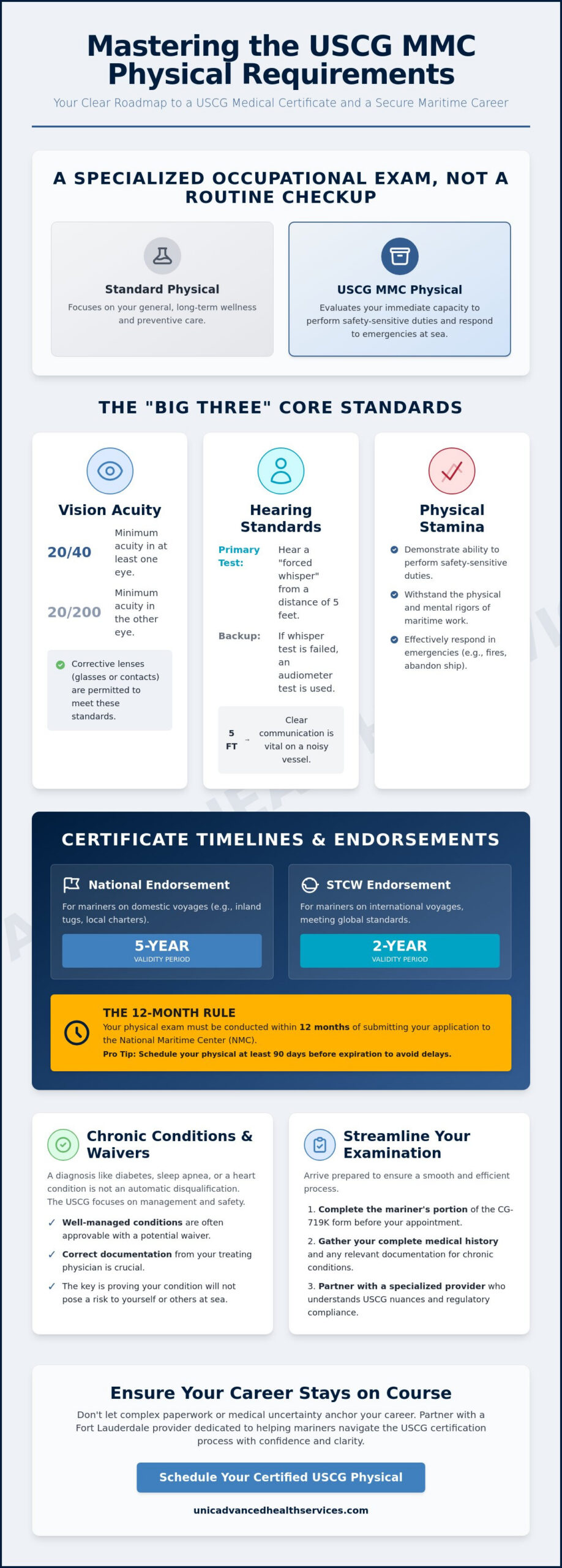
The USCG MMC physical requirements represent more than a simple health screening; they are a vital safety barrier for the maritime industry. Unlike a standard annual physical with your family doctor, this regulated occupational exam focuses specifically on your ability to perform safety-sensitive duties in a marine environment. The National Maritime Center (NMC) enforces these standards to ensure that every mariner can respond effectively during emergencies, such as shipboard fires or abandon-ship scenarios. These evaluations are strictly governed by the NVIC 01-08 (Change 4) guidelines, which provide the medical framework for determining fitness for service.
Securing a Merchant Mariner Credential (MMC) requires a medical certificate that proves you meet these specific physical benchmarks. While a general practitioner might focus on your long-term wellness, a USCG-authorized provider evaluates your immediate capacity to handle the physical and mental rigors of life at sea. This distinction is critical because maritime environments demand high levels of physical stamina and sensory acuity that aren’t typically tested in a routine checkup. For a thorough breakdown of what this evaluation entails, review this comprehensive guide to the coast guard physical exam mariners must complete in 2026.
To better understand the paperwork involved in this process, watch this helpful video:
National vs. STCW Endorsements: Which Standards Apply?
The level of medical scrutiny you face depends largely on where you intend to work. National endorsements are typically for mariners operating on domestic voyages, such as inland tugs or local charters. In contrast, the Standards of Training, Certification, and Watchkeeping (STCW) apply to those on international voyages. If you are an entry-level mariner seeking a basic rating, you may use the streamlined CG-719K/E form. However, officers, pilots, and engineers must utilize the full CG-719K form. Your specific capacity also dictates the intensity of the exam. For example, a Captain’s vision requirements are often more stringent than those for a member of the engineering department because of the different safety-sensitive tasks they perform.
Validity and Renewal Cycles for Medical Certificates
Understanding the timeline of your medical certificate is essential for maintaining your employment. Most national medical certificates remain valid for five years, while STCW certificates typically require renewal every two years. It’s vital to remember the “12-month rule,” which dictates that your physical examination must have been conducted within one year of your application submission to the NMC. As of 2026, the Coast Guard has also implemented specific extensions; medical certificates expiring between January 1 and July 31, 2026, are currently extended until August 31, 2026. To avoid future processing delays, we recommend scheduling your physical at least 90 days before your current certificate expires. This proactive approach ensures you have ample time to address any requests for additional information from the Coast Guard without risking your time on the water. For a comprehensive overview of the full certification process, review this detailed guide to obtaining your maritime medical certificate in Florida.
The ‘Big Three’ Standards: Vision, Hearing, and Physical Stamina
The foundation of maritime safety rests on three specific physiological pillars: vision, hearing, and physical stamina. These USCG MMC physical requirements ensure that every mariner can navigate safely and respond to emergencies under pressure. For vision, the Coast Guard requires a minimum acuity of 20/40 in at least one eye. The other eye must meet a minimum of 20/200. These standards apply whether your vision is corrected with lenses or uncorrected. If you wear glasses or contacts to meet these benchmarks, your USCG Medical Certificate requirements will simply note that corrective lenses are required while on duty.
Hearing standards are equally precise to ensure clear communication on a noisy vessel. You must demonstrate the ability to hear a “forced whisper” from a distance of five feet. If you can’t pass this informal test, an audiometer test serves as the backup. This electronic evaluation measures your hearing threshold across various frequencies to ensure you can detect alarms and radio transmissions. Beyond sensory input, the Coast Guard evaluates your physical stamina and balance. You’ll need to show you can move confidently on a pitching deck and climb vertical ladders without assistance. If you’re concerned about meeting these benchmarks, scheduling a USCG Boat Captain Physical can help you identify and address any potential issues early.
Color Vision and the Ishihara Test
Reading navigational lights and digital charts correctly is a non-negotiable skill for deck officers. The standard evaluation uses Ishihara plates to test for color blindness. If you struggle with the plate test, don’t panic. You may still qualify by passing an alternative “lantern” test, such as the Farnsworth Lantern or Optec 900. These tests simulate real-world light signals more closely. If a mariner cannot pass any approved color vision test, the Coast Guard may issue a “Daylight Only” restriction. This allows you to work during sunrise to sunset but prohibits night navigation.
Physical Capability Demonstration
The 2026 guidelines place heavy emphasis on functional capacity. This isn’t about being an athlete; it’s about being capable of saving a life. You must possess the strength to pull an unconscious person from the water or lift heavy emergency equipment. These functional assessments are a core part of the USCG MMC physical requirements, focusing on practical movement rather than just medical numbers. The exam often includes demonstrating your ability to open and close heavy watertight doors and crawl through tight hatches. It’s also important to note that a high Body Mass Index (BMI) doesn’t automatically disqualify you. However, if your BMI is exceptionally high, the examiner might require additional functional testing to ensure your weight doesn’t impede your ability to perform emergency duties or exit a vessel quickly through small escape routes.
Chronic Conditions and USCG Waivers: Diabetes, Heart Health, and Sleep Apnea
Anxiety often spikes when mariners encounter “red flag” conditions on the CG-719K form. Conditions like hypertension, diabetes, and obstructive sleep apnea are common, but they don’t automatically disqualify you from service. The National Maritime Center (NMC) prioritizes stability and control over the mere presence of a diagnosis. If your condition is well-managed and your medications don’t cause side effects like drowsiness or dizziness, you can often meet the USCG MMC physical requirements through a waiver or by providing “Amplifying Information.”
The review process relies heavily on “mitigating factors.” This means the NMC considers how long you’ve been stable, your history of compliance with treatment, and the specific reports from your treating specialists. A thorough evaluation from your personal doctor can provide the clinical evidence needed to prove you are fit for duty. Understanding these maritime academy medical requirements can help you prepare the necessary documentation before you even step into the exam room. The goal is to demonstrate that your health status won’t compromise the safety of the vessel or your fellow crew members.
Navigating Hypertension (High Blood Pressure) Requirements
The standard threshold for blood pressure is 140/90. If your reading exceeds this during the exam, it doesn’t mean your application is denied. It usually results in a request for more information or a shorter-duration medical certificate. Managing these levels through a dedicated NP-led approach used for chronic care ensures you remain within the required limits. Mariners on medication must provide records showing their blood pressure has remained stable over time and that the treatment is well-tolerated without impacting their ability to work safely at sea.
Diabetes and the USCG: Insulin vs. Oral Medications
The 2026 standards have introduced more nuanced pathways for mariners treated with insulin. While insulin was once a major hurdle, the focus has shifted to demonstrating consistent blood sugar control. You’ll need to provide recent HbA1c results, typically showing levels within a safe range, along with several months of glucose logs. A specialist “Endocrinologist Evaluation” is usually the most critical piece of your waiver application. This report confirms that your diabetes is stable and that you don’t suffer from severe hypoglycemic episodes. By proactively managing these USCG MMC physical requirements with your healthcare team, you can maintain your career while prioritizing your long-term health and safety.
The CG-719K Examination Process: What to Expect
Approaching your appointment with a clear understanding of the steps involved can significantly reduce the stress of the day. The examination process is a systematic evaluation designed to confirm you meet the USCG MMC physical requirements without exception. Many mariners make the mistake of seeing a general practitioner who isn’t familiar with the intricacies of the CG-719K form. This often leads to incomplete sections or incorrect testing methods, which the National Maritime Center will quickly reject. Choosing a provider experienced in maritime occupational health ensures your paperwork is handled with the precision the Coast Guard demands.
The first step begins before you even enter the clinic. You are responsible for completing Section I of the CG-719K form. Be honest and thorough; discrepancies between your self-report and clinical findings can raise red flags during the review. Once you arrive, the provider will review your medical history in a clinical interview. This is your opportunity to discuss any chronic conditions or medications in a professional setting. Following the interview, the physical exam assesses your vitals, sensory acuity, and general physical capacity. The final step is the provider’s signature and the submission of the 10-page document to the Regional Exam Center (REC).
The Difference Between a Physical and a Drug Test
It’s important to distinguish between the clinical urinalysis and a DOT-style drug test. The CG-719K requires a urine sample to check for protein, blood, and glucose. This helps the examiner identify potential metabolic or renal issues that might impact your safety at sea. However, this clinical screening does not satisfy the requirement for a drug screen. You must also submit a CG-719P Periodic Drug Testing Form, which requires a separate laboratory analysis for controlled substances. Coordinating these two requirements in a single visit is the most efficient way to manage your certification. If you are ready to complete your requirements, you can book your USCG Boat Captain Physical at a facility equipped to handle both the exam and the necessary lab work.
Common Paperwork Errors That Delay Your MMC
Minor administrative oversights are the leading cause of application delays. The NMC requires every signature and date to be exactly where they belong on the 10-page form. Incomplete medication lists are another common pitfall. You must list the exact name, dosage, and frequency of everything you take, including over-the-counter supplements. If the form is missing even one detail, the REC will return the entire packet. Always scan a high-quality copy of the completed form for your files. This provides a reliable backup in case the original is lost in transit or if you need to reference your medical data during the next renewal cycle. Following these steps ensures your USCG MMC physical requirements are met with minimal friction.
Certified USCG Physicals in Fort Lauderdale: Expert Compliance
Fort Lauderdale serves as a global hub for the maritime industry, and mariners working out of this port require a healthcare partner who understands the high stakes of their profession. Navigating the USCG MMC physical requirements becomes significantly more manageable when you work with a provider who specializes in regulatory compliance. At Unic Advanced Health Services, we offer a calculated blend of clinical expertise and supportive guidance to ensure your certification process is as smooth as possible. We understand that your livelihood depends on a medical certificate, and we treat every evaluation with the seriousness it deserves.
Choosing a provider like Marc Joseph, who possesses deep experience in occupational health exams, provides mariners with a distinct advantage. This specialized focus means our team is intimately familiar with the latest 2026 National Maritime Center standards. We adopt a “steady hand” approach, acting as a proactive advocate for your career. Instead of simply conducting a test, we help you identify and gather the specific documentation required for waivers before you submit your application. This preparation reduces the likelihood of the Coast Guard requesting additional information, which can often stall a career for months. We also offer Saturday appointments to accommodate the unpredictable schedules that define life at sea.
Personalized Support for Complex Medical Histories
Many mariners worry that a history of chronic illness will disqualify them from service. Our clinic provides dedicated support for chronic disease management, ensuring that conditions like hypertension or sleep apnea are stabilized to meet federal standards. With on-site lab services, we provide fast and accurate results, allowing us to address potential “red flags” immediately. We maintain direct communication with every mariner, providing a transparent evaluation of your medical history and current health status. This collaborative relationship ensures that all clinical data is thoroughly documented and ready for NMC review, giving you the best possible chance at a successful certification.
Book Your Captain’s Physical in Fort Lauderdale
Preparing for your appointment is the final step in securing your medical certificate. When you arrive for your exam, please bring a valid photo ID, a complete list of your current medications including dosages, and any corrective lenses you use for duty. Professional transparency is essential during the clinical interview, and our team provides an empathetic environment where you can discuss your health with confidence. We prioritize your peace of mind by ensuring every box on the CG-719K is checked with clinical precision. Don’t let paperwork delays keep you at the dock. Schedule your USCG Boat Captain Physical today and take the next step in your maritime career with a partner you can trust.
Securing Your Future on the Water
Maintaining your medical certification is a vital part of a successful maritime career. By mastering the sensory benchmarks and preparing for the clinical interview, you can approach your next exam with absolute clarity. The USCG MMC physical requirements are a standard for safety, and meeting them is a manageable process when you have the right documentation and clinical support. Most health conditions don’t have to end your time at sea if they are well-managed and properly reported. Proactive health management ensures you remain fit for duty and ready for any challenge the ocean presents.
Our Fort Lauderdale clinic provides the specialized expertise you need to navigate these complex regulations. Led by an Autonomous Nurse Practitioner, we offer on-site labs for rapid results and Saturday hours for your convenience. We take pride in being a reliable partner for local mariners, ensuring every form is completed with precision and care. Schedule Your USCG Captain’s Physical at our Fort Lauderdale Clinic today. We are ready to help you clear the fog and keep your career moving forward with confidence and peace of mind.
Frequently Asked Questions
Can I pass the USCG physical if I have a heart condition?
Yes, you can pass with a heart condition if it is stable and supported by specialist documentation. The National Maritime Center (NMC) evaluates cardiac health individually rather than issuing automatic denials. You will likely need to provide a recent evaluation from a cardiologist, which may include a stress test or an echocardiogram. This evidence proves that your condition does not pose a sudden risk of incapacitation while you are performing safety-sensitive duties at sea.
What happens if I fail the color vision portion of the USCG exam?
Failing the initial Ishihara plate test doesn’t mean your application is over. You have the option to take an alternative lantern test, such as the Farnsworth Lantern or Optec 900, which many mariners find more representative of actual navigational lights. If you cannot pass these secondary tests, the Coast Guard may still issue your certificate with a Daylight Only restriction, limiting your work hours to between sunrise and sunset.
Do I need a separate drug test for my Merchant Mariner Credential?
Yes, you must complete a separate drug test in addition to your physical. The urinalysis performed during the CG-719K exam only screens for clinical markers like protein or glucose to assess your general health. For your credential, you must provide a negative drug screen on form CG-719P. This test must be conducted at a SAMHSA-certified lab within 185 days of your application submission to the Coast Guard.
How long is the USCG medical certificate valid for in 2026?
Validity periods are determined by the type of endorsement you hold. Most national medical certificates for domestic use are valid for five years. However, STCW certificates required for international voyages typically expire after two years. It’s important to monitor the National Maritime Center website for specific 2026 extensions, as some certificates expiring in early 2026 have been granted additional validity due to federal processing backlogs. For a full breakdown of Florida-specific certification timelines and renewal procedures, consult this complete guide to the maritime medical certificate Florida mariners need in 2026.
Can a Nurse Practitioner perform my USCG physical exam in Florida?
Yes, a licensed Nurse Practitioner is fully authorized to conduct your USCG physical exam. The Coast Guard regulations specify that the evaluation must be performed by a licensed physician, physician assistant, or nurse practitioner. Choosing an NP who specializes in occupational health can be beneficial, as they often have a deep understanding of the USCG MMC physical requirements and the specific documentation needed to ensure a successful application. To learn more about what this evaluation involves from start to finish, explore this detailed overview of the coast guard physical exam mariners are required to complete.
What is the difference between the CG-719K and CG-719K/E forms?
The primary difference lies in the scope of the maritime endorsement you are seeking. The CG-719K is a comprehensive 10-page form required for officers, pilots, and those working under STCW international standards. The CG-719K/E is a shorter, simplified version designed specifically for entry-level mariners on domestic vessels. It’s essential to use the correct form version to avoid immediate rejection by the Regional Exam Center.
Will taking antidepressants disqualify me from getting a USCG license?
Antidepressants aren’t an automatic disqualifier, but they do require a detailed review by the NMC. The Coast Guard needs to confirm that the medication is effective and doesn’t cause side effects like significant drowsiness or impaired coordination. You’ll typically need to provide a letter from your prescribing physician stating that you’ve been stable on the medication for a specific period and are fit for duty; to ensure your mental health treatment is properly documented and managed, check out Solid Foundation Psychiatry.
How much does a USCG physical exam typically cost in Fort Lauderdale?
The cost of a maritime physical in Fort Lauderdale depends on several factors, including the need for additional lab work or specialist reviews. While we don’t quote specific prices for our clinical services, you should consider the value of seeing a provider familiar with the USCG MMC physical requirements. Investing in a thorough exam can prevent costly delays or the need for re-testing if your paperwork is filed incorrectly.