
Your ability to work on the water depends more on a physician’s pen than it does on your years of experience at sea. It’s a stressful reality for many captains and crew members, particularly when the process of obtaining a maritime medical certificate Florida feels like a maze of conflicting USCG and ENG1 regulations. You might worry about meeting strict vision and hearing standards or feel frustrated by the difficulty of locating a qualified examiner in South Florida. These concerns are valid, as even a minor oversight on Form CG-719K can lead to significant delays in your career progression.
This guide provides a comprehensive roadmap to navigating these requirements, ensuring you meet every 2026 regulatory standard with absolute confidence. We’ll clarify exactly which certification your vessel requires, explain how to prepare for your physical examination, and show you how to streamline your appointment process in Fort Lauderdale. By following this structured path, you can move past the paperwork and get back to the bridge where you belong.
Key Takeaways
- Understand the critical differences between domestic USCG requirements and international ENG1 standards to ensure you hold the correct credentials for your specific vessel.
- Identify the precise vision, hearing, and physical agility thresholds you must meet to successfully pass your evaluation and maintain your career at sea.
- Follow a structured, five-step roadmap to secure your maritime medical certificate Florida while avoiding common application errors that lead to processing delays.
- Discover how partnering with a specialized occupational health provider in Fort Lauderdale can provide the thorough and supportive examination needed for a successful medical sign-off.
What is a Maritime Medical Certificate and Why Do You Need One?
A maritime medical certificate Florida is a specialized legal document that confirms a mariner is physically and mentally fit for duty at sea. It isn’t a standard physical. Instead, it’s a targeted assessment designed to ensure you can handle the unique stressors of a maritime environment, from heavy lifting to emergency response in high-pressure situations. For professionals operating in South Florida’s busy ports, this document is a vital component of the Merchant Mariner Credential (MMC). The Maritime Medical Certificate serves as the primary safeguard for vessel safety and crew health.
Florida’s maritime industry maintains rigorous oversight because of the high density of commercial traffic and the complexity of international yachting operations. Regulators in regions like Fort Lauderdale prioritize these evaluations because a medical emergency at sea isn’t just a personal health crisis. It represents a significant risk to the entire vessel, the environment, and the safety of fellow crew members. Obtaining your certificate from a provider who understands these high stakes is the first step toward a compliant and stable career.
To better understand the renewal process and the importance of this document, watch this helpful video:
The Legal Framework: USCG and STCW Standards
The U.S. Coast Guard (USCG) oversees domestic medical standards to ensure safety in American waters. Most mariners utilize the CG-719K form for this purpose. However, many Florida mariners also fall under the International Convention on Standards of Training, Certification, and Watchkeeping (STCW). These global standards are demanding and require a deep understanding of international maritime law. As of 2026, the National Maritime Center has experienced increased application volumes. While certain extensions have been granted for credentials expiring in early 2026, the window for renewals remains tight. You must stay proactive to avoid the backlogs currently impacting the industry.
Who Needs a Maritime Medical Certificate in Florida?
The requirement for a maritime medical certificate Florida applies to a wide range of professionals across the state’s diverse marine sectors. If you’re seeking an original, renewal, or raise in grade for your merchant mariner credentials, an exam is mandatory. This includes:
- Commercial boat captains and charter operators working out of Fort Lauderdale and Miami.
- Deckhands, engineers, and stewards serving on private or commercial yachts.
- Cruise ship employees and merchant mariners stationed on international vessels.
- Individuals requiring specific STCW endorsements for global travel.
Whether you’re a seasoned captain or an entry-level deckhand, your ability to legally work depends on this medical sign-off. The process ensures that every person on a vessel can perform their essential functions without posing a risk to themselves or others.
USCG vs. ENG1: Identifying the Right Certificate for Your Career
Choosing the correct medical documentation is a critical career decision that impacts where you can work and which vessels you can board. While the maritime medical certificate Florida is often associated with domestic standards, the reality for South Florida mariners is more complex. If you operate on U.S.-flagged vessels, you must adhere to U.S. Coast Guard medical certificate requirements using form CG-719K. Conversely, if you’re eyeing a position on a UK-flagged superyacht, an ENG1 certificate becomes the mandatory standard. Many professionals in Fort Lauderdale maintain both to maximize their global employability and ensure they’re never sidelined by a paperwork technicality.
You might also hear about “Fit for Duty” letters. It’s vital to distinguish these from a full medical certificate. A Fit for Duty letter is often a supplemental internal safety measure requested by specific employers or charter companies. It doesn’t replace the official USCG or ENG1 certificate required for your Merchant Mariner Credential. Understanding this distinction prevents the frustration of showing up to a new job with the wrong set of health clearances.
Decoding the USCG CG-719K Form
The standard CG-719K is a comprehensive 10-page document required for officers and those seeking STCW endorsements. For entry-level ratings like food handlers or wipers on domestic voyages, the CG-719K/E is a shorter, simplified version. Your medical provider must meticulously complete sections regarding vision, hearing, and physical stamina. Small errors or omissions in these specific fields are the leading cause of application returns. Validity also varies by endorsement; national certificates typically last five years, while STCW medical certificates expire after only two years.
International Standards: ENG1 and Beyond
The ENG1 is the gold standard for the international yachting community. It’s issued by doctors approved by the UK’s Maritime and Coastguard Agency (MCA) and is recognized by most major yachting hubs. Beyond the UK, you might encounter specific requirements for the Marshall Islands, Cayman Islands, or Bahamas flag states. Each jurisdiction has its own medical forms and physical criteria. At Unic Advanced Health Services, we help mariners identify which standards apply to their specific career goals. If you’re unsure which maritime medical certificate Florida requirements apply to your next contract, a pre-exam consultation can provide the clarity you need to move forward without stress.
Navigating the Medical Requirements: Vision, Hearing, and Physicality
The physical examination is often the most stressful part of securing a maritime medical certificate Florida. Many mariners worry that a slight decline in vision or a managed health condition might end their careers. However, the primary goal of these standards is safety rather than exclusion. We focus on whether you can perform essential functions, such as climbing ladders, handling heavy equipment, and responding to shipboard emergencies. For students or those new to the industry, reviewing maritime academy medical requirements provides a helpful baseline for what to expect during your professional evaluation. Most controlled medical conditions do not automatically disqualify a mariner if managed by a specialist.
Addressing chronic conditions like diabetes, hypertension, and sleep apnea requires a methodical approach. The U.S. Coast Guard looks for stability and professional oversight to ensure these conditions don’t cause sudden incapacitation at sea. By maintaining a clear record of treatment and specialist sign-offs, most mariners can continue their work without interruption. We act as your advocate during this process, ensuring your medical history is presented accurately and thoroughly to the National Maritime Center.
Vision and Hearing Standards for Mariners
Deck officers must meet specific correctable vision thresholds, typically 20/40 in each eye, while demonstrating adequate color sense through the Ishihara test. This is vital for distinguishing navigation lights and buoy signals at night. Hearing is equally critical; you’ll undergo a “whisper test” or an audiometry exam to ensure you can hear alarms and radio communications over ambient engine noise. If you wear corrective lenses or hearing aids, bring your current prescription and backup equipment to your Fort Lauderdale appointment to avoid unnecessary delays.
Managing Chronic Conditions for Certification
Managing long-term health requires more than just a one-time checkup. Our autonomous nurse practitioners specialize in chronic care management that aligns with maritime safety standards. Integrating your license requirements into your annual physical exam Fort Lauderdale ensures your documentation is always current and comprehensive. If you take medications that the USCG may consider “impairing,” you’ll need specific documentation from your treating physician. We guide you through gathering these specialist notes to prove your condition is stable and your treatment is effective for life at sea. For a deeper look at how blood pressure thresholds and other clinical benchmarks are evaluated, our overview of the USCG boat captain physical Florida requirements explains exactly what examiners assess during your evaluation.
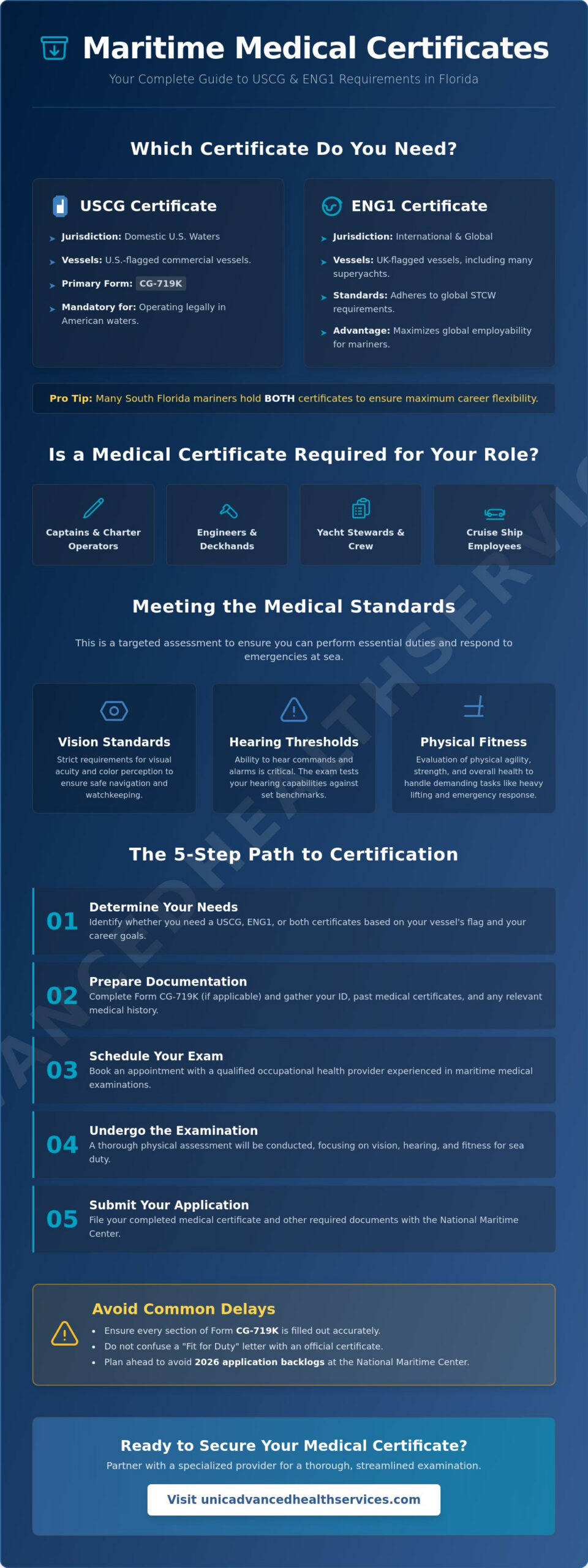
How to Get Your Maritime Medical Certificate in Florida: A 5-Step Process
Securing your maritime medical certificate Florida involves a specific sequence of actions designed to satisfy federal safety standards. While the paperwork might seem daunting, following a methodical approach ensures your application moves through the National Maritime Center without being flagged for errors. The process begins with clarity and preparation, allowing you to focus on your career rather than administrative hurdles.
- Step 1: Identify license requirements. Determine if you need the full CG-719K or the entry-level CG-719K/E. Download the current version of the form directly from the USCG website to ensure you aren’t using an expired edition.
- Step 2: Schedule your examination. Choose a provider who understands the nuances of an occupational health exam Fort Lauderdale. An experienced examiner knows exactly what the USCG looks for in the physical agility and clinical sections.
- Step 3: Gather medical history. Compile a list of current medications and obtain reports from any specialists you see for chronic conditions. Having these ready prevents the clinic from needing to follow up with you later.
- Step 4: Attend the physical exam. Complete the diagnostic screenings, including vision and hearing tests. Your provider will review your history and perform the physical assessment required by your rating. For a detailed breakdown of exactly what this evaluation entails, our guide on the coast guard physical exam mariners must complete in 2026 walks you through every section of the CG-719K.
- Step 5: Submit your paperwork. Send the completed, signed documents to the National Maritime Center (NMC) via their designated channels.
Preparation Checklist for Your Appointment
Arriving prepared saves time and reduces the risk of having to return for a second visit. You must bring a valid government issued photo ID, any previous medical certificates, and your corrective lenses or hearing aids. It’s highly recommended to complete the mariner’s portion of the CG-719K (Sections 1 through 3) before you arrive at the clinic. This allows the medical team to focus entirely on the clinical evaluation. To ensure your blood pressure remains in the optimal range, avoid caffeine and nicotine for at least two hours prior to your exam, and try to arrive a few minutes early to settle in. Commercial boat captains and charter operators will find additional preparation guidance in our dedicated resource on the USCG boat captain physical Florida credentialing process.
Submitting Your Paperwork to the USCG
In 2026, electronic submission has become the standard for efficiency. While traditional mail is still an option, scanning your completed maritime medical certificate Florida and emailing it to the regional exam center significantly reduces processing times. You can track your application status in real time through the NMC portal. Most delays occur because of ‘Awaiting Information’ (AI) status, which is usually triggered by missing signatures or incomplete checkboxes in the physical agility section. Double checking every page before submission is the best way to avoid these common pitfalls. If you’re ready to start the process, you can schedule your mariner physical today to ensure your credentials remain current.
Expert Maritime Exams at Unic Advanced Health Services
Mariners in South Florida operate in one of the world’s busiest maritime corridors. When it’s time to renew your maritime medical certificate Florida, you need a provider who understands the specific pressures of the Fort Lauderdale and Miami ports. Marc Joseph and the team at Unic Advanced Health Services have built a reputation as reliable partners for captains and crew. We provide the professional authority required for regulatory compliance while maintaining the empathetic reassurance mariners deserve when their livelihoods are on the line.
Our practice operates under the guidance of an autonomous nurse practitioner who specializes in maritime occupational health. This model ensures that you aren’t just another number in a crowded waiting room. We take the time to understand your unique health history and career goals. Whether you’re managing a complex medical waiver or simply need a routine sign-off, we offer a steady hand to guide you through the process. Our schedule is designed for the mariner’s life, offering appointments from Monday through Saturday to accommodate your limited time in port.
Personalized Care for the Florida Mariner
We believe that high-quality healthcare should be accessible and affordable. Our clinic provides a streamlined experience by offering on-site lab services, which allows you to satisfy USCG MMC physical requirements in a single visit. If you’re dealing with a chronic condition, we don’t just clear you for one exam; we work with you on long-term management strategies. This integrated approach ensures that your health remains stable throughout your career, reducing the risk of future application denials. We’re committed to regulatory-compliant care that respects the individual needs of every mariner.
Book Your Maritime Physical in Fort Lauderdale
Our facility is located in the heart of the South Florida maritime hub, making it easy for mariners to visit while their vessels are docked. We offer easy online booking and telehealth options for initial consultations, allowing you to start the process even before you reach the shore. This modern efficiency, combined with our thorough methodology, makes us a grounded healthcare partner for the maritime community. Securing your maritime medical certificate Florida shouldn’t be a source of anxiety. Schedule your maritime medical exam today at Unic Advanced Health Services and experience a healthcare partnership built on expertise and individualized attention.
Secure Your Future on the Water
Achieving professional compliance is the foundation of a safe and successful life at sea. You now have a clear understanding of how to distinguish between domestic USCG forms and international standards. You also know what to expect during your vision and hearing assessments and how to navigate the 5-step submission process. By taking these proactive steps for your maritime medical certificate Florida, you protect your career from the processing backlogs that often affect the industry.
Unic Advanced Health Services serves as your dedicated partner in this journey. Led by Marc Joseph, an experienced autonomous nurse practitioner, our clinic specializes in the precise clinical evaluations required for USCG and STCW endorsements. We recognize that your time in port is valuable; therefore, we provide flexible scheduling, including Saturday appointments. Our goal is to offer a thorough, supportive environment where your health and your credentials are our primary focus.
A valid medical sign-off is the final bridge to your next maritime opportunity. We’re ready to help you cross it with ease and professional transparency. Schedule Your Maritime Medical Exam in Fort Lauderdale today and return to the water with peace of mind.
Frequently Asked Questions
What is the difference between a USCG physical and an ENG1 medical?
A USCG physical is mandatory for mariners working on U.S. flagged vessels and follows the standards set by the National Maritime Center using form CG-719K. The ENG1 is a specific medical certificate required for those working on UK flagged vessels, particularly in the international superyacht industry. While both assess fitness for duty, they use different forms and are recognized by different international regulatory bodies.
How long does a maritime medical certificate last in Florida?
The validity of a maritime medical certificate Florida depends on the type of endorsement you hold. National endorsements typically remain valid for five years, while STCW endorsements for international voyages must be renewed every two years. It’s important to note that the Coast Guard issued specific extensions in 2026 for certificates expiring between January and July, extending their validity through August 31, 2026.
Can I pass my USCG physical if I take medication for high blood pressure?
Yes, you can pass the physical while taking medication for hypertension as long as your blood pressure is consistently controlled and stable. You’ll need to provide documentation from your treating physician or specialist confirming the medication is effective and doesn’t cause impairing side effects. We specialize in managing these chronic conditions to ensure your documentation meets all federal safety standards.
What happens if I fail the color vision test for my boat captain’s license?
Failing the initial Ishihara color vision test doesn’t necessarily end your career, but it may result in a “daylight signaling only” restriction on your license. You may have the option to take an alternative test, such as the Farnsworth Lantern test, to prove you can distinguish red, green, and amber lights. Specific vision requirements for deck officers are more stringent than those for engineering or radio personnel.
Do I need a maritime medical certificate for a private boat license?
You don’t typically need a maritime medical certificate for a standard recreational boat license used for private use. However, if you intend to operate a vessel for hire, such as a fishing charter or a private yacht with paying guests, you must obtain a Merchant Mariner Credential. This credential requires a full medical evaluation to ensure you are fit for commercial responsibility and passenger safety.
How much does a maritime medical exam cost in Fort Lauderdale?
The cost of a maritime medical exam in Fort Lauderdale varies depending on the complexity of the physical and any additional diagnostic screenings required for your rating. While industry averages for these specialized occupational exams often range between $75 and $200, the final amount depends on whether you need on-site lab work or specialist consultations. We focus on providing comprehensive evaluations that offer long term value for your career.
Can I use my DOT physical exam for my USCG captain’s license?
You can’t use a DOT physical exam form in place of a USCG medical certificate because the regulatory requirements and forms are distinct. While both exams assess general health and physical stamina, the USCG uses form CG-719K, which includes specific maritime agility and vision standards not found in a standard DOT evaluation. You must ensure your provider completes the correct maritime specific documentation to avoid application rejection.
How long does it take for the Coast Guard to process my medical certificate?
Processing times for a maritime medical certificate Florida can vary significantly based on the current volume at the National Maritime Center. In 2026, increased application volumes have led to some backlogs, which is why the Coast Guard implemented temporary extensions for certain expiring credentials. Submitting your paperwork electronically and ensuring every section of the CG-719K is error free is the best way to minimize delays.