
What if a medical “disqualification” from the Coast Guard wasn’t actually the end of your career, but simply a request for better clinical documentation? For many mariners, receiving a notice of delay from the National Maritime Center (NMC) creates immediate anxiety about their professional future. It’s understandable to feel overwhelmed by the complex standards in 46 CFR 10.302, especially with the recent application backlog surpassing 16,000 files. You likely want a straightforward answer regarding what can disqualify you for a USCG medical certificate so you can protect your livelihood and maintain your status on the water.
This 2026 guide provides the clinical clarity you need by outlining the specific vision, hearing, and chronic condition thresholds required for federal compliance. You’ll learn how to properly document issues like hypertension or diabetes to meet the current standards of the Merchant Mariner Medical Manual. We will also preview the waiver process and show you how expert guidance can help you navigate these regulations with confidence. By understanding these requirements today, you can avoid unnecessary delays and ensure your medical certificate arrives in your inbox without the stress of a denial.
Key Takeaways
- Learn the distinction between automatic denials and conditions subject to review to better identify what can disqualify you for a USCG medical certificate.
- Understand the specific vision and hearing benchmarks, including the 20/40 visual acuity and color perception requirements necessary for maritime safety.
- Discover how managing chronic conditions like hypertension and diabetes through thorough clinical documentation can prevent application delays at the National Maritime Center.
- Review the mandatory compliance data for sleep apnea and psychiatric conditions to ensure your “fit for duty” status remains secure.
- Follow a professional preparation checklist, such as scheduling your exam 90 days in advance, to streamline your certification process and avoid career interruptions.
Understanding USCG Medical Disqualification: Delay vs. Denial
The USCG medical certificate, officially known as form CG-719K, serves as a critical evaluation of a mariner’s ability to safely perform both routine and emergency duties at sea. This document is a foundational requirement for obtaining a Merchant Mariner Credential (MMC), ensuring that every individual on a vessel can respond effectively during a crisis. The primary purpose of the USCG Medical Certificate is to act as a safety-of-life-at-sea measure by verifying physical and mental readiness.
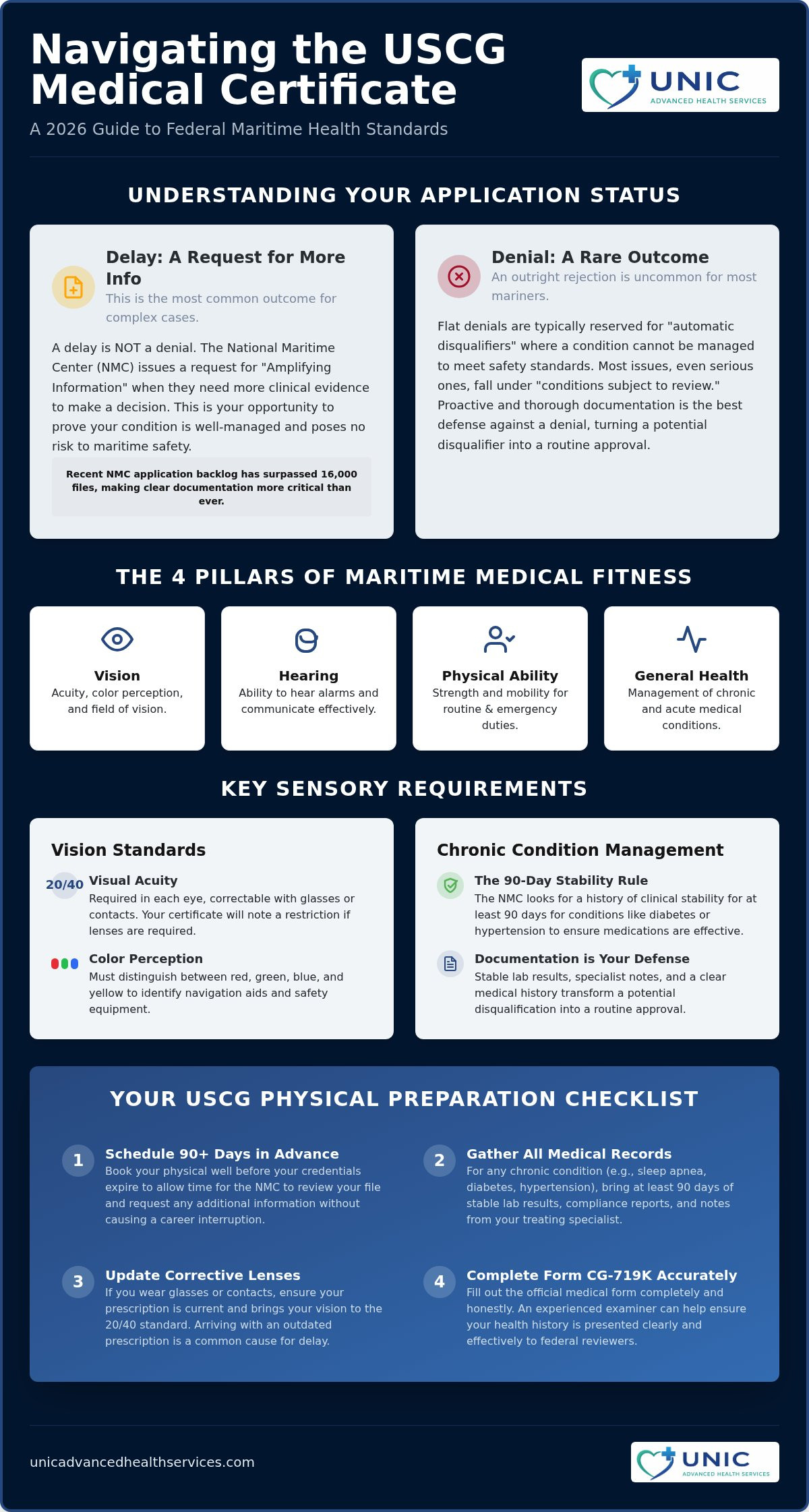
Many mariners experience significant stress when considering what can disqualify you for a USCG medical certificate, but it is vital to understand that a flat denial is quite rare. Most medical issues fall under “conditions subject to review” rather than “automatic disqualifiers.” When the National Maritime Center (NMC) identifies a potential concern, they typically issue a request for “Amplifying Information.” This is not a rejection; it is an invitation to provide clinical evidence that your condition is well-managed and does not pose a risk to maritime safety. Having an experienced medical examiner in Fort Lauderdale helps bridge this gap, as they act as a clinical advocate who understands how to present your health history to federal reviewers.
The 2026 Standards for Commercial Mariners
Current regulations under 46 CFR 10.302 establish the four pillars of maritime medical fitness: vision, hearing, physical ability, and general medical health. It is a common misconception that commercial mariners must meet the same rigid physical standards as applicants for the Coast Guard Academy or active-duty military service. Commercial standards are designed for functional safety in a working environment, allowing for greater flexibility through the waiver process. While military entry requirements often seek “perfect” health, the NMC focuses on whether a mariner can perform specific tasks, such as climbing a vertical ladder or handling emergency equipment, despite having a managed medical diagnosis.
Why Documentation is Your Best Defense
The most important distinction in the eyes of the NMC is the difference between a diagnosis and an “uncontrolled condition.” A diagnosis of hypertension or diabetes does not necessarily stop your career; however, an unmanaged or unstable version of those conditions will cause delays. The NMC generally looks for clinical stability over a period of at least 90 days to ensure that medications are effective and side effects are minimal. Providing a clear history of stable lab results and specialist notes is the most effective way to avoid a lengthy backlog. For more details on preparing for your exam, see our USCG Boat Captain Physical Florida: Your 2026 Mariner Certification Guide. Detailed records transform a potential disqualification into a routine approval by proving you are fit for duty.
Vision and Hearing Requirements: Common Physical Disqualifiers
Sensory readiness is the backbone of safe navigation on any vessel. While the USCG Academy lists many Common Disqualifying Medical Conditions for its cadets, commercial mariners operate under functional standards that prioritize safe performance over physical perfection. Understanding what can disqualify you for a USCG medical certificate in the sensory category often comes down to two main factors: clarity and perception. The National Maritime Center (NMC) needs to know that you can identify navigation aids, hear emergency signals, and communicate effectively with your crew under stressful conditions.
Navigating Color Blindness and Corrective Lenses
For vision, the primary standard is 20/40 visual acuity in each eye. This threshold can be achieved with or without corrective lenses. If you require glasses or contacts to reach this level, your certificate will carry a restriction requiring you to wear them while on duty. A common pitfall during the exam is arriving with an outdated prescription; if your current lenses don’t bring you to the required 20/40, your application will be delayed. Color vision is equally critical. You must be able to distinguish between red, green, blue, and yellow. While failing the initial Ishihara or Richmond PIP plate test is stressful, it doesn’t mean your career is over. Commercial mariners can often pursue a functional vision test, which is a practical demonstration of their ability to identify lights and signals in a real-world setting.
Hearing Loss and the Use of Hearing Aids
Hearing requirements follow a similar logic of functional capability. The initial screening involves hearing a whispered voice from five feet away. If you cannot pass this, an audiometer test becomes necessary. The Coast Guard looks for an unaided hearing threshold of 30 decibels or less when averaged across the 500, 1,000, 2,000, and 3,000 Hz frequencies in at least one ear. Hearing aids are permitted, but there are specific operational restrictions. If you rely on them to pass the exam, your medical certificate will reflect that they must be worn and operational while working. If you’re concerned about your sensory results, scheduling a USCG boat captain physical with a provider who understands these nuances can help you document your stability correctly.
Minor clinical issues like untreated ear infections or excessive wax buildup are frequent reasons for a temporary delay. Addressing these before your appointment ensures that your results accurately reflect your long-term health rather than a temporary ailment. Being proactive with your sensory health is the best way to ensure a smooth certification process without unnecessary interruptions to your career.
Chronic Health Conditions: Diabetes, Heart Disease, and Hypertension
Chronic conditions are the most frequent area of concern for mariners during their medical evaluation. While a diagnosis of heart disease or diabetes might feel like a career-ending event, the National Maritime Center focuses on clinical stability rather than the mere presence of a condition. When asking what can disqualify you for a USCG medical certificate, it’s essential to look at how well your condition is managed. The USCG Merchant Mariner Medical Manual provides the definitive framework for these evaluations, emphasizing that mariners with chronic issues can often remain fit for duty with the right documentation. Our role is to help you present that documentation clearly and accurately.
Blood Pressure Standards for Mariners
Hypertension is a primary focus during the physical. If your blood pressure reading exceeds 160/100 mmHg on the day of your exam, it can lead to an immediate delay in your certification. While 160/100 is the threshold for a delay, the clinical goal is typically 140/90 mmHg or lower. Maintaining this range ensures you are eligible for a multi-year certificate rather than a shorter, one-year restricted issuance. Our clinic helps mariners achieve these goals through proactive Chronic Care Management Nurse Practitioner Fort Lauderdale services. We also evaluate the side effects of your blood pressure medications, such as dizziness or fatigue, which the Coast Guard monitors to ensure they don’t interfere with shipboard safety.
Managing Diabetes for the USCG Certificate
Diabetes management has seen a significant shift toward inclusivity for both Type 1 and Type 2 mariners. The Coast Guard now allows insulin-dependent individuals to serve, provided they demonstrate a consistent history of glycemic control. To pass, you must provide recent A1C results, a detailed letter from your treating specialist, and a documented history showing no severe hypoglycemic episodes. The USCG requires evidence of self-management and stability for at least 90 days. This period allows reviewers to see that your treatment plan is effective and your health is predictable. Proper documentation of your daily monitoring and stable lab results is the best way to avoid a “subject to review” delay.
Cardiac Stability and Post-Surgery Requirements
For those with a history of cardiac events, such as heart surgery or the placement of a stent, the requirements are more rigorous but still navigable. You’ll typically need to provide a recent exercise stress test that meets specific metabolic equivalents (METS) and an echocardiogram. These tests prove that your heart can handle the physical rigors of maritime work without sudden incapacitation. By gathering this data before your appointment, you transform a complex medical history into a clear case for your fitness for duty. Proactive clinical oversight ensures that your cardiac health meets the federal standards for safety at sea.
Psychiatric, Neurological, and Sleep Disorders
Psychiatric, neurological, and sleep disorders represent some of the most complex areas of maritime medical review. Unlike vision or hearing, these conditions often require longitudinal data to prove that a mariner can safely manage the isolation and high-stress environment of life at sea. When evaluating what can disqualify you for a USCG medical certificate, the National Maritime Center (NMC) looks for patterns of stability and strict compliance with treatment protocols. These categories aren’t designed to exclude capable mariners; they ensure that sudden incapacitation doesn’t occur while navigating or during a critical emergency.
The Sleep Apnea Compliance Checklist
Obstructive Sleep Apnea (OSA) is a leading cause of application delays. The NMC requires specific evidence that the condition is being treated effectively to prevent excessive daytime sleepiness on watch. Reviewers focus on three primary areas during their evaluation:
- The 70% Rule: You must provide a 90-day compliance report from your CPAP machine showing usage for at least four hours per night on 70% of those nights.
- BMI Triggers: A high Body Mass Index (BMI) often triggers a requirement for a sleep study during your physical, even if you haven’t been previously diagnosed.
- Alternative Treatments: If you use an oral appliance or have had surgery for OSA, you must provide clinical notes from a sleep specialist confirming the treatment’s efficacy.
Mental Health and Medication Safety
Managing depression or anxiety doesn’t automatically end a maritime career. The focus remains on your “fit for duty” status and the specific medications used for treatment. While many common SSRIs are acceptable, sedatives, narcotics, and certain sleep aids are on the “Dangerous Drug” list and can lead to disqualification. Proactive mental health care is a sign of professional responsibility. To support your application, we recommend obtaining a “letter of support” from your treating provider that details your clinical stability and confirms that your medication doesn’t cause impairing side effects. If you’re concerned about how your medications might affect your standing, you can book a USCG boat captain physical to review your records with an expert before submitting your application.
Neurological conditions, particularly seizure disorders, carry the strictest requirements. The USCG typically requires a mariner to be seizure-free for several years, often while off all anti-convulsant medications, before a waiver is even considered. This conservative approach is due to the extreme safety risks of a seizure occurring while on watch. Addressing these sensitive concerns through thorough documentation and specialist letters is the most effective way to protect your credentials and your future on the water.
How to Pass Your USCG Physical in Fort Lauderdale: Preparation Checklist
Successfully securing your credentials requires more than just a medical appointment; it demands a strategic approach to clinical documentation. With the National Maritime Center facing a backlog of over 16,000 applications as of mid-2026, any administrative error can cause months of lost income. Understanding what can disqualify you for a USCG medical certificate allows you to address potential red flags before they reach a reviewer’s desk. We recommend scheduling your exam at least 90 days before your current certificate expires. This window provides ample time for our team to coordinate with your specialists and ensure your file is complete upon submission.
Preparation begins with organizing your medical history into a clear, verifiable narrative. When you arrive for your appointment in Fort Lauderdale, our team acts as your clinical advocate, translating your health status into the specific language required by federal reviewers. Choosing an examiner who is well-versed in the nuances of the CG-719K form is the most effective way to minimize the risk of a “Letter of Awaiting Information.”
The Mariner’s Pre-Exam Checklist
To ensure a smooth evaluation, please gather the following items before your appointment. Having these documents ready allows us to address any concerns immediately rather than waiting for external records to arrive. A complete file typically includes:
- Identification and Credentials: Bring your current Merchant Mariner Credential (MMC) and any previously issued medical waivers or “fit for duty” letters.
- Comprehensive Medication List: Include the exact names, dosages, and the specific conditions each medication treats.
- Specialist Records: If you manage chronic conditions like diabetes or heart disease, provide the last 90 days of clinical notes and relevant lab results.
- Corrective Lenses: Bring the glasses or contacts you use while on duty to ensure your vision test accurately reflects your working capabilities.
One of the primary benefits of visiting Unic Advanced Health Services is our on-site lab services. We provide immediate clinical data for blood pressure and glucose monitoring, which saves you from making multiple trips to external testing centers. This integrated approach ensures that your physical exam and diagnostic data are synchronized and ready for submission.
Navigating the Medical Waiver Process
If the NMC identifies a condition that requires further scrutiny, they will issue a “Letter of Awaiting Information” (AI). This is not a final denial; it is a request for specific clinical data to prove your condition is stable. You typically have a set window to respond with additional specialist letters or test results. We help you navigate this timeline by identifying exactly what the NMC needs to see to clear your file. If you are ready to begin the process, Schedule your USCG Boat Captain Physical in Fort Lauderdale today to ensure your career remains on track and your health is documented with professional precision.
Securing Your Future on the Water
Understanding what can disqualify you for a USCG medical certificate is the first step in protecting your maritime career. Most health concerns don’t lead to a final denial; they simply require precise documentation and a clear history of clinical stability. By addressing vision, hearing, and chronic health thresholds before your appointment, you ensure a smoother path through the National Maritime Center’s review process.
At Unic Advanced Health Services, we specialize in helping mariners maintain their credentials through expert NP-led evaluations. We provide comprehensive chronic care management and occupational health services under one roof, allowing you to manage your health and your certification simultaneously. With convenient Saturday appointments available, you can focus on your professional growth without disrupting your work schedule. Our team acts as a steady hand to guide you through complex federal regulations while prioritizing your well-being.
Don’t let medical uncertainty delay your license. Book Your USCG Captain’s Physical in Fort Lauderdale today to partner with a team that values your livelihood as much as your health. Your expert guide is ready to help you navigate these requirements with confidence and peace of mind.
Frequently Asked Questions
Can I get a USCG medical certificate if I have sleep apnea?
Yes, you can obtain a certificate if you demonstrate consistent compliance with your treatment. The National Maritime Center requires a 90-day report showing you use your CPAP machine for at least four hours per night on 70% of those nights. This documentation proves that your condition doesn’t cause excessive daytime sleepiness. Providing this data upfront prevents the common delays that mariners face when asking what can disqualify you for a USCG medical certificate.
Does the Coast Guard allow mariners to take antidepressants?
Yes, the Coast Guard allows the use of many common antidepressants, such as SSRIs, provided your condition is stable and you aren’t experiencing impairing side effects. You will typically need a letter from your treating provider confirming your stability for at least 90 days. However, medications classified as sedatives or those on the “Dangerous Drug” list may require a more intensive waiver process or could lead to a denial.
What happens if I fail the color vision test during my captain’s license physical?
Failing the initial PIP plate test doesn’t automatically end your career; you can often take an alternative test or a functional vision evaluation. If you fail the Ishihara or Richmond plates, you may be eligible for a “Light and Signal” test. This practical exam allows you to demonstrate your ability to distinguish navigation lights in a real-world setting. Passing an approved alternative test satisfies the requirement for most commercial endorsements.
Is there a maximum BMI for a USCG medical certificate?
No, there is no specific maximum BMI that causes an automatic denial, but high readings trigger additional screening. A BMI over 40, or a BMI over 35 with certain risk factors, typically requires a sleep study to rule out obstructive sleep apnea. The Coast Guard is primarily concerned with whether your weight interferes with your ability to perform emergency duties, such as climbing vertical ladders or entering confined spaces.
How long does a USCG medical waiver take to be approved in 2026?
Approval times for medical waivers in 2026 are currently impacted by a significant application backlog at the National Maritime Center. As of March 2026, the backlog surpassed 16,000 applications, which can extend processing times by several months. To avoid a lapse in your credentials, it’s vital to submit your complete clinical documentation at least 90 days before your current certificate expires.
Can I take blood pressure medication and still hold a captain’s license?
Yes, you can take blood pressure medication while holding a captain’s license as long as your readings remain within the allowable limits. For most mariners, the maximum threshold is 160/100 mmHg, while those over age 50 have a threshold of 175/100 mmHg. Stable documentation of your blood pressure is essential to show that your medication is effective and doesn’t cause dizziness or other safety-related side effects.
What medical conditions are automatic disqualifiers for the USCG?
Very few conditions are permanent, automatic disqualifiers because the waiver process allows for individualized review. However, active seizure disorders, severe unmanaged psychiatric conditions, or current substance abuse are primary concerns that can disqualify you for a USCG medical certificate. Most other chronic issues are “subject to review,” meaning they are manageable if you provide specialist letters and stable clinical data proving you are fit for duty.
Do I need a new physical every time I renew my MMC?
Yes, you must maintain a valid medical certificate, which typically expires every two years for national endorsements. While your Merchant Mariner Credential is valid for five years, your medical fitness must be recertified more frequently. Always check the expiration date on your physical certificate to ensure you remain compliant, as the USCG requires a fresh CG-719K evaluation for each renewal cycle to confirm ongoing fitness.