
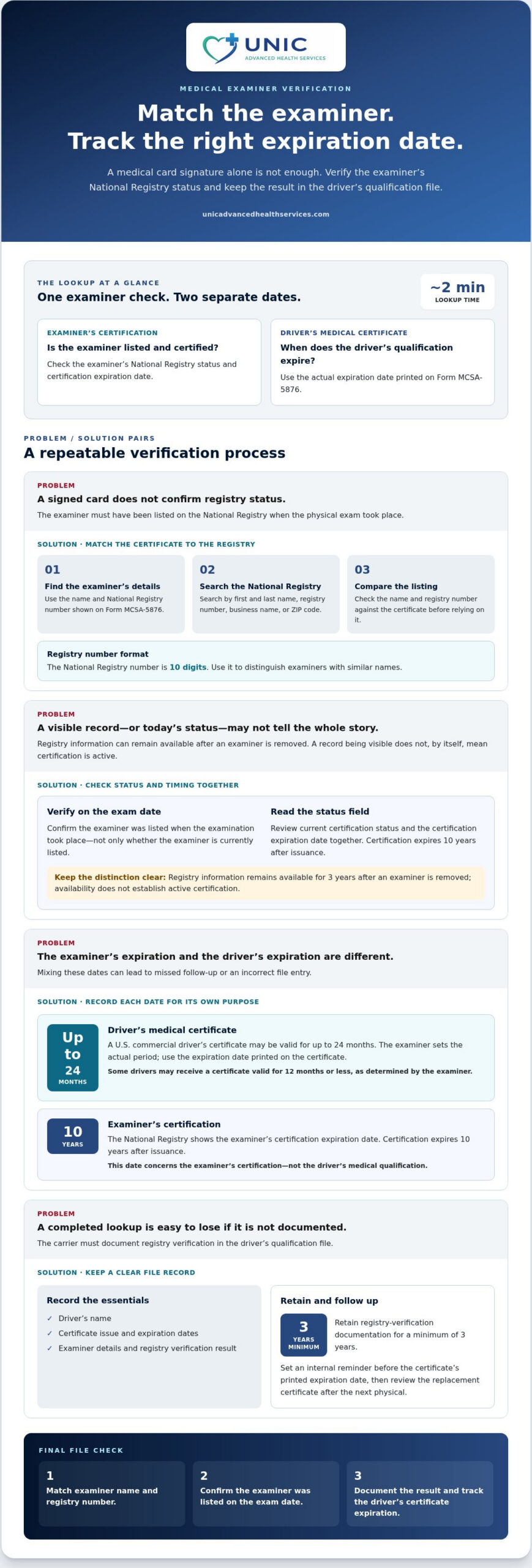
A signed medical card alone isn’t enough: motor carriers must verify that the medical examiner is listed in the National Registry and document that verification in the driver’s qualification file. A medical examiner certificate lookup helps confirm the examiner’s registry status, while the certificate shows when the driver’s medical qualification expires.
It’s understandable to want a clear, repeatable process for every driver record. FMCSA says carriers must retain registry-verification documentation for a minimum of 3 years. This guide explains how to check an examiner’s certification and expiration date, what to record, how electronic reporting relates to state CDL records, and where to find the examiner’s registry number on Form MCSA-5876.
Use the results to keep qualification files organized and identify records that need attention. Locate the examiner’s details, compare the registry listing with the certificate, document the verification, and track the certificate’s expiration date.
Key Takeaways
- Verify that the examiner is listed on the National Registry, then document the result in the driver’s qualification file.
- A U.S. commercial driver’s medical certificate may be valid for up to 24 months, according to the Federal Motor Carrier Safety Administration; check the certificate’s actual expiration date.
- Use the examiner’s details to review certification status and expiration, and note that electronic reporting and state CDL records may update on different timelines.
- Retain registry-verification documentation for a minimum of 3 years, according to the Federal Motor Carrier Safety Administration.
- Find the examiner’s National Registry number on Form MCSA-5876 to help match the certificate to the registry record.
Are motor carriers required to verify medical examiner certification?
Yes. A motor carrier must verify the examiner’s National Registry status and document that verification in the driver’s qualification file. A medical examiner certificate lookup connects the examiner’s record with the certificate being reviewed.
Commercial Driver Medical Certificates
A Medical Examiner’s Certificate, or MEC, is Form MCSA-5876. It records the result of a commercial driver’s physical exam and the medical qualification period assigned by the examiner. The examiner must have been listed on the FMCSA National Registry when the examination took place. Compare the examiner’s name and registry number with the certificate, rather than relying on a signature alone.
For interstate commercial driving, drivers must obtain Form MCSA-5876 from a certified examiner listed on the National Registry. In Florida, CDL holders required to maintain a valid medical certificate must comply with Part 383. For intrastate CDL work, identify the driver’s applicable certification category and Florida requirements; don’t assume interstate and intrastate classifications are interchangeable.
The MEC records whether the examiner certified the driver after a DOT physical. It also shows the examination outcome and expiration date, but it does not mean the driver has unrestricted approval to drive in every circumstance. The carrier must review the document and verify the examiner’s credentials.
Certificate Validity and Renewal
A U.S. commercial driver’s medical certificate may be valid for up to 24 months, according to the Federal Motor Carrier Safety Administration. That is a maximum, not a standard term for every driver. The examiner records the actual expiration date after considering the examination and relevant medical information. Use the date printed on the certificate to schedule renewal follow-up.
A DOT physical certificate can therefore expire before the maximum interval. Drivers with conditions such as high blood pressure, diabetes, or sleep apnea may receive certificates valid for 12 months or less, as determined by the examiner. For example, a certificate showing an earlier expiration date needs earlier follow-up, even if another driver’s card lasts longer.
To track medical card validity, record the driver’s name, certificate issue and expiration dates, and examiner details. Set an internal reminder before the printed expiration date, then review the replacement certificate after the next physical exam. This helps prevent an expired card from going unnoticed in the driver’s file.
If a driver loses the MEC, request a replacement copy from the examiner who performed the physical exam. Before filing it, compare the name, examiner details, and expiration date with the carrier’s records.
If the certificate contains an error, contact the issuing examiner to correct it. To update CDL medical status, follow the state licensing agency’s record-update process and keep the corrected certificate in the driver’s file.
Checking examiner certification status and expiration
Use the FMCSA National Registry to confirm the examiner’s status and review the listing details. Compare the registry record with the examiner information on the certificate before relying on it.
Examiner Certification Status
Open the National Registry search and enter the examiner’s first and last name, National Registry number, business name, or ZIP code. The number is 10 digits. Search results show current certification status, the examiner’s certification expiration date, and business address. Allow about two minutes to complete the lookup, then compare the result with the certificate details.
Check the examiner’s status on the date of the physical exam, not only their current status. The examiner must have been listed when the examination took place for the certificate to be valid. If a name or business address differs, use the registry number to distinguish the examiner from similarly named listings.
An examiner’s federal certification and a driver’s medical certificate have separate expiration dates. Certification expires 10 years after issuance. Registry information remains available for 3 years after an examiner is removed, so a visible record alone doesn’t mean the examiner currently has active certification. Read the current status field and expiration date together.
Certificate Expiration Dates
For the driver’s certificate, read the printed expiration date and record it in the carrier’s tracking system. For the examiner, review the separate certification expiration date in the National Registry search results. These dates serve different purposes: one concerns the driver’s medical qualification, the other the examiner’s authority to perform a DOT physical exam.
If the examiner’s certification date has passed, compare the exam date with the registry record and keep a copy of the lookup result. Federal rules identify failure to renew certification, loss of a state medical license, and failure to submit examination results as reasons an examiner may be removed. Issuing a certificate to a driver who didn’t meet physical qualification standards is another stated reason.
A lapsed driver certificate can also affect CDL status. A state licensing agency must complete and record a CDL downgrade within 60 days after notifying a driver that medical certification has lapsed. Treat a missing or expired certificate as a record issue that needs prompt follow-up, and confirm the state record reflects any updated medical certification.
Keep a dated copy or record of the search, including the examiner’s name, registry number, displayed status, certification expiration date, and business address. These details help clarify which listing the carrier checked and what the review showed.
Electronic reporting and state CDL records
Electronic reporting links the medical examiner’s submission to a driver’s state record, but the records serve different purposes. In Florida, review the CDL record as well as the medical documentation held by the driver or motor carrier.
Online Medical Status Lookup
To verify a commercial driver’s medical status online, review the driver’s CDL record through the state licensing agency’s process. In Florida, medical examination results have been transmitted electronically to the Florida Department of Highway Safety and Motor Vehicles and posted to the CDLIS driving record since December 15, 2025. Confirm that the record reflects the submitted examination, rather than assuming electronic reporting means the update is already visible.
According to the Federal Motor Carrier Safety Administration, FMCSA-registered medical examiners must report examination results electronically by midnight local time on the next calendar day after the exam. This deadline applies to the examiner’s submission. It doesn’t establish when a state record will display the result or replace the need to review the CDL record itself.
Finding Certificate and Exam Records
Look for the driver’s certificate in their personal medical records or the motor carrier’s driver qualification file. The state CDL record is a separate source for the medical status associated with the commercial driving record. If the records differ, compare the driver’s name, exam details, and certificate dates, then determine whether the examination result has been submitted.
Florida advises CDL holders to carry their Med Card for at least 15 days after electronic submission so the driver record can be updated. This gives the state record time to reflect the submitted result. Keep the certificate available during that interval, and compare the updated CDLIS record against the certificate once the electronic entry appears.
State Submission Portals
To find a state DMV or licensing agency portal, start with the official agency website for the state where the CDL is maintained. Search for medical certification, CDL records, or medical certificate submission, then follow that state’s instructions. For Florida records, look for FLHSMV’s CDL-related information and submission instructions.
Before submitting a document, check that the portal’s process applies to the driver’s certification category. Enter the requested driver information carefully, upload or submit the certificate as directed, and save any confirmation or receipt. Then review the state record for the resulting status. A successful submission and a visible CDL record entry are distinct checkpoints.
FMCSA regulations also allow a designated Medical Examiner Administrative Assistant to report examination results for the certified examiner they assist. The assistant does not become the examiner who conducted the physical exam. Carriers should still compare the submitted result with the driver’s CDL status and keep consistent documentation.
Motor-carrier verification and driver qualification file documentation
A motor carrier should make registry verification a documented step in each driver’s qualification review. Under 49 CFR §391.23(m), U.S. motor carriers must verify the medical examiner’s National Registry status and document the verification in the driver’s qualification file.
Keep evidence specific enough to show what the carrier checked and when. A useful record identifies the driver, examiner, examination, and registry result. For example, save a dated copy or screenshot of the search result with the certificate, rather than relying on a note that simply says “verified.”
For each review, record these details where practical:
- The driver’s name and the medical examination date.
- The examiner’s name and National Registry number.
- The registry status and certification expiration displayed during the search.
- The date the carrier performed the lookup and the result reviewed.
- The certificate copy or record associated with that examination.
Compare the details across records before filing them. If the certificate lists an examiner number that differs from the lookup record, pause the review and resolve the mismatch. A similar name or business address alone may not identify the intended examiner. The registry number is a more precise comparison point.
The Federal Motor Carrier Safety Administration says a motor carrier must retain registry-verification documentation for a minimum of 3 years. Organize records by driver and examination date so staff can retrieve the relevant verification during a file review. If a driver has more than one examination on record, keep each lookup tied to the certificate it supports.
A clear file separates examiner verification from the driver’s medical qualification. Registry evidence shows the examiner’s status; the certificate records the examination outcome and its expiration. Keeping both together helps confirm that the verified examiner record corresponds to the driver’s certificate, rather than treating one document as a substitute for the other.
Use the same review sequence for every driver: compare the certificate with the registry result, save the evidence, and enter the review date in the file index. If a record is corrected or replaced, keep the updated document with a note describing what changed. This creates a traceable record of the original review and later correction.
Before closing the review, check that the saved evidence is readable and connected to the correct driver. A registry result without an examination date can be difficult to match later. A certificate without verification evidence leaves the file incomplete. Consistent naming, dated records, and the 3-year retention period make the documentation easier to maintain.
Where to find the examiner’s registry number on the medical certificate
Form MCSA-5876 prints the medical examiner’s 10-digit National Registry number. Use that number to connect the certificate with the examiner’s record in the National Registry of Certified Medical Examiners. It identifies the examiner, not the driver, and differs from the certificate’s medical expiration date.
Start with the examiner information on Form MCSA-5876. Look for the National Registry number among the examiner’s identifying details, then read all 10 digits carefully. On a scanned or photocopied form, enlarge the image if a digit is faint. Don’t substitute the driver’s license number, certificate dates, or another form identifier.
Follow these steps to match the document with the registry listing:
- Locate the examiner’s 10-digit National Registry number on Form MCSA-5876.
- Enter the number in the National Registry search, or search by the examiner’s name.
- Compare the examiner name and business details shown in the registry record with the certificate.
- Record the lookup date and retain the certificate with the matching result.
The National Registry search also accepts an examiner’s first and last name, business name, or ZIP code. If the printed number is damaged or hard to read, search using another detail and compare the examiner information returned with the certificate. A name match alone may be less precise when examiners have similar names, so use a clearer certificate copy to resolve the number when possible.
Keep the number distinct from expiration information. The examiner’s registry number identifies the examiner’s listing; the driver’s certificate expiration date identifies how long that medical qualification remains valid. For example, a registry match doesn’t change an expiration date printed on Form MCSA-5876. Record each item separately in the driver’s file.
If a certificate is submitted electronically or stored as a scan, preserve a readable copy that shows the examiner details and all 10 digits. A cropped image that hides part of the identifying information can make a later comparison harder. Check the saved document before filing it, and link it to the correct driver and examination record.
For a new certificate, the DOT physical examination produces the medical document used for this comparison. Drivers arranging an examination can schedule a DOT physical examination, then use the completed Form MCSA-5876 to locate the examiner number and check the registry record.
Unic Advanced Health Services: DOT Physical Examination
Unic Advanced Health Services offers DOT Physical Examinations for commercial drivers preparing for an exam or renewal. This is the next step when a certificate is nearing expiration or a driver needs a new medical assessment. After the exam, use the completed certificate to review the examiner details and match the registry number with the National Registry record.
Drivers managing an ongoing condition can also access Chronic Condition Management alongside their routine care. The U.S. Coast Guard (USCG) Boat Captain Physical is a separate service for maritime credential needs, not a replacement for a DOT physical.
Contact Unic Advanced Health Services to discuss a DOT Physical Examination in Fort Lauderdale, or visit unicadvancedhealthservices.com.
Make your next certificate review easier
Make the medical examiner certificate lookup a consistent checkpoint whenever a driver’s medical paperwork changes. A clear routine helps move from receiving a certificate to reviewing it, updating internal records, and identifying any follow-up. Keep the process practical: assign responsibility, use the same review steps, and make the latest record easy to find.
For drivers preparing for a DOT physical, planning ahead can help keep medical documentation current. Unic Advanced Health Services in Fort Lauderdale offers DOT Physical Examinations for drivers who need an exam. The clinic also offers Chronic Condition Management and U.S. Coast Guard (USCG) Boat Captain Physicals for other health and credential needs.
When you’re ready to discuss your care, contact Unic Advanced Health Services. A steady, organized approach can help you move forward with clarity.
Frequently Asked Questions
What happens if my DOT physical was done by an uncertified medical examiner?
A certificate may not be valid if its issuer wasn’t listed on the FMCSA National Registry when the examination took place. Compare the exam date with the examiner’s registry record, then keep the search result and certificate together. If the listing doesn’t support the certificate, arrange an examination with a currently listed examiner and update the records used for the qualification review. A signed form alone doesn’t resolve the issue.
What If the Verification Fails?
First, check for an entry error in the examiner’s name or 10-digit registry number. Search again using another available detail, such as the examiner’s business name or ZIP code, and compare the returned identifying information. If you still can’t locate a matching record, save the details you searched and contact the National Registry Technical Support Help Desk at 617-494-3003, option 2. Keep the certificate separate from any unresolved verification record.
What does “decertified” mean on the FMCSA registry?
“Decertified” means the examiner’s certification is no longer active in the registry. Possible reasons include failure to renew certification, loss of a state medical license, or failure to submit examination results to FMCSA. A historical record may remain visible after removal, so its presence doesn’t prove current authorization. Compare the displayed status with the examination date and keep the result reviewed.
Who Can Request Verification?
A driver or motor carrier conducting a qualification review can search for an examiner in the National Registry. Search by the examiner’s name, registry number, business name, or ZIP code, using whichever identifying detail is available. For a clear file trail, record who performed the search, the date, the search detail used, and the result associated with the driver’s examination.
How do I check whether a medical examiner is listed in the FMCSA National Registry?
Open the National Registry search and enter the examiner’s first and last name, 10-digit registry number, business name, or ZIP code. Review the returned status, certification expiration, and business address. If you’re checking a particular examination, compare the exam date with the listing information, then save the result alongside the related paperwork. Use another search field if the first entry produces multiple or unclear matches.
How long is a medical examiner certificate valid, and when does it expire?
A U.S. commercial driver’s certificate may be valid for up to 24 months, according to the Federal Motor Carrier Safety Administration. The expiration date printed on the individual certificate determines when that driver’s qualification period ends. Some drivers receive shorter periods based on health conditions and examination findings. For planning, use the printed date in your record rather than assuming every certificate follows the maximum interval.
What happens if my medical examiner certificate expires or is not on file?
An expired or missing certificate can leave the driver’s medical qualification unrecorded, so locate the current document and review the state CDL record. In Florida, a state licensing agency must complete and record a CDL downgrade within 60 days after notifying a driver that medical certification has lapsed. If the certificate was submitted electronically, allow time for the state record to update and retain the document during that period.