
What should you do when a new symptom appears after starting a medication: wait, stop taking it, or call your clinician? Uncertainty is understandable, but a side effect doesn’t automatically mean your treatment is unsafe or unsuitable. Managing medication side effects starts with noticing what’s changed and sharing clear details with a healthcare professional, not changing your dose on your own.
It can be difficult to tell whether a symptom is related to a medication or has another cause. Stopping or adjusting a medicine without guidance may carry risks, so get advice tailored to your health and treatment plan. If a symptom feels severe or urgent, seek immediate medical help.
This article explains what to record, how to describe symptoms and their timing, and when to contact a clinician or seek urgent care. You’ll also learn how to prepare for a focused conversation about medication concerns during primary care or a Manage Chronic Conditions visit at Unic Advanced Health Services in Fort Lauderdale.
Key Takeaways
- Record symptom details and medication timing so you can share useful context with your clinician.
- Understand why timing can offer clues about a possible side effect without proving its cause.
- Use a safety-first approach to managing medication side effects, including knowing when to seek urgent help.
- Prepare for a more focused conversation by bringing a complete list of medicines and supplements and questions about next steps.
- Discuss medication concerns as part of your broader health needs through primary care, Manage Chronic Conditions, and Coordinate Care.
Managing Medication Side Effects Starts with Recognizing and Recording Symptoms
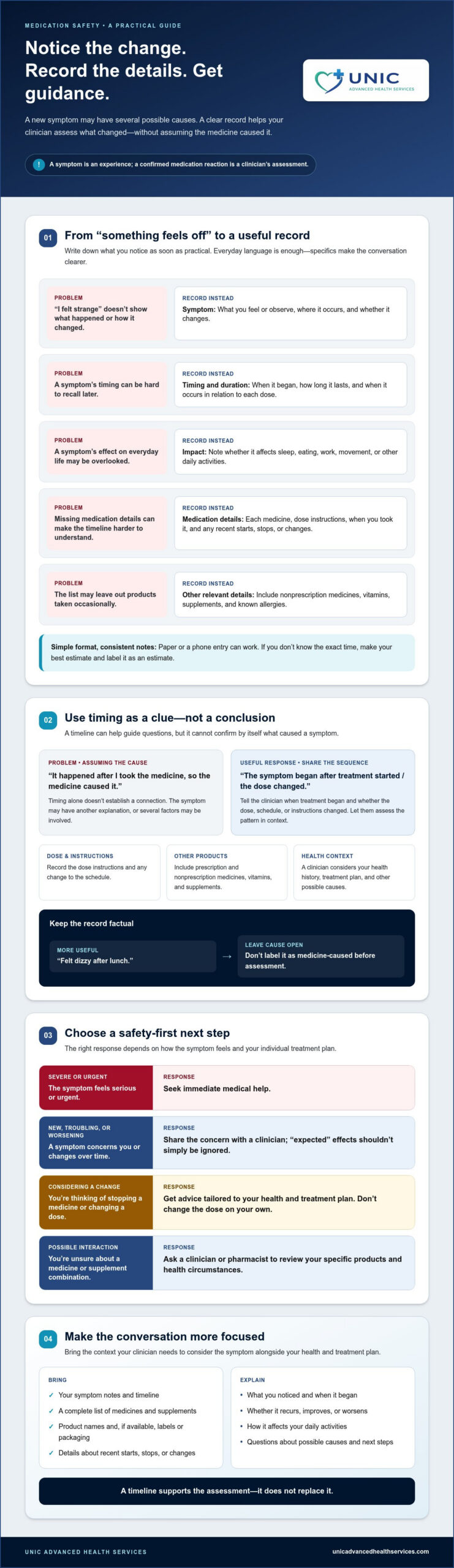
A medication side effect is an unwanted effect that may occur alongside a medicine’s intended effect. A useful distinction is: A symptom is something you experience; a confirmed medication reaction is a clinician’s assessment that the medicine caused it. Managing medication side effects starts with describing what happened without assuming the cause.
A new symptom after starting or changing a medicine can understandably raise concern. But symptoms can have several possible causes, and timing alone doesn’t establish a connection. The overview Understanding Medication Side Effects explains the term and its different forms. A clinician can consider your experience in the context of your health and treatment plan.
A brief, factual record can make that conversation clearer. This video discusses medication side effects in the context of NTM treatment:
What details should you record when a symptom appears?
Write down what you notice as soon as practical. Use everyday language and include enough detail to show how the symptom changes over time:
- Symptom: Describe what you feel or observe, where it occurs, and whether it changes.
- Timing and duration: Note when it began, how long it lasts, and when it occurs in relation to each dose.
- Impact: Record whether it affects sleep, eating, work, movement, or other daily activities.
- Medication details: List each medicine, its dose instructions, when you took it, and any recent starts, stops, or other changes.
- Other relevant information: Include nonprescription medicines, vitamins, supplements, and known allergies.
If you don’t know the exact time, make your best estimate and label it as an estimate. A paper note or phone entry can work; consistency matters more than the format.
Why does a clear symptom record help?
A timeline gives a clinician a practical way to compare when symptoms appeared with medication starts, dose changes, or other events. It can help guide questions about possible causes, but it can’t confirm one by itself. Keeping that distinction in mind leaves room to consider other explanations instead of settling on a self-diagnosis.
Keep observations factual: “felt dizzy after lunch” is more useful than “the medicine caused dizziness” if the cause hasn’t been assessed. Note whether the symptom recurs, improves, or affects your routine, and include details that seem relevant even if you’re unsure how they connect.
Bring your notes to an appointment or have them ready during a call. A clear record helps you explain what changed and gives the clinician a fuller picture to consider alongside your health history and treatment plan.
Why Medication Side Effects Happen and How Timing Can Offer Clues
A medicine’s effects depend on more than its name. The dose, how it’s taken, other medicines or substances, and a person’s health circumstances can all shape what they experience. The same medicine can help one person without noticeable problems and cause unwanted effects for another because people differ in their health, medication combinations, and individual responses.
Timing can help guide a conversation. If a symptom appears after treatment starts or a dose changes, that sequence is useful context, but it doesn’t prove the medicine caused the symptom. The symptom may have another explanation, or several factors may be involved. A clinician considers the pattern alongside your treatment plan and health history.
Some effects are known possibilities described in medication information, but “expected” doesn’t mean they should be ignored. A new, troubling, or worsening symptom deserves attention, and a serious reaction may need urgent care. Harvard Health’s guide to When to Seek Help for Medication Side Effects offers further context on concerning effects and interactions.
How can starting or changing a medicine affect symptoms?
Make a note of when you began treatment and whether the dose, schedule, or instructions changed. If a symptom appears, record when it started in relation to those events. A pattern may help your clinician decide what questions to ask, but don’t use timing alone to decide that a medicine is responsible.
A clinician can assess the symptom in light of your treatment plan, health history, and other possible causes. There’s no single timeline that predicts whether or when an unwanted effect will improve. Share your concern rather than waiting for it to pass or changing the medicine without guidance.
Can other medicines or supplements play a role?
Yes. Prescription and nonprescription products may interact, and combinations can affect how a medicine works or what symptoms occur. Include vitamins and supplements in your medication record, even if you take them only occasionally. Bring product names and, if available, their labels or packaging so the details are clear.
For questions about a possible interaction, speak with a clinician or pharmacist who can consider your specific medicines and health circumstances. Don’t stop a product or alter a dose based on a general interaction list alone. Managing medication side effects is safest when decisions are based on a full, individualized review.
If you’re concerned about a symptom during ongoing treatment, a primary-care visit can provide an opportunity to discuss it in the context of your broader health needs. Discuss medication concerns during primary care and bring your current medication information to support the conversation.
Managing Medication Side Effects and When to Seek Help
A concerning symptom can leave you unsure whether to wait, call your clinician, or seek emergency care. Use this sequence to choose a safer next step. If you’re uncertain about how serious a symptom is, seek medical guidance rather than trying to manage it with an unapproved dose change or home remedy.
- Assess immediate safety. If symptoms are severe, rapidly worsening, or potentially life-threatening, call 911 or seek emergency services now. Examples include difficulty breathing, loss of consciousness, or swelling of the face or throat. Don’t delay urgent care to finish documenting symptoms.
- Record what’s happening. For symptoms that aren’t an emergency, note what you’re experiencing, when it began, and any recent treatment changes. Keep the medication packaging and your current notes available so you can refer to the product name and instructions accurately.
- Follow the medication directions. Take medicine only as directed unless a clinician or emergency professional gives you different instructions. Don’t stop, skip, double, or change a dose on your own, even if you suspect the medicine is causing the symptom.
- Contact a clinician. For a non-emergency concern, follow the prescriber’s or care team’s contact instructions. Explain the symptom, when it started, and what you’ve taken. Ask what to do next and how soon you should follow up.
What should you do first when a side effect concerns you?
Start by judging the urgency, not by deciding what caused the symptom. A mild concern that isn’t worsening may be appropriate to discuss with your care team using its usual contact process. A severe or quickly worsening symptom calls for emergency help. Keep the medicine container or packaging nearby, along with your notes, for a clearer conversation.
While waiting for guidance on a non-emergency concern, avoid guessing at a solution. Don’t take an extra dose, skip the next one, or try a remedy to counter the symptom unless a qualified professional advises you. If the situation worsens, reassess its urgency and seek emergency services when appropriate.
Why should you avoid changing a dose on your own?
Stopping or changing treatment can affect the condition the medicine is intended to treat, and the risks depend on the specific treatment and your health. A clinician can review the symptom and decide whether a change is appropriate, including what adjustment or follow-up may be needed. The right response isn’t the same for every medicine or person.
Don’t take someone else’s medication or add an over-the-counter product, supplement, or home remedy without professional advice. These choices may create new risks or make it harder to understand what’s causing a symptom. Share what you’re considering with a clinician or pharmacist before acting.
Medication concerns can be discussed as part of primary care, including care focused on ongoing conditions. If you’re in Fort Lauderdale, primary care for medication concerns can be part of a broader conversation about your health and treatment plan.
How to Prepare for a Medication Side-Effect Conversation
A focused conversation can help your clinician understand what you’re experiencing and decide what to assess next. Bring your symptom timeline and a complete list of medicines and supplements, then describe how the symptoms affect your routine. You don’t need to know the cause before the visit. Clear observations and questions are enough to begin.
What information should you bring to a clinical visit?
Gather details that help your clinician review the treatment in context. A written list or organized notes on your phone can make it easier to cover everything, especially if you take several products or have had recent changes.
- Medication information: Bring names, dose instructions, schedules, prescribing details, and notes about recent starts or changes. Include nonprescription medicines, vitamins, and supplements.
- Symptom timeline: Note when each symptom began, how it has changed, and when it occurs in relation to your routine or medication schedule.
- Daily impact: Describe effects on sleep, work, eating, movement, or usual activities. For example, explain whether a symptom interrupts sleep or makes it harder to complete a normal task.
- Relevant background: Bring health records that may help explain the concern, along with known allergies and questions you’ve noted since the symptom appeared.
- First-visit items: If this is your first visit, bring a valid ID, your insurance card if applicable, and relevant health records.
Helpful checklist: Bring your symptom timeline, complete medication and supplement list, relevant health records, and written questions.
Which questions can help guide the discussion?
Choose the questions that matter most to you and write them down before the visit. You can ask whether the symptom could be related to a medicine or another health factor, what changes or patterns the clinician wants you to monitor, and which warning signs need prompt or urgent attention.
Also ask whom to contact if the symptom changes, what next steps are appropriate for your situation, and how any recommended plan will be monitored. Clarify when to follow up and what information to track before then. If an answer isn’t clear, ask for it in plain language or repeat it back to make sure you understand.
Be specific about what you hope to address, such as getting through work comfortably or sleeping without interruption. That context helps the clinician understand the practical impact, not just the symptom itself. Managing medication side effects is a shared conversation: your observations inform the review, while clinical guidance helps shape safe next steps.
For medication concerns related to your overall health or an ongoing condition, discuss them during a primary-care visit. Schedule a primary-care visit to discuss medication concerns with your symptom notes and medication list ready.
Ongoing Medication Side-Effect Support in Fort Lauderdale
Medication concerns can be easier to assess when considered alongside your broader health, rather than as an isolated symptom. During primary care, you can discuss what you’ve noticed, how it affects your routine, and how it fits with your current treatment plan. A clinician can review those details alongside your health history and help identify appropriate next steps without assuming a medication change is needed.
For patients managing ongoing conditions, this conversation can be part of personalized care. At Unic Advanced Health Services in Fort Lauderdale, Manage Chronic Conditions supports discussion of treatment concerns within a broader health plan. The goal is an individualized clinical review, not a promise that a symptom will resolve or that a particular treatment adjustment will be made.
How can follow-up support people managing chronic conditions?
Regular primary-care follow-up gives you an opportunity to raise new concerns as your health and treatment needs evolve. Share what has changed, what questions remain, and whether a symptom is affecting your usual routine. This helps keep the conversation connected to your overall care, including the condition being treated.
Coordinate Care can help connect relevant information across a patient’s care when appropriate. For example, a clinician may consider medication details alongside available health records and other relevant information when reviewing a concern. If routine testing or chronic-condition monitoring is appropriate, On-Site Lab Services may be part of a clinician-directed plan. Testing is guided by clinical judgment and the patient’s needs.
For a more useful follow-up, bring your current medication and supplement list, symptom notes, and any questions you couldn’t cover earlier. You can also explain what you hope to understand, such as whether a symptom needs monitoring or what signs should prompt you to seek help. This supports a clear discussion while leaving clinical decisions to you and your healthcare professional.
How can Fort Lauderdale patients take the next step?
If you have a non-emergency medication concern, a primary-care appointment can provide time to discuss it alongside your broader health needs. Before the visit, gather the medication packaging or an up-to-date list, note any recent treatment changes, and write down your main questions. You don’t need to arrive with a conclusion about the cause. A careful review can begin with what you’ve noticed and when.
Managing medication side effects is an ongoing, collaborative process. Your observations help inform the conversation, while a clinician can assess them in the context of your personal care plan. If you’re experiencing symptoms that are severe, rapidly worsening, or potentially life-threatening, seek emergency services rather than waiting for a routine appointment.
To discuss medication concerns as part of primary care in Fort Lauderdale, schedule a visit with Unic Advanced Health Services by calling (954) 767‑0228. Office hours are Monday through Saturday, 9:00 AM - 5:00 PM; Saturday until 1:00 PM; closed on Sundays.
Make Your Next Medication Conversation a Step Toward Clarity
Medication concerns don’t have to be sorted out alone. Discussing them as part of your broader health care can help you make informed decisions with a clinician who understands your care needs. Managing medication side effects is not about guessing or rushing into a change. It’s about getting support as you consider what comes next.
Unic Advanced Health Services provides personalized, compassionate primary care in Fort Lauderdale. Medication concerns can be discussed as part of Manage Chronic Conditions, with On-Site Lab Services available for clinician-directed routine testing and chronic-condition monitoring when appropriate. Your questions and health circumstances can guide an individualized discussion without assuming a particular treatment outcome.
Take the next step by scheduling a primary-care visit with Unic Advanced Health Services. Bring the concerns you want to discuss and give yourself room to ask questions. A thoughtful conversation can help you move forward with greater confidence and support.
Schedule a primary-care visit with Unic Advanced Health Services or call (954) 767‑0228.
Frequently Asked Questions
Can I stop taking a medication if I think it is causing side effects?
Don’t stop, skip, double, or change a dose without instructions from a healthcare professional. Stopping suddenly may affect the condition being treated, and the safest response depends on the medication and your circumstances. Contact the prescriber or care team for guidance. If you’re having severe or potentially life-threatening symptoms, seek emergency help rather than waiting for a routine reply.
How can I tell whether a symptom is a medication side effect?
You can’t reliably confirm the cause from timing alone. For example, a headache that begins after a new medicine may be related, but illness, dehydration, or another factor could also contribute. Note when it occurs, whether it returns, and what else has changed in your health or routine. A clinician can assess these details alongside your treatment and health history.
What should I do if a medication side effect gets worse?
If the symptom becomes severe, worsens quickly, or makes you feel unsafe, seek urgent medical help. For a concern that is worsening but not an emergency, contact the prescriber or care team and explain what changed, when it changed, and how it affects you. Keep following the medication’s directions unless a healthcare professional gives you different instructions.
Can medications, vitamins, and supplements interact and cause side effects?
Yes. Prescription medicines, over-the-counter products, vitamins, and supplements can interact or affect each other’s effects. Share the full list with your clinician or pharmacist, including products you take only occasionally and any recent additions. For example, mention a new herbal supplement even if you consider it separate from your medications. Get individualized advice before combining products or changing how you take them.
Should I take a medication with food to reduce side effects?
Only if the medication’s directions say to take it with food or a healthcare professional recommends doing so. Food can affect how some medicines are absorbed, so taking a dose with a meal may not be appropriate for every product. Check the prescription label and patient information, and ask a pharmacist or prescriber if the instructions are unclear. Don’t change the timing or food instructions on your own.
When should I seek emergency help for a possible medication reaction?
Call 911 or seek emergency services for symptoms that are severe, rapidly worsening, or potentially life-threatening. Examples include difficulty breathing, swelling of the face or throat, fainting, or loss of consciousness. Don’t wait to see if these symptoms pass or delay seeking help to contact a routine care team. For less urgent concerns, contact a healthcare professional for advice about what to do next.
What information should I bring to a medication review?
Bring an up-to-date medication list or the containers themselves, including prescriptions, nonprescription products, vitamins, and supplements. Include dose instructions and note which medicines you take only as needed. Recent discharge paperwork or relevant test results may also help provide context. For a first visit, bring a valid ID, an insurance card if applicable, and relevant health records so the clinician has useful background for the review.