What if the key to keeping your commercial driver’s license isn’t just about the numbers on the monitor, but how you prepare in the minutes before the cuff tightens around your arm? For many drivers, the blood pressure check is the most stressful part of the entire certification process. It’s natural to feel a surge of “white coat syndrome” the moment you step into a clinic. You aren’t alone in searching for the most effective ways of managing blood pressure to pass DOT physical exams without the fear of a sudden disqualification or being forced onto unwanted medications.
We understand that you need clear, reliable information to meet these medical standards with confidence. This guide provides the exact FMCSA blood pressure requirements for 2026, immediate relaxation techniques for the exam room, and long-term management strategies to protect your health. You’ll learn how to interpret the different hypertension stages, what to do if your reading is elevated, and how to find a supportive medical examiner in Fort Lauderdale who views you as a partner. By the end of this article, you’ll have a clear roadmap to secure your medical certificate on the first try and stay on the road where you belong.
Key Takeaways
- Understand that 140/90 is the critical threshold for a standard medical certificate and learn how different hypertension stages impact your certification length.
- Discover how managing blood pressure to pass DOT physical exams can be supported through pre-exam hydration and natural nitric oxide boosters like beet juice.
- Master the 4-7-8 breathing technique to neutralize “white coat syndrome” and lower your heart rate during the clinical evaluation.
- Clarify common misconceptions regarding blood pressure medications and see how moderate weight management provides long-term regulatory compliance.
- Learn how partnering with a specialized examiner in Fort Lauderdale provides a low-stress environment to help you maintain your career.
Understanding FMCSA Blood Pressure Requirements for 2026
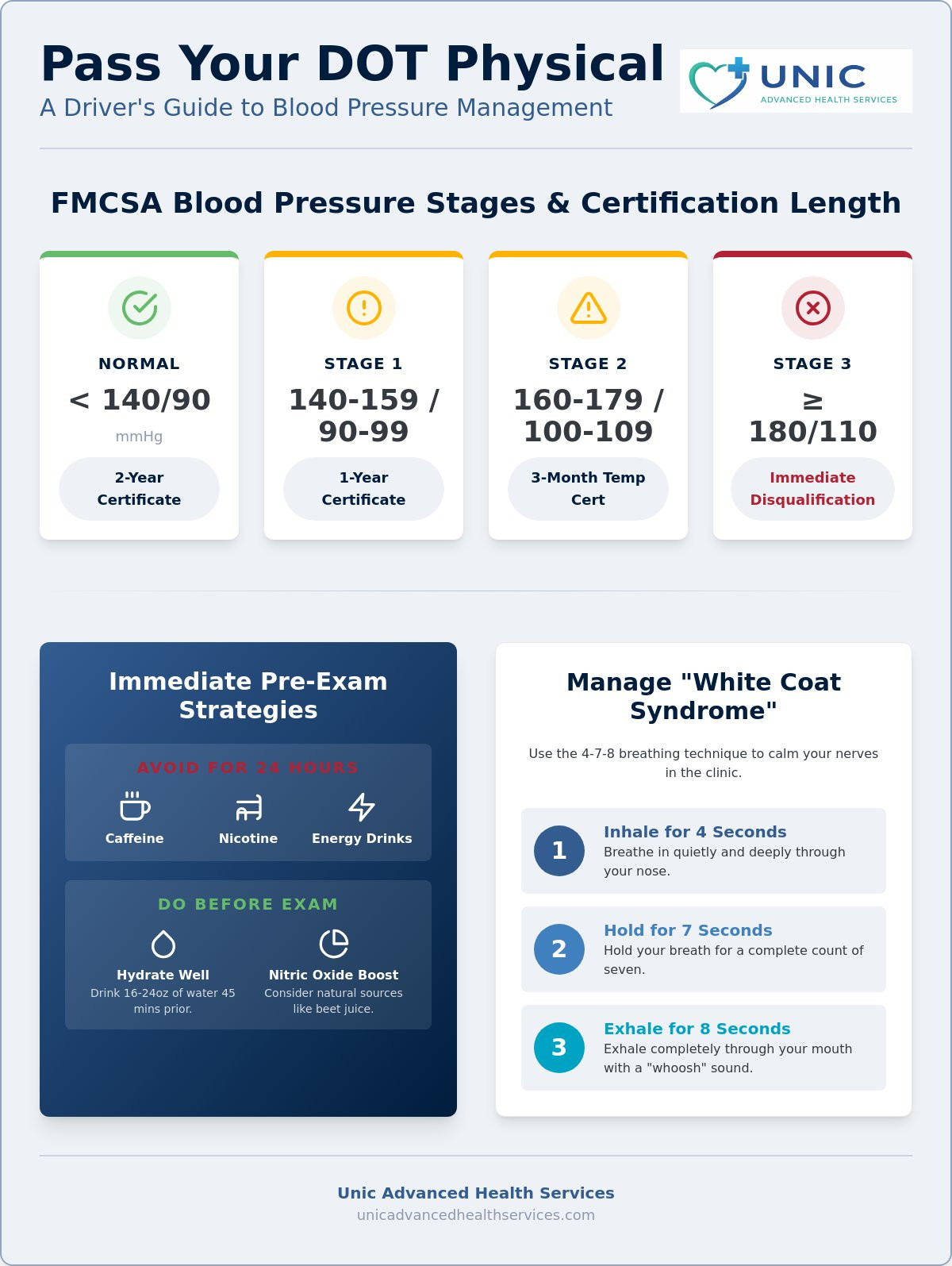
The Federal Motor Carrier Safety Administration (FMCSA) maintains strict standards for cardiovascular health to ensure every driver can safely operate a heavy vehicle. The magic number you need to memorize is 140/90 mmHg. If your reading stays below this threshold, you’re generally eligible for a standard two-year medical certificate. However, managing blood pressure to pass DOT physical exams becomes more complicated if your numbers start to creep upward. Understanding Hypertension and how the FMCSA categorizes different stages is the first step toward staying compliant and keeping your CDL active.
To better understand how these medical requirements work in practice, watch this helpful video:
Hypertension Stages and Certification Lengths
The length of your medical certificate is directly tied to your blood pressure reading on the day of the exam. If your blood pressure is Normal (Below 140/90), you’ll typically receive a 2-year certificate. Once you cross into Stage 1 (140-159/90-99), the examiner will likely limit your certification to one year. This shorter timeframe allows for more frequent monitoring to ensure your health remains stable. It’s a proactive measure designed to catch potential issues before they become serious risks.
If your reading reaches Stage 2 (160-179/100-109), the situation becomes more urgent. In these cases, the FMCSA allows for a one-time, 3-month certificate. This is essentially a grace period. It gives you 90 days to work with a healthcare provider, start treatment if necessary, and bring your numbers back below 140/90. If you cannot meet that goal within the three-month window, you’ll be disqualified until your blood pressure is under control. Finally, Stage 3 (180/110 or higher) is considered an immediate disqualifying condition. You cannot be certified until your blood pressure is reduced to safe levels and your treatment is well-tolerated.
Why the DOT Cares About Your Numbers
The focus on blood pressure isn’t just about regulatory paperwork; it’s about your safety and the safety of everyone on the road. High blood pressure is often asymptomatic, meaning you might feel perfectly fine while your heart and arteries are under significant strain. Untreated hypertension is a primary cause of sudden medical emergencies. For long-haul drivers, the combination of sedentary shifts, high-sodium diets, and irregular sleep can exacerbate these risks. Managing blood pressure to pass DOT physical requirements helps prevent catastrophic events like strokes or heart attacks while you’re behind the wheel.
Hypertension is a silent risk factor for commercial drivers. By maintaining these strict standards, the FMCSA aims to reduce the likelihood of a driver losing consciousness or experiencing a cardiovascular crisis during a shift. Partnering with a medical examiner who understands these nuances ensures you aren’t just passing a test, but actually protecting your long-term health and your livelihood.
Immediate Strategies to Lower Blood Pressure Before Your Exam
Preparation for your medical evaluation starts long before you sit in the examiner’s chair. You can take specific, actionable steps to ensure your body is in the best possible state for your reading. Managing blood pressure to pass DOT physical requirements often involves controlling external factors that cause temporary spikes. For at least 24 hours before your appointment, you should strictly avoid the “Big Three”: caffeine, nicotine, and energy drinks. These substances are powerful stimulants that constrict blood vessels and can artificially inflate your numbers by 10 to 15 points. Even if you don’t feel jittery, these chemicals stay in your system and can lead to a borderline result.
Hydration is another critical tool for your success. Drinking 16 to 24 ounces of water about 45 minutes before your exam helps flush excess sodium from your kidneys. This simple act can reduce blood volume tension and promote a more accurate reading. Some drivers also find success with a “Beet Juice Boost” on the morning of their physical. Beets are naturally high in nitrates, which the body converts into nitric oxide. This molecule helps dilate blood vessels, allowing blood to flow more freely and potentially lowering your systolic pressure for several hours. Adding potassium-rich snacks like a banana or half an avocado to your routine can also help counteract the effects of a high-sodium dinner from the night before.
The 24-Hour Preparation Protocol
Your actions the day before the physical are just as important as your actions on the day of. Focus on reducing sodium intake by avoiding processed “road food,” salty snacks, and fast food. In the humid environment of Fort Lauderdale, drivers often lose significant fluids through perspiration during pre-trip inspections. This dehydration leads to electrolyte imbalances that can negatively impact your vascular health. Ensure you get a full 8 hours of rest, as sleep deprivation triggers the sympathetic nervous system, leading to higher baseline readings. Even with physical preparation, psychological stress can lead to a spike. Managing ‘White Coat Syndrome’ is a vital part of your exam day strategy to ensure your reading reflects your true baseline.
What to Eat (and Avoid) on Exam Day
Choose a light, low-sodium breakfast such as oatmeal with berries or fresh fruit. Skipping breakfast is a mistake; an empty stomach can lead to a stress-related cortisol spike that raises blood pressure. Avoid the temptation of a fast food breakfast sandwich, which can contain over 1,000 milligrams of sodium in a single serving. If you have concerns about your current readings, scheduling a consultation for Chronic Condition Management can help you establish a stable baseline before your official physical. This proactive approach ensures that when you walk into the clinic, you’re doing so with a body that is rested, hydrated, and ready for a successful evaluation.
Managing ‘White Coat Syndrome’ During the Physical
White Coat Syndrome is a documented phenomenon where a patient’s blood pressure rises specifically within a clinical environment. For commercial drivers, this spike is often fueled by the high stakes of the medical certificate. Managing blood pressure to pass DOT physical evaluations requires more than just physical preparation; it requires a strategy to calm the nervous system. When you visit our Fort Lauderdale office, remember that Marc Joseph is a dedicated partner in your health. If you feel your heart racing as the cuff is applied, simply communicate that you’re experiencing anxiety. For those who also experience physical tension like throat tightness, resources from Precision Spinal Care can provide insight into how the upper neck affects the nervous system. Acknowledging the stress can often lower the physiological response immediately.
Arriving early for your appointment is a simple yet effective way to prevent a stress-induced reading. Rushing through South Florida traffic to reach the clinic at the last minute triggers a fight-or-flight response that can take 20 to 30 minutes to subside. Give yourself a buffer of at least 15 minutes to sit quietly in the waiting room. During this time, practice the 4-7-8 breathing technique. Inhale through your nose for four seconds, hold your breath for seven, and exhale forcefully through your mouth for eight. This specific rhythm acts as a physiological “reset” button for your autonomic nervous system, signaling to your brain that you aren’t in danger.
Physiological Relaxation Techniques
Beyond the 4-7-8 method, box breathing is another powerful tool for stabilizing your heart rate. Inhale for four counts, hold for four, exhale for four, and hold again for four. Repeat this cycle five times to achieve a state of focused calm. While waiting, you can also use progressive muscle relaxation by tensing and then releasing each muscle group, starting from your toes and moving up to your shoulders. When it’s time for the actual reading, your posture is critical. Keep both feet flat on the floor and ensure your arm is supported at heart level. According to the FMCSA Blood Pressure Guidelines, even small shifts in body position or crossing your legs can alter the accuracy of the results.
The Psychological Shift
Your mental approach to the evaluation can significantly influence the outcome. Instead of viewing the physical as a “test” that you might fail, reframe it as a routine wellness check designed to keep you safe on the road. Visualize yourself receiving a clear 1-year or 2-year certificate and driving away with total peace of mind. If the first reading is high, don’t panic. It is perfectly acceptable to request a second reading after you’ve had a few more minutes to relax. Often, the second attempt is much closer to your true baseline once the initial “white coat” spike has passed. Managing blood pressure to pass DOT physical exams is a collaborative process between you and your examiner.
Long-Term Management for Continued DOT Compliance
While immediate strategies provide a temporary benefit, managing blood pressure to pass DOT physical exams consistently requires a sustainable, long-term plan. Many drivers fall for the “Medication Myth,” believing that starting blood pressure medicine will automatically disqualify them from commercial driving. This is incorrect. The FMCSA explicitly allows the use of antihypertensive medications as long as they are well-tolerated and don’t cause side effects like severe dizziness or fatigue. Taking steps to stabilize your health through medication often shows the medical examiner that you are proactive about your safety on the road.
Weight management serves as one of the most powerful tools in your arsenal. Clinical data suggests that losing just 10 to 20 pounds can lead to a significant drop in systolic blood pressure, often by as much as 5 to 20 points. Adopting the DASH (Dietary Approaches to Stop Hypertension) diet is a practical way to achieve this while working. Focus on high-potassium foods and low-sodium alternatives that are easy to find at rest stops:
- Low-sodium snacks like unsalted almonds or walnuts.
- Fresh fruits and vegetables that travel well, such as apples or carrots.
- Lean proteins like grilled chicken or tuna pouches.
- Whole grains like oatmeal or whole-wheat crackers.
Every driver should consider owning a high-quality home blood pressure cuff. Tracking your trends over several weeks provides a more accurate picture of your health than a single reading in a clinic; for professional-grade monitoring equipment, you can check out GetMedicalDevice. If you notice your numbers rising during stressful hauls, you can adjust your habits or consult your provider before your medical certificate expires. Managing blood pressure to pass DOT physical requirements is much easier when you aren’t surprised by your results on the day of the exam.
Working with a Chronic Care NP
Partnering with a specialized provider allows you to address health issues before they become emergencies. Our chronic care management services provide a long-term safety net by monitoring your progress between physicals. We integrate hypertension treatment with your broader wellness goals to ensure you stay compliant with federal regulations. This often includes linking your blood pressure plan to obesity management, which addresses the root causes of cardiovascular strain. By focusing on sustainable lifestyle changes, you reduce the stress of the exam room and protect your career longevity.
Medication and the DOT Medical Card
If you use prescription medication, you must bring a current list of your dosages and the prescribing physician’s contact information to your appointment. The examiner needs to verify that the medication doesn’t interfere with your ability to safely operate a commercial vehicle. Maintaining a stable blood pressure on medication typically results in a 1-year certificate rather than the standard two-year limit. This ensures regular oversight of your condition and its treatment. If you are ready to take control of your cardiovascular health, schedule an appointment for Chronic Condition Management today to prepare for your next evaluation.
Professional DOT Physicals at Unic Advanced Health Services
Unic Advanced Health Services is built around the understanding that a medical evaluation shouldn’t be a source of dread. Led by Marc Joseph, an autonomous nurse practitioner, our clinic provides a supportive environment where your career goals and your health are prioritized equally. We recognize that the stress of the exam room is often the biggest hurdle in managing blood pressure to pass DOT physical requirements. That’s why we’ve designed our process to be as calm and efficient as possible, allowing you to focus on the task at hand without unnecessary anxiety.
Many drivers struggle to find time for medical appointments between long-haul routes. To accommodate your busy schedule, we offer Saturday appointments at our Fort Lauderdale location. This flexibility ensures you don’t have to sacrifice a day of work to maintain your compliance. Our approach goes beyond a simple check-box evaluation. We provide a comprehensive DOT physical exam that integrates with long-term health tracking, ensuring you stay road-ready year after year.
Why Fort Lauderdale Drivers Choose Unic
Drivers choose us because we offer a streamlined process that values your time. Our location is easy to access, and we maintain transparent pricing for all occupational health exams. If your initial reading is elevated or if you have a history of hypertension, our on-site lab services allow for quick diagnostic verification. This means you won’t have to wait days for results from an outside facility. We act as a “steady hand,” guiding you through the complexities of federal regulations while providing the clinical expertise needed for managing blood pressure to pass DOT physical standards.
Booking Your Appointment
Preparation is the final step in ensuring a successful visit. Before arriving at our clinic, gather your necessary documentation to avoid last-minute stress. You’ll need to bring a valid government-issued ID, a complete list of your current medications including dosages, and any prior medical waivers or clearance letters from specialists. If you wear glasses or use a hearing aid, ensure those are with you as well.
Having your paperwork organized allows our team to move through the administrative portion of the exam quickly, giving you more time to relax before your vitals are taken. We are dedicated to providing individualized care that respects your role as a professional driver. Schedule your DOT Physical at Unic Advanced Health Services today. and experience a healthcare partnership designed for your lifestyle.
Secure Your Career with a Proactive Health Strategy
Meeting the medical requirements of the FMCSA doesn’t have to be a source of anxiety. By understanding the 140/90 threshold and implementing relaxation techniques like the 4-7-8 breathing method, you can walk into your evaluation with confidence. You can feel empowered in managing blood pressure to pass DOT physical evaluations by focusing on both immediate preparation and long-term wellness. Prioritizing rest, hydration, and professional guidance ensures that your vitals reflect your true health and keeps your medical certificate secure.
At Unic Advanced Health Services, we provide the steady hand you need to navigate these regulations. Our NP-led practice specializes in chronic care management and offers the convenience of Saturday appointments and on-site laboratory services to fit your professional life. We’re committed to helping you maintain your livelihood while protecting your long-term well-being through every stage of your career.
Take the first step toward a stress-free certification today. Book Your Supportive DOT Physical in Fort Lauderdale and let us help you stay on the road safely. You’ve worked hard for your CDL, and we’re here to ensure you keep it.
Frequently Asked Questions
Can I pass a DOT physical if I am on blood pressure medication?
Yes, you can pass the physical while taking blood pressure medication. The FMCSA allows most antihypertensive drugs as long as they effectively control your blood pressure and don’t cause side effects like dizziness or extreme fatigue. You must bring a list of your current prescriptions and dosages to your appointment so the medical examiner can verify that your treatment plan is safe for commercial driving.
What is the highest blood pressure allowed for a DOT physical?
The maximum reading allowed to receive any form of certification is 179/109 mmHg. A reading in this range (Stage 2 hypertension) results in a one-time, three-month medical certificate. To qualify for a standard one-year or two-year certificate, your blood pressure must be below 140/90. Any reading of 180/110 or higher is immediately disqualifying until your numbers are lowered and stabilized through treatment.
Will I fail my DOT physical if I have White Coat Syndrome?
You won’t fail specifically for having White Coat Syndrome, but you must still meet the required blood pressure thresholds during the evaluation. If your initial reading is high due to clinical anxiety, our team typically allows you to rest and perform a second reading. Managing blood pressure to pass DOT physical exams often requires using relaxation techniques to ensure the recorded numbers reflect your actual baseline rather than a temporary spike.
How long does a 3-month temporary DOT medical card last?
A three-month temporary card lasts exactly 90 days from the date of your initial examination. This is a one-time “grace period” provided to drivers with Stage 2 hypertension. During these three months, you must work with a healthcare provider to bring your blood pressure down to 140/90 or lower. If you successfully reach this goal, you can then be certified for a longer period, typically one year.
Does beet juice really lower blood pressure for the DOT exam?
Beet juice contains natural nitrates that can temporarily dilate blood vessels and lower blood pressure for several hours. While this can provide a helpful boost on the day of your exam, it isn’t a substitute for long-term health management. Relying on temporary fixes rather than a consistent treatment plan can lead to inconsistent results and potential certification issues during future renewals.
What happens if my blood pressure is too high during the exam?
If your blood pressure exceeds the FMCSA limits, the examiner cannot issue a long-term medical certificate. Depending on the reading, you may receive a one-time, 90-day certificate to address the issue or face immediate disqualification. In either scenario, you’ll need to consult a primary care provider to start or adjust treatment before you can return for a successful recertification.
Can I drink coffee before my DOT physical?
You should avoid drinking coffee or any caffeinated beverages for at least 24 hours before your appointment. Caffeine is a stimulant that can cause a temporary but significant increase in both heart rate and blood pressure. Eliminating stimulants is a critical part of managing blood pressure to pass DOT physical evaluations because it prevents an artificial spike that could result in a shorter certification period.
How often do I need a DOT physical if I have hypertension?
Drivers with a diagnosis of hypertension typically require a DOT physical once every 12 months. This annual schedule allows the medical examiner to monitor your condition more frequently and ensure your blood pressure remains stable. If your blood pressure is well-controlled without medication and consistently stays below 140/90, you might be eligible for the standard two-year certificate, depending on the examiner’s clinical judgment.