
You take a blood pressure reading, see a number you didn’t expect, and wonder whether to worry or try again. Learning how to monitor blood pressure at home can make those moments easier to handle. A single result may not show the whole picture, and small technique errors can make readings less useful.
It’s understandable to be unsure which monitor and cuff to choose, when to measure, or how much weight to give one unusual result. A calm, repeatable routine helps you collect clearer readings and spot patterns without trying to diagnose yourself.
This guide explains how to choose a suitable monitor, prepare for a reading, measure consistently, and keep a useful record for your healthcare team. You’ll also learn when to seek professional guidance. If you’re managing hypertension in Fort Lauderdale, home readings can support personalized care discussions through Manage Chronic Conditions at Unic Advanced Health Services.
Key Takeaways
- Learn how to monitor blood pressure at home with a steady routine that makes readings more useful.
- Choose a monitor and cuff that fit properly, and use current validation guidance when comparing devices.
- Prepare consistently before measuring so small changes in technique are less likely to affect your results.
- Keep a log of readings and relevant context to help distinguish a one-time result from a pattern.
- Bring your home readings to a preventive or chronic-condition appointment for personalized guidance.
Why Monitor Blood Pressure at Home? Understand What the Numbers Can, and Cannot, Tell You
Home blood pressure monitoring means measuring and recording your blood pressure outside a healthcare setting so you and your care team can review readings over time. It can provide useful context between appointments, but it isn’t a diagnosis or a substitute for professional assessment.
That context matters because high blood pressure may not cause noticeable symptoms. Feeling well doesn’t tell you what a measurement would show, and one reading can’t establish whether a result reflects a lasting pattern or a temporary change. A record of readings taken over time gives a clinician more information to consider alongside your health history and other clinical findings.
Understanding how to monitor blood pressure at home starts with knowing what the displayed numbers represent. They describe pressure in your arteries at different points in the heartbeat. They’re useful measurements, but they don’t tell the whole story of your health or determine your care plan by themselves.
What do the two blood pressure numbers mean?
The top number is systolic pressure, the pressure in your arteries as your heart contracts and pumps blood. The bottom number is diastolic pressure, the pressure between heartbeats as the heart relaxes. In a reading of 118/76 mmHg, 118 is the systolic number and 76 is the diastolic number. The device used to measure blood pressure is called a sphygmomanometer.
Both numbers matter. Don’t focus only on the top number or assume the bottom one is less relevant. Your healthcare professional can interpret the pair in context, including whether repeated home readings differ from measurements taken during a clinical visit.
Why compare home readings with clinical care?
A clinic measurement captures one moment. A home log can show how readings vary across different days and circumstances, giving your clinician a broader view to discuss with you. Repeated measurements may help assess whether an existing care plan or lifestyle changes appear to be associated with a shift in your readings. The log is information for a conversation, not a verdict.
Don’t diagnose hypertension from one result, and don’t start, stop, or change medication based on a home reading unless your healthcare professional has instructed you to do so. If a number surprises you, follow the measurement instructions you’ve been given and record the result instead of drawing conclusions from it alone. Share persistent concerns or a pattern of unusual readings with your care team.
For people managing hypertension in Fort Lauderdale and surrounding communities, home readings can support a personalized discussion through Manage Chronic Conditions. Your clinician can review your record as part of an individual care plan. Monitoring works best as a partnership: you provide consistent observations, and your care team helps determine what they mean and what steps, if any, are appropriate.
How to Choose a Home Blood Pressure Monitor and the Right Cuff
A monitor is useful only if it suits your needs, fits correctly, and is used as directed. Look beyond convenience or display features. Confirm that the device has been validated for accuracy using current guidance from an authoritative health organization, and make sure its cuff range matches your arm.
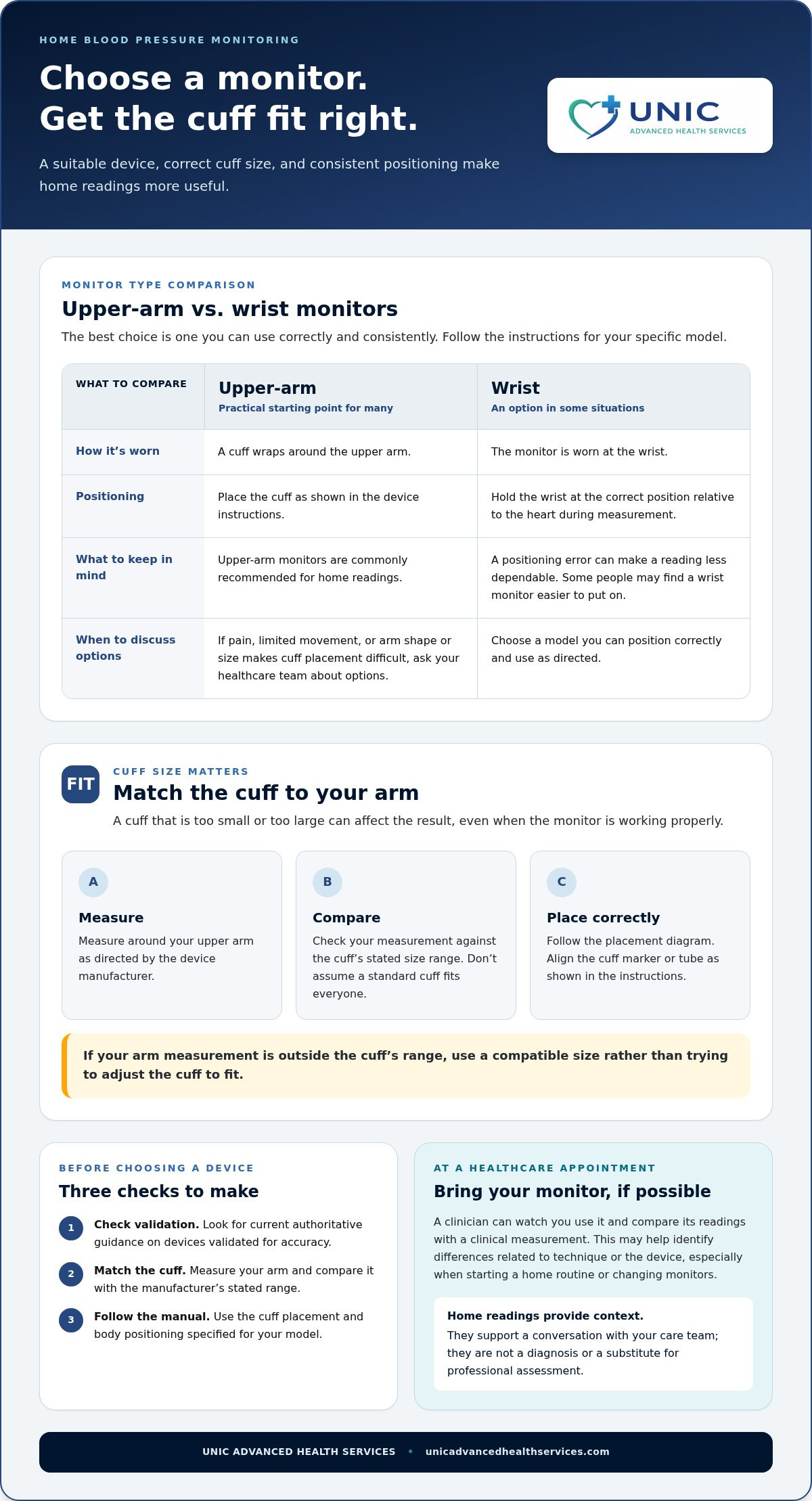
For many people, an automatic upper-arm monitor is a practical starting point. Wrist monitors may be an option when an upper-arm cuff is unsuitable, but positioning is especially important. Models and users can differ, so follow the instructions for your specific monitor rather than relying on a general rule.
Upper-arm or wrist monitor: which type may suit you?
Upper-arm monitors use a cuff around the upper arm and are commonly recommended for home readings. Wrist monitors can be easier to put on for some people, but the wrist generally needs to be held at the correct position relative to the heart during measurement. A positioning error can make a reading less dependable.
If pain, limited movement, or the shape or size of your arm makes cuff placement difficult, discuss options with your healthcare team. Choose a monitor you can use consistently and correctly. Check current authoritative device-validation guidance when selecting a model, and use the monitor’s instructions for setup and positioning.
How should a blood pressure cuff fit?
Measure around your upper arm as directed by the device manufacturer, then compare that measurement with the cuff’s stated size range. Don’t assume a standard cuff will fit everyone. A cuff that’s too small or too large can affect the result, even if the monitor is functioning properly.
When putting on the cuff, follow the placement diagram in the instructions. It should sit on the correct part of your arm, with its marker or tube aligned as shown. If your arm measurement falls outside the cuff’s range, use a compatible size rather than trying to adjust the cuff to fit. Correct fit is part of getting readings your care team can use.
- Check validation: Look for current authoritative guidance on devices validated for accuracy.
- Match the cuff: Measure your arm and compare it with the manufacturer’s stated range.
- Follow the manual: Use the cuff placement and body positioning specified for your model.
Bring your monitor to a healthcare appointment if you can. Your clinician can watch you use it and compare its readings with a clinical measurement. This may help identify differences related to technique or the device, especially when you’re starting a home routine or changing monitors.
If you’re managing hypertension in Fort Lauderdale or nearby communities, these details can make discussions through Manage Chronic Conditions more useful. A correctly fitted monitor and consistent technique give your care team clearer information to consider. You can discuss your readings and device during personalized hypertension care.
How to Take an Accurate Blood Pressure Reading at Home
A repeatable routine makes readings more useful to discuss with your healthcare team. Follow your monitor’s instructions and any timing guidance from your clinician. If you’re learning how to monitor blood pressure at home, use the same careful sequence each time instead of rushing to get a number.
Prepare your body and surroundings before measuring
Choose a quiet place where you can sit comfortably. For 30 minutes beforehand, avoid exercise, smoking, and caffeine, which can affect a reading. Empty your bladder, then sit quietly for five minutes before starting. Don’t talk or use your phone during the measurement. If your clinician has recommended a particular schedule, follow it. Otherwise, ask what timing is appropriate for your care.
Use consistent posture and repeat the measurement
Settle into a supported position before placing the cuff. Keep your back against the chair, both feet flat on the floor, and your legs uncrossed. Rest your arm on a table or other support so the cuff is at heart level. Place the cuff on bare skin, not over clothing, and use the position shown in your device instructions.
Work through these steps in order:
- Get ready. Avoid exercise, smoking, and caffeine for 30 minutes, empty your bladder, and sit quietly for five minutes.
- Set your posture. Sit with your back supported, feet flat, and legs uncrossed. Rest your arm at heart level.
- Position the cuff. Put it on bare skin and align it as directed by the monitor’s instructions. Keep your arm supported.
- Take the first reading. Stay still and silent while the monitor measures. Follow any additional instructions for your specific device.
- Repeat and record. Wait one or two minutes, take a second reading, then write down both results.
Record the date and time with each pair of readings. Use the same arm and a similar routine each time unless your clinician advises otherwise. If the two results differ, keep both in your record instead of choosing the one you prefer or repeating measurements until you see a particular number. Your healthcare team can review the pattern and help decide what it means.
Consistency matters more than trying to create a perfect reading. If you miss a step or get interrupted, note anything that may have affected the measurement and return to your usual routine at the next scheduled time. Don’t change medication or diagnose yourself based on a home measurement alone. Share concerns and your record with your healthcare professional.
Track Readings and Manage High or Inconsistent Results
A home blood pressure log turns separate measurements into information your healthcare team can review over time. Use a paper notebook or a digital record, whichever makes it easier to capture results consistently. Follow the schedule your clinician recommends. The right frequency can vary, so don’t add extra checks or change your routine without guidance if the readings are making you anxious.
What should a useful blood pressure log include?
For each measurement session, record the date, time, and both readings, including the systolic and diastolic numbers from each. Keep the first and second results separate rather than averaging them yourself. Add brief context only when it may help explain the measurement, such as a missed rest period or an interruption. Avoid trying to interpret every change in the moment.
Bring the log and, when practical, your monitor to appointments. Reviewing the results together helps your clinician compare home measurements with other clinical information and consider whether a pattern needs attention. A clear record is more helpful than relying on memory or sharing only the reading that seems most concerning.
What if readings are high, low, or different each time?
Pause before reacting to an unexpected result. Check that you’re seated as instructed, your cuff is positioned correctly, and you’ve had time to rest. If your routine was disrupted, note that context and repeat the reading according to your clinician’s instructions. Continue recording both results. Repeated patterns are generally more informative than a conclusion drawn from one measurement, but persistent concerns deserve professional guidance.
Don’t stop, skip, or adjust prescribed medication based on a home reading unless your healthcare professional tells you to. If readings are repeatedly outside the range your care team has discussed with you, contact them for individual advice. They can interpret the log and determine whether your care plan needs review.
Know the urgent threshold. The American Heart Association advises that a reading higher than 180 systolic and/or 120 diastolic requires immediate attention. If you get a result in this range, wait at least one minute and take another reading. If it remains that high, contact a healthcare professional immediately. If the high reading occurs with symptoms such as chest pain, shortness of breath, weakness, numbness, vision changes, or difficulty speaking, call 911. Don’t wait for another measurement to seek emergency help when these symptoms are present.
If you’re tracking hypertension in Fort Lauderdale or nearby communities, a well-kept log can support personalized care through Manage Chronic Conditions. You can discuss your readings with Unic Advanced Health Services.
When to Discuss Home Blood Pressure Monitoring with a Fort Lauderdale Care Team
A home record is most useful when it becomes part of a conversation with a healthcare professional. Bring it to a preventive care appointment or a visit about blood pressure, especially if you’ve been asked to track readings, have questions about your results, or are following an existing care plan. If you’re unsure how often to measure, ask your clinician for a schedule that fits your needs.
Knowing how to monitor blood pressure at home helps you collect information, while professional review puts it in context. A clinician can consider repeated readings alongside your health history, medications, symptoms, and other clinical information. Together, you can discuss whether the readings suggest a pattern and what follow-up, if any, is appropriate.
What should you bring to a blood pressure appointment?
Bring your monitor, its cuff, and a recent record of readings. Include the times you measured and note anything that could help explain an unusual result, such as difficulty positioning the cuff. If you’re unsure about your posture, cuff placement, or how to use the device, demonstrate your usual routine so the care professional can address specific questions.
- Your device and cuff: These allow the care professional to see what you’re using and review your technique.
- Your record: A dated log helps show how readings have varied over time.
- Your questions: Note concerns about timing, measurement, or what to do with results between appointments.
There’s no need to interpret the record before the visit. Its purpose is to give your care team a clearer picture than memory or a single measurement can provide. Ask how the information fits your care plan and when to follow up about changes or concerns.
How can ongoing hypertension care help in Fort Lauderdale?
Unic Advanced Health Services provides personalized care for hypertension through Manage Chronic Conditions in Fort Lauderdale and surrounding South Florida communities. Nurse practitioner Marc Joseph can consider your home readings alongside your health history and other relevant clinical information when discussing ongoing care. Care coordination can help bring relevant information together.
On-Site Lab Services can support chronic-condition monitoring and diagnostic care plans as part of your care. They’re one part of care, not a replacement for your home log or a professional review of your readings. Your clinician can help determine what information is relevant to your individual plan and how monitoring fits into follow-up.
If you have a home log ready, bring it to a visit and discuss what the pattern may mean for your care. You can learn about hypertension care at Unic Advanced Health Services.
Make Your Next Reading Part of a Bigger Care Plan
Home monitoring is most valuable when it helps you take an informed next step, not when you feel responsible for interpreting every number alone. Use your readings to start a conversation about what matters for your health and what follow-up makes sense. The goal of learning how to monitor blood pressure at home is to collect useful information that supports care, not to manage a condition without guidance.
At Unic Advanced Health Services, personalized care through Manage Chronic Conditions can put your readings into the context of your individual health needs. When appropriate, On-Site Lab Services can also support chronic-condition monitoring and diagnostic care plans. Your care team can help you understand how these elements fit together.
If you’re ready to discuss your blood pressure readings and next steps, call Unic Advanced Health Services at (954) 767‑0228 or connect with the care team.
Frequently Asked Questions
Can stress cause a temporarily high blood pressure reading?
Yes. Stress or feeling rushed may affect a measurement, but don’t assume stress alone explains repeated high readings. If you feel tense, sit quietly, then repeat the measurement using your usual careful technique. Record both results and note that you felt stressed or hurried. If elevated readings recur or continue to concern you, share the log with a healthcare professional rather than trying to interpret the pattern on your own.
Should I measure my blood pressure in both arms?
Follow your healthcare professional’s instructions, particularly if readings in both arms haven’t previously been compared. Don’t use a difference between arms to diagnose yourself or decide on treatment. Note which arm you used for each measurement so readings remain consistent and easier to compare. If you notice a noticeable, repeated difference between arms, bring that information to your care team and ask how you should measure going forward.
Can I take my blood pressure over clothing?
Generally, place the cuff on bare skin and follow your monitor’s instructions. Fabric can interfere with correct cuff placement or the measurement. Avoid pushing a tight sleeve up your arm, since it may constrict the area. If you realize you measured over clothing or a bunched sleeve, don’t rely on that result as your only reading. Remove the clothing from beneath the cuff, reposition it as instructed, and repeat the measurement.
Does one high home blood pressure reading mean I have hypertension?
No. One high measurement doesn’t establish a diagnosis, and preparation, posture, cuff fit, or timing may influence a result. Repeat the measurement using the recommended technique, record it, and follow any instructions your healthcare professional has given you. A clinician can assess readings in context and determine whether further evaluation is appropriate. Don’t start, stop, or adjust prescribed medication based on an isolated result without professional guidance.
What should I do if my home readings are consistently different from clinic readings?
Bring your home monitor and reading log to an appointment so your healthcare professional can review the pattern, measurement technique, and circumstances surrounding each reading. For example, note whether the home measurement was taken at a different time than the clinic visit. Differences don’t establish a diagnosis or mean your treatment should change. A clinician can assess both sets of measurements alongside your health history and advise you on next steps.
When should I seek urgent help for a high home blood pressure reading?
Follow any emergency instructions from your healthcare professional. The American Heart Association advises that a reading higher than 180 systolic and/or 120 diastolic should be repeated after at least one minute. If it remains that high, seek immediate medical attention. If a concerning reading occurs with chest pain, shortness of breath, weakness, numbness, vision changes, or difficulty speaking, call 911. Don’t wait for a routine appointment when urgent symptoms are present.