
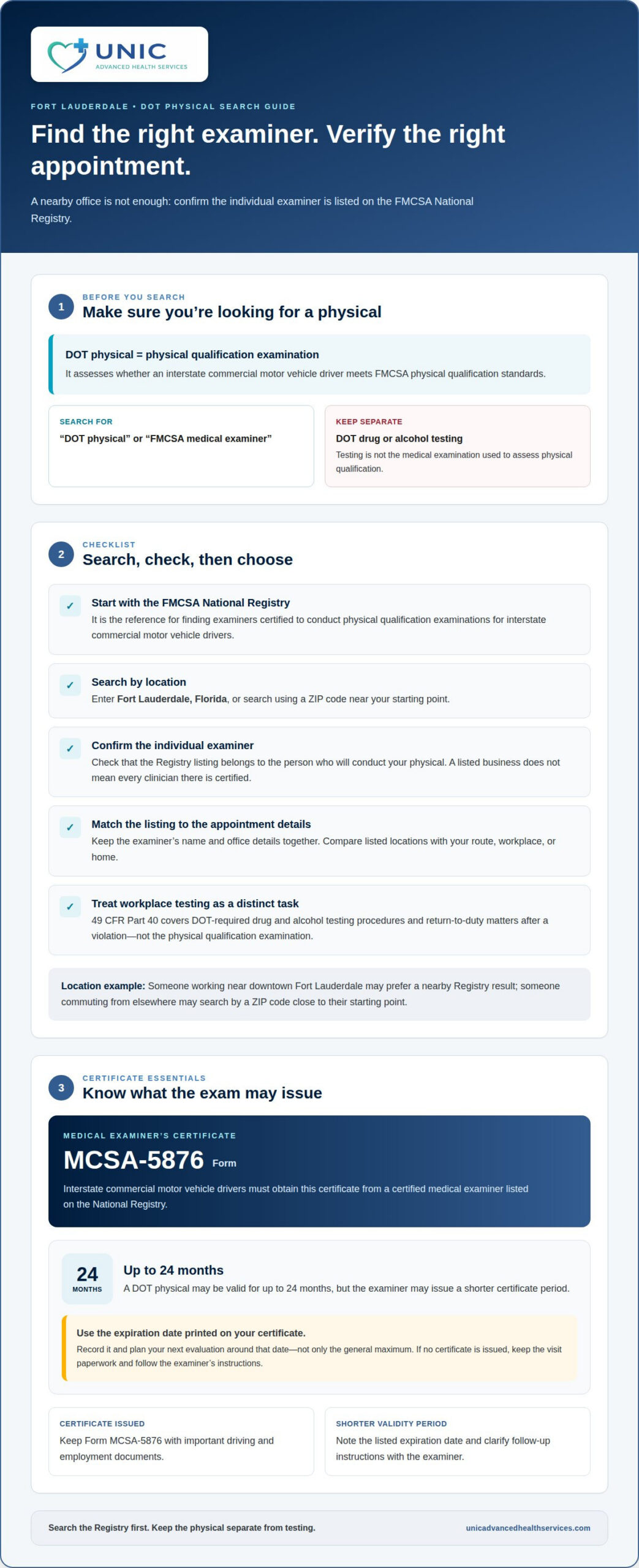
A nearby appointment is only useful if the examiner is FMCSA-certified. If you’re finding an FMCSA certified medical examiner near me in Fort Lauderdale, start with the National Registry and search by city and state or ZIP code. A certified examiner listed there can issue a Medical Examiner’s Certificate, Form MCSA-5876; according to the Federal Motor Carrier Safety Administration, a DOT physical exam is valid for up to 24 months, though the examiner may issue a shorter certificate period.
It’s understandable to want a straightforward way to find an examiner and know what to expect from the paperwork. This guide explains how to search the National Registry by location or, if you have the details, by an examiner’s name or business name. You’ll also learn what the medical examiner’s certificate confirms and how its validity period can affect your next steps. With this information, you can narrow your search and prepare for your DOT physical with greater confidence.
Key Takeaways
- Search the National Registry by city and state or by ZIP code to find certified medical examiners near Fort Lauderdale.
- Use Advanced Search to narrow results with an examiner’s name, business name, or National Registry number.
- According to the Federal Motor Carrier Safety Administration, interstate CMV drivers must obtain Form MCSA-5876 from a certified examiner listed on the National Registry.
- A DOT physical exam may be valid for up to 24 months, but the medical examiner can issue a certificate for a shorter period.
Finding a local DOT physical provider
- First, identify the examination you need. An interstate commercial motor vehicle driver’s physical qualification examination assesses whether the driver meets FMCSA physical qualification standards. A DOT physical is different from a DOT drug or alcohol test. Keeping that distinction clear helps you search for the right appointment in Fort Lauderdale, Florida. Search for a “DOT physical” or “FMCSA medical examiner,” rather than drug testing. Start with the specific examination you need, not a broad request for occupational health care.
- Use the FMCSA National Registry to find a certified medical examiner. Search by city and state, entering Fort Lauderdale and Florida, or use a ZIP code near your starting point. The Registry is the key reference for finding examiners certified to conduct physical qualification examinations for interstate commercial motor vehicle drivers. A general web search may show nearby medical offices, but proximity alone does not establish FMCSA certification. Start with the Registry, then consider which listed location is practical for you.
- Review the examiner’s Registry listing before arranging your visit. Confirm that the listed name belongs to the person who will conduct your physical, rather than assuming every clinician at a listed business is certified. Use the business name and examiner details to distinguish an office from an individual examiner. If several results serve the Fort Lauderdale area, compare their locations with your route, workplace, or home. This helps you choose a convenient destination while keeping certification central to your decision.
- Keep physical qualification separate from drug and alcohol testing. According to the Electronic Code of Federal Regulations, 49 CFR Part 40 sets procedures for DOT-required drug and alcohol testing and for returning employees to safety-sensitive duties after a violation. Those procedures concern testing and return-to-duty matters; they aren’t the same as the medical examination used to assess physical qualification. If your employer has given you separate instructions about testing, treat those as a distinct task. For the physical, focus your search on an examiner listed on the FMCSA National Registry.
- Choose a reachable location and plan your next steps around the appointment. For example, a driver who works near downtown Fort Lauderdale may prefer a Registry result nearby, while someone commuting from elsewhere may search using a ZIP code close to their starting point. Keep the examiner’s name and office details together so you can match the Registry listing with your appointment information. Before your physical, gather relevant health information and review any instructions you’ve received. A clear plan helps prevent mix-ups between the medical visit, Registry search, and separate workplace testing.
The physical qualification examination assesses whether a commercial driver meets FMCSA physical qualification standards. It is separate from a DOT drug or alcohol test.
Medical examiner’s certificates
If the examination finds that you don’t meet FMCSA physical qualification standards, you won’t receive a certificate from that examination. If you receive a certificate with a shorter validity period, use its expiration date to plan your next evaluation.
- Understand what the certificate represents. Interstate commercial motor vehicle drivers must obtain a Medical Examiner’s Certificate, Form MCSA-5876, from a certified medical examiner listed on the National Registry, according to the Federal Motor Carrier Safety Administration. The document follows a physical qualification examination. It records the outcome relevant to the driver’s qualification, rather than serving as a general-purpose health record. Keep the form with your important driving and employment documents so you can find it when needed.
- Check the certification period printed on your form. According to the Federal Motor Carrier Safety Administration, a DOT physical exam is valid for up to 24 months, although a medical examiner may issue a certificate for a shorter period. The maximum period doesn’t mean every driver receives that duration. Read the expiration date on your own certificate and use that date when planning ahead. For example, if your form expires earlier than 24 months, treat the printed date as your next deadline.
- Record the expiration date after receiving the certificate. Add it to a personal calendar or another system you use for work documents. Include a reminder before the listed date so you have time to arrange another examination. This practical step matters most when a medical examiner issues a shorter certificate. A driver who tracks only the general 24-month maximum could overlook an earlier date specific to their form.
- Ask the examiner to explain the result and any follow-up instructions during your visit. The examiner determines whether you meet FMCSA physical qualification standards. If your certificate covers a shorter period, note its expiration date and clarify when to plan your next evaluation. Keep relevant health records and current information available for that conversation. For example, if you manage an ongoing condition, bring the details needed to discuss it accurately with the medical examiner.
- If you don’t receive a certificate, clarify what the examination found and what next steps apply to your situation. The outcome depends on whether the examiner determines that you meet the physical qualification standards. Don’t treat the absence of a certificate as one with a routine expiration date. Keep any paperwork from the visit and follow the examiner’s instructions about further evaluation or additional information needed.
- Keep the certificate’s purpose separate from other workplace records. Form MCSA-5876 concerns the medical examiner’s physical qualification determination. It doesn’t replace an employer’s separate instructions or other documentation unrelated to that determination. When organizing your records, label the certificate clearly and retain its date alongside your other driving documents. This makes it easier to distinguish the medical form from routine health records and to identify the date that controls your next physical.
Interstate commercial motor vehicle drivers need a Medical Examiner’s Certificate, Form MCSA-5876, after an examination by a medical examiner certified on the FMCSA National Registry. The certificate can be valid for up to 24 months or for a shorter period; if the examiner finds that you don’t meet FMCSA physical qualification standards, you won’t receive one. The section does not identify specific disqualifying conditions.
Searching for certified examiners by location or name
- Open the FMCSA National Registry search and start with a location you know. Enter Fort Lauderdale, Florida, in the city and state fields. This narrows your search to a specific place instead of relying on broad terms such as “DOT doctor.” If you’re planning from work or home, choose the location you’ll travel from. Keep the city and state consistent so you can distinguish these results from those for another area.
- Search by ZIP code for a more precise location. The National Registry allows searches by ZIP code as well as by city and state. Enter the code that best matches your starting point, such as your home or workplace. To compare locations, search each relevant ZIP code separately and note which search produced each result. This makes it easier to compare examiner listings without assuming a city-wide search reflects your preferred travel area.
- Use Advanced Search when you know an examiner’s name. You can enter the medical examiner’s first and last name. Include both names when available, then compare the result with the spelling you have. A partial or misspelled name may make it harder to identify the right listing. If you know only part of the name, use the location fields to narrow the search rather than guessing the rest.
- Enter the examiner’s National Registry number in Advanced Search if you have it. This gives you a direct identifier to use alongside a name or location search. Copy the number carefully, keeping its characters in the same order. For example, if your employer provides an examiner’s name and Registry number, search those details rather than relying on the business name alone. The number can help distinguish examiners with similar names.
- Search by business name if you know the medical office but not the examiner’s full name. Advanced Search lets you enter a business name, helping you connect an office with its Registry listing. Enter the name as you know it, then compare the examiner information in the result with your appointment details. A business name and an individual examiner are different identifiers. To identify who will conduct your physical, use the person’s name or Registry number.
- Compare results against the exact details you entered. Match the examiner’s name, Registry number, business name, and location wherever available. If you searched for Fort Lauderdale, Florida, keep that location in view while reviewing names returned through Advanced Search. This helps prevent mistaking a familiar business name for confirmation of an examiner’s identity. Record the name and identifying details together so you can refer to the same listing while arranging your appointment.
- If your first search doesn’t locate the person you expected, change one detail at a time. Switch from city and state to a ZIP code, or from a business-name search to the examiner’s first and last name. If you have the National Registry number, use it instead of trying guessed spellings. Changing one field at a time helps you see which detail narrows the results and keeps your Fort Lauderdale-area search organized.
How soon can I get an appointment for a DOT physical near me?
- Start with your deadline and the expiration date on your current medical certificate, if you have one. The date helps you decide how far ahead to plan. Begin your search before the final day, and note any work schedule, travel, or other commitments that affect when you can attend. These details help you focus on appointment options that fit your calendar.
- Use the National Registry to identify certified examiners serving Fort Lauderdale, Florida. Search by city and state or ZIP code, then record the examiner’s name and location. A focused list makes it easier to consider practical destinations. If your first search returns few options, try another ZIP code that fits your commute. Keep the certified-examiner requirement central as you compare appointment locations.
- Consider how flexible you are about the appointment date and location. A driver able to visit different parts of Fort Lauderdale may have more options than someone limited to one neighborhood. Factor in travel time, work shifts, and the days you can attend. Write down acceptable dates and nearby locations before arranging your visit. This gives you a clear basis for choosing an available appointment that works for you.
- Prepare relevant information for your DOT physical before the appointment. Gather current health details, medication information, and records you need to discuss with the examiner. If you manage a chronic condition, organize related information so you can describe it clearly. Preparation helps keep the visit focused on the examination rather than searching for basic details. Follow the instructions provided for your appointment and bring the requested materials.
- Plan for the examination outcome as well as the appointment date. The medical examiner assesses whether you meet FMCSA physical qualification standards and determines the certificate period, when applicable. A certificate may be issued for less than the maximum validity period, so note the expiration date on your form. If the examiner needs to evaluate health information, that may affect your next steps after the visit. Leave room in your schedule to manage any follow-up.
- Once you have identified a suitable appointment option, save its date, location, and examiner details together. Add the appointment to your calendar and set a reminder to gather your paperwork. If your current certificate has an expiration date, keep that date visible while planning. For a DOT physical in Fort Lauderdale, you can schedule a DOT physical examination as your next step.
Set a reminder to confirm your visit and review any instructions before you go. Keep the examiner’s contact details with your appointment information so you can check practical details if needed.
In the United States, an applicant must pass the exam and have their medical license validated before FMCSA may certify them to conduct physical qualification examinations of interstate commercial motor vehicle drivers. To become an FMCSA-certified medical examiner, a healthcare professional must be licensed, certified, or registered to perform physical examinations under applicable state laws and regulations. This is why it’s important to check the Registry when planning your appointment. After the visit, allow for the required reporting process: the Federal Motor Carrier Safety Administration says FMCSA-certified medical examiners must submit the results of every interstate CMV driver physical qualification examination by midnight local time on the next calendar day after the examination. Keep your appointment information and any visit documents together for reference as you arrange next steps.
Unic Advanced Health Services: DOT Physical Examination
Unic Advanced Health Services offers DOT Physical Examination for drivers preparing for a commercial motor vehicle physical. After identifying an examiner through the National Registry, this is a practical next step for arranging the medical evaluation. Bring relevant health information and follow any instructions provided for your appointment. If you also need care for an ongoing health condition, the practice offers Chronic Condition Management. Its U.S. Coast Guard (USCG) Boat Captain Physical serves a different occupational examination need. Choose the service that matches your role and the examination you’re preparing for. For help with a DOT physical, contact Unic Advanced Health Services to discuss your next step.
Make your next step a clear one
Finding an FMCSA-certified medical examiner near you is easier when you turn the Registry results into a practical plan. Choose a location that fits your schedule, gather the health information you’ll need, and keep your certificate date in view. If you’re ready to arrange a physical in Fort Lauderdale, Unic Advanced Health Services offers DOT Physical Examination. It also offers U.S. Coast Guard (USCG) Boat Captain Physical and Chronic Condition Management for patients with ongoing health needs.
A thoughtful appointment plan can help you approach the examination prepared, with relevant information at hand and time to understand the next steps. For help moving forward, contact Unic Advanced Health Services. Taking one step at a time can make the process feel more manageable.
Frequently Asked Questions
How do I find an FMCSA-certified medical examiner near me using the National Registry?
Search the FMCSA National Registry by city and state or ZIP code, using Fort Lauderdale, Florida, or a nearby ZIP code. Review the results and note the examiner’s name and business details. If you have an examiner in mind, use Advanced Search to search by name or business. Compare the listing with your appointment information to identify the examiner conducting your physical.
What information do I need to search for a certified DOT medical examiner by ZIP code?
You need the ZIP code for the area where you want to find an examiner. Choose one near your home, workplace, or usual route through Fort Lauderdale, then enter it in the National Registry search. You can start a location search without knowing an examiner’s name. If the results don’t match your preferred area, try another nearby ZIP code and compare the locations.
How can I verify that a medical examiner is currently listed on the FMCSA National Registry?
Look up the examiner in the National Registry and match the result to the person named for your appointment. Compare the name’s spelling and, if available, the examiner’s National Registry number and business name. These details help distinguish an individual examiner from an office or someone with a similar name. Use the Registry listing, rather than an office’s general description, to confirm the examiner’s listing.
How long is a DOT medical certificate valid, and when must I renew it?
According to the Federal Motor Carrier Safety Administration, a DOT physical exam is valid for up to 24 months, but an examiner may issue a certificate for a shorter period. Use the expiration date printed on your Medical Examiner’s Certificate as your personal planning date. For example, if your form shows an earlier date, arrange your next physical before that date rather than planning around the maximum period.