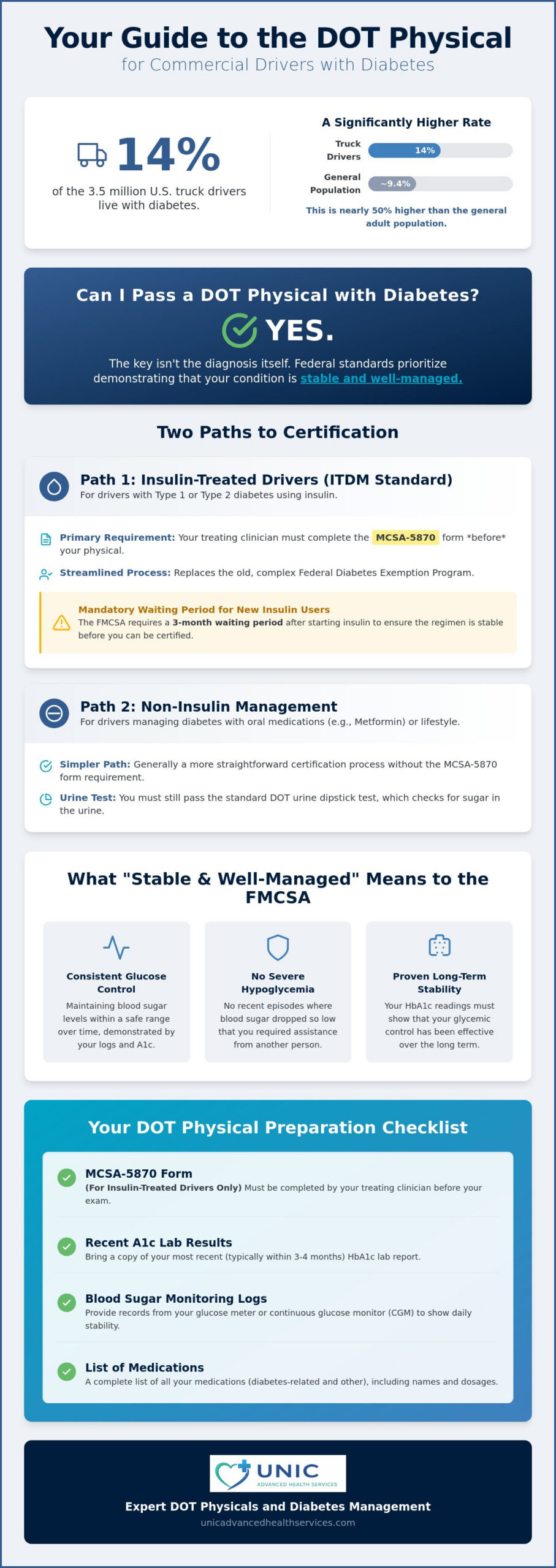
Did you know that approximately 14% of the 3.5 million U.S. truck drivers live with diabetes, a rate nearly 50% higher than the general adult population? If you’re managing this condition, preparing for a DOT physical for drivers with diabetes often brings a sense of unease. It’s stressful to worry that a medical exam could suddenly stall your career, especially when the federal regulations and paperwork feel like a moving target.
We understand that your CDL is your livelihood, and we believe clinical oversight should be a support system rather than a barrier. This guide will show you exactly how to navigate the FMCSA standards and secure your medical certificate without risking your future on the road. You’ll find a clear checklist of required forms, an explanation of the 2026 National Registry II updates, and the confidence you need to pass your next physical with ease.
Article at a Glance:
Drivers with Type 1 or Type 2 diabetes can successfully pass their medical exam by demonstrating that their condition is stable and well-managed. The core requirement for a DOT physical for drivers with diabetes involves proving clinical stability through specific federal documentation rather than simple medical summaries.
Insulin-treated drivers must adhere to the ITDM standard, which requires the MCSA-5870 form to be completed by a treating clinician. It’s important to remember that new insulin users face a mandatory three-month waiting period before they can be certified for commercial driving.
Those managing diabetes with oral medications like Metformin often have a simpler certification path, though they must still pass the DOT urine dipstick test. Arriving with a complete checklist of medical evidence ensures that administrative hurdles don’t stall your career.
At Unic Advanced Health Services in Fort Lauderdale, Marc Joseph (NP) provides specialized oversight and on-site lab services. This collaborative approach ensures you meet 2026 FMCSA requirements while maintaining your long-term health and professional livelihood.
Can I Pass a DOT Physical with Diabetes in 2026?
Drivers often worry that a diabetes diagnosis means the end of their commercial driving career. However, you can absolutely pass a DOT physical for drivers with diabetes regardless of whether you have Type 1 or Type 2. The key isn’t the diagnosis itself, but rather demonstrating that your condition is stable and well-managed. In 2026, federal standards prioritize your actual clinical health data over the mere presence of a chronic disease. Whether you manage your condition with oral medication, lifestyle changes, or insulin therapy, the goal remains your safety and the safety of the public.
This modern approach is designed to evaluate your medical fitness to practice without creating unnecessary barriers to your livelihood. If your blood sugar or A1c levels aren’t where they need to be on the day of your exam, don’t panic. Examiners often issue a temporary medical hold instead of a flat disqualification. This pause gives you a window to work with your healthcare provider, adjust your treatment plan, and return for your medical certificate once your numbers are within a safe range.
To better understand how these standards apply specifically to insulin-dependent drivers, watch this helpful video:
The Shift from Exemptions to Standards
The process for insulin users has become much more straightforward. Years ago, drivers had to navigate the complex Federal Diabetes Exemption Program, which involved lengthy waiting periods and significant administrative hurdles. That program is now retired. The current Insulin-Treated Diabetes Mellitus (ITDM) standard simplifies your path to certification by putting more authority in the hands of your treating clinician. Your primary doctor now completes the essential MCSA-5870 form, providing the medical examiner with the professional assurance that your diabetes is under control before you even step into the clinic.
Defining “Stable and Well-Managed” for FMCSA
When we evaluate a DOT physical for drivers with diabetes, we look for more than just a single blood sugar reading. The FMCSA’s primary concern is preventing sudden incapacitation on the road, specifically from severe hypoglycemic episodes. These are events where blood sugar drops so low that you require help from another person to recover. To meet federal requirements, stable management is defined as the consistent maintenance of blood glucose levels that avoid severe hypoglycemia and are supported by HbA1c readings that demonstrate long-term glycemic control. We look for a pattern of stability over time, ensuring you can safely manage the physical demands of long-haul driving.
The ITDM Standard: Requirements for Insulin-Treated Drivers
The Insulin-Treated Diabetes Mellitus (ITDM) standard represents a significant shift in how the FMCSA manages road safety. Under the 2018 Final Rule on Diabetes Standard, drivers who use insulin no longer need to apply for a federal exemption. Instead, the process is handled directly during your DOT physical for drivers with diabetes through a collaborative assessment between your treating clinician and a Certified Medical Examiner (CME). This standard applies equally to drivers with Type 1 and Type 2 diabetes. The focus is not on the insulin itself, but on ensuring your treatment prevents sudden, incapacitating blood sugar drops while you are behind the wheel.
If you have recently started using insulin, you must be aware of the mandatory three-month waiting period. The FMCSA requires this time to establish that your new medication regimen is stable and that you aren’t experiencing adverse reactions. During this period, you cannot be medically certified to operate a commercial vehicle. Once this window passes, your CME will review your specialist’s notes and glucose data to confirm you meet the necessary safety thresholds. If you are preparing for your first exam under these rules, booking a DOT physical examination with a provider who understands these nuances can save you from unnecessary delays.
Navigating Form MCSA-5870
The Insulin-Treated Diabetes Mellitus Assessment Form, or MCSA-5870, is the most critical document for your certification. Your treating clinician, the doctor who manages your diabetes, must complete this form in its entirety. Timing is vital. The form must be signed and provided to your medical examiner within 45 days of its completion. If the form is older than 45 days, it is considered expired, and you will need a new one. Common delays occur when clinicians skip sections regarding hypoglycemic history or fail to provide a clear statement on your ability to safely operate a vehicle.
Blood Sugar Monitoring and Logbooks
You must provide evidence of consistent blood sugar monitoring. Most drivers now use electronic glucose monitoring systems, which provide a digital record of their levels. For your first ITDM certification, you generally need to provide at least three months of data. If you use a manual logbook, it must be legible and accurate. Never attempt to “fill in” or guess your readings at the last minute. This practice, often called logbook padding, is a major red flag for medical examiners and can lead to an immediate denial of your medical certificate.
Non-Insulin Diabetes Management and DOT Certification
Managing diabetes with oral medications or diet alone generally allows for a more straightforward certification process. Unlike those who must submit the FMCSA Insulin-Treated Diabetes Mellitus Assessment Form, drivers on oral agents like Metformin don’t face the same level of federal assessment hurdles. However, the condition must still be documented accurately on your Medical Examination Report (MER). Even if you’re diet-controlled, the examiner needs to see that your blood sugar remains within a safe range. This ensures you won’t experience sudden fatigue or vision changes while operating a commercial vehicle.
Every DOT physical for drivers with diabetes includes a mandatory urine dipstick test. This screen checks for the presence of glucose, which can be a sign of “hidden” or undiagnosed diabetes. If glucose is found in your urine, it doesn’t mean an automatic disqualification. Instead, it signals that we need to investigate further to ensure your safety. Identifying a high sugar level during an exam is often the first step toward getting the clinical oversight you need to keep your CDL and protect your long-term health.
While a standard medical certificate often lasts two years, a diagnosis of diabetes frequently results in a one-year certificate. This isn’t a penalty. It’s a proactive safety measure to monitor your health more frequently. Annual checks ensure that your management plan is still effective and that your condition hasn’t progressed to a point where it might interfere with road safety. Regular oversight helps us catch potential issues before they become career-threatening problems.
HbA1c Targets for Commercial Drivers
Your HbA1c level provides a three-month average of your blood sugar, making it a critical metric for a DOT physical for drivers with diabetes. While the FMCSA doesn’t set a universal “fail” number, an A1c reading above 10% is typically a signal that your condition is not currently stable. High A1c levels are strongly correlated with long-term complications like nerve damage or vision loss, both of which directly impact your ability to safely operate heavy machinery. To keep your certification process moving, we provide on-site lab work Fort Lauderdale drivers can use to get immediate, accurate readings during their visit.
Medication Side Effects and Driving Safety
Oral medications are highly effective, but they can occasionally cause side effects that impact your driving performance. Some drugs might cause frequent urination, while others can lead to mild dizziness or gastrointestinal distress. It’s vital to disclose all medications, supplements, and over-the-counter aids you’re taking. Consistency in your medication routine is far more important than achieving a single “perfect” blood sugar reading on the day of the exam. We want to see that your body has adapted to your treatment and that you can maintain focus throughout a long shift without physical distraction.
For drivers who want to optimize their metabolic health and manage weight effectively, Helio Peptide offers physician-supervised telehealth programs, including GLP-1 and metabolic wellness therapies, to support a stable and healthy lifestyle on the road.
Your Preparation Checklist: Essential Documents for Drivers with Diabetes
Preparation is the most effective way to alleviate the anxiety often associated with a DOT physical for drivers with diabetes. Arriving at the clinic with the correct documentation ensures that your exam proceeds without administrative delays. Many drivers mistakenly believe that a general clinical summary from their doctor is sufficient. However, the FMCSA requires specific federal forms that provide a detailed analysis of your blood sugar stability and treatment history. Providing a generic medical note instead of the required documentation is a common reason for a temporary medical hold.
For drivers in South Florida, coordinating with a chronic care management nurse practitioner Fort Lauderdale can be a strategic advantage. Working with a specialist who understands both the clinical side of diabetes and the regulatory side of the DOT ensures that your paperwork is accurate before you even walk into the exam room. This proactive approach helps identify potential red flags in your glucose logs or A1c levels, allowing you to address them in a supportive clinical environment rather than during a high-stakes certification exam.
You’ll also need to complete the health history section of the Medical Examination Report (MER). This is often referred to as the “Self-Mastery” portion of the exam. It’s your opportunity to demonstrate that you are an active participant in your own care. Be prepared to discuss how you manage your diet, how you monitor your blood sugar on long shifts, and any symptoms you’ve experienced. Honesty in this section builds trust with your medical examiner and reinforces your standing as a safe, responsible commercial driver.
The 48-Hour Pre-Exam Countdown
The two days leading up to your DOT physical for drivers with diabetes are critical for ensuring your clinical data is optimal. Avoid high-sugar foods and excessive caffeine, as these can cause a temporary “spike” in your urine glucose levels. Stay well-hydrated with water to ensure your urine sample is clear and easy to analyze. Most importantly, verify that your MCSA-5870 form is signed and dated by your treating clinician within the last 45 days. If the signature is older than that, federal rules require a new assessment before you can be certified.
What to Bring to the Clinic
To ensure a smooth and efficient visit, please have the following items ready when you arrive for your appointment:
- A complete list of all current medications, including the exact dosage and the name of the prescribing physician.
- The full contact information for your treating diabetes specialist or primary care provider.
- Recent laboratory results, specifically your HbA1c readings from the last three to six months.
- Your prescription glasses or contact lenses if you use them for driving.
- A copy of your most recent Medical Examiner’s Certificate if you are renewing.
If you’re ready to secure your medical certificate with a provider who understands your unique health needs, schedule your DOT physical today at our Fort Lauderdale clinic.
Expert DOT Physicals and Diabetes Management in Fort Lauderdale
At Unic Advanced Health Services, we recognize that a DOT physical for drivers with diabetes is often the most stressful appointment on a driver’s calendar. Marc Joseph, an experienced autonomous nurse practitioner, approaches every examination as a collaborative partnership rather than a simple pass or fail assessment. By choosing an examiner who deeply understands chronic disease management, you gain a healthcare partner who looks at your long-term wellness alongside your immediate certification needs. This specialized perspective ensures that your diabetes management plan is robust enough to meet federal safety standards while supporting your everyday health on the road.
Efficiency is a cornerstone of our practice because we know that for commercial drivers, time is money. Our on-site laboratory services provide immediate clinical data, which eliminates the need for multiple trips to external testing centers for A1c checks or glucose screenings. This integrated approach reduces the back-and-forth that often delays certification. By utilizing modern digital record keeping, we also streamline your occupational health exam Fort Lauderdale, ensuring that your results are processed with the accuracy and speed that 2026 regulations demand.
Compassionate Care for Professional Drivers
We believe that every driver deserves to be treated with respect and professional empathy. The anxiety of a high-stakes medical exam can often lead to “White Coat Hypertension,” where blood pressure readings spike due to stress rather than underlying health issues. Our clinic environment is designed to be steady and calming to help you remain relaxed during your evaluation. We’re committed to keeping safe, capable drivers on the road through proactive management and clear communication. You aren’t just a number in a registry; you’re a professional whose livelihood we aim to protect through thorough, fair clinical oversight.
Scheduling Your Exam in Fort Lauderdale
Accessibility is vital for busy CDL holders who may be away from home for days or weeks at a time. To accommodate your demanding schedule, we offer convenient Monday through Saturday office hours, including Saturday appointment availability specifically for working drivers. If you have questions about your documentation or current management plan before your physical, you can use our telehealth Fort Lauderdale services for a pre-exam consultation. This virtual option allows us to review your paperwork and glucose logs from the comfort of your home or cab, ensuring you’re fully prepared before you arrive at the clinic. Don’t let paperwork or health anxiety stall your career. Book your stress-free DOT physical for drivers with diabetes today and experience a higher standard of supportive care.
Securing Your Professional Future on the Road
Your CDL represents your hard work and your dedication to the road. Navigating a DOT physical for drivers with diabetes doesn’t have to be a source of anxiety when you’re equipped with the right information and a supportive medical partner. By understanding the 2026 ITDM standards and maintaining precise clinical documentation, you can continue your commercial driving career with complete confidence. Stability and proactive management are the keys to maintaining your medical fitness to practice.
At Unic Advanced Health Services, we’re dedicated to helping you meet federal requirements while prioritizing your overall wellness. Our clinic is led by Marc Joseph, an experienced autonomous nurse practitioner who specializes in chronic care management. We provide an on-site lab for instant A1c checks to save you time and offer Saturday appointments to fit your demanding schedule. We believe that with the right preparation and clinical support, your health will always be an asset to your career rather than a hurdle.
Schedule Your Stress-Free DOT Physical in Fort Lauderdale today. You’ve worked hard for your livelihood, and we’re here to help you protect it.
Frequently Asked Questions
Can I get a 2-year DOT medical certificate if I have diabetes?
Usually, drivers managing diabetes with medication receive a certificate for one year rather than two. This annual requirement ensures your condition remains stable and your treatment plan is effective for safe driving. While diet-controlled drivers might sometimes qualify for longer periods, the standard practice for a DOT physical for drivers with diabetes is a 12-month renewal to protect your health and public safety.
What happens if glucose is found in my urine during the DOT physical?
Detecting glucose in your urine isn’t an automatic failure, but it does require immediate follow-up. The examiner will typically perform a blood glucose test or request a recent HbA1c lab to determine your current sugar levels. This finding often signals that your diabetes isn’t currently well-managed. We use these results to decide if you can be certified immediately or if you need a temporary hold to adjust your treatment.
Is Type 1 diabetes an automatic disqualification for CDL drivers?
Type 1 diabetes is absolutely not an automatic disqualification for commercial drivers. Under the current federal ITDM standard, drivers with Type 1 diabetes are eligible for certification as long as their condition is stable. You’ll need to provide the MCSA-5870 form from your treating clinician to prove you haven’t had severe hypoglycemic episodes. The goal is to ensure you can safely operate a vehicle, regardless of your diabetes type.
How often do I need to see my treating clinician if I am on insulin?
You must visit your treating clinician at least once every 12 months for a comprehensive evaluation. This visit is necessary to complete the mandatory MCSA-5870 assessment form required for your medical certificate. Keep in mind that this form must be signed within 45 days of your actual DOT exam. Regular check-ups between these annual evaluations are also recommended to ensure your glucose levels stay within the required safety ranges.
What is the maximum HbA1c level allowed for a DOT physical?
The FMCSA doesn’t mandate a specific maximum HbA1c level, but most medical examiners view a reading above 10% as a sign of poor management. If your A1c is significantly high, it suggests a greater risk for long-term complications that could impair your driving. In these cases, an examiner might issue a shorter, 3-month certificate, giving you time to work with your doctor and specialists—including a podiatrist near me for foot health—to lower your levels and demonstrate improved stability.
Can a nurse practitioner perform a DOT physical for a driver with diabetes in Florida?
Yes, a Certified Medical Examiner who is a nurse practitioner can perform these exams in Florida. At our clinic, Marc Joseph (NP) provides specialized DOT physical for drivers with diabetes. As an autonomous provider, he has the authority to review your specialist’s findings and issue your medical certificate. Choosing a nurse practitioner who understands chronic care management ensures you receive a thorough and supportive evaluation that considers your total health.
What should I do if my diabetes medication changes between DOT exams?
If your medication changes, especially if you start using insulin, you should consult your medical examiner before your next physical. Starting insulin triggers a mandatory 3-month waiting period to ensure you don’t have adverse reactions. For non-insulin changes, it’s still wise to keep a record of the new dosage and prescribing doctor. Disclosing these changes early prevents surprises and potential delays when it’s time for your certificate renewal.
Do I need a special waiver from the FMCSA for my diabetes in 2026?
You don’t need a special federal waiver or exemption for diabetes in 2026. The FMCSA retired the old exemption program several years ago in favor of the ITDM standard. Now, the process is streamlined. Your qualification is determined by your medical examiner based on the clinical data provided by your treating physician. This change has made it much faster and easier for safe, well-managed drivers to maintain their commercial driving careers.