
What if the form you complete during a DOT physical isn’t the same document you carry as proof of certification? If you’re asking what is the DOT medical long form (MCSA-5875), the key distinction is that it documents the examination, while the Medical Examiner’s Certificate is a separate document.
It’s understandable to have questions about what the long form asks or whether your medical history could affect the outcome. The MCSA-5875 records health history and the examiner’s findings. Sharing accurate details helps the examiner assess your fitness to drive. A condition or medication, by itself, doesn’t mean you won’t be certified.
This article explains the form’s purpose, how it differs from the Medical Examiner’s Certificate, Form MCSA-5876, and what to expect when completing the medical history section. You’ll also find practical steps for gathering information before your appointment so you can discuss your health clearly and feel prepared for the exam.
Key Takeaways
- Learn what is the DOT medical long form (MCSA-5875) and why it’s used during a DOT medical examination.
- See how the examination report differs from the MCSA-5876 Medical Examiner’s Certificate.
- Understand how health history and medication details inform the examiner’s evaluation without automatically determining the outcome.
- Use a simple preparation checklist to gather accurate information and relevant medical records before your exam.
- Find out what may happen after the examiner reviews the form, including when additional information could be needed.
What Is the DOT Medical Long Form (MCSA-5875)?
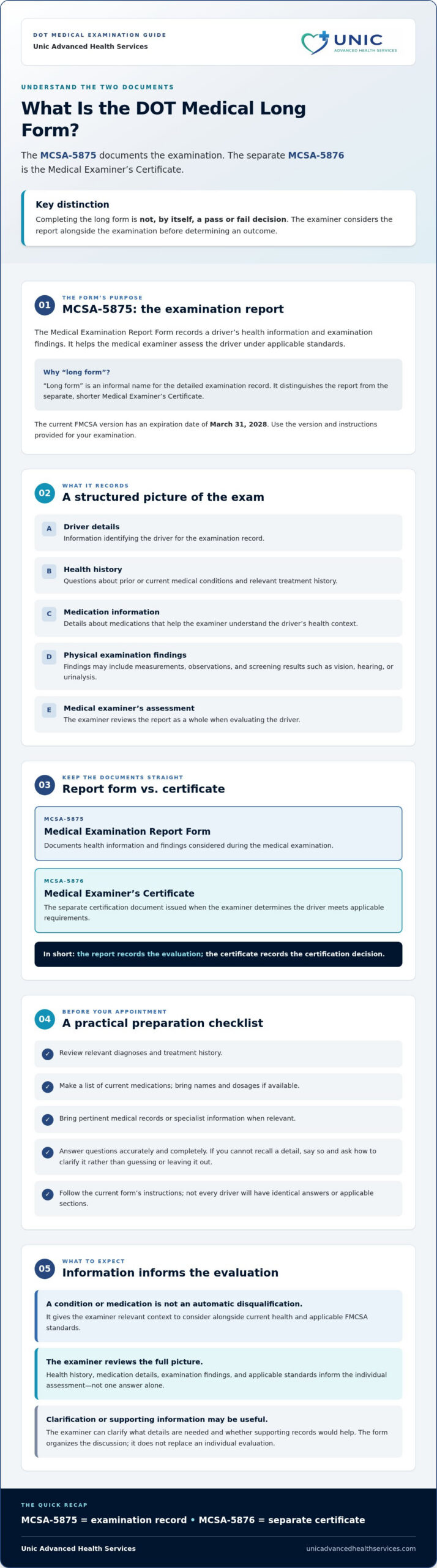
The MCSA-5875 is the Medical Examination Report Form used to document a driver’s DOT medical examination. It records health information and examination findings that help the medical examiner assess the driver under applicable standards.
If you’re searching for what is the DOT medical long form (MCSA-5875), keep this distinction in mind: the report documents the evaluation, but completing it does not mean you passed or failed. The examiner considers the information alongside the examination before determining an outcome. The current FMCSA version has an expiration date of March 31, 2028. Use the version and instructions provided for your examination.
Why is the MCSA-5875 called the DOT medical long form?
“Long form” is a common, informal name for the Medical Examination Report Form. It distinguishes the detailed examination record from the separate, shorter Medical Examiner’s Certificate, Form MCSA-5876. The report captures information used in the evaluation, while the certificate records the examiner’s certification decision. The general purpose of a medical certificate is to document a person’s medical status for a particular purpose.
Who uses the Medical Examination Report Form?
Both the driver and the medical examiner contribute to the examination process. The driver provides accurate health history and medication information. The examiner reviews relevant details, conducts the examination, and completes the appropriate parts of the report. The current form’s instructions guide how it should be completed, so not every driver will provide the same answers or have identical sections apply.
Be open about diagnoses, treatment, and medications, even if you’re unsure whether a detail matters. The examiner can clarify what information is needed and whether supporting records would help. Reporting a condition or medication is not, by itself, an automatic disqualification. It gives the examiner relevant context for the assessment.
What Information Does the MCSA-5875 Record?
The current FMCSA Medical Examination Report Form groups information into driver details, health history, medication information, physical examination findings, and the medical examiner’s assessment. Health-history questions cover areas such as prior or current medical conditions. The examination portion records findings from the evaluation, including relevant measurements and screening results.
This detail helps the examiner assess your health in context. A “yes” response about a diagnosis or a listed prescription isn’t automatically a disqualification. It gives the examiner information to consider alongside your current health and applicable FMCSA standards. If you’re wondering what is the DOT medical long form (MCSA-5875) really for, think of it as a structured record of information and findings used in the examination, not a simple pass or fail checklist.
What health history should a driver be ready to discuss?
Before your exam, review relevant diagnoses, treatment history, and current medications. Bring medication names and dosages if available, along with pertinent medical records or specialist information when relevant. Answer each question accurately and completely. If you can’t recall a detail, say so and ask how to clarify it rather than guessing or leaving it out.
Health circumstances differ from person to person. Ask the examiner how a particular condition, treatment, or medication may be considered, and consult current FMCSA guidance for regulatory information. The form helps organize the discussion, but it doesn’t replace an individual evaluation.
What does the examiner document during the physical?
The examiner records findings from the medical examination in the form’s physical examination section. Depending on the applicable fields and the evaluation, this can include measurements and observations, along with screening results such as vision, hearing, or urinalysis findings. The examiner reviews the report as a whole rather than treating one answer or finding as an automatic decision.
The medical examiner’s role is central to interpreting the form. You can use the FMCSA’s National Registry of Certified Medical Examiners to check examiner information. If you’re arranging a DOT physical examination in Fort Lauderdale, learn about local DOT physical examinations and confirm what information to bring when scheduling.
MCSA-5875 vs. MCSA-5876: Report Form or Medical Certificate?
The MCSA-5875 and MCSA-5876 are related, but they aren’t interchangeable. The MCSA-5875 is the Medical Examination Report Form, which documents information and findings considered during the exam. The MCSA-5876 is the Medical Examiner’s Certificate, the certification document issued when the examiner determines the driver meets applicable requirements.
Completing the report isn’t the same as receiving a certificate. The examiner’s assessment informs whether a certificate is issued and, if so, its terms. If you’re asking what is the DOT medical long form (MCSA-5875) compared with your medical card, the table below shows the distinction.
| Document | Purpose | Typical contents | Role in the examination |
|---|---|---|---|
| MCSA-5875 Medical Examination Report Form |
Documents the medical evaluation. | Health history, examination findings, and the examiner’s assessment. | Provides information the examiner uses to evaluate the driver. |
| MCSA-5876 Medical Examiner’s Certificate |
Records the certification decision. | Certification details when the examiner determines the driver is qualified. | Serves as the medical certification document issued to the driver when applicable. |
Is the DOT medical long form the same as a DOT medical card?
No. “Medical card” is a common informal term for the Medical Examiner’s Certificate, MCSA-5876. The long form is the detailed examination report, MCSA-5875. Use the form numbers and official names when discussing paperwork with an examiner or employer, since everyday terms can refer to different documents. State procedures for handling certification information may vary, so confirm what applies to your situation.
What happens to the MCSA-5875 after the examination?
The examiner reviews the completed report as part of the evaluation and maintains the examination record. The examiner’s determination, rather than the mere completion of the MCSA-5875, informs whether a Medical Examiner’s Certificate is issued. Ask which documents you’ll receive and whether any additional information is needed. Don’t assume every driver receives or submits identical paperwork.
For a broader overview of the local examination, see DOT Physical Exam Fort Lauderdale: The 2026 Guide for Commercial Drivers. Knowing which form records the exam and which document records certification can make the paperwork easier to interpret.
How to Prepare to Complete the DOT Medical Long Form
A little preparation can help you give clear, accurate answers and make useful records available during your DOT physical. If you’ve been wondering what is the DOT medical long form (MCSA-5875) likely to ask of you, reviewing your health information beforehand can make the form easier to complete. Preparation supports an informed evaluation, but it can’t guarantee a specific certification outcome.
What should drivers gather before the appointment?
Use this checklist to organize information you may need. Follow any additional instructions from the clinic or examiner, since document requests can vary with your circumstances.
- 1. Identification: Bring your driver’s license or other identification requested for the appointment.
- 2. Medication details: Write down current medication names and dosages. Include over-the-counter medicines if they may be relevant, and note who prescribed them when known.
- 3. Health information: Review diagnoses, treatment history, and relevant records for conditions you expect to discuss. Bring available documentation that may help explain your care, such as information from a treating provider.
- 4. Appointment instructions: Confirm with the clinic which documents to bring. If you’re unsure whether a record is useful, ask before your visit.
You don’t need to assemble every medical record you’ve ever received. Focus on information related to your current health and the questions on the form. If a medication list or record is incomplete, be ready to explain what you know and what you need to confirm.
How should drivers answer questions about medical history?
Answer truthfully and completely, using clear, everyday language. Don’t leave out a condition because you’re worried it could affect the examination, and don’t guess if you can’t remember a date, dosage, or treatment detail. Tell the examiner what you know and explain what remains uncertain.
Questions from the examiner are a normal part of clarifying health information. For example, the examiner may ask about a treatment’s timing or how a medication is used. These questions help provide context; they don’t, on their own, determine the certification decision. For complex or condition-specific concerns, ask the examining clinician rather than relying on assumptions from general online information.
If you’re arranging a DOT physical in Fort Lauderdale, schedule a DOT physical examination and confirm what to bring for your appointment.
What Happens After the MCSA-5875 Is Reviewed?
After reviewing the MCSA-5875 and completing the examination, the medical examiner determines the appropriate outcome under current federal requirements. If information needs clarification, the examiner may ask questions or request relevant medical documentation before making a determination. Responding to a request helps provide context, but the outcome depends on the individual evaluation.
If the examiner determines that you meet the applicable requirements, a Medical Examiner’s Certificate may be issued. The certificate’s duration depends on the examiner’s determination and current rules. Completing the report alone doesn’t establish that you’re certified, and no specific result or certification period can be assumed before the evaluation is complete.
Can a medical condition listed on the form prevent certification?
A condition listed on the form doesn’t automatically determine whether you can be certified. The examiner considers relevant health details, treatment, and examination findings under current federal standards. If you have a concern about a diagnosis or medication, discuss your individual circumstances with the examiner rather than relying on a general online answer. The examiner can explain whether more information is needed to assess your situation.
Where can Fort Lauderdale drivers ask about a DOT physical?
Unic Advanced Health Services provides DOT physical examinations in Fort Lauderdale. If you’re preparing for an exam, ask the clinic what documents to bring and what to expect during the visit. The appointment includes a medical evaluation and required documentation, but certification is determined by the examiner and isn’t guaranteed.
For a practical next step, ask about a DOT physical appointment.
Prepare for Your DOT Physical With Confidence
Knowing what is the DOT medical long form (MCSA-5875) makes the exam paperwork easier to understand. The MCSA-5875 documents health information and findings for the examiner’s review. The MCSA-5876 is the Medical Examiner’s Certificate. They serve different purposes, and completing the report alone doesn’t determine whether you’ll be certified.
Before your appointment, gather an accurate medication list and relevant medical information. Answer health-history questions honestly, and ask the examiner about details you’re unsure how to report. A condition or medication on the form isn’t automatically a disqualifier, but the examiner must assess your individual circumstances under applicable requirements.
Unic Advanced Health Services provides DOT physical examinations and occupational physical examinations in Fort Lauderdale. If you’re ready to discuss your exam, contact Unic Advanced Health Services about a DOT physical. Preparing your information and asking questions can help you approach the evaluation with greater clarity and confidence.
Frequently Asked Questions
What is the MCSA-5875 form?
The MCSA-5875 is the Medical Examination Report Form used to document a DOT medical examination. It records health history and examination findings for the medical examiner’s review. It is not the medical certificate itself, and completing the form does not mean a driver has passed or failed. The current FMCSA form version has an expiration date of March 31, 2028. Follow the version and instructions provided for your examination.
Is the DOT medical long form the same as the DOT medical card?
No. The DOT medical long form is the MCSA-5875, the report documenting the examination. “Medical card” is an informal term commonly used for the Medical Examiner’s Certificate, Form MCSA-5876. The examiner’s determination informs whether a certificate is issued. Keep the form numbers clear when discussing your documents, and check applicable state or employer instructions about how certification information should be handled.
Who fills out the MCSA-5875?
The driver provides accurate health-history and medication information, while the medical examiner reviews that information and documents the examination. The exact responses and applicable sections depend on the driver’s circumstances and the current form instructions. Be prepared to answer questions about diagnoses, treatment, and medications. If you’re unsure how to report something, explain what you know and ask the examiner for guidance instead of guessing.
What information is on a DOT medical long form?
The MCSA-5875 records driver and health-history information, medication details, physical examination findings, and the examiner’s assessment. The form helps organize information relevant to the medical evaluation. A reported condition or medication is not, by itself, an automatic disqualifier. The examiner considers the details in context and may ask questions or request supporting information if clarification is needed.
Can a medical condition listed on the MCSA-5875 disqualify a driver?
A condition listed on the MCSA-5875 does not automatically determine the certification outcome. The medical examiner considers the driver’s individual circumstances, examination findings, and applicable federal standards. The effect of a diagnosis or medication can depend on details that aren’t captured by a general answer online. Discuss your situation with the examiner and bring relevant treatment or medical information if requested.
Do I need to carry the MCSA-5875 while driving?
The MCSA-5875 is the examination report, not the Medical Examiner’s Certificate commonly called the medical card. The report is generally maintained as part of the examiner’s record, but documentation requirements can depend on current rules and applicable state procedures. Ask your examiner which documents you’ll receive and confirm what you need to carry or provide to your employer. Don’t assume the long form replaces proof of certification.
How can I prepare to complete the DOT medical long form?
Review your health history before the appointment and bring a current medication list with names and dosages. Gather relevant information about diagnoses or treatment you expect to discuss, and follow the clinic’s instructions about documents to bring. Answer each question honestly and completely. If you’re arranging a DOT physical in Fort Lauderdale, Unic Advanced Health Services provides DOT physical examinations. Contact the clinic to confirm appointment-specific requirements.