
What if your career on the water wasn’t decided by a single, stressful moment in a medical clinic? For many mariners, the fear that a USCG physical high blood pressure reading will lead to a denied medical certificate is a constant source of anxiety. It’s understandable to worry about “white coat syndrome” or the complex documentation required by the National Maritime Center. You’ve worked hard for your license; the thought of losing your income over a manageable health metric is daunting.
We understand that hypertension is a hurdle, not a career-ender. This guide will show you exactly how to navigate the 2026 blood pressure standards, including the 160/100 mmHg threshold and the 175/100 mmHg standard for mariners over age 50. We’ll also explain how to properly document your treatment on Form CG-719K so you can avoid processing delays. By the end of this article, you’ll have a clear roadmap to pass your exam on the first visit and find a supportive partner in Fort Lauderdale who specializes in both chronic care and maritime compliance.
Key Takeaways
- Identify the specific 2026 USCG blood pressure thresholds for your age group to ensure you meet the standards for a full medical certificate.
- Learn how thorough documentation of your hypertension treatment ensures a USCG physical high blood pressure reading doesn’t lead to a “limited” certificate or administrative delays.
- Discover the essential preparation steps, from medication consistency to stress management, that help you arrive at your physical with stable, controlled readings.
- Understand the clinical protocols used to manage “white coat syndrome” and elevated readings during your exam to protect your career and your health.
- Explore the benefits of using a specialized Fort Lauderdale provider who combines chronic condition management with maritime regulatory expertise for a seamless certification process.
USCG Blood Pressure Standards: What Mariners Need to Know
The US Coast Guard maintains rigorous medical standards because the maritime environment is uniquely demanding. When you’re miles offshore, a sudden cardiovascular event isn’t just a personal health crisis; it’s a safety risk for the entire vessel. This is why the National Maritime Center (NMC) closely monitors Hypertension during the credentialing process. If you’re concerned about a USCG physical high blood pressure reading, it’s helpful to understand that these guidelines are designed to ensure you can safely perform emergency duties, like firefighting or abandoning ship, without physical collapse.
To see a firsthand perspective on the examination process and what to expect during your appointment, watch this overview:
The 140/90 Threshold Explained
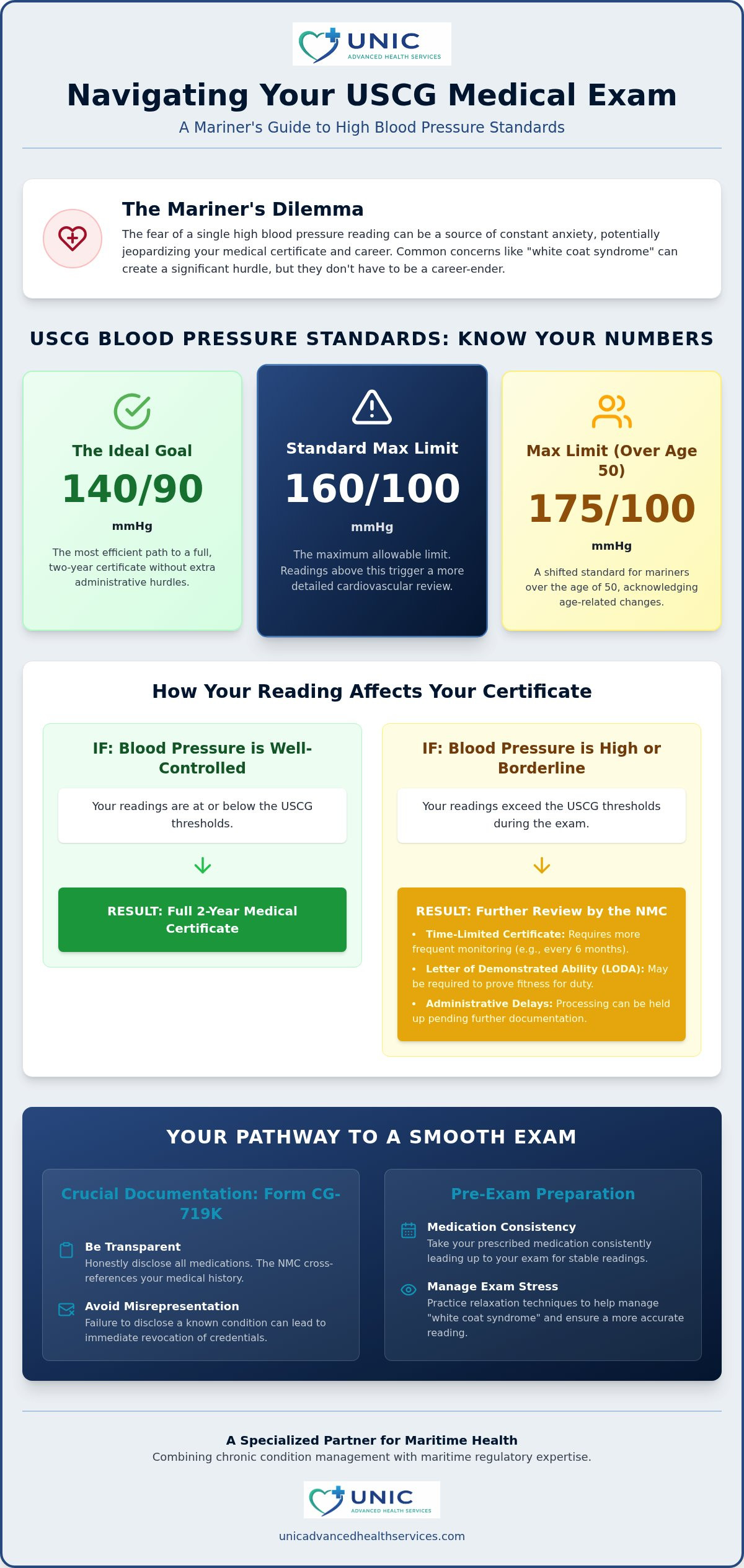
While the general goal for a standard medical certificate is 140/90 mmHg, the 2026 USCG maximum allowable limit is 160/100 mmHg. For mariners over the age of 50, this standard shifts to 175/100 mmHg. Hitting that lower 140/90 mark is still the most efficient path to a full two-year certificate without extra administrative hurdles. If your blood pressure falls into the Stage 1 or Stage 2 categories, the NMC won’t necessarily deny your application. Instead, they’ll look for evidence that the condition is stable. A reading above these limits triggers a more detailed review of your cardiovascular health to assess the risk of a heart attack or stroke while on duty.
How the CG-719K Form Tracks Hypertension
Your vitals are officially recorded in Section IV of the CG-719K Merchant Mariner Credential Medical Evaluation Report. This section is where your provider enters your systolic and diastolic numbers. It’s vital to be transparent about any medications you take to manage blood pressure. Some mariners mistakenly believe that hiding a diagnosis will protect their career. In reality, the NMC cross-references your medical history, and failing to disclose a condition like high blood pressure can lead to the immediate revocation of your credentials for fraudulent or intentional misrepresentation. Accurate reporting, backed by a provider who understands maritime regulations, is the only sustainable way to stay on the water. Dealing with USCG physical high blood pressure requires a proactive approach rather than avoidance.
How Hypertension Affects Your Maritime Medical Certificate
A USCG physical high blood pressure reading doesn’t automatically anchor your career. If your hypertension is well-controlled through lifestyle or medication, you can typically secure a full two-year medical certificate. The National Maritime Center (NMC) isn’t looking for perfect health; they’re looking for stability. Their primary concern is the risk of sudden incapacitation while you’re at the helm or performing safety-critical duties. If your readings are consistently high, the NMC views this as a liability that could lead to an emergency at sea. They want to ensure that every captain and crew member can handle the physical rigors of the job without a cardiovascular event.
Documentation serves as your primary defense during the review process. The NMC needs objective proof that your blood pressure remains within safe limits over time and that your medications don’t cause side effects like dizziness or fatigue. Reviewing the Facts About High Blood Pressure can help you understand why these physiological markers are so vital for maritime safety. When managing a USCG physical high blood pressure finding, having a provider who documents your treatment history clearly can make the difference between a quick approval and months of back-and-forth correspondence. It’s about presenting a complete picture of your health management.
Medical Waivers and Restrictions
If your readings are borderline, the USCG might issue a time-limited certificate. This requires more frequent monitoring, perhaps every six months, rather than the standard two-year cycle. You might also encounter a Letter of Demonstrated Ability (LODA). In some cases, a restriction like “Not valid for service on vessels without a second person in the wheelhouse” is added. This ensures someone else can take control during a health event.
The NMC Review Process
Once Marc Joseph submits your CG-719K form, the NMC medical division reviews it. If your data is insufficient, they’ll issue a Request for Information (AI) letter. This isn’t a denial; it’s a request for more clinical data, like a stress test. Handling these requests promptly with professional support prevents your application from stalling. Partnering with a clinic that offers comprehensive health oversight keeps your paperwork ready before the exam even begins.
How to Prepare for Your USCG Physical with High Blood Pressure
Success on exam day is rarely an accident. When you’re managing a USCG physical high blood pressure concern, the preparation phase is just as vital as the clinical evaluation itself. Marc Joseph at our Fort Lauderdale clinic advises mariners that stability is the primary goal. This means your health routine should be established and steady well before you walk through our doors. Consistency with your prescribed medication is the most critical factor. You should never attempt to adjust your dosage or skip a day in the hopes of “clearing” your system. The National Maritime Center looks for long-term control, not a temporary dip in numbers.
Marc Joseph often recommends that mariners maintain a 7-day blood pressure log leading up to their appointment. This log serves as a powerful piece of clinical evidence. If your vitals spike during the actual exam due to stress, this record provides a broader context of your cardiovascular health. It shows that your condition is managed in your daily life, which is exactly what the regulators want to see when they review your USCG Application for Medical Certificate (Form CG-719K). Identifying your personal triggers is also essential. Caffeine, nicotine, and even minor dehydration can cause short-term spikes that complicate your certification process.
7-Day Preparation Checklist
A structured approach reduces uncertainty and helps you stay focused on the outcome. Follow these steps to ensure you’re ready for your evaluation:
- Monitor your blood pressure at home twice daily and bring the written results to your visit.
- Avoid high-sodium foods and excessive caffeine for at least 48 hours before the exam.
- Ensure you have a 90-day supply of your current medications documented and ready for disclosure.
- Schedule a chronic care management visit if your numbers are fluctuating or if you’ve recently changed prescriptions.
Managing “White Coat Syndrome”
Anxiety in a clinical setting is a common phenomenon that many mariners face. We call this “white coat syndrome,” and it’s something we’re fully prepared to handle. Arriving 15 minutes early to our Fort Lauderdale office allows your body to reach a resting state before we take your vitals. During the measurement, focus on slow, deep breathing and try to stay as relaxed as possible. Marc Joseph is an empathetic guide who understands these nerves. Open communication about your anxiety helps us create a calmer environment, ensuring your USCG physical high blood pressure reading reflects your true health rather than just your exam-day stress. We’re here to help you navigate this process with confidence.
What Happens If Your Blood Pressure Is High During the Exam?
Seeing a high number on the monitor during your evaluation can be frustrating. However, a single elevated reading during a USCG physical high blood pressure assessment isn’t an automatic disqualification. At our clinic, we recognize that stress or “white coat” effects can temporarily inflate your vitals. If your initial reading exceeds the 160/100 mmHg limit, or 175/100 mmHg for those over 50, Marc Joseph typically implements a rest period. We allow you to sit quietly for 10 to 15 minutes before performing a second reading. This methodical approach ensures your certificate isn’t jeopardized by a momentary spike caused by traffic or exam-day jitters.
We don’t just record a number and send you on your way. If your blood pressure remains high, we utilize our on-site lab services to investigate potential secondary causes immediately. This might include checking for kidney function or electrolyte imbalances that could be driving your numbers up. This proactive strategy allows us to address the root issue rather than just documenting a failure. Our goal is to provide the National Maritime Center with a comprehensive clinical picture that demonstrates your health is being managed responsibly. We believe in treating the patient, not just the metric.
Immediate Clinical Steps
Our re-testing protocols are designed to give you every opportunity to succeed. If your current medication isn’t achieving the necessary control, we can discuss adjusting your treatment plan during the same visit. This “one-stop” approach is vital for mariners who need to return to sea quickly. We provide the specific primary care notes required for your NMC file, ensuring that any cardiovascular concerns are addressed with professional authority and clear clinical evidence. We focus on finding a solution that keeps you safe and compliant with 2026 regulations.
Documentation for the NMC
The secret to avoiding license delays is thorough documentation. We write a clinical summary that explains your blood pressure control in detail, often including recent lab results or EKG readings to show a healthy heart profile. This documentation proves to the NMC that you are not at risk for sudden incapacitation. If the NMC issues an inquiry or a request for more information, we help you respond with the exact data they need. This level of oversight turns a potential denial into a manageable administrative step, protecting both your health and your livelihood. To ensure your health and credentials are in expert hands, book your USCG physical with Marc Joseph today.
Expert USCG Physical Exams and BP Management in Fort Lauderdale
Navigating the requirements for a medical certificate is simpler when your provider understands both the clinical and regulatory sides of the maritime industry. Marc Joseph, an autonomous nurse practitioner, offers a distinct advantage for captains and crew members. Unlike traditional clinics where you might see a different provider every visit, our practice provides a steady hand and a consistent point of contact. We specialize in the USCG boat captain physical while simultaneously managing the long-term health of our patients. This integrated approach means we don’t just identify a USCG physical high blood pressure reading; we provide the medical oversight necessary to treat it.
Our Fort Lauderdale clinic is designed to be a “one-stop shop” for the local maritime community. We understand that your time is valuable and your income depends on your health. By offering affordable flat-fee physicals paired with comprehensive chronic care management, we eliminate the need for multiple appointments at different offices. Whether you’re a local yacht captain or a merchant mariner passing through South Florida, you’ll find a supportive environment that prioritizes your career longevity. We focus on modern methodology and regulatory compliance to ensure your paperwork is accurate the first time.
Comprehensive Care for Mariners
Maintaining your health shouldn’t be a source of stress. We make it easy to combine your occupational health exam with annual wellness checkups and preventive care. This holistic view allows us to catch fluctuating blood pressure trends before they become a problem for the National Maritime Center. To accommodate the demanding schedules of maritime professionals, we offer Saturday appointments. This flexibility ensures you can receive expert care without missing time on the water. Our personalized care plans are tailored to your specific lifestyle, helping you keep your blood pressure stable through practical, sustainable strategies.
Book Your USCG Physical Today
Securing your medical certificate is a straightforward process with our organized scheduling system. You can easily book your appointment through our online portal. For follow-up consultations or medication management, we offer telehealth services that allow you to check in with Marc Joseph even while you’re away from port. When you arrive at Unic Advanced Health Services for your exam, please bring a valid government ID, a list of your current medications, and any blood pressure logs you’ve maintained. Having these items ready ensures a smooth, efficient evaluation. Don’t let health concerns delay your next voyage. Schedule your USCG physical in Fort Lauderdale today.
Secure Your Medical Certificate and Your Career
Navigating the 2026 maritime standards doesn’t have to be a source of anxiety. By understanding the 160/100 mmHg threshold and preparing with a consistent health log, you’ve already taken the most important steps toward a successful evaluation. Successfully managing a USCG physical high blood pressure finding requires a combination of clinical accuracy and regulatory knowledge. We focus on providing the thorough documentation the National Maritime Center requires to keep your credentials active and your vessel moving.
Marc Joseph, an autonomous nurse practitioner specialized in USCG and DOT compliance, is here to act as your dedicated health advocate. With on-site lab services and Saturday appointments available for active mariners, we provide a streamlined path to certification. Don’t let a manageable condition stand between you and your livelihood. Book Your USCG Physical Exam in Fort Lauderdale to partner with a team that values your time and your peace of mind. We’re ready to help you navigate your health with confidence and professional support.
Frequently Asked Questions
What is the highest blood pressure allowed for a USCG physical?
The maximum allowable blood pressure for a standard USCG medical certificate is 160/100 mmHg. If you are over the age of 50, the threshold increases to 175/100 mmHg according to the Merchant Mariner Medical Manual. Readings that exceed these specific limits will require you to demonstrate that your condition is under medical control before the National Maritime Center issues your certificate.
Can I still get a captains license if I take blood pressure medication?
Yes, you can obtain a captain’s license while using prescription medication to manage hypertension. The USCG requires that your blood pressure is stable and that the medication doesn’t cause adverse side effects like dizziness that could impair your duties. It’s essential to disclose all medications accurately in Section IV of Form CG-719K to ensure your application is processed without delays.
How long does the USCG medical certificate last if I have hypertension?
A standard USCG medical certificate is typically valid for two years, but the National Maritime Center may shorten this duration if you have hypertension. They might issue a “time-limited” certificate valid for only one year or six months to ensure more frequent monitoring of your health. This oversight helps confirm that your USCG physical high blood pressure remains well-controlled during your time at sea.
What happens if I fail my USCG physical due to high blood pressure?
If your blood pressure is too high during the exam, it isn’t usually a permanent disqualification. The Coast Guard will typically issue a “Request for Information” (AI) letter asking for additional documentation or proof of treatment. Once you work with a provider to stabilize your readings and submit the required clinical notes, your medical certificate application can move forward for approval.
Do I need a special letter from my doctor if I have high blood pressure?
Yes, providing a clinical summary from your treating physician can significantly speed up the approval process. This letter should outline your diagnosis, your current treatment plan, and a professional statement confirming that your blood pressure is stable and well-controlled. Submitting this documentation alongside your CG-719K form helps the NMC medical evaluators make a faster decision regarding your fitness for duty.
How can I lower my blood pressure quickly before my USCG exam?
You can help stabilize your blood pressure by avoiding caffeine, nicotine, and high-sodium foods for at least 24 hours before your appointment. Staying properly hydrated and practicing slow, deep breathing exercises during the measurement can also reduce the impact of “white coat syndrome.” Arriving at our clinic 15 minutes early allows your body to reach a resting state, which often results in more accurate readings.
Will the Coast Guard deny my MMC for Stage 1 hypertension?
The Coast Guard will not deny your Merchant Mariner Credential simply for having Stage 1 hypertension. Stage 1 readings generally fall between 130/80 and 139/89 mmHg, which is well below the USCG maximum limit of 160/100 mmHg. As long as your blood pressure doesn’t exceed the official regulatory thresholds and you are otherwise fit for duty, your medical certificate should be granted.
Does Unic Advanced Health Services offer same-day USCG physicals?
We offer efficient scheduling and thorough evaluations to help mariners meet their certification deadlines as quickly as possible. Our clinic provides Saturday appointments to accommodate those with demanding work schedules on the water. We focus on precise documentation and professional oversight to ensure your USCG physical high blood pressure assessment is handled correctly the first time, preventing the common administrative errors that lead to license delays.