
What if the clearest sign of good care isn’t a test or prescription, but whether your clinician understands what matters in your daily life? If you’ve searched for patient-centered medical care explained, you’re likely looking for more than a formal definition. You want to know whether your concerns, preferences, and circumstances should shape decisions about your health. They should.
Medical appointments can feel rushed or confusing, especially when a care plan doesn’t fit your routines or priorities. Patient-centered care makes the conversation part of care itself: your clinician listens, explains relevant options, and works with you on next steps. This guide explains what that looks like in an appointment, how shared decisions differ from one-way instructions, and how to prepare practical questions for primary care.
These principles matter in preventive visits as well as ongoing chronic-condition management. At Unic Advanced Health Services in Fort Lauderdale, primary care includes annual physicals, preventive care, chronic-condition management, and telehealth. Knowing what collaboration can look like helps you take a more active role in these conversations and explain what you need from your care.
Key Takeaways
- Patient-centered medical care explained: care plans consider your preferences and circumstances alongside clinical evidence, not just a diagnosis or test result.
- Look for practical signs of partnership, such as being listened to, receiving clear explanations, and having appropriate options discussed with you.
- Understand the difference between patient-centered care, a medical-home delivery model, and a payment approach.
- Prepare for appointments by identifying your priorities, sharing relevant context, and clarifying choices and follow-up steps.
- See how these principles can inform preventive care, annual physicals, chronic-condition management, and telehealth in Fort Lauderdale.
What Does Patient-Centered Medical Care Mean?
Patient-centered medical care considers the person, not only a diagnosis, symptom, or test result. It brings your health needs, values, preferences, and circumstances into the conversation alongside clinical evidence. That context helps a clinician explain relevant options and consider a plan that is medically appropriate and workable for you. In practical terms, your perspective belongs in decisions about your care.
Patient-centered medical care is an approach to planning and delivering care around a person’s needs and preferences, not a specific treatment or procedure. It doesn’t mean every request can be accommodated or that a particular outcome is guaranteed. Clinical judgment remains essential, and a clinician can explain when a preferred option may not be appropriate.
For a brief overview, watch this video on the idea of patient-centered care:
How Is Patient-Centered Care Different from Routine, One-Way Care?
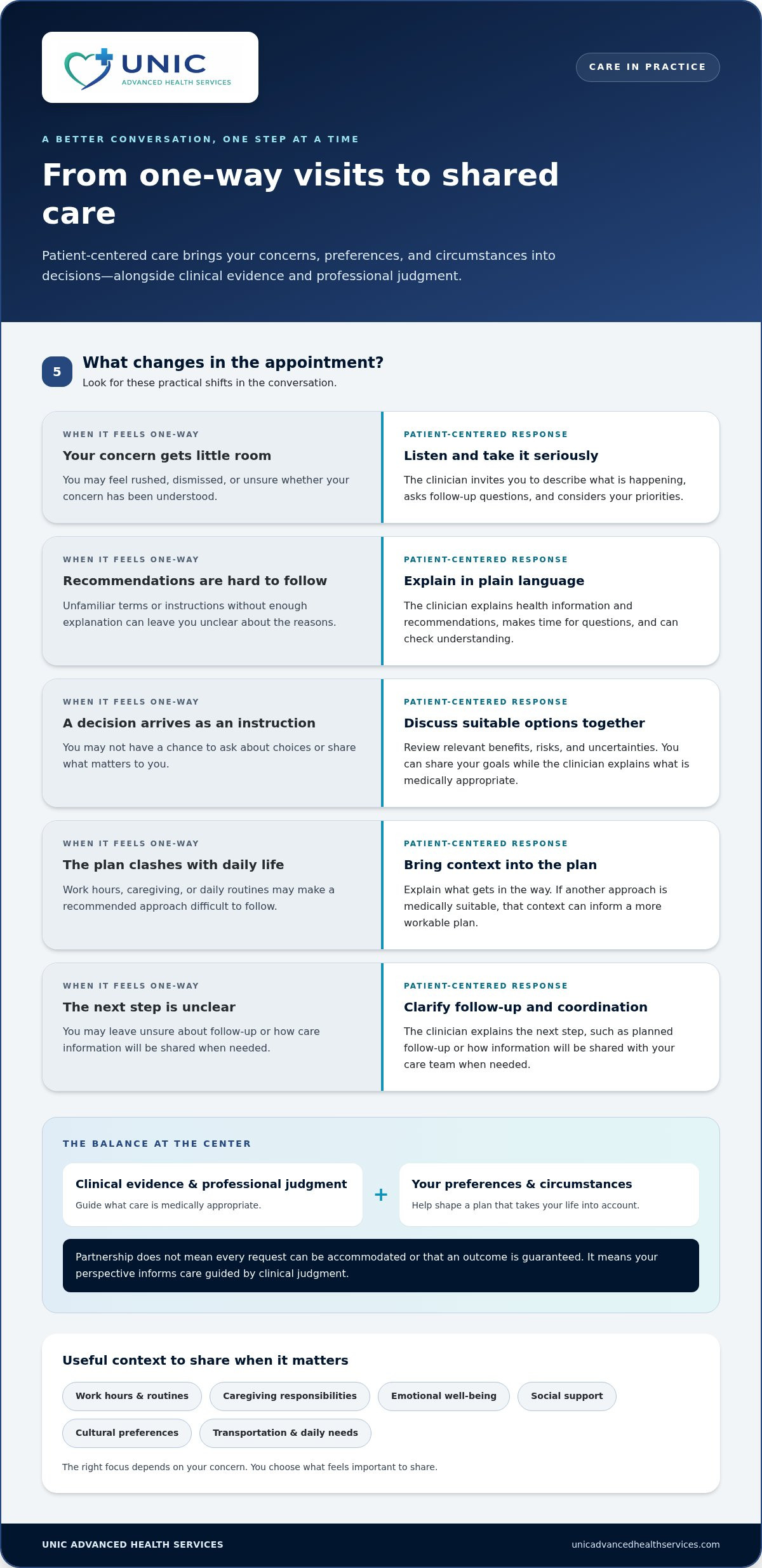
In a one-way conversation, a clinician may give instructions without enough explanation for you to understand the reasons or raise concerns. A patient-centered conversation makes room for questions. The clinician shares relevant medical guidance, listens to what matters to you, and considers that context when discussing a clinically appropriate plan. This is dialogue, not a rejection of medical expertise.
For example, a recommended routine may be difficult to follow because of work hours or caregiving responsibilities. Tell the clinician what gets in the way. If another approach is medically suitable, that context can help you discuss a plan that fits your day more realistically. You can also raise concerns before deciding how to proceed.
Which Parts of a Person’s Well-Being Matter?
Physical health is central, but other parts of life can affect what care makes sense. Depending on the concern, a conversation may touch on emotional well-being, social support, cultural preferences, or practical matters such as transportation and daily routines. The right focus depends on your needs. An appointment doesn’t need to address every part of your life.
For instance, if stress is affecting your sleep, you might mention it during a visit about another health concern. That context may help the clinician understand the wider picture and discuss relevant next steps. You can choose what feels important to share. The goal is to make the conversation useful to you.
Patient-centered care is also described as person-centered care. Person-centered care on Wikipedia offers a broader overview of the approach and its principles. In an appointment, the key idea is straightforward: your clinician considers your individual circumstances while using clinical evidence to guide care.
The Core Principles of Patient-Centered Medical Care in Practice
To recognize patient-centered medical care in practice, notice what happens during the conversation. Does the clinician take your concerns seriously, explain recommendations, and make room for questions? These are observable signs of respect, communication, shared decisions, and coordination. Your preferences matter, and clinical expertise remains essential to appropriate care.
- Respect: The clinician speaks to you directly, takes your concerns seriously, and considers your preferences.
- Listening: They invite you to describe what’s happening and ask follow-up questions to understand your priorities.
- Clear communication: They explain health information and recommendations in plain language, then give you time to ask questions.
- Shared decisions: They discuss suitable options with you, including relevant benefits, risks, and uncertainties.
- Coordination: They clarify the next step, such as planned follow-up or how information will be shared with your care team when needed.
A care plan brings clinical evidence and professional judgment together with the patient’s preferences, goals, and circumstances. That balance is central to collaboration. It doesn’t mean you must make medical decisions without guidance or that a clinician must agree to every request. It means your perspective informs a plan grounded in appropriate clinical care.
What Respectful Communication Looks Like
Respectful communication is something you can notice. A clinician listens without dismissing your concern, explains unfamiliar terms, and treats questions as part of the conversation. They may check understanding by asking you to describe the plan in your own words. If an explanation is unclear, ask for it another way. You can also start by telling the clinician what matters most to you.
How Shared Decisions Balance Preferences and Medical Judgment
Shared decision-making is a guided discussion, not a handoff of responsibility. A clinician explains which options are medically appropriate and reviews relevant benefits, risks, and uncertainties. You can describe your goals and practical concerns, such as whether a proposed routine fits your workday. Together, you can consider a suitable approach. If no option is straightforward, discuss what remains uncertain and what the next step should be.
These conversations can continue over time. A plan may need to be revisited if your needs change, it proves difficult to follow, or you have new questions. Raising that early gives you and your clinician an opportunity to review the situation and consider whether an adjustment is appropriate.
Coordination also makes care easier to follow. A clear explanation of who will follow up and what to expect next can prevent uncertainty after a visit. In primary care, this communication can support discussions about preventive care and ongoing health needs. Learn more about primary care and telehealth services available through Unic Advanced Health Services.
Patient & Person-Centered Care and the Medical Home
Patient-centered medical care describes a guiding philosophy. A medical home is a way to organize primary care, while value-based care describes a payment or performance context. These ideas can overlap, but they aren’t interchangeable. A practice may use a structured delivery model, for example, while the quality of an individual interaction still depends on whether the patient is heard and involved.
This comparison separates the terms:
| Term | What it describes | What a patient may notice |
|---|---|---|
| Patient-centered care | A philosophy for planning and delivering care around the individual. | Care conversations take the person’s needs and preferences into account. |
| Patient-Centered Medical Home (PCMH) | An organized model for delivering primary care. | The practice may structure primary care around coordinated, ongoing services. |
| Value-based care | A payment or performance context that may reward quality and outcomes. | It describes how care is evaluated or paid for, not necessarily how one conversation feels. |
Patient-Centered Care Versus Person-Centered Care
“Patient-centered” and “person-centered” are often used with overlapping meanings. Both emphasize the individual, personal preferences, and meaningful participation in care. The language may vary among healthcare settings and frameworks. Some use “person-centered” to stress that someone’s identity extends beyond their role as a patient. These terms aren’t universally standardized opposites, so the label alone may not tell you exactly how a practice applies the idea.
In practical terms, look for whether the care conversation makes room for your priorities and treats you as an individual. The terminology matters less than the respect and participation you experience.
Patient-Centered Medical Home Versus a Care Philosophy
A Patient-Centered Medical Home is a model for organizing primary care. It describes how a practice structures care, while patient-centered care is the broader philosophy that can guide planning and delivery in any setting. The two ideas can support one another, but they aren’t synonyms. An organizational model doesn’t describe every detail of an individual appointment.
For a patient, the distinction is useful. A model may establish an organized approach to primary care. During a particular visit, you can still notice whether the clinician explains recommendations, listens to your concerns, and includes your perspective. A program name or recognition label by itself doesn’t prove that every interaction will feel collaborative.
Value-based care belongs in a different category. It refers to a payment or performance approach, not a specific communication style or delivery model. A payment arrangement may focus on quality or outcomes, but it doesn’t automatically tell you how decisions are discussed with you. In short, the philosophy describes the care relationship, the medical home describes a delivery model, and value-based care describes a payment or performance context.
How Patients Can Recognize and Take Part in Patient-Centered Care
Understanding patient-centered medical care in practice can help you prepare for an appointment without needing medical terminology or a perfect script. Take part by sharing what matters to you, asking about choices, and making sure you understand what happens next. Try this sequence:
- Identify your priorities. Before the visit, consider the main concern you want to address and what you hope to understand or accomplish. If you have several concerns, say which feels most pressing so you and the clinician can decide how to use the conversation.
- Share relevant context. Explain how the concern affects your daily life, what you’ve already tried, and any practical limits or preferences that could affect a plan. You don’t need technical language. “I’m concerned this will be hard to fit around my work schedule” is useful information.
- Discuss options. Ask which approaches may be appropriate and what each involves. A collaborative conversation makes room to consider how the options relate to your goals and circumstances.
- Clarify next steps. Before the conversation ends, make sure you understand the plan, expected follow-up, and whom to contact with questions. If instructions are unclear, ask for them to be explained again.
Questions That Can Support a Collaborative Appointment
Choose the questions that fit your situation. Write them down or bring a support person if that helps you follow the discussion. Asking for clarification is a normal part of taking part in your care.
- “What options are appropriate for my situation, and what does each involve?”
- “What are the possible benefits, risks, or trade-offs?”
- “How might this plan fit with my daily routine or responsibilities?”
- “What should I do next, and when should I follow up?”
- “Could I repeat the instructions back to make sure I understood them correctly?”
What to Notice After a Care Conversation
After the visit, consider whether you can describe the plan in your own words and identify the next step. If care will continue over time, clear follow-up and coordination can help you understand how the conversation connects to future care. If something remains uncertain, note the question so you can raise it with the care team.
One appointment can offer clues about how well communication worked, but it can’t establish clinical quality or predict future outcomes on its own. Notice whether your questions were addressed and whether you left with a clear understanding. Ongoing care may involve further discussion as your needs change.
Routine primary care isn’t a substitute for urgent evaluation. If symptoms seem urgent or potentially life-threatening, seek appropriate urgent or emergency services rather than waiting for a routine appointment.
For primary care conversations and care options in Fort Lauderdale, explore primary care and telehealth services from Unic Advanced Health Services.
Patient-Centered Primary Care in Fort Lauderdale
The principles of patient-centered medical care become tangible in primary care through conversations about prevention, current health concerns, and what comes next. A preventive visit, annual physical, or discussion about an ongoing condition can include your questions and circumstances while remaining guided by clinical judgment. Start by sharing what you hope to address, then ask how recommendations relate to your needs.
Applying the Approach to Preventive and Ongoing Care
Preventive care and annual physicals offer a chance to discuss health priorities, relevant history, and questions about recommended screenings. Sharing your concerns helps the clinician explain which preventive steps are appropriate and why. You don’t need detailed medical vocabulary. A clear description of what you want to understand is a useful starting point.
For ongoing conditions such as diabetes or hypertension, patient-centered conversations can bring everyday context into the discussion. You might raise questions about monitoring, concerns about a recommendation, or practical challenges following a plan. The clinician can explain relevant considerations and discuss next steps using clinical judgment. These examples are educational, not a diagnosis or a promise about which treatment is right for an individual.
Unic Advanced Health Services also offers on-site lab services. If lab work is part of a conversation about your care, ask what it is intended to inform and how it relates to the broader plan. Specific testing and decisions depend on individual clinical needs.
Primary Care and Telehealth in the Fort Lauderdale Area
Unic Advanced Health Services provides primary care and telehealth in Fort Lauderdale and surrounding communities. Led by an experienced autonomous nurse practitioner, the practice offers annual physicals, preventive care, chronic-condition management, and telehealth services. Telehealth is one care format. It doesn’t mean every service or concern is handled virtually.
The appropriate visit format depends on the concern and clinical needs. A conversation about a health question may differ from a visit that requires an in-person assessment or another service. Explain what you need to discuss so the clinical context can guide how care is delivered. The practice’s Telehealth Fort Lauderdale guide provides further information about virtual care.
Whether you’re discussing prevention or managing an ongoing condition, bring your priorities, questions, and practical circumstances into the conversation. Clear communication helps you understand how recommendations relate to your care, while clinical judgment guides what is appropriate. This is how a patient-centered approach can take shape in a local primary-care relationship.
To learn more about care options in the area, explore care at Unic Advanced Health Services.
Make Your Next Care Conversation Count
Patient-centered medical care is most useful when it helps you take a confident next step. Before your next appointment, choose one priority to discuss. Think about what would make a recommendation easier or harder to follow, and note any questions you don’t want to leave unanswered. You don’t need to have a solution ready. Your clinician can help you consider what’s appropriate.
After the conversation, check that you understand the plan and what happens next. If anything feels unclear, ask for an explanation or raise the question during follow-up. A collaborative care relationship develops through ongoing communication, not one perfect appointment. Your perspective can make each discussion more relevant to your needs while clinical judgment guides care.
If you’re ready to explore primary care in Fort Lauderdale, explore primary care and telehealth services at Unic Advanced Health Services. Bring your questions, share what matters to you, and take the next step at a pace that feels manageable. You deserve to feel informed and included in conversations about your health.
Frequently Asked Questions
Is patient-centered care the same as patient-centered medicine?
Often, the terms describe a similar commitment to taking an individual’s needs, preferences, and values seriously in care. Their exact use can vary across healthcare settings and frameworks, so there isn’t one wording that applies universally. Rather than relying on a label, notice what happens in the conversation: are your concerns considered, and do you understand how decisions relate to your situation? Those details offer a more practical guide.
Can patient-centered care be used for people who have more than one chronic condition?
Yes. When discussing several chronic conditions, patient-centered care makes room to talk about which concerns affect you most, how your routines interact with care, and what questions you have about managing them together. Bringing an updated list of medications and concerns can help structure that discussion. A clinician determines appropriate evaluation and treatment. This approach doesn’t guarantee improved control or replace specialist input when needed.
Can a family member take part in a patient-centered medical appointment?
Often, a patient can choose to involve a family member or another support person when it’s appropriate and consistent with privacy and consent. Tell the clinician whether you’d like that person to listen, help you remember information, or contribute to the discussion. The patient should remain central whenever possible. Practical arrangements can vary by care setting, so state your preference and the role you want your support person to have.
Does patient-centered care mean every test or treatment is optional?
No. Patient-centered care supports discussion and respect for your preferences, but it doesn’t mean every requested test or treatment is clinically appropriate or available. Your clinician can explain relevant options and the professional judgment behind a recommendation. Ask why a test is being considered, what a proposed treatment involves, or what concerns you should discuss before proceeding. This is general educational information, not legal advice about consent.
Can patient-centered care work through telehealth?
Yes, clear communication and discussion of your goals can take place through telehealth when your concern is suitable for a virtual visit. Some issues may require an in-person examination, testing, or another care setting. Describe your concern and relevant context so the clinician can guide the appropriate next step. Unic Advanced Health Services provides telehealth as part of its primary care in Fort Lauderdale and surrounding communities.
What can I do if I leave an appointment unsure about the plan?
Write down what remains unclear, then ask the care team to explain the plan, instructions, or follow-up. You can also repeat the next steps in your own words to help identify any misunderstanding. Clarify what you’re expected to do and what follow-up is planned. Don’t wait for a routine-care conversation if symptoms are urgent. Seek appropriate urgent or emergency services.