
A diagnosis is most useful when you understand what it means and what comes next. A doctor who explains medical conditions clearly listens to your concerns, asks about your symptoms and how long they’ve lasted, and explains how those details inform an assessment and care plan. You should leave with a clearer sense of what your condition may involve and which next steps are appropriate.
It’s reasonable to want more than a brief label or a list of instructions. Clear, compassionate communication can make it easier to discuss what’s changed, understand the medical reasoning, and ask questions about treatment. Symptom duration, intensity, and impact can all help a doctor assess your concerns. Listening closely also provides context that a test or symptom name alone may not capture.
This article explains how doctors assess and treat illnesses, why symptom duration matters, and what clear explanations and empathetic listening can look like during an appointment. It also describes how primary care and ongoing condition management can help you understand your health and make informed decisions about care.
Key Takeaways
- Doctors combine your symptoms, medical history, examination, and test findings to assess what may be causing a concern and decide on care.
- Describe when symptoms began, how they’ve changed, and how they affect daily life; these details can help shape the assessment.
- Clear explanations should connect the diagnosis, recommended care, and next steps in language you understand.
- Choose a doctor who listens to your concerns, answers questions, and treats your experience with empathy.
- For ongoing health needs, chronic condition management can support continued care and a clearer understanding of your condition.
1. Doctors’ role in diagnosing and treating illnesses
Doctors assess illness by considering symptoms, medical history, examination findings, and relevant test results. Each detail helps build a picture: when a symptom began, what changes it, and how it affects daily activities. An examination can reveal findings that aren’t obvious from a symptom description alone. The doctor uses this information to consider possible causes, decide whether further evaluation is needed, and explain a care plan. A doctor who explains medical conditions clearly connects these steps in language patients can follow.
Primary care doctors often assess common concerns and ongoing health needs. For example, a primary care provider can typically treat common infections such as mild flu, strep throat, or COVID-19. If a concern needs specialized evaluation, care may involve another medical professional. A pediatrician, for instance, may refer a child to an ear, nose, and throat specialist when symptoms call for that expertise. This coordinated approach links an initial assessment with appropriate treatment.
Cancer care illustrates how diagnosis and treatment can involve several specialties. Radiologists use imaging tests, including X-rays and ultrasound, to help diagnose disease. Pathologists examine body tissues and fluids to identify causes of disease. Oncologists provide chemotherapy and often work with radiation oncologists and surgeons. The doctor can explain how findings relate to a diagnosis and how each specialist contributes to care. Roles depend on the condition and treatment being considered.
Doctors also match care to the body system involved. Cardiologists focus on the heart and blood vessels, while neurologists treat conditions affecting the nervous system. Dermatologists assess problems involving skin, hair, and nails. These specialties show why an initial doctor may coordinate care rather than handle every aspect alone. For a complex concern, communication among professionals helps connect examination findings, test results, and treatment decisions.
Does insurance cover appointments with a doctor I choose? Coverage depends on your insurance plan, the doctor, and the appointment. Before scheduling, review your plan’s terms for network participation, referrals, and patient costs, since these can affect coverage.
How can doctors communicate with patients in their preferred language? A doctor can explain medical terms in plain language and communicate directly when they share the patient’s preferred language. Otherwise, the patient and care team can discuss language assistance for the appointment.
During a visit, ask the doctor to explain how the diagnosis, treatment, and follow-up connect. A useful explanation distinguishes what the findings show from what remains under assessment, then explains why a next step is recommended. A doctor who explains medical conditions clearly gives patients room to raise concerns and understand how the plan relates to their health history and needs.
Doctors are specially trained medical professionals who diagnose and treat illnesses. Internists usually treat adults and serve as primary care doctors for common and complex illnesses. Ophthalmologists are medical doctors who can diagnose and treat eye conditions and perform eye surgery. Psychiatrists diagnose and treat mental, emotional, and addictive disorders, including depression, schizophrenia, substance abuse, and anxiety disorders. Gastroenterologists specialize in digestive organs and perform colonoscopies and other tests for colon cancer. Radiologists use X-rays, ultrasound, and other imaging tests to diagnose diseases and may specialize in radiation oncology to treat conditions such as cancer.
2. How symptom duration helps doctors assess a condition
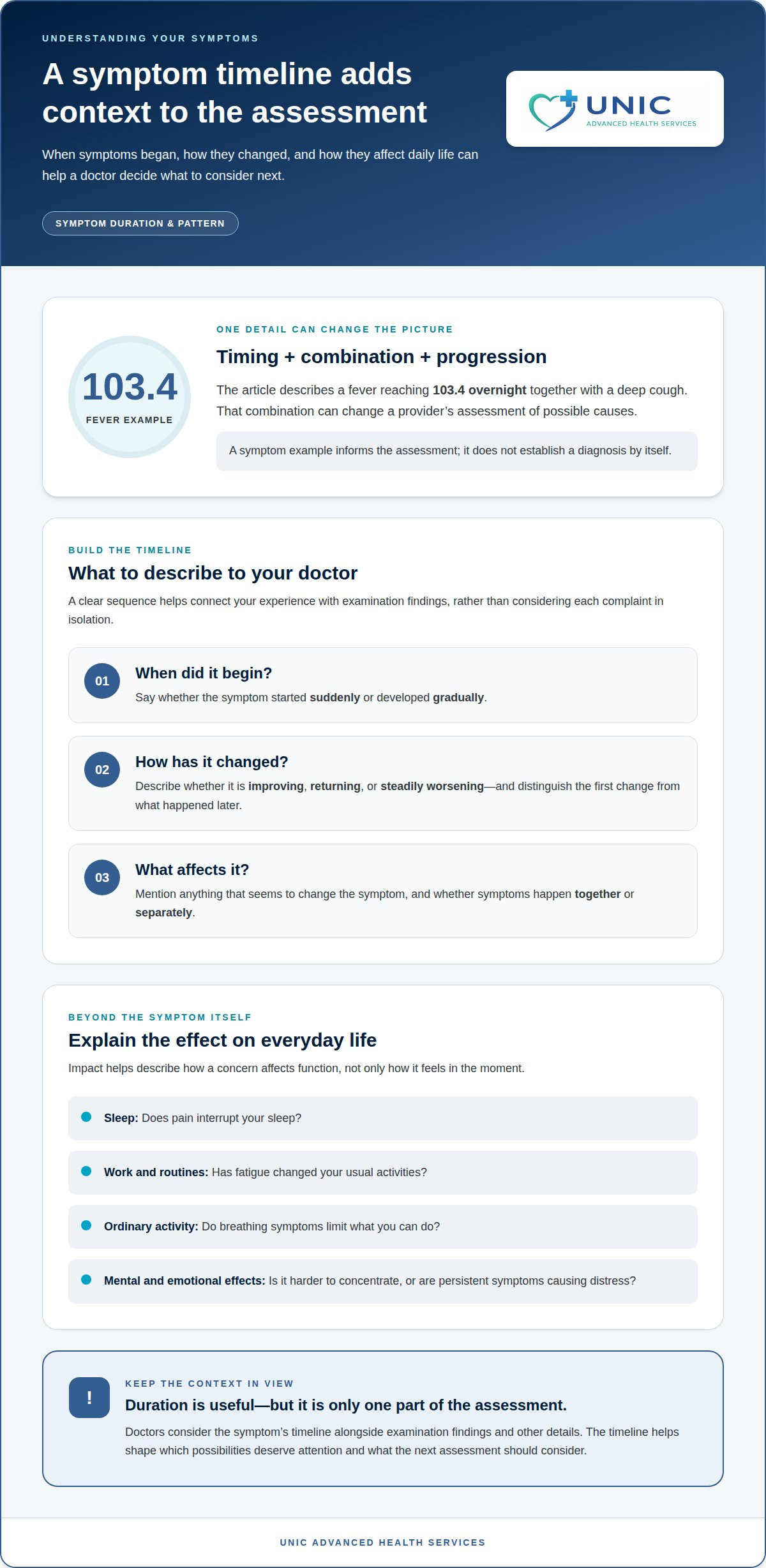
The length and pattern of symptoms give patients and doctors useful context. A symptom that began suddenly differs from one that developed gradually. A concern that improves, returns, or steadily worsens creates a different timeline for discussion. Doctors consider that sequence alongside examination findings and other details. Duration alone doesn’t identify an illness, but it helps shape which possibilities deserve attention and what the next assessment should consider.
Doctors often ask when symptoms started, how they changed, and whether anything affects them. For example, they may ask whether a cough is improving or becoming more disruptive. A precise timeline helps distinguish the first change from later developments. Patients can also describe whether symptoms occur together or separately. These details help the clinician connect the patient’s experience with examination findings instead of treating each complaint in isolation.
Specific changes can matter. A fever reaching 103.4 overnight together with a deep cough can change a provider’s assessment of possible causes. The timing, combination, and progression give more context than the word “fever” alone. If pneumonia is a concern, a doctor considers the full account alongside the examination. The patient’s description informs the assessment; it doesn’t establish a diagnosis by itself.
Daily impact adds another useful measure. A doctor may ask whether pain interrupts sleep, fatigue changes work routines, or breathing symptoms limit ordinary activity. These examples show how a concern affects function, not just how it feels in the moment. Mental and emotional effects also belong in the conversation. Difficulty concentrating or distress linked to persistent symptoms can help explain the broader burden of an illness.
During an examination, the clinician compares reported symptoms with observable findings. If a patient describes worsening discomfort, the doctor can ask where it is centered, when the change occurred, and what activity preceded it. The examination may focus on the affected area and other relevant signs. A mismatch between the account and findings isn’t a reason to dismiss the patient. It may prompt more questions or further assessment.
Clear descriptions of worsening symptoms help guide decisions. Patients can explain what changed, when it changed, and how that change affects daily life. For instance, “the cough is deeper and sleep is interrupted” gives a clearer picture than “I feel worse.” The clinician can compare the new report with the earlier history and current examination. That comparison helps determine whether the care plan needs reassessment.
For ongoing conditions, changes over time can inform follow-up and care planning. Chronic condition management can help patients discuss persistent symptoms and their effect on everyday routines with a clinician. A doctor who explains medical conditions clearly can connect the timeline, examination, and plan in understandable terms. This helps patients know what the assessment means and which changes should be raised at a later visit.
3. Clear communication with patients
Clear clinical communication helps patients understand what a physician thinks and why. A useful explanation connects symptoms, examination findings, and possible diagnoses without burying the meaning in medical terms. Dr. Robert Biernbaum has said that a clear, detailed patient conversation gets a clinician 80% of the way to a diagnosis. A doctor who explains medical conditions clearly can use that conversation to guide what they examine or ask next.
Pain ratings show why numbers need context. Physicians may ask patients to rate pain from 1 to 10, but a number alone can hide important differences. A patient whose usual headache is 4 or 5 out of 10 may describe a current headache as 10. That change from their normal experience gives the physician useful context beyond the rating alone.
A physician should make room for questions about treatment. For example, a patient discussing medication needs to understand its purpose, how it fits into the plan, and what follow-up involves. If a specialist is part of the care team, the explanation should clarify that person’s role. Clear wording helps patients connect each clinical step rather than receive separate instructions without context.
For a diagnosis, the doctor should explain the conclusion, the findings that support it, and any remaining uncertainty. The explanation can distinguish a confirmed condition from a possibility still being assessed. For treatment, the doctor should describe the goal, the next steps, and how progress will be reviewed. Patients can then ask focused questions, such as, “What does this result mean for me?”
Communication matters in urgent situations, too. When a patient is assessed for an emergency concern, concise explanations can help them understand what the care team is evaluating and which step comes next. Specialists may contribute different expertise, so the physician should explain their roles in plain language. The patient should be able to describe the plan back in their own words.
How can you choose a doctor with good patient communication reviews near you? Read local reviews for specific patterns, such as physicians who listen, explain diagnoses, and answer questions respectfully. Treat individual reviews as personal experiences, and look for descriptions of communication rather than relying on star ratings alone.
How should a doctor explain a diagnosis or treatment clearly? The doctor should use familiar language, connect the conclusion to relevant findings, and explain the purpose of each recommended step. A doctor who explains medical conditions clearly also makes time for questions and checks that the patient understands the plan.
Clear explanations support informed conversations, not one-way instructions. A patient may need a simpler explanation of a test result or more detail about why a specialist is involved. The physician can adapt the discussion while keeping the clinical meaning accurate. This helps patients understand their diagnoses and take part in decisions about their care.
4. Listening and empathy
Empathy in a medical visit means taking the patient’s physical, emotional, and social needs seriously. A doctor listens not only for symptoms but also for how illness affects everyday life. Pain, for example, may interfere with sleep, while worry about a disease may make treatment decisions feel difficult. These details put the health concern in the context of the person experiencing it.
Listening starts with giving patients room to describe what concerns them most. A doctor can invite the patient to explain the main change, then ask focused questions about its impact. If fatigue is affecting a patient’s work, the physician can ask which tasks have become harder. This turns a broad statement into useful context without reducing the experience to a single clinical finding.
Empathy also shows in how a doctor responds. Acknowledging that a new diagnosis can feel overwhelming recognizes its emotional impact without making assumptions about the patient. The doctor can then clarify what is known, explain the next step, and ask which part remains confusing. This approach supports trust by giving the patient’s concerns attention alongside the medical details.
In primary care, an ongoing relationship can help a doctor understand changes in a patient’s circumstances. Someone managing a disease may face practical barriers, such as difficulty fitting treatment into a workday. Discussing that constraint helps the clinician understand the patient’s routine and consider how care fits into daily life. Treating a condition involves more than naming it: the plan should make sense to the person following it.
Patients can recognize listening through specific behaviors during an appointment. The doctor lets them finish describing a concern, asks a relevant follow-up question, and checks whether the response addressed it. If a patient raises two issues, the physician can acknowledge both and explain how each will be discussed. These steps make the conversation more collaborative and reduce the chance that an important concern gets overlooked.
Medical education and clinical training prepare doctors to assess illness, but patients’ accounts add personal context. A trained clinician can connect examination findings with what the patient reports, including fears about a possible diagnosis. For instance, someone worried about a family disease may need the doctor to distinguish that concern from the findings of the current evaluation. Listening makes the distinction clearer and more respectful.
Empathy doesn’t require a doctor to agree with every interpretation. It means responding respectfully, explaining clinical reasoning, and treating the patient as a partner in decisions. If a patient feels dismissed, they may leave without sharing a key concern or understanding the plan. A doctor who listens carefully can invite questions, clarify misunderstandings, and support a more constructive relationship throughout care.
A compassionate, empathetic doctor can help patients feel more comfortable, supporting trust and a positive doctor-patient relationship. A patient-centered approach considers physical, emotional, and social needs rather than focusing only on a medical condition. This keeps attention on the whole person and can make it easier to share concerns that matter.
5. How to find a doctor who explains medical conditions clearly
Look for signs of good communication in patient reviews, appointment information, and your first conversation. Reviews are most useful when they describe specific behavior, such as a physician answering questions or explaining a test result in plain language. A general statement like “great doctor” gives less insight. Consider whether the examples match your needs, especially if you want ongoing support for a health concern.
Check that the doctor’s focus fits the reason for your appointment. A primary care physician can assess a range of concerns and coordinate care when another specialty is relevant. For example, someone managing diabetes may value clear discussions about ongoing care, while a new eye concern may require an eye specialist. The right clinical focus helps ensure the conversation addresses the issue you’re bringing forward.
Pay attention to how the doctor handles your first questions. A useful explanation connects your concern to the assessment and next steps. If the doctor uses unfamiliar terms, they should be willing to explain them in everyday language. Notice whether the response addresses what you asked instead of immediately shifting to another topic. These details give you a practical sense of what future conversations may be like.
Communication also means listening. A doctor should let you describe your concern, ask follow-up questions, and take your circumstances into account. If a treatment plan affects your work schedule, for example, the conversation should make room for that practical concern. Reviews that mention respectful listening can be informative, but your own interaction gives direct evidence of whether the communication feels clear and collaborative.
Consider how the doctor explains uncertainty and coordination. Some concerns need additional evaluation or input from specialists. A clear physician can explain what the current assessment indicates, why another clinician may be involved, and how that next step fits into the plan. If you leave unsure what happens next, ask for the plan to be restated in simpler terms before the appointment ends.
For ongoing health needs, prioritize a communication style that supports follow-up over time. A doctor who explains medical conditions clearly can help you understand how your care plan relates to your goals and daily routine. Look for respectful conversation, plain explanations, and clear next steps. These qualities make it easier to raise new questions as your needs change.
If you’re looking for support with an ongoing condition, discuss chronic condition care as a next step.
Unic Advanced Health Services: Chronic Condition Management
Unic Advanced Health Services provides Chronic Condition Management for patients living with conditions such as diabetes, hypertension, and obesity. This may be a helpful next step when you need ongoing support or want to discuss how a condition affects daily life. Clear conversations with a healthcare professional can help you understand your condition and discuss care options suited to your needs.
At appointments, bring questions about symptoms, treatment, or changes in your routine. Sharing what feels unclear helps guide a focused conversation about your health. Chronic conditions can involve ongoing decisions, so understanding the purpose of your care and what to discuss at follow-up can support informed participation.
If you’re ready to discuss ongoing care, contact Unic Advanced Health Services.
Make your next conversation work for you
Before your next appointment, decide what you need to leave understanding. It may be the reason for a recommendation, how a care plan fits your priorities, or what decision comes next. Naming that goal can help keep the conversation focused on what matters to you. A doctor who explains medical conditions clearly can help turn your concerns into a more informed discussion.
For ongoing health needs, Unic Advanced Health Services offers Chronic Condition Management. The practice also provides DOT Physical Examination and U.S. Coast Guard (USCG) Boat Captain Physical services. Choose the appointment that matches your reason for seeking care, and bring the questions you want addressed.
Contact Unic Advanced Health Services today to discuss your care. A thoughtful conversation is a practical place to begin, and you can take the next step at your own pace.
Frequently Asked Questions
What questions can you ask to assess a doctor’s communication skills?
Ask, “Could you explain what this result means in everyday language?” and “What choices do I have, and what would each involve?” You can also ask how the doctor will keep you informed if the plan changes. Notice whether the physician answers directly, welcomes follow-up questions, and checks what matters most to you. For example, a clear response addresses your concern rather than relying on unexplained medical terms.