How much of your week is spent acting as your own medical coordinator, trying to bridge the gap between specialists who rarely communicate? It’s a heavy burden to carry when you’re already managing a long term illness. The traditional, disconnected approach to medicine often leaves patients feeling like a collection of symptoms rather than a human being. This is why integrated care for chronic conditions is the essential standard for 2026. By merging medical oversight with lifestyle support under one expert guide, you can stop fighting the healthcare system and start focusing on your recovery.
You likely agree that the constant cycle of multiple co-pays and conflicting treatment plans creates unnecessary anxiety. It’s hard to feel secure when your care feels like a series of disjointed appointments. This guide will show you how a unified medical approach can simplify your routine, reduce your costs, and improve your daily quality of life. We will preview how a single point of contact, combined with on-site diagnostics and lifestyle-integrated care, can lead to better health outcomes and fewer prescriptions.
Key Takeaways
- Learn how integrated care for chronic conditions replaces fragmented visits with a unified medical strategy that prioritizes your long term stability.
- Discover how a collaborative model addresses the root causes of illness by merging clinical oversight with targeted nutritional and behavioral support.
- Compare the efficiency of a high touch integrated home against traditional models to see how streamlined communication reduces both costs and medical anxiety.
- Understand the advantages of a Nurse Practitioner led approach that focuses on whole person evaluation and steady, individualized oversight.
- Identify the specific steps and documentation needed to transition your health management to a more convenient and comprehensive care environment.
What is Integrated Care for Chronic Conditions?
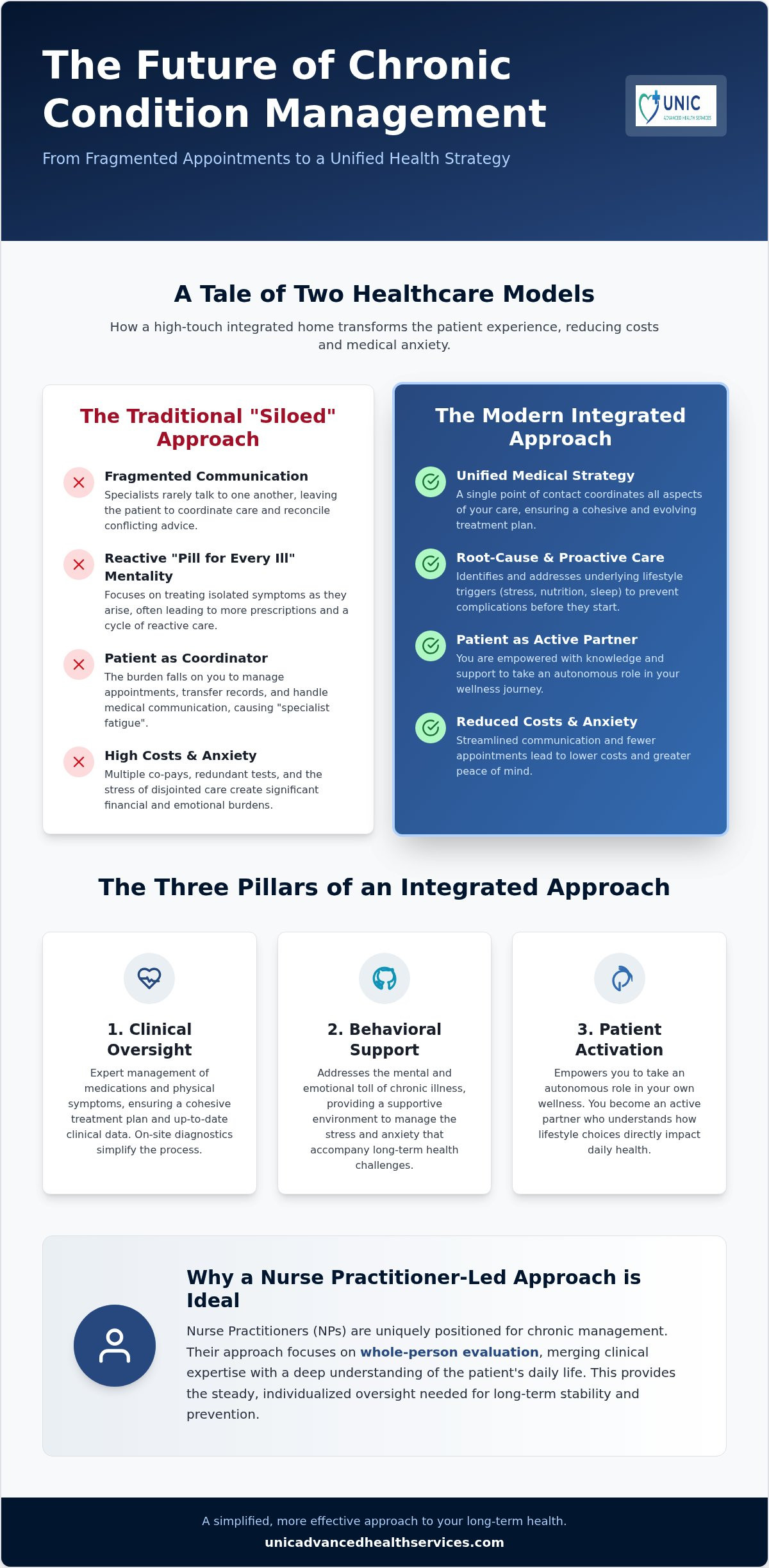
Integrated care for chronic conditions isn’t just a clinical buzzword; it’s a strategic merger of medical management, behavioral support, and lifestyle intervention. Unlike traditional healthcare, which often treats each symptom in isolation, this model views your health as a single, connected ecosystem. It moves away from the “pill for every ill” mentality and toward a comprehensive strategy that prioritizes long term stability. Instead of a series of isolated visits, you experience a unified health strategy designed to evolve with your needs.
When you work with a single healthcare partner, you gain a dedicated guide who reconciles conflicting specialist advice. This “steady hand” ensures that your treatment plan is cohesive rather than a collection of guesses. It’s about creating a centralized medical home that simplifies your life while improving your physical outcomes. By coordinating every aspect of your care, your provider can spot potential issues before they become emergencies.
The Problem with Fragmented Healthcare
The traditional “siloed” model of healthcare frequently fails patients with multiple chronic conditions. You might see a cardiologist for your heart, an endocrinologist for your diabetes, and a nutritionist for your diet, but these professionals rarely speak to one another. This lack of communication is often cited as a primary risk for chronic patients, leading to conflicting medication orders and redundant diagnostic tests. When doctors don’t talk, the patient is the one who pays the price.
Specialist fatigue is a real phenomenon that causes patient burnout and increases the risk of medical errors. The financial burden is also significant; multiple co-pays and travel costs for various appointments add up quickly. A fragmented system forces you to act as your own medical secretary, a role that adds unnecessary stress to an already difficult situation. Integrated care removes this burden by streamlining your medical journey.
The Three Pillars of an Integrated Approach
A successful integrated model rests on three essential foundations that work in harmony to support your recovery:
- Clinical Oversight: This involves the expert management of medications and physical symptoms. It ensures that every prescription works in tandem with your existing treatments and that your clinical data is always up to date.
- Behavioral Support: Chronic illness takes a mental toll. Integrated care addresses the stress and anxiety that accompany long term health challenges, providing a supportive environment for your emotional well-being.
- Patient Activation: This pillar empowers you to take an autonomous role in your wellness. You aren’t just a passive recipient of care; you’re an active partner who understands how lifestyle choices impact your daily health.
By focusing on these pillars, providers like Marc Joseph at Unic Advanced Health Services help patients transition from merely surviving their illness to actively managing it. This approach ensures that every aspect of your life is considered, from the labs drawn on-site to the way you sleep at night.
The Collaborative Care Model: Merging Medical and Lifestyle Health
The collaborative care model represents a fundamental shift in how we approach long term wellness. It moves beyond the “pill for every ill” mentality, focusing instead on identifying the underlying drivers of disease. Root-cause care is the identification of physiological and lifestyle triggers for chronic flare-ups. By recognizing these triggers, a provider can create a plan that addresses stress, nutrition, and sleep alongside necessary prescriptions. This holistic view is the hallmark of integrated care for chronic conditions, ensuring that no part of your health is ignored.
Continuous monitoring is another critical component of this model. Relying on once-a-year checkups often leads to a reactive cycle where problems are only addressed after they become severe. In a collaborative system, your health is monitored regularly through telehealth and frequent touchpoints. This proactive stance allows for small adjustments that prevent major complications. It’s a method that values prevention as much as it values treatment.
Managing Diabetes and Hypertension Together
Diabetes and high blood pressure are often treated as separate issues, yet they function as a single metabolic system. High blood sugar can damage arteries, while high blood pressure strains the heart and kidneys, creating a dangerous feedback loop. Effective hypertension treatment in Fort Lauderdale must integrate seamlessly with diabetic nutrition plans to be truly successful. Managing these conditions in isolation often leads to conflicting advice that confuses the patient.
Our approach utilizes on-site labs to provide real-time clinical data for both conditions simultaneously. Having immediate access to your A1c levels and lipid profiles allows for rapid intervention. This level of coordination ensures that a change in one treatment plan doesn’t negatively impact the other. By looking at the whole system, we create a more stable environment for your body to heal.
Behavioral Health as a Chronic Care Tool
Managing a long term illness often brings a significant amount of anxiety. Behavioral health isn’t just about mental wellness; it’s a vital tool for physical recovery. High stress levels increase inflammatory markers and negatively impact heart health, making stress reduction a clinical necessity. When you’re stressed, your body’s ability to manage blood sugar and blood pressure diminishes significantly.
Adherence strategies are also essential for long term success. It’s common to feel overwhelmed by new dietary restrictions or exercise goals. We work with you to develop manageable habits that stick, ensuring your lifestyle changes are sustainable. This supportive environment makes it easier to follow through on complex care plans without feeling defeated. If you’re ready to simplify your medical journey, exploring our chronic condition management options can provide the clarity you need.
Integrated Care vs. Traditional Healthcare: A Comparison
Choosing the right clinical model is often the difference between managing a condition and being managed by it. Traditional healthcare systems typically operate on a transactional basis, where each visit is a separate event with little connection to the last. In contrast, integrated care for chronic conditions functions as a continuous partnership. This model prioritizes the relationship between the provider and the patient, ensuring that every medical decision aligns with a long term health strategy. It’s a shift from reactive treatment to proactive oversight.
There is a frequent debate regarding “high-touch” versus “high-tech” care, but modern medicine requires both. High-tech tools like digital monitoring and advanced labs provide the necessary data, while high-touch interaction ensures that data is interpreted within the context of your unique life. Integrated care reduces emergent care use by closing gaps in primary management. By addressing small physiological changes early, you avoid the physical and financial trauma of a medical crisis.
Comparing the Patient Journey
The traditional patient journey is often a logistical nightmare. You might spend hours traveling between different offices, only to find that your records haven’t been shared between specialists. This disconnection leads to “specialist fatigue” and a higher risk of medication errors. When doctors don’t talk, the patient is left to fill in the blanks, which increases anxiety and the likelihood of conflicting treatment plans.
In an integrated model, you have a single point of contact and a unified medical record. This coordination eliminates the need for you to repeat your medical history at every appointment. Digital tools also play a vital role in keeping you connected. For example, telehealth in Fort Lauderdale bridges the gap between in-office visits, allowing for steady oversight without the need for constant travel. It’s a more respectful use of your time and energy.
Cost-Benefit Analysis for Chronic Patients
Financial anxiety is a major component of chronic illness management. Traditional models often result in redundant lab work because one doctor doesn’t have access to the results from another. By utilizing on-site diagnostics, an integrated practice ensures that all necessary data is captured once and shared immediately across your care plan. This efficiency directly reduces your out-of-pocket expenses.
Proactive management also significantly lowers the risk of expensive emergency room visits. When your health is monitored with a “steady hand,” complications are caught in their infancy. This shift toward value-based care means you’re investing in outcomes rather than just paying for a high volume of disconnected services. Over time, this focused approach leads to better health stability and a more predictable financial future.
Why a Nurse Practitioner-Led Approach is Ideal for Chronic Management
Many patients carry the misconception that managing a complex, long term illness requires a team of disparate specialists. While specialists provide valuable expertise for specific organs, they often focus on a single symptom rather than the entire person. Autonomous Nurse Practitioners (NPs) are trained in a “whole-person” model that serves as the gold standard for integrated care for chronic conditions. This educational background emphasizes the connection between physical health, mental well-being, and social environment. By choosing an NP-led clinic, you benefit from longer appointment times and a provider who prioritizes your overall stability over brief, transactional visits.
Marc Joseph has established himself as a clinical authority in the Fort Lauderdale medical community by offering this high level of individualized oversight. He acts as a “steady hand” for patients who feel overwhelmed by the complexities of their health requirements. Effective integrated care for chronic conditions requires a clinician who can synthesize data from various sources and translate it into a manageable daily routine. This approach ensures that you aren’t just a collection of lab results, but a partner in a well-coordinated health strategy.
The Autonomous NP Advantage
Autonomous NPs combine advanced clinical expertise with a deep commitment to patient education and advocacy. They have the flexibility to provide personalized care plans that specialists often overlook due to rigid, high-volume schedules. This advocacy is vital when you’re managing multiple conditions that require careful balance. For instance, obesity management often serves as a foundational step in managing other issues like hypertension or joint pain. By addressing metabolic health in a supportive environment, an NP can often help you reduce the severity of other chronic symptoms.
The ability to prescribe medications, order diagnostics, and interpret labs on-site allows for a seamless experience. You don’t have to wait weeks for a specialist to review your data. Instead, your NP can make immediate adjustments to your treatment plan based on real-time findings. This agility is essential for maintaining stability and preventing the flare-ups that lead to emergency room visits.
Building a Long-Term Health Partnership
Successful management requires moving away from the “revolving door” of traditional medicine. You need a provider who knows your full medical history, your lifestyle challenges, and your personal health goals. Continuity of care is the strongest predictor of success in chronic disease management because it allows for the detection of subtle changes that an unfamiliar doctor might miss. When your clinician understands your daily routine, they can tailor interventions that fit your actual life rather than a generic medical template.
This partnership alleviates the anxiety that often accompanies long term illness. Knowing that you have a steady point of contact for all your needs provides a sense of security and peace of mind. If you’re tired of feeling like a number in a crowded waiting room, you can schedule an initial evaluation to experience a more attentive and integrated approach to your wellness.
Implementing Your Integrated Care Plan in Fort Lauderdale
Transitioning to integrated care for chronic conditions is a decisive step toward reclaiming your time and peace of mind. It requires moving your medical records from disparate silos into a single, secure medical home. This transition allows for a proactive rather than reactive approach to your health. By centralizing your care, you ensure that every lab result and specialist note is viewed through the same expert lens. It’s about creating a baseline that serves as the foundation for all future clinical decisions.
This organized model removes the burden of self-coordination from the patient. Instead of you acting as the messenger between different doctors, your primary care provider manages the communication and reconciles various treatment paths. This methodology ensures that your health strategy is always moving in a single, clear direction. It’s a supportive framework designed to provide longevity and stability.
Preparing for Your First Integrated Visit
To ensure a comprehensive start, come prepared with a complete list of your current medications and supplements. Specialist notes from the last twelve months are also helpful in building your clinical history. Your first visit is the time to identify your primary health goals. Are you seeking weight loss, lower blood pressure, or improved daily energy levels? We utilize on-site labs during this initial consultation to establish an immediate baseline. This clinical data allows for a precise evaluation of your current status.
Many patients find that occupational health exams are a useful entry point for identifying early chronic warning signs. These screenings often reveal physiological triggers that might’ve been overlooked in a traditional, rushed environment. By addressing these markers early, we can incorporate them into your broader management strategy. This thoroughness is what defines a high-standard primary care home.
Local Access: Care on Your Schedule
Consistency is the most important factor in managing long term health, yet busy professional lives often interfere with clinical needs. For maritime workers and corporate professionals in the region, Saturday doctor appointments in Fort Lauderdale are an essential resource. These weekend hours ensure that you don’t have to choose between your career and your well-being. It’s much easier to maintain a treatment plan when your provider respects your schedule and professional obligations.
By combining your annual physicals with chronic care oversight, you maximize the efficiency of every visit. This approach reduces the total number of appointments you need while increasing the quality of each interaction. Marc Joseph at Unic Advanced Health Services provides the steady, organized management required for complex cases. Scheduling your first consultation is the first step toward a more predictable and supported health journey. Our goal is to provide the stability you need to live a full, active life without the constant anxiety of a fragmented medical system.
Reclaiming Your Health Through Unified Care
Managing a long term illness shouldn’t feel like a second career. By transitioning from a fragmented system to a unified medical home, you replace medical anxiety with a structured, proactive strategy. This guide has explored how merging clinical expertise with lifestyle intervention provides a clearer path to wellness. Embracing integrated care for chronic conditions ensures that your treatment plan is cohesive, your diagnostics are efficient, and your provider truly understands your full medical history.
Choosing a dedicated partner like Marc Joseph, NP, provides the steady hand you need to navigate complex health requirements. With the convenience of Saturday appointments and the precision of on-site diagnostic labs, you can maintain your health without disrupting your professional life. As an expert autonomous nurse practitioner, Marc Joseph offers the individualized oversight necessary for sustainable recovery. Don’t wait for a medical crisis to seek better coordination. You can schedule your integrated chronic care consultation with Marc Joseph, NP today to start your journey toward a more stable and simplified future. You deserve a healthcare partner who values your time as much as your well-being.
Frequently Asked Questions
What is the main difference between integrated care and standard primary care?
The main difference is that integrated care for chronic conditions functions as a coordinated hub for all your health needs rather than a series of disconnected visits. While standard primary care often focuses on acute symptoms, the integrated model synthesizes medical management with behavioral and lifestyle data. This ensures every aspect of your wellness is aligned under a single, comprehensive strategy. It’s a proactive approach that prioritizes your long term stability.
Can a Nurse Practitioner manage my diabetes and hypertension without a specialist?
An autonomous Nurse Practitioner is fully qualified to manage diabetes and hypertension as part of a primary care plan. NPs are trained in a whole-person model that is ideal for metabolic health management. If a case becomes extremely rare or requires surgery, your NP will coordinate with a specialist, but the day-to-day oversight remains centralized for your convenience. This ensures your care remains personal, attentive, and highly coordinated.
Does integrated care for chronic conditions cost more than regular doctor visits?
Integrated care for chronic conditions is often more cost-effective because it eliminates redundant lab work and prevents expensive emergency room visits. By catching small physiological changes early, you avoid the high costs associated with medical crises. You’re investing in long-term stability rather than paying for a high volume of disconnected, transactional services. This value-based model focuses on your actual health outcomes rather than just the number of appointments you attend.
How does telehealth fit into an integrated chronic care management plan?
Telehealth serves as a bridge for continuous monitoring between in-office visits. It allows your provider to review your data and adjust prescriptions without requiring you to travel for every minor update. This virtual access ensures that your management plan remains active and responsive to your daily health trends. It’s an essential tool for maintaining consistency in your care without the logistical stress of frequent office visits.
What should I do if my different specialists are giving me conflicting advice?
If you receive conflicting advice, your integrated care provider acts as the central authority to reconcile those differences. We review all specialist notes and clinical data to create a single, unified treatment path. This removes the burden of decision-making from the patient and ensures your medications and lifestyle changes don’t work against each other. It provides the steady hand needed to navigate a complex medical landscape safely.
Is integrated care suitable for someone with only one chronic condition?
Integrated care is highly beneficial even if you’re only managing one chronic condition. Proactive management helps prevent the development of secondary issues and keeps your current symptoms stable. By addressing nutrition and stress alongside your medical treatment, you improve your overall quality of life and long-term health outlook. It’s about maintaining your baseline health and ensuring that one condition doesn’t escalate into multiple complex requirements.
How often do I need to visit the clinic for integrated chronic care management?
The frequency of your visits depends on the complexity of your health needs and the stability of your current condition. Many patients benefit from quarterly comprehensive reviews supplemented by monthly telehealth check-ins. We tailor the schedule to ensure you feel supported without overwhelming your personal or professional calendar. Our goal is to provide enough oversight to maintain stability while respecting your time and daily routine.
Does Unic Advanced Health Services offer on-site lab work for chronic monitoring?
Unic Advanced Health Services provides on-site lab services to ensure immediate access to your clinical data. This convenience allows Marc Joseph to review your results during your appointment and make real-time adjustments to your care plan. Having labs in the same office reduces travel time and speeds up your path to recovery. It’s a key part of our commitment to providing efficient, high-quality management for our patients.