
Your commercial driver’s license is more than just a credential; it’s your livelihood and your family’s financial foundation. The thought of losing it because of a standard prescription is enough to keep any professional driver awake at night. We understand that the pressure to pass your medical exam is immense, especially when you’re dealing with the anxiety of a potential “disqualified” status on your permanent record. You’ve likely heard conflicting stories at truck stops or received vague advice from doctors who don’t understand the strict FMCSA regulations.
This 2026 guide is designed to replace that confusion with clinical certainty by identifying common DOT physical disqualifying medications and the specific pathways to clearance. You’ll learn which substances are absolute “no-go” drugs and how to handle medications that fall into the complex gray area of federal oversight. We’ll provide a step-by-step plan to secure the necessary medical documentation before your appointment. By the end of this article, you’ll have the tools to walk into your next exam in Fort Lauderdale with total confidence, knowing exactly how to protect your health and your career.
Key Takeaways
- Understand the distinction between a medical condition and a specific prescription to prevent unexpected issues during your certification.
- Identify common DOT physical disqualifying medications like opioids and anti-seizure drugs that carry strict FMCSA restrictions.
- Navigate the “gray area” of conditional medications by obtaining a precise clearance letter from your prescribing physician.
- Use our professional checklist to organize your dosages and documentation, ensuring you arrive at your exam fully prepared.
- Learn why choosing a Fort Lauderdale examiner with chronic condition expertise can help you manage complex medical requirements.
Understanding FMCSA Standards: How Medications Affect Your CDL
The primary objective of the DOT physical is to uphold public safety on our shared highways. When you sit down for your exam, the focus extends beyond your personal wellness to the functional safety of every person on the road. The Federal Motor Carrier Safety Administration (FMCSA) mandates that drivers must be free from any condition or treatment that could impair their ability to control a commercial motor vehicle. This is why understanding common DOT physical disqualifying medications is vital for your career longevity.
It’s a common misconception that a legal prescription from your primary doctor acts as a “hall pass” for the DOT exam. In reality, a medication can be disqualifying even if it’s perfectly appropriate for your clinical diagnosis. The medical examiner is looking for side effects that compromise your performance, such as sudden drowsiness, dizziness, or slowed reaction times. While a condition like chronic pain might be stable, the opioids used to treat it could create a safety risk that the federal government won’t accept.
To better understand how these regulations impact your certification, watch this helpful video:
The Role of the Medical Examiner (ME)
The medical examiner acts as a gatekeeper for road safety. At Unic Advanced Health Services in Fort Lauderdale, Marc Joseph and his team look beyond the pharmacy label to understand how a drug interacts with your specific physiology. Our goal is to identify any common DOT physical disqualifying medications early so we can discuss alternative treatments with your prescribing physician. We take a “steady hand” approach, acting as a supportive partner to help you find a clear path to certification. It’s essential to provide full disclosure during your medical history review. If a medication is discovered later through a drug screen or audit, it can lead to much harsher consequences than a simple delay in your medical card.
The “Safety-Sensitive” Standard
Commercial driving isn’t a typical office job. It involves “safety-sensitive” functions, which include any duty where a lapse in attention could result in a catastrophic accident. Medications that are safe for someone at a desk might be dangerous during a 10-hour shift behind the wheel of an 80,000-pound truck. Federal medical standards in 2026 define safety-sensitive functions as any task involving the operation, loading, or mechanical inspection of a commercial motor vehicle where impaired physical or mental alertness poses a direct threat to public safety. Because of this high bar, the examiner must verify that your treatment plan won’t cause “micro-sleeps” or cognitive fog while you’re in traffic. We focus on ensuring your treatment plan aligns with these rigorous standards while keeping you healthy and employed.
The 4 Categories of Common DOT Physical Disqualifying Medications
Understanding common DOT physical disqualifying medications is essential for any driver who relies on a prescription for daily health. The FMCSA categorizes these drugs based on their potential to cause impairment, focusing on four primary areas: opioids, anti-seizure medications, cannabis, and sedatives. While some are strictly prohibited, others require a specific clearance pathway to ensure you can safely handle a 10-hour driving shift. Knowing where your medication falls within these groups can save you from an unexpected disqualification.
Opioids and Controlled Substances
The DOT maintains a zero-tolerance policy for chronic opioid use due to the high risk of central nervous system depression. Specific examples include Methadone, OxyContin, and Percocet. These substances are incompatible with safety-sensitive duties because they can lead to sudden drowsiness or clouded judgment. If you’ve recently stopped using these medications, be aware that mandatory waiting periods apply to ensure the drug is entirely out of your system. At Unic Advanced Health Services, Marc Joseph and our clinical team use on-site lab work to provide the immediate data required to verify your compliance and safety.
Stimulants and ADHD Medications
Medications like Adderall and Ritalin exist in a persistent “gray area.” They aren’t automatically disqualifying, but they do require a high level of clinical oversight. You must provide a detailed letter from your prescribing physician confirming that the medication doesn’t impair your driving and that your condition is stable. We often conduct functional assessments for drivers on long-term stimulant therapy to monitor for potential cardiovascular side effects. If you’re concerned about how your current regimen affects your medical card, a consultation for chronic condition management can help you organize your documentation before your exam day.
Sedatives, Cannabis, and Anti-Seizure Meds
Benzodiazepines and sedatives like Xanax or Valium are heavily restricted because of their “hangover effects.” These drugs can cause lingering sluggishness that persists into your morning haul, significantly increasing the risk of an accident. Similarly, the FMCSA medication guidelines maintain a strict stance on cannabis. Despite Florida’s state laws regarding medical marijuana, federal law still classifies it as a disqualifying substance for CDL holders in 2026. Finally, anti-seizure medications used for epilepsy are generally prohibited for seizure prevention. The 2024 handbook updates emphasize that the risk of a breakthrough seizure while operating heavy machinery is a primary safety concern that the federal government cannot ignore.
Managing “Gray Area” Prescriptions and Medical Waivers
While some substances are strictly prohibited, many drugs fall into a nuanced “gray area.” These medications require extra steps rather than an immediate disqualification. The FMCSA medication guidelines specify that habit-forming drugs or those with impairment potential can be accepted if the prescribing doctor provides a detailed clearance and the medical examiner concurs. This process ensures that your treatment plan is compatible with the safety-sensitive nature of commercial driving. Understanding these conditional approvals is the key to maintaining your livelihood while managing your health.
The Physician Clearance Letter
To move past a conditional status, you’ll need a formal letter from your treating physician. This document must be precise to satisfy federal auditors. It should list your exact dosage and frequency while providing a clear clinical statement that the medication doesn’t interfere with your ability to safely operate a commercial vehicle. The most critical phrase your doctor can use is that you are “stable on medication” with no adverse side effects. Without this specific wording, the examiner may be forced to delay your certification. For a deeper look at the broader requirements for your exam, review our DOT Physical Exam Fort Lauderdale: The 2026 Guide.
Blood Pressure and Diabetes Meds
Hypertension and diabetes medications are excellent examples of how treatment helps you pass. In 2026, the standards for insulin-treated diabetes mellitus (ITDM) allow drivers to maintain their CDL if they provide an Assessment Form (MCSA-5870) signed by their treating clinician. Similarly, blood pressure medications like beta-blockers or diuretics are generally acceptable if they successfully control your readings without causing significant dizziness or fainting. We monitor these side effects closely at Unic Advanced Health Services to ensure your regimen remains within federal safety parameters. If you’re taking a diuretic, we’ll verify that your electrolyte levels are stable during your physical.
Managing a complex medical history requires a “steady hand” and a provider who understands the stakes. Marc Joseph, our autonomous nurse practitioner, specializes in chronic condition management for commercial drivers in Fort Lauderdale. We don’t just identify common DOT physical disqualifying medications; we help you navigate the clearance process by communicating with your specialists. Our clinic serves as a bridge, ensuring your documentation meets the rigorous 2026 standards before you step into the exam room. This proactive approach alleviates the anxiety of potential disqualification and keeps you on the road legally and safely.
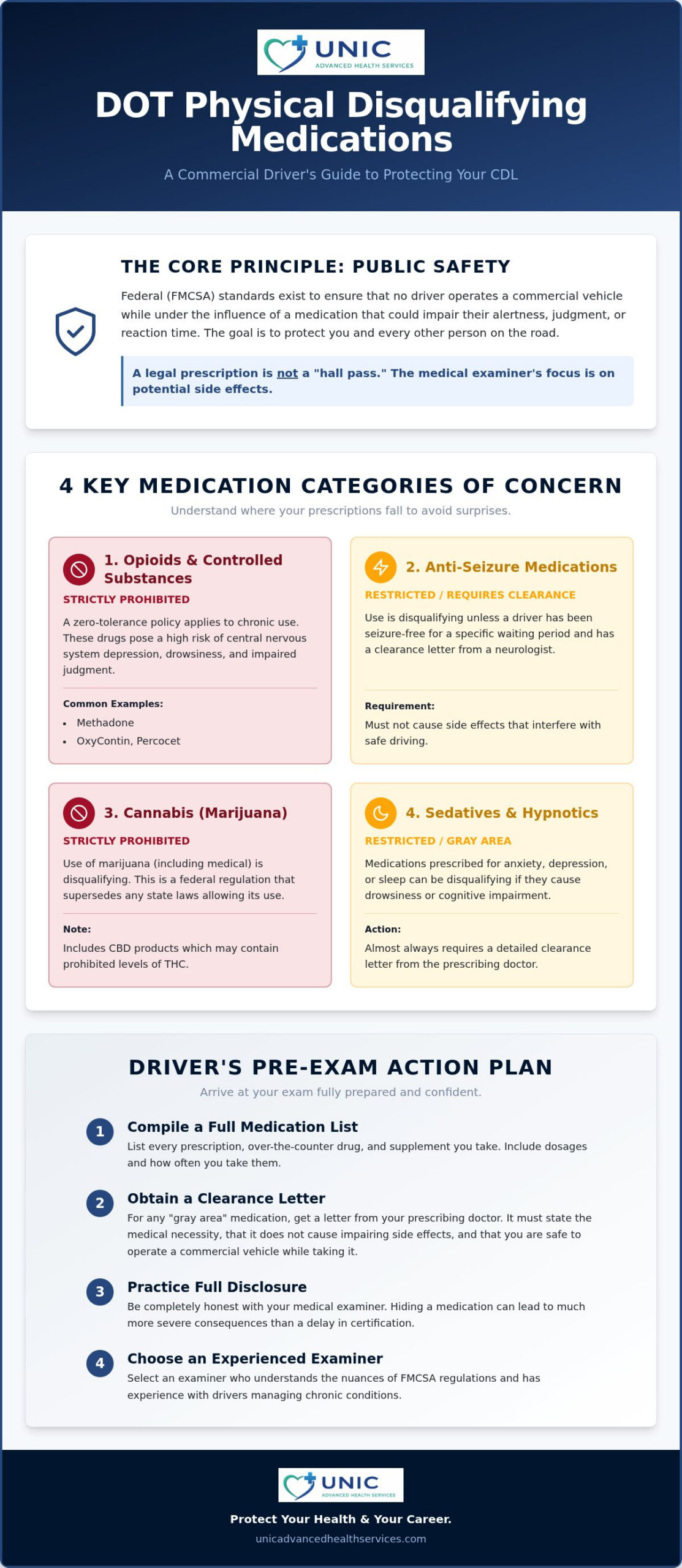
Driver’s Checklist: Preparing for Your Exam with Medications
Preparation is the most effective tool for managing the anxiety of a medical certification. When you arrive for your appointment, having your health data organized prevents delays and demonstrates to the examiner that your conditions are well-controlled. We recommend starting your review at least 30 days before your current medical card expires. This three-decade window provides enough time to secure any necessary clearance letters or adjust your treatment plan if you are currently taking common DOT physical disqualifying medications. Early action ensures that a simple paperwork delay doesn’t result in a “disqualified” status on your permanent driving record.
Consistency is equally vital on the day of your exam. Many drivers mistakenly believe that skipping a dose of blood pressure or diabetes medication will “clear their system” for the test. This approach is dangerous and often backfires. Skipping your hypertension medication can cause a rebound effect, leading to a high blood pressure reading that could limit your certification to just three months or result in a temporary disqualification. Take all medications exactly as prescribed by your doctor to ensure your vitals reflect your true, managed health status.
What to Bring to Unic Advanced Health Services
To streamline your visit to our Fort Lauderdale clinic, we suggest creating a “Medication Passport.” This is a simple, organized list that includes the names of all your prescriptions, the exact dosages, and the contact information for the prescribing doctors. If you have been diagnosed with obstructive sleep apnea, you must bring a compliance report from your CPAP machine covering the last 90 days. This data proves you’re receiving adequate rest and are safe for long hauls. Additionally, bring the names and phone numbers of any specialists you see, such as a cardiologist or neurologist, so Marc Joseph can quickly verify your clinical history if a “gray area” medication arises.
The “Don’ts” of Exam Preparation
Safety is our shared priority, so there are several pitfalls you must avoid. Never stop taking a prescribed medication without a direct order from your treating physician. Stopping a controlled substance abruptly can cause withdrawal symptoms or a recurrence of the underlying condition, both of which are safety risks. You should also be cautious with herbal supplements or over-the-counter aids that claim to be “DOT safe.” Federal standards in 2026 are rigorous; many natural supplements can interfere with lab results or cause unexpected side effects like heart palpitations. For more detailed strategies on navigating these requirements, you can read our guide on How to Pass Your DOT Physical Exam.
Managing your health while maintaining a commercial career requires a proactive healthcare partner. At Unic Advanced Health Services, we act as a steady hand to guide you through the complexities of federal medical compliance. If you’re unsure how your current prescriptions align with the 2024 handbook updates, we’re here to help you find a clear path forward. You can schedule your DOT physical exam at our convenient Fort Lauderdale location to ensure your documentation is handled with professional precision.
Expert DOT Physicals in Fort Lauderdale at Unic Advanced Health Services
Choosing the right medical examiner is a critical decision for your career, especially when your health history involves prescription management. At Unic Advanced Health Services, we specialize in providing a “steady hand” for drivers navigating the complexities of federal medical standards. Led by Marc Joseph, an experienced autonomous nurse practitioner, our clinic offers a high level of clinical seriousness combined with a supportive, patient-first perspective. We understand that your medical card is your livelihood, and our goal is to ensure you meet all regulatory requirements while maintaining your long-term health.
Our clinical environment is designed for modern efficiency. We provide on-site lab services, which means you don’t have to make extra stops at external diagnostic centers to get the data required for your certification. This is particularly beneficial for drivers who may be transitioning off common DOT physical disqualifying medications and need immediate verification of their clinical status. We also offer convenient Saturday hours in our Fort Lauderdale office, allowing you to schedule your exam without disrupting your busy hauling schedule or losing valuable time on the road.
A Compassionate Approach to Compliance
We believe in looking at the “whole driver” rather than just a checklist of regulations. Our approach to chronic disease management allows us to work collaboratively with your other healthcare providers to ensure your treatment plans are DOT-compliant. We help you bridge the gap between clinical necessity and federal safety standards, providing the professional oversight needed for complex medical cases. For fleet managers looking to maintain a healthy, compliant workforce, we also offer specialized Occupational Health Exam Fort Lauderdale services tailored to the needs of the transportation industry.
Schedule Your 2026 DOT Physical Today
Securing your medical certification shouldn’t be a source of stress. Our booking process is straightforward and designed for the convenience of drivers in Fort Lauderdale and the surrounding Florida communities. We offer affordable flat-fee pricing for our occupational physicals, ensuring you receive thorough, expert care without hidden costs. Whether you have a straightforward medical history or need assistance navigating “gray area” medications, our team is ready to provide the stable, professional guidance you deserve. Don’t wait until your current card is about to expire. Book your DOT Physical at Unic Advanced Health Services today!
Protecting Your Career with Proactive Medical Planning
Navigating the complexities of federal health standards doesn’t have to be a solo journey that threatens your livelihood. By understanding the categories of common DOT physical disqualifying medications and preparing your clinical documentation in advance, you can approach your next exam with total confidence. The key to a successful certification in 2026 lies in proactive communication with your medical team and a thorough understanding of the “stable on medication” requirement for conditional approvals.
At Unic Advanced Health Services, we’re dedicated to acting as your expert guide through every step of this process. Led by Marc Joseph, our autonomous nurse practitioner, we offer a specialized perspective on chronic condition management that prioritizes both your safety and your career longevity. With on-site lab work for immediate results and convenient Saturday appointments, we provide the modern efficiency you need to stay on the road. Don’t leave your CDL to chance. Schedule your professional DOT physical in Fort Lauderdale today and let our team provide the steady hand you need for a stress-free certification. We look forward to partnering with you for your long-term health and professional success.
Frequently Asked Questions
Can I pass a DOT physical if I take Adderall for ADHD?
Yes, you can pass your exam while taking Adderall, but it requires specific documentation. You’ll need a formal letter from your prescribing physician that confirms your diagnosis and states that the medication doesn’t impair your ability to safely operate a commercial vehicle. During your physical in Fort Lauderdale, our medical examiner will review this letter to ensure your treatment plan meets federal safety standards.
Is medical marijuana a disqualifying medication in 2026?
Yes, medical marijuana remains a disqualifying substance for all commercial drivers in 2026. Although Florida law permits its use for various medical conditions, the federal government still classifies cannabis as a Schedule I controlled substance. Because DOT regulations follow federal law, any driver who tests positive for marijuana or admits to its use will be disqualified from safety-sensitive duties until they complete a return-to-duty process.
What happens if my medication is on the disqualifying list?
If your current prescription is among the common DOT physical disqualifying medications, you won’t be able to receive a medical certificate immediately. You must work with your treating physician to find a safer, non-disqualifying alternative that manages your condition effectively. At Unic Advanced Health Services, we can coordinate with your doctor to help you transition to a treatment plan that complies with FMCSA safety requirements.
Do I need a letter from my doctor for blood pressure medication?
You typically don’t need a formal clearance letter for standard blood pressure medications if your readings are well-controlled during the exam. If your blood pressure is under 140/90 and you aren’t experiencing side effects like dizziness, the medication is generally accepted. However, bringing a list of your current dosages and prescribing doctors helps us verify your chronic condition management plan during your visit to our Fort Lauderdale clinic.
Can I take Benadryl or other OTC sleep aids before driving?
You should avoid taking Benadryl or any sedating over-the-counter sleep aids within 12 to 24 hours of operating a commercial vehicle. These medications often cause lingering drowsiness and significantly slower reaction times, which pose a major safety risk on the road. If you struggle with sleep, it’s better to discuss non-sedating options with a healthcare provider to ensure you remain alert and compliant with federal safety standards.
How does Unic Advanced Health Services help drivers with “gray area” meds?
Marc Joseph and our team provide a steady hand by reviewing the specific interactions of your medications. We use on-site lab work to get immediate clinical data and ensure your levels are stable for driving. Our Fort Lauderdale office acts as a bridge between your specialists and the DOT requirements, helping you secure the precise clearance letters needed to prove you’re “stable on medication” without side effects.
What is the most common medication that causes drivers to fail?
Opioids and habit-forming narcotics are the most common DOT physical disqualifying medications that lead to driver failure. These substances are strictly regulated because they depress the central nervous system and impair cognitive function. Even with a valid prescription for pain management, these drugs are often deemed incompatible with safety-sensitive tasks, making it essential to discuss alternative pain relief strategies with your medical provider before your exam.
Can I get a temporary DOT medical card while changing medications?
Yes, a medical examiner can issue a short-term or temporary certificate if you’re in the process of stabilizing on a new, non-prohibited medication. This is common for treatments related to high blood pressure or diabetes where a monitoring period is required. In Fort Lauderdale, we use these temporary cards to keep you working legally while we verify that your body is adjusting safely to the new treatment regimen.