
Your medical certificate shouldn’t feel like a barrier between you and your career on the water, yet the coast guard physical exam mariners must undergo often feels like a high-stakes hurdle. We understand the anxiety that comes with a ten-page form and the fear that a manageable health condition might sideline your ambitions. It’s common to feel overwhelmed by the technical requirements of the CG-719K or to struggle when searching for a provider who truly understands the rigors of maritime duty.
You deserve a clear path to compliance that treats your health as a long-term asset rather than a checklist of risks. This guide provides a comprehensive roadmap for 2026, offering clarity on the latest USCG medical standards and the specific differences between entry-level and professional rating forms. We’ll examine the current vision and hearing requirements, explain how to address potential medical disqualifiers, and help you identify a reliable local examiner who views your certification as a collaborative partnership. By the end of this article, you’ll have the tools to submit your application with confidence and peace of mind.
Key Takeaways
- Understand why the USCG physical is a mandatory component of your Merchant Mariner Credential and how it validates your ability to safely perform watchstanding duties.
- Identify the critical differences between Form CG-719K and CG-719K/E to ensure your coast guard physical exam mariners application is processed without administrative delays.
- Review the specific 2026 vision and hearing benchmarks required to meet federal maritime safety standards and maintain your professional standing.
- Learn which medical records and documentation to prepare before your appointment to streamline the evaluation and prevent the need for follow-up visits.
- Discover the advantages of working with a specialized maritime health provider who offers expert guidance through the complexities of federal medical compliance.
Understanding the Coast Guard Physical Exam for Mariners
The coast guard physical exam mariners undergo serves as a critical safeguard for the maritime industry. It acts as a mandatory medical evaluation required to obtain or maintain a Merchant Mariner Credential (MMC). Unlike a standard annual checkup, this evaluation focuses specifically on your ability to perform essential shipboard tasks. The primary objective is to confirm that you can safely handle watchstanding duties and respond effectively during emergency situations. In these high-pressure moments, your physical readiness directly impacts the safety of the vessel, the cargo, and your fellow crew members.
To gain a practical perspective on the examination process, watch this helpful walkthrough:
Federal regulations require that these examinations be performed by a United States licensed Physician, Physician Assistant, or Nurse Practitioner. These providers must evaluate your health against specific maritime standards rather than general wellness metrics. They look for conditions that could lead to sudden incapacitation or impaired judgment while at sea. Once the exam is complete, the results are submitted to the National Maritime Center (NMC). This agency conducts the final review to determine if a medical certificate should be issued, ensuring every mariner meets a uniform standard of fitness.
Who Needs a USCG Medical Certificate?
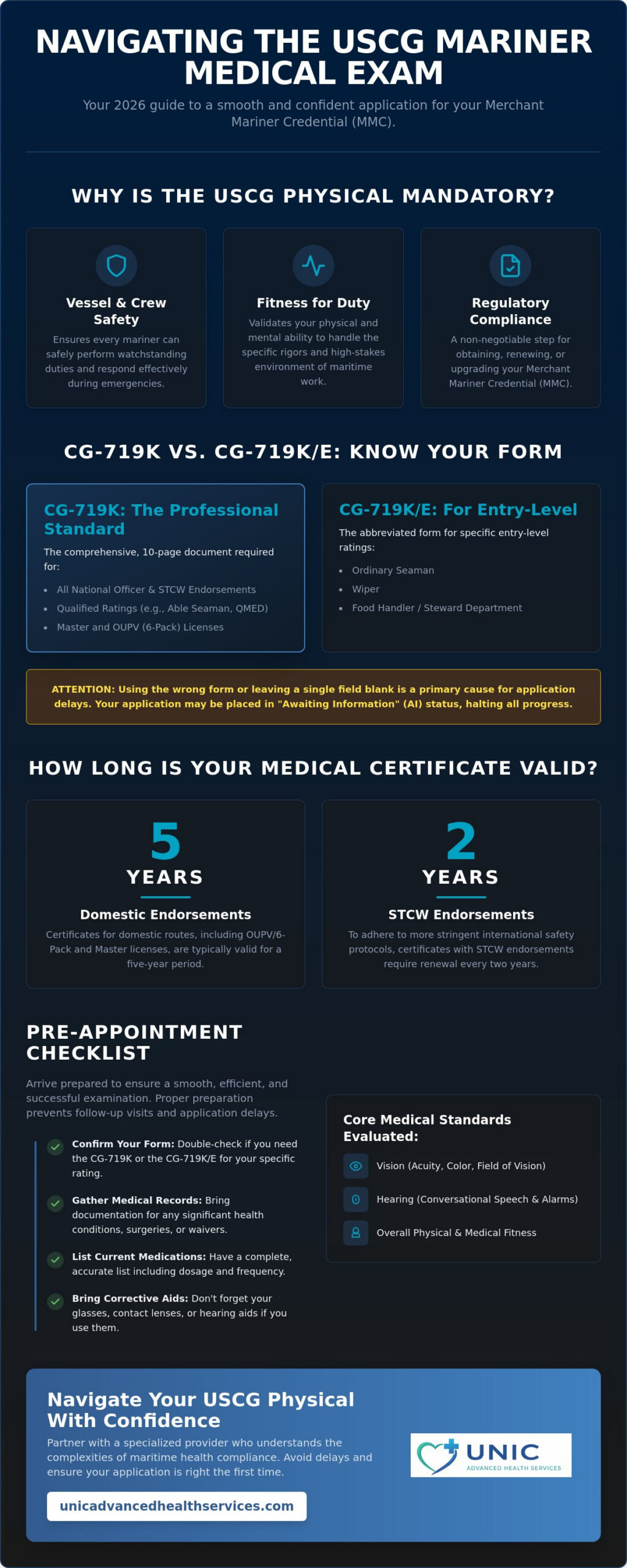
Every mariner seeking an original credential, a renewal, or an upgrade must hold a valid medical certificate. If you’re pursuing an OUPV (6-Pack) or a Master license, the coast guard physical exam mariners requirement remains a non-negotiable part of the application packet. There is a clear distinction between domestic endorsements and international STCW requirements. Domestic certificates are typically valid for five years. However, STCW endorsements require a renewal every two years because they adhere to more stringent international safety protocols. You should verify which standard applies to your specific route and vessel type before scheduling your appointment. Florida-based mariners can find detailed guidance on meeting these standards in this comprehensive resource on the USCG boat captain physical Florida requirements for 2026.
The Role of the National Maritime Center (NMC)
The NMC serves as the central clearinghouse for all maritime medical data in the United States. It’s essential to recognize that your medical certificate is a separate document from your physical credential. In 2026, the NMC has prioritized digital submission trends to reduce processing times and minimize paperwork errors. Submitting your forms through their online portal is now the standard method for avoiding the lengthy delays associated with traditional mail. This specialized agency ensures that every mariner on the water meets the same high standards of fitness, protecting both individual health and the integrity of the maritime profession.
Navigating Forms: CG-719K vs. CG-719K/E
Choosing the correct documentation is the first step in a successful application. Many mariners arrive at their appointment with the wrong PDF, which leads to wasted time and unnecessary stress. While both documents facilitate the official medical certificate requirements, they serve different career paths and license levels. Understanding which one you need ensures your examiner can focus on the correct clinical criteria from the start of your visit.
Completing these forms requires meticulous attention to detail. If a single field is left blank, the Coast Guard will place your application in “Awaiting Information” (AI) status. This status halts your progress until the missing data is provided. In 2026, electronic signatures are widely accepted; however, they must meet specific USCG verification standards to be valid. Working with a provider who understands these nuances, such as the team at Unic Advanced Health Services, can help you avoid these common administrative pitfalls.
CG-719K: The Standard for Professional Mariners
This 10-page document is the benchmark for professional mariners. It’s required for all officers, those seeking a Master or Mate license, and anyone with STCW endorsements. The CG-719K involves a deep dive into your medical history. It includes detailed sections for chronic condition management, current medications, and specialized physical tests. Because professional mariners often operate in remote environments, the Coast Guard requires this exhaustive level of detail to ensure you can handle the physical and mental demands of long-term duty. To help you maintain the psychological resilience needed for these roles, you can discover LivingWaters Integrative Health for specialized mental health services. It’s the most comprehensive version of the coast guard physical exam mariners must complete to maintain their professional standing.
CG-719K/E: Entry-Level and Small Vessel Options
The CG-719K/E is a streamlined version of the medical application. It’s primarily designed for entry-level ratings, such as ordinary seaman or wiper, and mariners on small vessels who don’t stand navigational watches. While it’s a simplified format, it still requires a comprehensive physical evaluation. The focus remains on basic physical fitness, vision, and hearing. If you’re applying for your initial credential and don’t require high-level endorsements, this form is often the appropriate choice. It provides a faster path for those just starting their maritime career or working in limited capacities.
Regardless of the form you use, the coast guard physical exam mariners undergo remains a thorough assessment of fitness for duty. Both forms require the same level of professional integrity from your medical examiner. Using the 2028 expiration version of these forms is currently recommended to ensure your packet remains valid throughout the processing period. Always double-check the expiration date in the top corner of the PDF before your appointment to prevent avoidable delays.
Core Medical Standards: Vision, Hearing, and Fitness
The clinical standards for the coast guard physical exam mariners must pass are designed to evaluate operational safety under stress. These benchmarks ensure that every individual on a vessel can reliably detect hazards and respond to emergencies. In the 2026 evaluation cycle, there is an increased focus on chronic condition management. This ensures that mariners with manageable health issues can continue their careers through a collaborative clinical partnership rather than facing immediate disqualification. Your examiner’s role is to verify that your physical health supports the demanding nature of life at sea.
Vision and Color Blindness Requirements
Clear sight is non-negotiable for maritime safety. Mariners must demonstrate a visual acuity of at least 20/40 in each eye, which can be achieved with or without corrective lenses. If you use glasses or contacts, your uncorrected vision must still meet a minimum threshold of 20/200 to ensure you can function if your corrective aids are lost or damaged. These requirements are explicitly detailed in Form CG-719K, which serves as the primary clinical record for your evaluation.
Color sense is equally vital for safe navigation. The standard screening typically uses the Ishihara pseudoisochromatic plate test. You must be able to distinguish between red, green, blue, and yellow to interpret navigation lights and signal flags correctly. If you don’t pass the initial plate test, don’t panic. The Coast Guard allows for alternative testing methods, such as the Farnsworth Lantern test or similar approved equipment, to confirm your functional color vision. Passing these secondary tests still allows you to meet the necessary safety thresholds for most endorsements.
Hearing and Physical Agility Standards
Auditory health ensures you can hear alarms, radio transmissions, and verbal commands over the roar of an engine room. Most exams begin with a “whisper test” conducted at a distance of five feet. If this initial screening is inconclusive, a formal audiometer test may be required to measure specific decibel thresholds. The goal is to ensure you aren’t a risk to yourself or others due to an inability to communicate in high-noise environments.
Physical agility is assessed through functional movements that mimic shipboard tasks. You may be asked to demonstrate your ability to:
- Climb vertical ladders and move through narrow hatches without difficulty.
- Lift and carry emergency equipment weighing up to 40 pounds.
- Maintain balance on moving surfaces or uneven decks.
- Step over coamings and other structural obstacles without assistance.
These tests confirm you possess the stamina to assist in shipboard emergencies, such as firefighting or abandon-ship drills. If you have concerns about a specific physical limitation, discussing your history of chronic condition management with your provider can help establish a clear record of your functional abilities. This proactive approach often simplifies the review process when your results reach the National Maritime Center. A steady hand and a clear medical history are your best assets during the coast guard physical exam mariners process. Mariners in Florida seeking to understand exactly how blood pressure thresholds and other clinical benchmarks are applied can review the full breakdown in this guide to the USCG boat captain physical Florida certification process.
Preparing for Your Appointment: A Mariner’s Checklist
Thorough preparation is the most effective way to streamline the coast guard physical exam mariners require for their credentials. Arriving at the clinic with a complete set of documentation prevents the frustration of “pending” results and the need for costly follow-up visits. We view this process as a professional partnership where your organization directly impacts the speed of your certification. By gathering your records ahead of time, you allow your examiner to focus on the clinical assessment rather than administrative troubleshooting. Preparation pays off.
What to Bring to the Clinic
You should arrive with a printed copy of the correct form, either the standard CG-719K or the entry-level CG-719K/E. It’s vital to ensure the version you use has the current September 30, 2028, expiration date to avoid rejection by the National Maritime Center. You must also present a valid government-issued photo ID and your current Merchant Mariner Credential if you’re seeking a renewal. If you rely on corrective lenses or hearing aids for daily duties, bring them to the appointment. The examiner needs to verify your vision and hearing acuity while you’re using these devices to confirm you meet the necessary safety thresholds for duty.
Documenting Chronic Conditions
Providing a clear history of chronic condition management is essential for mariners with ongoing health concerns. The Coast Guard requires examiners to document the stability of any condition that could impact shipboard safety or lead to sudden incapacitation. You should prepare a comprehensive list of all current medications, including precise dosages and the contact information for your prescribing physicians. Bringing recent lab results for conditions such as hypertension or high cholesterol helps establish a baseline of health and stability. Mariners with diabetes or sleep apnea must bring their latest compliance reports. These documents prove that your condition is under control and that you’re adhering to your prescribed treatment plan.
A well-documented medical history transforms a complex regulatory hurdle into a straightforward clinical review. It provides the “steady hand” evidence the Coast Guard needs to issue your certificate without delay. If you’re ready to complete your evaluation with a provider who understands these specific requirements, Schedule your U.S. Coast Guard Boat Captain Physical today. Our team is dedicated to providing the thoroughness and individualized care you need to stay on the water.
Professional USCG Physicals in Fort Lauderdale at Unic Advanced Health
Unic Advanced Health Services serves as a dedicated partner for the Florida maritime community. We specialize in occupational health, specifically focusing on the coast guard physical exam mariners need to maintain their professional credentials. Our practice is led by an autonomous nurse practitioner who possesses deep expertise in federal maritime regulations. This specialized knowledge ensures that your evaluation is conducted with clinical precision and a thorough understanding of what the National Maritime Center requires. By integrating primary care with occupational evaluations, we offer a holistic health approach that supports your long-term wellness alongside your career goals.
A holistic health regimen also includes specialized care for your skin, especially given the high levels of sun exposure mariners face; consulting a cosmetic dermatologist beverly hills can provide the expert attention needed to address these environmental impacts.
Our Fort Lauderdale clinic provides a supportive environment designed to alleviate the stress of medical compliance. We recognize that your time is valuable and that your career depends on a successful submission. To accommodate the demanding schedules of maritime professionals, we offer flexible appointment times, including Saturday availability. This ensures you can complete your U.S. Coast Guard (USCG) Boat Captain Physical without disrupting your operational duties. Our location is easily accessible for mariners working out of Port Everglades and the surrounding marinas, making us a convenient choice for your next renewal.
The Advantage of a Specialized Occupational Examiner
Working with a specialized examiner provides a significant advantage over visiting a general practitioner. General providers often lack familiarity with the specific nuances of maritime standards, which frequently leads to the dreaded “Awaiting Information” (AI) letters from the NMC. We understand these common pitfalls and meticulously review every section of your documentation to ensure total compliance. Our approach combines clinical seriousness with compassionate, patient-first care. Because we offer on-site lab services, we can streamline the entire documentation process, ensuring that all necessary tests are completed and recorded during a single visit. This efficiency reduces the likelihood of administrative delays and helps you return to work faster.
Booking Your Fort Lauderdale Maritime Exam
Scheduling your appointment is a straightforward and transparent process. We cater to individual captains seeking their first license and entire vessel crews requiring simultaneous renewals. Our practice maintains transparent flat-fee pricing for USCG occupational physicals, ensuring there are no surprises during your visit. We’re committed to being a reliable healthcare partner for the maritime industry, providing the stability and thoroughness you expect from a professional medical home. If you’re ready to move forward with your certification, Schedule your USCG physical exam in Fort Lauderdale today. Our team is here to guide you through every step of the medical certification process with a steady hand and expert care.
Securing Your Professional Future on the Water
Securing your medical certificate is a fundamental step in your professional maritime journey. By selecting the correct 2028 version of Form CG-719K and documenting your health history proactively, you eliminate the most common causes of application delays. A successful coast guard physical exam mariners undergo depends on both clinical accuracy and a comprehensive understanding of current National Maritime Center standards. Your health is your most valuable asset on the water; proper preparation ensures it remains a bridge to your career rather than a barrier.
Unic Advanced Health Services provides the expert guidance necessary to navigate these complex federal requirements. Our practice is led by an experienced autonomous nurse practitioner with deep expertise in USCG and DOT compliance. We offer a convenient Fort Lauderdale location with Saturday hours to accommodate your operational schedule and provide a supportive environment for your evaluation. Book Your USCG Physical Exam at Unic Advanced Health Services to ensure your documentation is handled with the thoroughness and individualized care your career demands. We look forward to supporting your long-term health and your professional success at sea.
Frequently Asked Questions
Can a Nurse Practitioner sign my USCG physical form?
Yes, a licensed Nurse Practitioner (NP) can legally sign your USCG physical form. Federal regulations permit Physicians, Physician Assistants, and Nurse Practitioners to conduct the examination and certify the results. It’s essential that the provider is licensed within the United States. Our practice is led by an autonomous nurse practitioner with extensive experience in maritime compliance, ensuring your documentation meets all National Maritime Center standards for accuracy and thoroughness.
What happens if I have a medical condition like high blood pressure?
A diagnosis of high blood pressure doesn’t result in an automatic denial of your medical certificate. The Coast Guard requires evidence that the condition is stable and effectively managed through medication or lifestyle changes. You should bring your most recent lab results and a list of current medications to your appointment. Your examiner will document your blood pressure readings and treatment plan to demonstrate that you can safely perform your duties at sea.
How long is a Coast Guard medical certificate valid for in 2026?
In 2026, the validity of your medical certificate depends on your specific endorsement. For mariners operating under STCW protocols, the certificate is valid for two years. If you’re working on vessels not subject to STCW requirements, the certificate is generally valid for five years. Always check the specific expiration date printed on your current certificate to ensure you remain in compliance with federal maritime safety regulations and avoid gaps in your credentialing.
Will the Coast Guard deny my license if I am color blind?
The Coast Guard won’t necessarily deny your license if you fail the initial color vision screening. While you must distinguish between red, green, blue, and yellow, the Ishihara plate test is just the first step. If you don’t pass, you can undergo alternative testing, such as a Farnsworth Lantern test or other approved methods. These secondary evaluations help determine if your functional color vision is sufficient for safe navigation and watchstanding duties.
Do I need a drug test at the same time as my physical exam?
While the medical certificate application doesn’t strictly include the drug test results, you’ll need a DOT 5-panel drug screen for your complete Merchant Mariner Credential packet. Many mariners choose to complete both during the same visit for convenience. We offer on-site lab services to streamline this process, allowing you to handle multiple regulatory requirements in one efficient appointment while ensuring all samples meet federal collection and chain-of-custody standards.
How long does it take for the NMC to process my medical certificate?
Processing times at the National Maritime Center vary based on current application volumes and the accuracy of your submission. Digital submissions through the online portal generally result in faster processing than mailed applications. To avoid delays, ensure every field on your form is complete and all supporting documentation for chronic conditions is included. Most mariners see their certificates issued within several weeks if the application packet is entirely error-free.
What medications are prohibited for mariners by the USCG?
The USCG prohibits medications that cause impairment, including most narcotics, benzodiazepines, and certain sedatives. Some medications require a specific observation period to ensure they don’t cause side effects that interfere with safety-sensitive duties. It’s vital to disclose all prescriptions during your coast guard physical exam mariners evaluation. Your examiner will review your medications against current federal guidelines to determine if a waiver or additional documentation from your prescribing physician is necessary for approval.
Can I get my USCG physical on a Saturday in Fort Lauderdale?
Yes, you can schedule your coast guard physical exam mariners appointment on a Saturday at our Fort Lauderdale clinic. We understand that mariners often work non-traditional hours and require flexible scheduling options. Our Saturday hours provide a convenient alternative for those who can’t visit during the standard work week. We’re committed to providing accessible, professional care that fits your schedule while ensuring you meet all mandatory maritime medical requirements for your credential.