
A complete, accurate form is your first defense against avoidable delays. Make sure you submit a complete copy of the form, including its instructions. Common mistakes on a USCG medical application include leaving fields blank, overlooking required signatures, and failing to attach supporting medical records.
It’s understandable to worry that a medical condition or a paperwork error could jeopardize your application. This guide explains which conditions may need additional documentation, what information a supporting provider’s report should include, and how to make sure the form and records are complete before submission. If your application is denied, a written reconsideration request must be postmarked within 30 days of the denial letter. The steps ahead will help you prepare carefully and understand what to do if the Coast Guard needs more information.
Key Takeaways
- Describe relevant conditions, symptoms, treatment, medication effects, and how the condition is managed so the medical review has useful context.
- Attach supporting provider statements and test results, making sure records are signed and clearly connected to the condition reported.
- Keep a copy of the completed application and every attachment so you can track exactly what you submitted.
- Make sure a DOT 5-panel drug test falls within 185 days of the application, as required under 46 CFR 16.220, according to the Office of the Federal Register, National Archives and Records Administration.
- Review the full submission for missing details and supporting records; incomplete information can lead to a request for more information and delay processing.
Conditions requiring further medical documentation
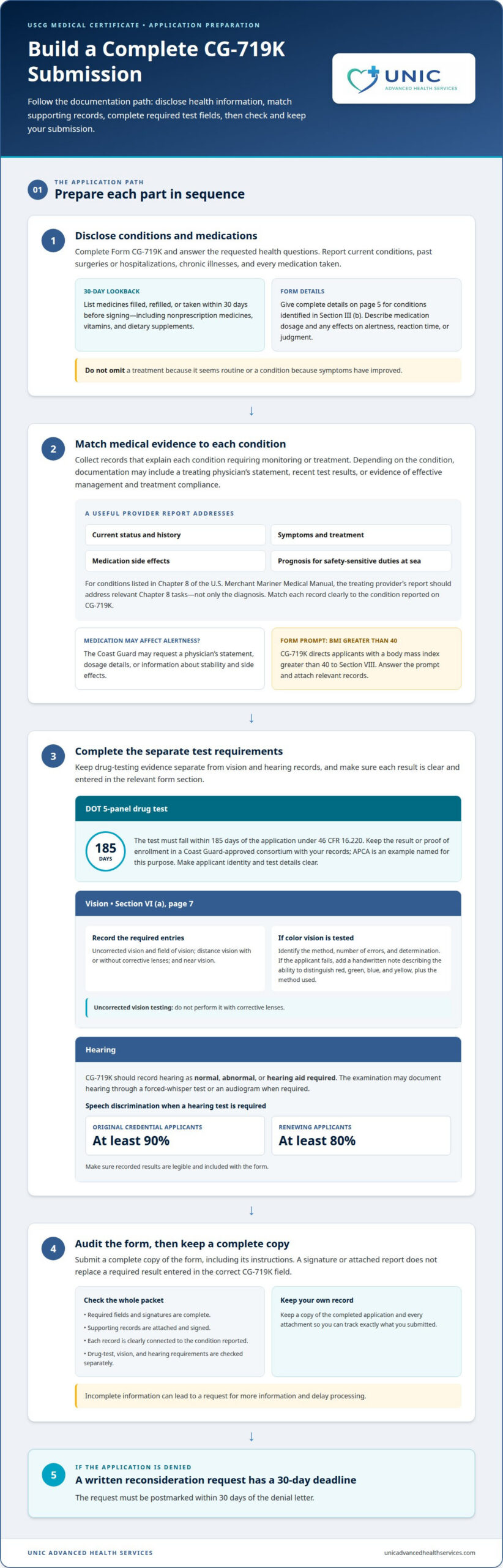
For a USCG medical certificate, complete Form CG-719K and disclose the requested health information. List medications filled, refilled, or taken within 30 days before signing the form.
-
Disclose Medical Conditions and Medications
Report current conditions, past surgeries or hospitalizations, chronic illnesses, and every medication you take. On page 5, provide complete details for conditions identified in Section III (b) of CG-719K. Include nonprescription medicines, vitamins, and dietary supplements used within 30 days before signing.
Describe your medication dosage and any effects on alertness, reaction time, or judgment. This information helps the Coast Guard assess whether a medication needs further review before issuing a certificate. Don’t omit a treatment because it seems routine or a condition because its symptoms have improved.
-
Gather Supporting Medical Records
Collect records that explain each condition requiring monitoring or treatment. Depending on the condition, supporting documentation may include a treating physician’s statement, recent test results, or evidence of effective management and treatment compliance. Match each record to the condition you reported on CG-719K.
For a medication that may affect alertness, the Coast Guard may request a physician’s statement, dosage details, or information about stability and side effects. Ask your treating provider to address the medication and condition directly. A record that is not clearly connected to your application may not answer the medical review’s questions.
- Review whether a condition appears in Chapter 8 of the U.S. Merchant Mariner Medical Manual, where listed conditions may require additional documentation from the treating provider. A useful report should explain the condition’s current status and history, symptoms, treatment, medication side effects, and prognosis for safety-sensitive duties at sea.
Ask the provider’s report to address your ability to perform relevant Chapter 8 tasks, not only your diagnosis. For example, a report about a condition managed with medication should describe management, side effects, and any effect on duties. This context helps the Coast Guard evaluate the medical information without avoidable waiting for clarification.
Check the form’s specific prompts before signing. CG-719K directs applicants with a body mass index greater than 40 to Section VIII. Answering that direction and attaching relevant records gives the medical reviewer clearer information than leaving the prompt unexplained.
Prepare drug-test records and medical-condition documents separately. The drug test is a distinct application requirement, while physician statements and test results support disclosed health conditions. Review both categories before submitting so a missing medical record doesn’t delay an otherwise complete certificate application.
Missing supporting medical documentation
Prepare the test results and examination details that complete your CG-719K submission. Separate drug-testing evidence from vision and hearing records so each item is easy to match to its form section.
- Match your drug-testing document to the Coast Guard application timeline. A U.S. Coast Guard applicant’s DOT 5-panel drug test must fall within 185 days of the application under 46 CFR 16.220, according to the Office of the Federal Register, National Archives and Records Administration.
Keep the result or proof of enrollment in a Coast Guard-approved consortium with your application records. APCA is an example of a consortium named for this purpose. Make sure the applicant’s identity and test details are clear, and include the result in your submission rather than assuming another maritime credential file will provide it.
- Record vision results carefully in the designated fields. Form CG-719K asks for uncorrected vision and field-of-vision entries in Section VI (a) on page 7. The uncorrected vision test should not be performed with corrective lenses. Distance vision, with or without corrective lenses, and near vision should also be documented as part of the examination.
Include the field-of-vision result, not just an acuity measurement. If color vision testing is performed, identify the method, number of errors, and determination. If an applicant fails the color vision test, add a handwritten note describing the ability to distinguish red, green, blue, and yellow, along with the method used.
- Confirm that the hearing section records a clear result. CG-719K should mark hearing as normal, abnormal, or hearing aid required. The examination may document hearing through a forced-whisper test or an audiogram when required. If the provider completes a hearing test, make sure the recorded results are legible and included with the form.
For original credential applicants taking a hearing test, speech discrimination must be at least 90 percent. Renewing applicants must show at least 80 percent when a hearing test is required. These figures help explain why missing or incomplete hearing results can prompt questions during review.
- Review the completed record against every relevant CG-719K test field before submission. A signature or attached report cannot replace a required result entered in the correct section. For example, a separate vision note does not fill the form’s page 7 field-of-vision entry.
If you need the medical examination completed for a captain application, Unic Advanced Health Services offers a USCG Boat Captain Physical. Keep its examination results with the supporting paperwork, then confirm that required findings appear on the Coast Guard form itself.
Keeping copies of submissions
Save a complete record of the CG-719K package before submitting it. An organized copy helps you identify what went to the Coast Guard and respond accurately if questions arise.
- Create one final copy of the application and every attachment you plan to submit. Include the completed CG-719K, supporting medical records, test results, and any required statements. Keep the documents together as one dated package, rather than saving only the form and trying to reconstruct its attachments later.
Before submitting, compare your saved copy with the actual application package. For example, if the application includes a provider statement about a reported condition, confirm that the statement is in the copy. This final check helps you identify which documents accompanied your medical certificate application.
- Keep a simple inventory beside your CG-719K copy. List each document by type and purpose, such as “vision results” or “treating provider statement.” Add the related form section when you can identify it. This makes it easier to locate a specific record without searching through unrelated medical files.
Use clear file names that distinguish versions. A label such as “CG-719K-submitted” helps separate the signed application from an earlier draft. Apply the same method to a captain’s vision report or drug-testing record, so you don’t mistake an outdated file for the version included in the submission.
- Record when and how you submit the package. Keep any submission confirmation or mailing record with your saved documents. If someone who already holds an MMC submits the medical application separately, record that it is separate from a new or renewal credential application.
That distinction matters when you review your records later. A new or renewal MMC application may include medical certificate paperwork, while an existing MMC holder may submit it separately. Note which route you used and retain the corresponding package rather than combining it with another license application.
- Preserve the copy in a private, organized location and keep a backup. Medical records contain personal information, so avoid leaving the CG-719K package in a shared folder that others can access. Use a clear folder name and keep the same document order as your submitted package.
If the Coast Guard requests information, compare the request with your saved inventory before responding. Identify whether it concerns a provider statement, a test result, or a form entry. A copy won’t replace a required document, but it helps you trace what you submitted and prepare a focused response.
Medical provider exams and required signatures
Complete the examination on Form CG-719K, then review its findings and signatures before submission. A separate physical, drug-testing record, or provider letter doesn’t replace required entries on the Coast Guard form.
- Complete the online Navita sections and print the generated CG-719K before your medical examination. Bring that form to the appointment so the provider can record results in the correct fields. A DOT or employer physical does not replace the USCG medical exam unless it’s completed properly on the required Coast Guard form.
This distinction matters for a merchant mariner using an employer’s physical paperwork. The examiner must document the Coast Guard evaluation on CG-719K itself. Drug testing records also remain separate from the medical examination, so don’t treat one as a substitute for the other.
- Have a qualified medical professional perform the evaluation. Under 46 CFR 10.302(b), a licensed medical doctor, physician assistant, or nurse practitioner may perform the U.S. Coast Guard medical evaluation. The examiner assesses whether a mariner can perform essential shipboard tasks, including standing watch, climbing, and working in confined or noisy spaces.
The review also considers your ability to respond to emergencies aboard a vessel. Give the provider a clear account of relevant health concerns and limitations. This context helps the examiner document findings related to the work a mariner may need to perform at sea.
- Review every examination entry on CG-719K before leaving the appointment. The form should record a normal or abnormal response for each listed body system or organ. It should also include the applicant’s physical ability results and all required test results on page 7.
Check that the provider selected a certification recommendation: Recommended, Not Recommended, or Needs Further Review. The form also asks the provider to indicate Yes, No, or Needs Further Review for significant risk of sudden incapacitation. A missing selection can leave the examination incomplete.
- Confirm that both you and the provider sign and date the USCG medical evaluation form. The provider should also include a license number. Check the names, dates, and signature fields before submitting, since an unsigned form can be returned for correction.
Make sure examination findings appear on CG-719K itself. A letter from an internist on letterhead isn’t a substitute for recording those findings on the form. The medical practitioner attestation also warns that knowingly omitting or falsifying material information may result in criminal prosecution under 18 USC § 1001.
Missing information rates and processing delays
Complete each part of Form CG-719K before applying. Missing or unclear entries can prompt a Request for More Info from the National Maritime Center and delay review.
- Review every section, including fields that don’t apply to you. Enter “N/A” where appropriate instead of leaving a blank. For example, if a question doesn’t fit your medical history, mark it clearly rather than assuming the reviewer will infer your answer.
Submit all 10 pages of CG-719K, including its instructions. Use the page order shown on the form, then check that no page is missing, duplicated, or difficult to read. A complete packet lets the National Maritime Center review the application without first requesting basic pages or answers.
- Compare each answer with the supporting document it refers to. If a form entry mentions a test result or provider statement, make sure the record is attached and readable. A missing attachment can leave a health response incomplete, even when the form itself is filled in.
Check the details for consistency before submitting. For instance, compare the condition named on CG-719K with the condition addressed in the attached statement. Correct a mismatch while preparing the packet, rather than leaving the reviewer to determine whether two documents refer to the same issue.
- Check handwriting, dates, and required signatures throughout the application. Unclear writing can make a response difficult to interpret, while a missing date can leave a completed form unfinished. Review the applicant and medical provider fields separately, since each person has information to complete.
Use a final page-by-page review of CG-719K. Confirm that each section has an answer, each required result is legible, and each supporting record is included. This practical pass can catch an overlooked “N/A” or a page left out during scanning.
- Understand why completeness matters: more than 10% of U.S. merchant mariner medical certificate applications are missing information on average. The National Maritime Center issued 7,882 awaiting-information reasons for medical certificate applications in 2021.
Those figures make a careful review worthwhile, but they don’t predict the outcome or timing of an individual application. Missing test results, physician statements, or form answers can trigger a request for more information. Respond to any National Maritime Center request by addressing the specific missing item, and keep your response with your application records.
- Organize the medical certificate application separately from the Merchant Mariner Credential application. The Coast Guard medical certificate application is separate, even when submitted with a new or renewal MMC application. If you already hold an MMC, you can also submit medical paperwork separately.
Label the package according to its purpose and make sure the medical form and supporting records are together. This helps prevent a medical document from being overlooked among credential paperwork and makes it easier to identify what the National Maritime Center needs.
Unic Advanced Health Services: DOT Physical Examination
Unic Advanced Health Services offers a U.S. Coast Guard (USCG) Boat Captain Physical for applicants preparing for their medical evaluation. If you need a Coast Guard examination completed on the required form, this is a relevant next step after organizing your application and supporting records.
A DOT Physical Examination is a separate service and doesn’t replace the USCG medical evaluation. If you manage a chronic condition, Chronic Condition Management may also support your ongoing care. Bring your relevant medical history and current medication details to inform the examination.
For support with a USCG Boat Captain Physical or related health needs, contact Unic Advanced Health Services or visit unicadvancedhealthservices.com.
Take the Next Step With Confidence
A well-prepared application gives you a clearer starting point for the Coast Guard’s review. Set aside time to organize your paperwork, note questions about your medical records, and keep your completed materials accessible. This preparation can make it easier to respond if the National Maritime Center requests clarification.
Avoiding common mistakes on a USCG medical application is part of preparing for the responsibilities of working at sea. If you need help with the medical examination itself or ongoing care for a chronic condition, choose a next step that fits your needs and supports your health alongside your application.
Unic Advanced Health Services offers medical services relevant to mariners, including a U.S. Coast Guard Boat Captain Physical, as well as DOT Physical Examination and Chronic Condition Management. Contact Unic Advanced Health Services to discuss your care needs and take your next step with clarity.
Frequently Asked Questions
What Happens If Your Application Is Denied?
You can request reconsideration in writing after a denial. Under 46 CFR 1.03-40, the request must be postmarked within 30 days of the denial letter. Address the reason stated in the letter and include relevant information or records. Keep a copy of your request and mailing record. This creates a clear reference if you need to follow up on the reconsideration process.
What Is Form CG-719K, and Who Needs It?
Form CG-719K is the Coast Guard medical evaluation form used by applicants seeking a medical certificate. The standard form is 10 pages and is used by applicants for OUPV/Six-Pack and Master licenses. CG-719K/E serves a narrower group of entry-level and staff-officer mariners. The medical certificate application is separate from the Merchant Mariner Credential application, even when submitted alongside it.
What’s the most common CG-719K mistake?
No single error applies to every applicant, but incomplete answers are avoidable. Common mistakes on a USCG medical application include unclear responses or inconsistent details across form entries. For example, if your medication list differs from a supporting record, reviewers may need clarification. Compare related answers and documents before submitting so your packet presents a consistent account.
What forms are required for a USCG medical certificate application?
Form CG-719K is the standard medical application form, and applicants must submit all 10 pages, including its instructions. Supporting records may also be needed for reported conditions or examination findings. The medical certificate paperwork is separate from the Merchant Mariner Credential application. It can accompany a new or renewal MMC application, or be submitted separately by someone who already holds an MMC.
How should I complete USCG Form CG-719K and avoid common errors?
Complete the form section by section, following each prompt rather than relying on assumptions. To avoid common mistakes on a USCG medical application, check that identifying details match across pages and every applicable field has a clear response. For example, an inconsistent name or date can complicate record matching. Review the finished form for legibility, then keep a copy for your files.
What medical conditions must be disclosed on a USCG medical application?
Disclose current medical conditions, chronic illnesses, past surgeries or hospitalizations, and medications you take. A condition still matters even if it is controlled or has caused no recent symptoms. For example, an applicant with managed hypertension should report it and provide information requested by the form. Complete disclosure gives the Coast Guard a clearer basis for reviewing your health information and relevant supporting records.
What medications can affect USCG medical certificate eligibility?
Medications that cause drowsiness, reduce alertness, slow reaction time, or impair judgment may receive additional review. The Coast Guard may request dosage information or a provider’s statement about stability and side effects. Report prescription and nonprescription medications, vitamins, and dietary supplements filled, refilled, or taken within 30 days before signing CG-719K. Don’t change prescribed treatment to prepare your application.
What documents and medical records should I submit with a USCG medical application?
Provide records that clarify conditions requiring monitoring or treatment. These may include a treating provider’s statement, relevant test results, or documentation describing how a condition is managed. For example, a report about medication treatment can explain its purpose and relevant side effects. Match each attachment to the condition or form response it supports, and make sure the record is legible and clearly identifies its subject.