
A captain’s license can hinge on medical fitness, not just boating experience. Applicants for U.S. OUPV/Six-Pack and 25-, 50-, or 100-ton Master licenses need a medical certificate; applicants who don’t meet the short-form categories use Form CG-719K. A licensed medical doctor, physician assistant, or nurse practitioner may perform the evaluation under 46 CFR 10.302(b). According to the U.S. Coast Guard, a medical certificate for national mariners is valid for up to five years. This guide provides USCG medical form CG-719K assistance by clarifying who can complete the form and what to prepare.
It’s understandable to want a clear answer before scheduling an examination or gathering medical records. The form asks about health history and physical ability, and the required information can depend on your endorsement and circumstances. Here, you’ll learn how the CG-719K applies to OUPV and Master applicants, which medical professional can conduct the evaluation, what supporting records should document, and how renewal and medical standards fit together. With the requirements laid out step by step, you can prepare for the process with greater confidence.
Key Takeaways
- Find out whether your OUPV or Master application calls for a medical certificate and which form applies to your endorsement.
- Learn which licensed medical professionals can perform the evaluation and what their role involves.
- Prepare supporting records that document medical history and test results clearly, including color-vision testing.
- Review the physical and medical standards that may affect certification, renewal, and the information you report.
- Use a section-by-section approach to complete the form and disclose medications and supplements accurately.
Can my family doctor complete the CG-719K?
Form CG-719K is the application for a U.S. Coast Guard medical certificate. Your family doctor may perform the evaluation if they are a licensed medical doctor. Under 46 CFR 10.302(b), a licensed medical doctor, physician assistant, or nurse practitioner may conduct it. The practitioner evaluates your fitness for maritime duties and completes the relevant medical sections. For USCG medical form CG-719K assistance, start by identifying who will conduct your evaluation and what records they need.
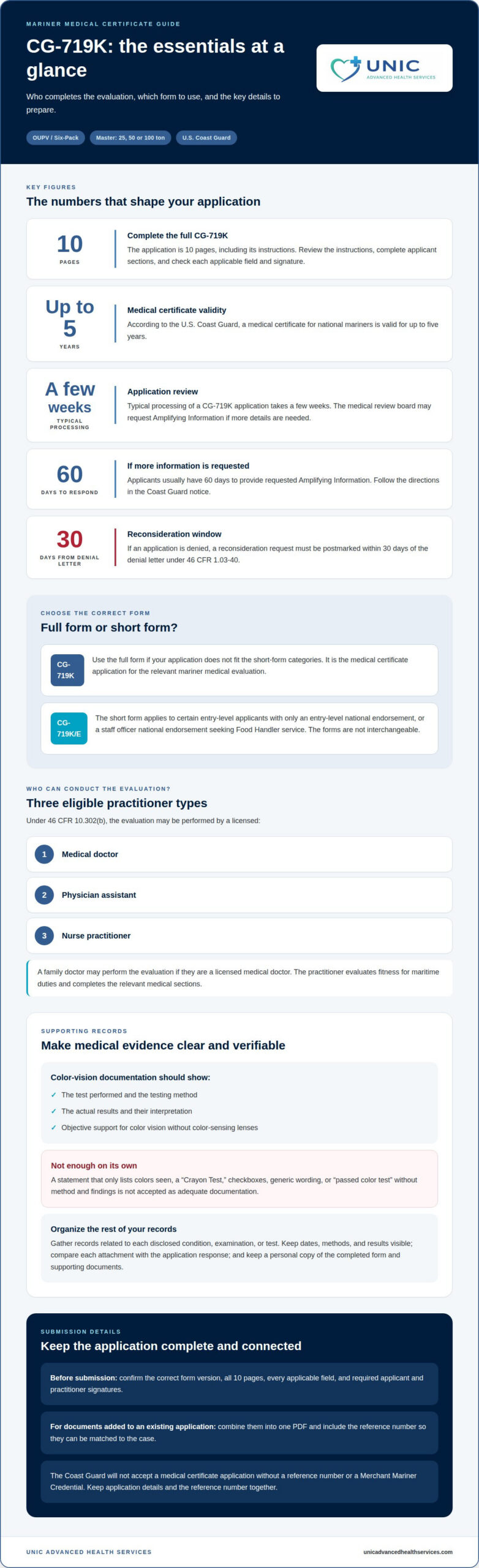
A Merchant Mariner Credential, or MMC, is the credential sought by many mariners. The medical certificate application supports the Coast Guard’s review of medical fitness for that credential. Applicants should complete all 10 pages of Form CG-719K, including its instructions. Read those instructions before your appointment, complete the applicant sections, and bring relevant records. The form also includes physical-ability tasks, so review those before the examination.
Form CG-719K/E is the short form for certain entry-level applicants. It applies to mariners with only an entry-level national endorsement or a staff officer national endorsement seeking Food Handler service. The forms serve different applicant categories, so they aren’t interchangeable. If your application doesn’t fit those short-form categories, use the full CG-719K. Allow enough time to review and complete the form’s information collection.
A reference number identifies an application already submitted to the Coast Guard. To add documents to an existing application, combine them into one PDF and submit them with the reference number. The Coast Guard will not accept a medical certificate application without a reference number or a Merchant Mariner Credential. Keep your application details and reference number together so additional documents can be matched to the correct case.
An application status update describes the Coast Guard’s handling of submitted materials. Typical processing of a CG-719K application takes a few weeks. The medical review board may request Amplifying Information, meaning further details needed to evaluate the application. Applicants usually have 60 days to provide requested information. Follow the instructions in any notice about a decision or additional documentation.
A completeness review checks that the form and attachments are ready for submission. Confirm you used the correct version, completed every applicable field, and included all 10 pages. Check for required applicant and practitioner signatures. Missing pages, unanswered fields, or documents separated from the application can delay review. For USCG medical form CG-719K assistance, a final page-by-page review can help catch omissions before submission. If the Coast Guard denies an application, a reconsideration request must be postmarked within 30 days of the denial letter under 46 CFR 1.03-40.
Supporting documents and medical records
Supporting documentation helps explain your medical history or test results. For a mariner applying for a certificate, clear records can connect the information reported on the application with the practitioner’s evaluation. Gather relevant documents before the appointment and organize them by condition or test. For example, file a vision-test report with other vision records. Keep the date, testing method, and results visible so it is clear what the report documents.
Color-vision documentation records an objective test and its results. The Coast Guard does not accept statements that simply list colors seen without a documented test. It also rejects informal methods such as the “Crayon Test,” checkboxes, and generic wording that omits the test method. Bring a report that identifies how the test was performed so the reviewing team can interpret the result.
Acceptable color-vision records include results from an approved USCG color-vision test. Documentation that identifies the test, method, actual results, and interpretation is another option. Check that the report includes each element: a statement such as “passed color test” does not give the method or findings. Objective, verifiable documentation must also support color vision without color-sensing lenses. Keep the original report available when completing the CG form.
Medical records provide context for information reported on the application. Use records directly related to a condition, examination, or test you disclose. For example, a report from the practitioner who performed a relevant test can clarify what was measured. Separate unrelated paperwork to keep key evidence easy to find. Before submitting, compare each document with the corresponding application response. Ask the medical provider to resolve mismatched dates or descriptions before sending your materials.
A document checklist is a brief inventory of records prepared for review. Use it to confirm that each attachment is readable and relevant. Include identifying details on accompanying material where appropriate, and check that every page belongs to the intended record. Keep a personal copy of the completed application and supporting documents. If the Coast Guard requests more information, the reference number helps link your response to the existing case. Submit requested records together in one clearly organized PDF.
For a master applicant, concise and legible records make medical review easier to follow. Bring the documentation to your appointment and identify which application response it supports. If you’re preparing for a maritime medical evaluation, organize your records before the visit and keep copies for your files.
Medical and physical standards
The CG-719K evaluation considers whether an applicant can meet medical and physical demands aboard a vessel. The form’s tests address vision, hearing, health history, and specified physical tasks.
Medical and physical requirements
Medical and physical requirements are standards used to assess a mariner’s fitness for assigned duties. The Coast Guard addresses general examinations and physical ability in 46 CFR 10.304. The form asks the practitioner to assess relevant abilities, not simply record a diagnosis. A medical certificate for U.S. national mariners is valid for up to five years, according to the U.S. Coast Guard.
Physical tasks on the form reflect shipboard demands. Applicants must be able to step over a 24-inch coaming without assistance and lift at least 40 pounds from the ground. The assessment also includes pulling an uncharged 1.5-inch-diameter, 50-foot fire hose with nozzle fully extended. Other tasks include passing through a 24-by-24-inch restricted opening and opening or closing watertight doors weighing up to 55 pounds.
Vision standards vary by endorsement. Deck applicants need at least one eye correctable to 20/40 or better. For an STCW deck endorsement, both eyes must be correctable to 20/40, with uncorrected vision of at least 20/200 in both eyes. An engine endorsement requires correctable vision of at least 20/50 in one eye and uncorrected vision of at least 20/200 in that same eye. The Coast Guard references 46 CFR 10.305 for vision standards.
Color vision needs documented, objective test results without color-sensing lenses. The CG-719K lists Ishihara passing thresholds of five or fewer errors on the 14-plate test, six or fewer on the 24-plate test, and eight or fewer on the 38-plate test. Hearing instructions also specify that normal forced-whispered-voice hearing beyond five feet, with or without hearing aids, removes the need for certain additional tests.
Conditions and medications to disclose
Disclosure means answering the form’s health-history questions and reporting specified medication use. On page 4, Section III(a) requires a YES or NO response for every listed condition. Applicants with a body mass index greater than 40 are directed to Section VIII. Read each item and answer it directly; don’t leave questions blank or rely on a general summary.
Medication reporting covers prescriptions, nonprescription medicines, dietary supplements, and vitamins. Report items filled, refilled, or taken within 30 days before signing the CG-719K. Also report medicines, supplements, and vitamins used for 30 or more days within the 90 days before signing. List each item accurately so the practitioner can review it alongside the medical history.
These regulations and form instructions connect disclosed health details with the duties and tests under review. Bring medication names and relevant records to your appointment. Clear answers help the practitioner document the evaluation and identify details that need explanation.
How do I fill out each section of CG-719K?
Form CG-719K is a 10-page application for a U.S. Coast Guard medical certificate. Its instructions are part of the submission, so review all pages before completing it. The applicant provides personal details and medical history. The medical practitioner records examination findings, test results, and professional information. Work through the form in order, then review each answer against your records.
The applicant section identifies the person seeking certification. Enter your legal name and date of birth as shown on your records. Answer every applicable field and follow the form’s directions for each question. Applicants under 18 years of age need notarized authorization signed by a parent or guardian. If you were signed off a vessel as sick or repatriated for medical reasons, answer the form’s question about the last six years accurately.
- Medical history: Section III(a) is the list of health conditions on page 4. Provide a YES or NO response for each condition listed. Don’t leave an item unanswered because you think it doesn’t apply. If you answer YES, prepare to give the practitioner relevant context and records during the evaluation.
- Body mass index direction: This instruction directs applicants with a body mass index greater than 40 to Section VIII. Follow that route and complete the requested information there. Don’t skip the section simply because you already answered the general health questions.
- Vision results: The color-vision section records test errors and the determination. On page 7, count the errors and indicate the result. Use the actual test findings rather than estimating or entering a general statement. Keep the test report available so the recorded result matches its documentation.
- Practitioner findings: This part records the medical evaluation and provider details. The practitioner completes the applicable examination fields and test information. On page 9, the provider must sign and date the form and provide a license number. Review those fields before leaving the appointment, while the examination details remain available.
- Signatures and final review: Signatures show that the applicant and medical practitioner have completed their respective responsibilities. The form requires signatures from both when applicable. Check the applicant’s signature, provider’s signature, dates, and license number. Then confirm that responses, test results, and attached records agree before submitting the completed application.
Applicants can complete the online CG-719K sections and print the generated form before the medical appointment. Bring that printed copy so the practitioner can complete the medical portion using the same application. Submit all 10 pages, including instructions, and retain a copy for your files. A final page-by-page review helps catch blank answers, missing signatures, and mismatched results before they interrupt processing.
What medical conditions or medications must be disclosed on CG-719K?
Disclosure means reporting the health information and medication use requested by the CG-719K. The form’s Section III(a) lists conditions and requires a YES or NO response for each item. Answer every listed question directly, then provide any details the form requests. A blank response leaves that item unanswered. If a condition needs context, prepare a concise explanation and relevant records for the medical practitioner.
Medication reporting covers prescription and nonprescription medicines, dietary supplements, and vitamins. Include items filled, refilled, or taken within 30 days before signing the form. The CG-719K also asks about medicines, supplements, and vitamins used for 30 or more days within the 90 days before signing. Read both instructions together. An item may fall within both periods, so don’t omit it because you already listed it elsewhere.
A medication inventory is a working list to compare against the form’s lookback periods. Before signing, review prescription containers, pharmacy records, and your own notes. Record each medicine’s name and whether it was prescribed, bought over the counter, or taken as a supplement or vitamin. Check refill dates as well as when you took each item. This can help you apply the form’s separate time windows consistently.
For example, if you refilled a prescription 20 days before signing, it falls within the 30-day reporting window. If you took a supplement for 30 or more days during the 90 days before signing, it also meets the longer-use instruction. Use the actual dates and duration rather than relying on memory. Bring the inventory to your appointment so the practitioner can review it alongside your health history.
Medical history answers should match the details you provide during the examination. Review Section III(a) item by item, and use the form’s requested YES or NO format. The form directs applicants with a body mass index greater than 40 to Section VIII. It also asks whether you were signed off a vessel as sick or repatriated for medical reasons within the last six years. Answer that specific history question according to your records.
Keep a copy of your signed CG-719K and medication list together. If the Coast Guard requests additional information, these records can help you respond consistently. Ongoing conditions may also call for care beyond the application process. You can explore chronic condition management for support with continuing health needs.
Unic Advanced Health Services: DOT Physical Examination
Unic Advanced Health Services offers a DOT Physical Examination and a U.S. Coast Guard (USCG) Boat Captain Physical in Fort Lauderdale. These are distinct examinations. If you’re seeking a Coast Guard medical certificate, choose the boat captain physical rather than assuming a DOT exam fulfills that requirement. The visit is a practical next step when preparing for a maritime medical evaluation or seeking a practitioner’s assessment of your health for captain duties.
Bring your completed form and relevant medical records to support the evaluation. If you manage a chronic condition, ongoing care can help keep health information organized for future appointments. Unic Advanced Health Services also offers telehealth services.
Contact Unic Advanced Health Services to discuss a U.S. Coast Guard Boat Captain Physical.
Make your next step a prepared one
Before scheduling your medical evaluation, set aside time to organize your questions. Note health details that need explanation, records you’re still gathering, and sections you’d like to review with the practitioner. This gives the appointment a clear purpose and helps you focus on what matters for your application.
For personalized USCG medical form CG-719K assistance, choose care that aligns with your maritime medical needs. Unic Advanced Health Services can help you take the next step with a U.S. Coast Guard Boat Captain Physical. If you need ongoing support for a chronic condition, that care can also be part of your health plan. Contact Unic Advanced Health Services to discuss your next step. You can move forward with a clearer plan and greater confidence.
Frequently Asked Questions
Do I need a CG-719K for an OUPV or Master license?
Applicants for U.S. OUPV/Six-Pack and 25-, 50-, or 100-ton Master licenses need a medical certificate. The full CG-719K applies when the applicant doesn’t qualify for the short-form categories. For example, a standard Master applicant generally uses the full application rather than CG-719K/E. Identify your endorsement and application category first, then use the corresponding Coast Guard medical form.
What Is Form CG-719K, and Who Needs It?
Form CG-719K is the U.S. Coast Guard application for a medical certificate. It’s used by Merchant Mariner Credential applicants who need the full medical evaluation form, including applicants outside the short-form categories. The certificate addresses medical fitness for maritime duties; it is separate from the credential itself. Before starting, identify the endorsement you’re applying for and whether it falls within an eligible CG-719K/E category.
How do I submit the CG-719K to the Coast Guard?
Submit the completed CG-719K online or mail it directly to the Coast Guard. Before sending, check that the practitioner has completed the applicable medical sections and that the form includes all required signatures. Keep a copy of the submitted application and its reference information. If you’re adding documents to an existing case, combine the materials into one PDF and include the reference number so they can be matched to your application.
What vision do I need to pass the CG-719K?
Vision requirements depend on the endorsement. For deck applicants, at least one eye must be correctable to 20/40 or better. Color vision also needs objective, verifiable test documentation, without color-sensing lenses. A report should identify the test, method, actual results, and interpretation. For an STCW deck endorsement, the requirements differ: both eyes need correctable vision of at least 20/40 and uncorrected vision of at least 20/200.
What’s the most common CG-719K mistake?
One preventable error is submitting color-vision information without a documented test method and results. A statement such as “passed color test” does not identify the test or show its findings. Informal checks, including the “Crayon Test,” are not accepted as color-vision documentation. Before submitting, compare the provider’s report with the form’s vision section and confirm that the method, results, and interpretation are clearly recorded.
Which CG-719K version do most captains need?
Applicants for standard OUPV/Six-Pack and Master licenses generally need the full CG-719K when they don’t fit the short-form categories. CG-719K/E is for eligible applicants with an entry-level or staff officer national endorsement seeking Food Handler service. The forms serve different purposes, so don’t select the shorter version just because it takes less space. Match the form to the endorsement and service you’re applying for.
What is USCG medical form CG-719K used for?
The CG-719K lets the Coast Guard evaluate an applicant’s medical fitness for maritime duties and a requested medical certificate. The practitioner records examination information, while the applicant supplies personal details and health history. The certificate provides evidence that a mariner meets applicable medical and physical standards. It supports the medical review connected to a Merchant Mariner Credential, but it isn’t a substitute for the credential application itself.
Where can I download the latest CG-719K form?
Get the form through the U.S. Coast Guard’s online CG-719K process, complete the applicant sections, and print the generated form for the medical appointment. Use the current form provided in that process rather than an old saved copy. Submit all 10 pages, including instructions. Before printing, check that the form is for your application category and that the generated copy includes your completed applicant information.