
If you’re asking what can a nurse practitioner prescribe in Florida, the answer depends on more than the medication. The NP’s practice pathway, legal authority, and assessment of your health all matter. Florida’s rules can feel confusing, particularly when autonomous practice and physician protocols are both part of the picture.
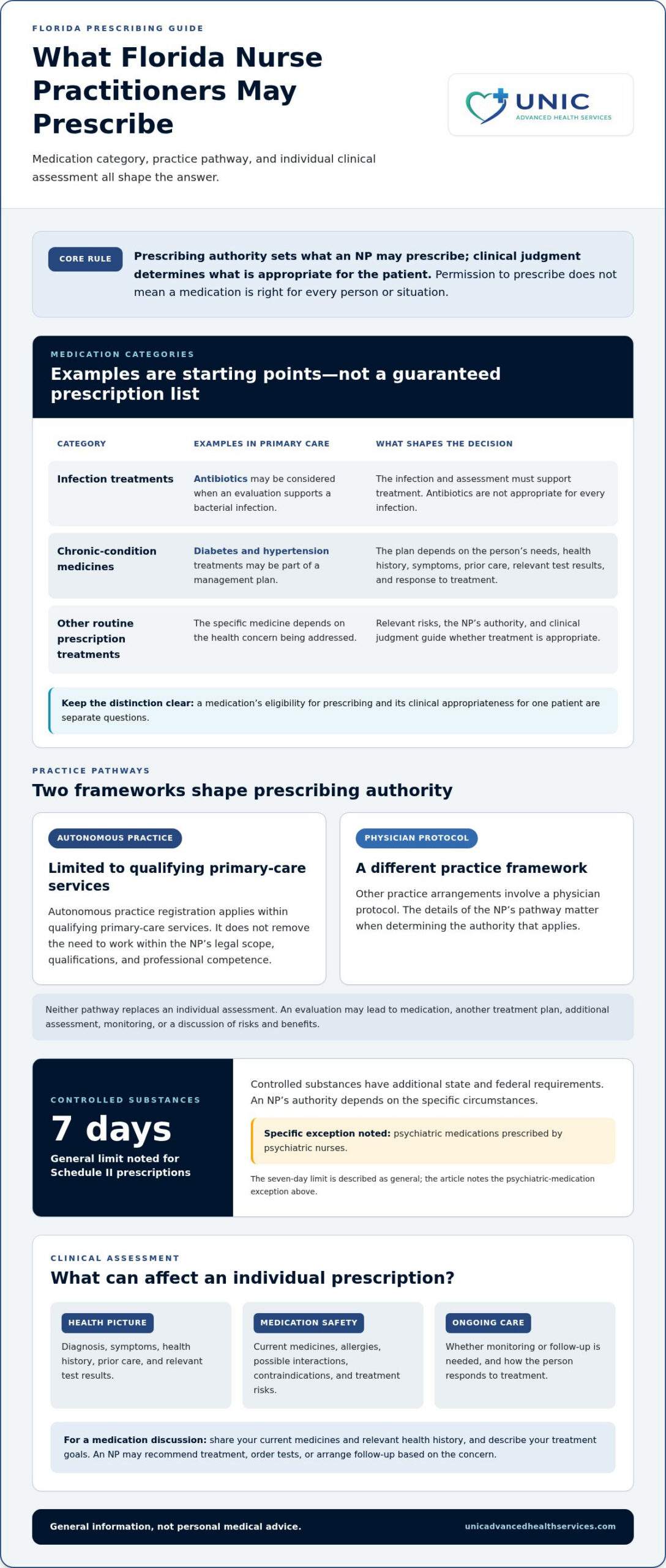
Florida NPs may prescribe within their legal scope and professional authority. Autonomous practice is limited to qualifying primary-care services, while other practice pathways involve a physician protocol. Controlled substances have additional requirements, including a general seven-day limit for Schedule II prescriptions and a specific exception for psychiatric medications prescribed by psychiatric nurses.
This 2026 guide explains the general prescribing framework, how autonomous practice differs from physician-protocol practice, and which medication or patient factors may affect a prescription. It also explains why clinical judgment matters when starting or continuing treatment. For ongoing needs such as chronic-condition management, an individualized primary-care visit can help clarify appropriate next steps. Unic Advanced Health Services provides primary care in Fort Lauderdale, including chronic-condition management and telehealth. This article offers general information, not personal medical advice.
Key Takeaways
- To understand what can a nurse practitioner prescribe in Florida, consider the NP’s practice pathway, the medication, and your individual clinical needs.
- Medication categories offer a general guide, but diagnosis, health history, possible interactions, and monitoring shape treatment decisions.
- Autonomous practice registration applies to qualifying primary-care services; other practice arrangements may involve a physician protocol.
- Controlled-substance prescriptions have additional state and federal requirements, so an NP’s authority depends on the specific circumstances.
- Prepare for a medication discussion by listing your current medicines, sharing relevant health history, and describing your treatment goals.
What can a nurse practitioner prescribe in Florida? Start with the scope
Florida nurse practitioners may prescribe within their legal authority and professional scope. The answer to what can a nurse practitioner prescribe in Florida depends on the NP’s practice pathway, the medication category, and the patient’s clinical assessment. An NP’s authority to prescribe a medication doesn’t mean it is appropriate for every patient or situation.
For patients, prescribing authority means an NP is legally permitted to prescribe within defined boundaries, based on their qualifications and the care they’re authorized to provide. Within that scope, an NP may assess a patient, review relevant health information, and develop a treatment plan. Florida NPs don’t all have identical authority: autonomous practice registration and practice under a physician protocol are different pathways, and the details matter.
For a general overview of how NP responsibilities and prescribing authority vary across states, see Nurse Practitioner Scope of Practice. Florida’s specific rules determine what applies to an individual NP.
To learn about one part of Florida’s prescribing requirements, watch this overview of prescription-related continuing education:
What does prescribing authority mean for a Florida patient?
Prescribing authority is permission bounded by law, professional competence, and the patient’s needs. It allows an NP to select a treatment when their authorized scope, training, and assessment support that choice. It doesn’t require the NP to prescribe a requested medication. An evaluation may instead lead to a different treatment plan, additional assessment, monitoring, or a discussion of potential risks and benefits. For ongoing care, such as chronic-condition management, treatment decisions should take the person’s health history and response to care into account.
Prescribing authority sets what an NP may prescribe; clinical judgment determines what is appropriate for the patient.
Why does the type of medication matter?
Medication rules vary by category. Non-controlled medications and controlled substances don’t follow identical requirements, and controlled medications may be subject to additional state and federal rules. A medication’s category is only one consideration. The NP also weighs the diagnosis, current medications, health history, possible contraindications, and whether follow-up is needed.
In Florida, autonomous practice registration is limited to qualifying primary-care services, while NPs practicing under a physician protocol follow a different framework. These pathways shape prescribing authority, but they don’t replace an individual clinical assessment. The sections below explain medication categories, the difference between autonomous practice and a physician protocol, and additional conditions that can apply to controlled substances.
Which medication categories may Florida nurse practitioners prescribe?
Medication categories can help you understand the kinds of treatment that may come up in primary care, but they aren’t a list of medicines every Florida NP can prescribe. The answer to what can a nurse practitioner prescribe in Florida depends on the NP’s authorized practice pathway and the circumstances of your care. Florida law addresses APRN prescribing authority in Florida Statute 464.012; an individual prescription still requires an appropriate clinical assessment.
Examples of broad categories that may be considered in a primary-care setting include:
- Infection treatments: Antibiotics may be considered when an evaluation supports a bacterial infection and treatment is appropriate.
- Chronic-condition medicines: Diabetes and hypertension treatments may be part of a plan to manage these conditions, depending on the patient’s needs and health history.
- Other routine prescription treatments: The specific medication depends on the health concern, relevant risks, and the NP’s authority and clinical judgment.
These examples are illustrative, not a promise that a particular medication is available from every NP. Antibiotics, for example, aren’t appropriate for every infection, and chronic-condition treatment may need adjustment as a person’s health changes.
A medication’s eligibility for prescribing and its clinical appropriateness for one patient are separate questions.
Non-controlled prescription medications and routine treatment
For non-controlled medications, the NP considers the reason for treatment alongside the patient’s medical history, current medicines, allergies, and possible contraindications. Someone managing diabetes or hypertension may need a plan that considers symptoms, prior care, and relevant test results. The NP may also discuss how to take a medicine and what follow-up or monitoring is appropriate. The goal is an individualized plan, not simply a prescription based on a diagnosis or request.
The evaluation can shape the next step. Depending on the concern, an NP may recommend treatment, order tests, or arrange follow-up to assess how a plan is working. Tell the NP about side effects, missed doses, and changes in your health. These details can help guide decisions over time.
Refills, renewals, and changes to an existing prescription
A current prescription doesn’t automatically qualify for renewal. Before authorizing a refill, an NP may need to review the medication, its purpose, how it’s working, and whether monitoring is due. Changes in symptoms or health status, a possible interaction, or missing clinical information may affect whether to renew the same prescription or recommend another step.
For ongoing treatment, bring an up-to-date medication list and share where the medication was prescribed, how you take it, and any concerns. If you’re receiving continuing care for a chronic condition, primary care and chronic-condition management can provide a setting to discuss medication needs and follow-up as part of an individualized care plan.
Autonomous practice or physician protocol: how Florida NP authority differs
Florida has two distinct practice pathways that help explain what can a nurse practitioner prescribe in Florida. An APRN may qualify to register for autonomous practice in a defined area of primary care, or practice under a protocol established with a physician. Neither pathway gives an NP unlimited prescribing authority. The applicable statute, the NP’s qualifications and practice scope, the medication, and the patient’s clinical needs all matter.
What autonomous practice means in Florida
Under Florida Statutes section 464.0123, an eligible APRN may register to provide autonomous services in primary care without a supervisory protocol with a physician. The statutory scope includes family medicine, general pediatrics, and general internal medicine. Registration has qualification requirements, including an active, unencumbered Florida license, specified clinical experience, and graduate-level coursework in pharmacology and differential diagnosis.
Autonomous registration is a defined pathway, not blanket authority to practice in every specialty or prescribe every medication. It also doesn’t remove the duty to make clinically appropriate decisions. An APRN registered for autonomous practice may not prescribe controlled substances under this pathway.
How physician-protocol practice differs
Under section 464.012(3), an APRN may prescribe within an established physician protocol and the limits of applicable law. The protocol provides the framework for the APRN’s practice; it doesn’t mean that every prescription requires a physician’s separate approval. Prescribing controlled substances involves additional qualifications and restrictions, distinct from the rules for non-controlled medications.
For patients, the pathway can explain why two NPs may not have the same prescribing authority. A physician protocol may support prescribing that autonomous registration alone does not, but the specific medication, the protocol, and state and federal requirements still determine what’s permitted.
| Practice pathway | General scope | Controlled-substance limits |
|---|---|---|
| Autonomous registration | Qualifying primary-care services within the statutory scope | Does not authorize controlled-substance prescribing |
| Physician protocol | Practice and prescribing within the protocol and applicable law | Additional qualifications and restrictions apply |
This comparison is a starting point, not a decision about an individual prescription. A patient’s care may involve medication review, assessment, and follow-up regardless of pathway. If you’re discussing ongoing treatment, such as care for a chronic condition, the NP can explain how their practice authority relates to the options being considered.
In brief, autonomous registration defines a limited primary-care pathway, while a physician protocol provides a different framework for authorized practice and prescribing. The next section covers additional rules for controlled substances.
Can a Florida nurse practitioner prescribe controlled substances?
Yes, some Florida nurse practitioners can prescribe controlled substances, but only when their practice pathway, qualifications, and the medication meet applicable requirements. Controlled-substance prescribing is governed by state and federal rules, so an NP’s general authority to prescribe doesn’t automatically include every controlled medication. The NP’s practice arrangement matters too: Florida autonomous practice registration does not authorize controlled-substance prescribing.
Under Florida law, an APRN with a qualifying master’s or doctoral degree in a clinical nursing specialty and relevant training may prescribe controlled substances within the applicable legal framework. That authority is subject to restrictions, including limits related to the medication schedule and the APRN’s specialty. Patients can review the relevant provisions in Florida Statutes section 464.012 and Chapter 464.
What extra requirements can apply?
Requirements depend on the controlled substance, its schedule, the NP’s qualifications, and whether the NP practices under a physician protocol. Federal requirements may also apply. The Drug Enforcement Administration (DEA) is the federal agency responsible for controlled-substance registration, and federal rules must be considered alongside Florida law.
Florida generally limits a Schedule II controlled-substance prescription to a seven-day supply. The exception applies to psychiatric medications prescribed by psychiatric nurses. Additional rules apply to psychiatric mental-health controlled substances prescribed to patients under 18: only APRNs who are also psychiatric nurses may prescribe them to minors. A Board of Nursing committee also recommends a controlled-substance formulary that may prohibit certain drugs or restrict their use or quantity.
Florida requires APRNs to complete a three-hour continuing education course on safe and effective controlled-substance prescribing for each biennial license renewal, whether or not they hold a DEA registration. These rules don’t mean every APRN has the same controlled-substance authority. The medication and the NP’s specific qualifications and practice pathway remain central.
Why might an NP decline or change a controlled-medication plan?
A decision not to prescribe a requested controlled medication doesn’t mean NPs generally lack prescribing authority. The NP may need to consider the patient’s medication history, current symptoms, possible interactions, safety risks, and monitoring needs. Legal restrictions or missing information may also affect the decision.
An evaluation may lead to a different dose or plan, additional assessment, closer monitoring, or discussion of other treatment options. Share an accurate medication list, including medications prescribed by other clinicians, and describe changes in symptoms or side effects. These details support a safer, more informed conversation.
If you need to review ongoing treatment or medication concerns, schedule a primary-care discussion with Unic Advanced Health Services in Fort Lauderdale. An individualized visit can help clarify appropriate next steps based on your health needs.
How to discuss prescriptions with a Florida nurse practitioner
A useful medication conversation starts with the details of your health, not just the name of a prescription you hope to receive. Bring accurate information, explain what you’d like help with, and allow the NP to assess whether a medication, a different approach, or follow-up is appropriate. These steps make it easier to discuss what can a nurse practitioner prescribe in Florida in the context of your own care.
What information should you bring to a medication visit?
Before your appointment, gather information that can help the NP understand your current treatment and health concerns. A written list or pharmacy record can help you avoid relying on memory.
- List medicines and supplements: Include prescription and over-the-counter medications, vitamins, and supplements. Add doses and how often you take them when known.
- Share relevant health history: Note allergies, diagnoses, prior treatments, and whether previous medicines helped or caused side effects.
- Describe current symptoms and goals: Explain what has changed, how long you’ve noticed it, and what you hope treatment will help you manage.
- Bring relevant records if available: Recent measurements, test results, or a medication summary can provide useful context for the discussion.
Be open about missed doses, difficulty taking a medicine, or concerns about side effects. These details help the NP assess the whole situation and consider practical next steps without judgment.
When can primary care help with prescription questions?
Primary care provides a setting to review medication concerns within the NP’s legal scope. The NP may assess your symptoms, review available records, consider your health history, and decide whether tests or monitoring could help guide care. A refill or treatment change may depend on that assessment, so discuss the reason for the medication as well as the prescription itself.
For ongoing concerns, such as managing a chronic condition, regular follow-up can help track how your health and treatment needs change. Unic Advanced Health Services provides primary care and chronic-condition management in Fort Lauderdale. For ongoing care related to weight concerns, its chronic-condition management care can be part of a broader conversation about health goals and appropriate follow-up.
Preventive visits can also provide time to review health needs and discuss questions before they become more difficult to manage. Learn about what to expect from an annual physical exam as part of preventive care.
If you’re ready to discuss your health concerns and ongoing care, explore primary care at Unic Advanced Health Services. An individual assessment can help clarify appropriate next steps without assuming a specific prescription is right for everyone.
Take the next step toward informed, ongoing care
Understanding what can a nurse practitioner prescribe in Florida is a useful starting point, but a treatment plan should fit your health, priorities, and circumstances. You deserve a conversation where you can raise concerns, understand why an option is being considered, and discuss follow-up. If a prescription isn’t the right choice, ask what other steps could address your needs.
Building a relationship with a primary-care provider can make it easier to discuss new concerns and changes in ongoing treatment. At Unic Advanced Health Services, an experienced autonomous nurse practitioner leads care that includes primary care, chronic-condition management, telehealth, and preventive services in Fort Lauderdale.
Explore primary care at Unic Advanced Health Services to discuss your health concerns and take a considered next step toward care that supports your goals.
Frequently Asked Questions
Can a nurse practitioner in Florida prescribe medication without a physician?
Yes. A Florida APRN registered for autonomous practice may provide qualifying primary-care services without a physician protocol. That answers part of what can a nurse practitioner prescribe in Florida, but autonomous registration doesn’t cover every specialty or authorize controlled-substance prescribing. For example, an NP treating a routine primary-care concern may work autonomously if registered and practicing within the statutory scope. The individual treatment decision still depends on the patient’s circumstances.
Can a Florida nurse practitioner prescribe antibiotics?
Yes, an NP may prescribe an antibiotic when authorized to practice and the assessment supports that treatment. Antibiotics treat bacterial infections, not viral illnesses such as a common cold, so symptoms alone may not be enough to determine whether one is appropriate. An NP may ask about symptom duration, allergies, and prior reactions, and may examine you or order testing before deciding on treatment.
Can a nurse practitioner prescribe Adderall in Florida?
Potentially, but Florida requirements apply because Adderall is a Schedule II controlled medication. An NP must have authority under the applicable practice arrangement and meet relevant state and federal requirements, including DEA registration where required. Florida generally limits Schedule II prescriptions to a seven-day supply; the psychiatric-medication exception is specific and shouldn’t be assumed to apply to every ADHD prescription. The NP also determines whether the medication is clinically appropriate.
Can a nurse practitioner in Florida prescribe anxiety medication?
Yes, depending on the medication and the NP’s authority. “Anxiety medication” can refer to different drugs, and some are controlled substances while others aren’t. That distinction can change which legal requirements apply. An NP may ask about symptoms, other medicines, past treatment, and safety concerns before recommending a plan. If a medication isn’t appropriate, the NP can discuss other care options or follow-up based on your needs.
Can a Florida nurse practitioner refill a prescription from another provider?
Possibly, but a prescription from another clinician isn’t automatically renewed. The NP may need to understand why it was prescribed, confirm the dose and instructions, and review relevant records or recent monitoring. This is especially important if the medicine has safety risks or is controlled. Bring the medication container or a current pharmacy list, and share the original prescriber’s details so the NP can assess the request with useful context.
Does Florida require a physician protocol for every nurse practitioner?
No. Eligible APRNs who register for autonomous practice may provide services within Florida’s defined primary-care scope without a physician protocol. Other APRNs practice under a physician protocol, and autonomous registration doesn’t extend to every specialty. For patients in Fort Lauderdale, the NP’s practice pathway helps explain how care is organized, but it doesn’t determine a treatment by itself. The medication, legal requirements, and your individual health assessment also matter.