
Does “autonomous” mean a nurse practitioner in Florida can practice without limits? No. If you’re searching “autonomous nurse practitioner Florida law,” the key distinction is that qualifying advanced practice registered nurses (APRNs) may practice autonomously in a defined primary care scope. That does not grant unrestricted authority across every specialty. The distinction matters when you’re choosing care or reviewing your own eligibility to practice.
This guide explains what Florida’s autonomous practice status means in 2026, including the registration and experience requirements NPs must meet and the limits on scope. You’ll also learn how to use official Florida resources to review a practitioner’s license and autonomous registration. Whether you’re looking for primary care or support managing a chronic condition in Fort Lauderdale, understanding the legal framework can help you make informed decisions.
Key Takeaways
- Florida’s autonomous practice status is a defined legal authority, not permission to practice without limits. The autonomous nurse practitioner Florida law framework sets boundaries on that authority.
- NPs should confirm their APRN licensure, review current eligibility criteria, and follow the Board’s registration requirements.
- Autonomous practice is limited to specified primary care services. A provider’s scope and the service being offered both matter.
- Patients can use Florida’s official license verification resources to review an NP’s credentials and autonomous registration.
- In Fort Lauderdale, Unic Advanced Health Services provides NP-led primary care and chronic condition management, led by Marc Joseph.
What does autonomous nurse practitioner practice mean under Florida law?
Under Florida Statutes section 464.0123, an eligible, registered advanced practice registered nurse (APRN) may provide specified primary care services without a physician supervisory protocol. This is a defined practice status, not unrestricted authority to offer any service or enter any specialty independently. Its scope is limited to primary care, including family medicine, general pediatrics, and general internal medicine.
That distinction matters whether you’re seeking care or reviewing your professional responsibilities. The phrase “autonomous nurse practitioner Florida law” refers to authority granted under specific statutory conditions, not an exemption from licensing rules, oversight requirements, or other applicable laws. A nurse practitioner is one type of APRN. The terms are related, but Florida’s statute uses “APRN” when describing this registration.
For a general overview of the nurse practitioner role, see Nurse Practitioner. Florida’s statute and Board guidance, rather than a general reference, establish the state’s legal requirements.
This video offers another introduction to how Florida defines autonomous practice:
How Florida uses the term autonomous APRN
Autonomous practice registration is additional to an APRN license. It is not a separate clinical license or a substitute for the underlying license. An NP must hold the appropriate APRN licensure and meet Florida’s criteria to qualify for autonomous registration. For the exact requirements, use the Florida Board of Nursing’s current guidance and section 464.0123.
In practice, the registration identifies a legal status that permits qualifying APRNs to work independently within the statute’s boundaries. It does not automatically authorize every activity associated with advanced nursing practice. Authority to provide primary care under this status, for example, should not be confused with authority to practice in a specialty outside the statutory scope.
Why autonomy matters to patients and practitioners
For patients, the legal distinction clarifies who may provide eligible primary care and under what authority. It can also help you ask informed questions about the type of care being offered, especially at a practice that provides services in different areas. Registration describes legal authority. On its own, it does not measure or guarantee care quality or promise faster appointments.
For practitioners, autonomy changes the practice relationship within the authorized scope, but it does not remove professional obligations. APRNs remain responsible for practicing within their competence and complying with applicable licensing rules, professional standards, and laws. A service outside autonomous primary care may involve other legal requirements, so do not infer authority from the word “autonomous” alone.
In Florida, autonomous practice is an additional APRN registration that permits qualifying primary care within a defined legal scope, not unrestricted practice.
What eligibility and registration rules apply to autonomous NPs in Florida?
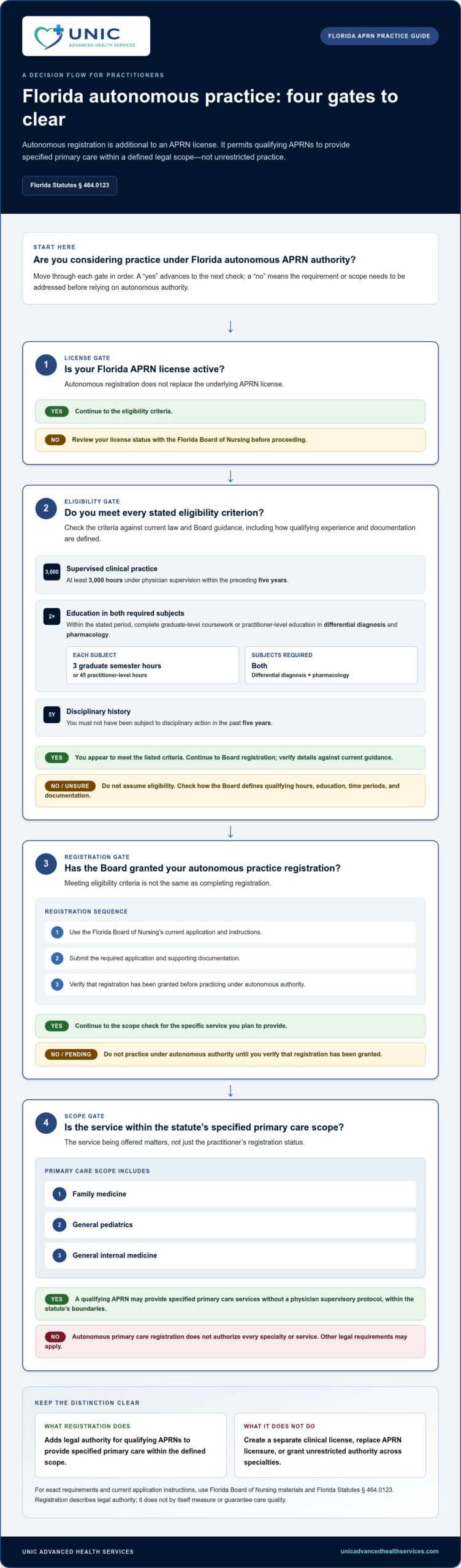
Eligibility and registration are separate steps. An APRN must meet Florida’s statutory criteria and complete the Florida Board of Nursing’s autonomous practice registration process before practicing under that status. When reviewing autonomous nurse practitioner Florida law, follow the official requirements rather than assuming that experience, education, or an active license alone is enough.
Use this sequence to organize your review:
- Confirm that your Florida APRN license is active and review its current status.
- Compare your education, supervised clinical experience, and disciplinary history with the criteria in current law and Board materials.
- Follow the Board’s current application instructions, submit the required documentation, and verify that registration has been granted.
Eligibility criteria to verify before applying
Florida’s current criteria include at least 3,000 hours of clinical practice under physician supervision within the preceding five years. Applicants must also have completed graduate-level coursework or practitioner-level education in both differential diagnosis and pharmacology within that period, and must not have been subject to disciplinary action in the past five years. Check how the Board defines qualifying hours, coursework, and documentation before applying.
The stated coursework threshold is three graduate-level semester hours, or 45 practitioner-level hours, in each subject: differential diagnosis and pharmacology. Pay attention to “in each.” Your documentation should match the Board’s instructions, including the required time period and how hours or coursework must be demonstrated. If your experience or education does not fit neatly into the listed categories, do not assume you qualify based on a summary. Use the Board’s current guidance to interpret the criteria.
Registration with the Florida Board of Nursing
After reviewing the criteria, find the autonomous practice registration application and instructions on the Florida Board of Nursing’s official website. Use the current materials to identify the forms, supporting records, submission method, and any process for checking application status. Requirements can change, so rely on the live Board materials rather than an old checklist or third-party summary.
Meeting the criteria does not complete registration. The Board must process the application, and applicants should verify their registration status before practicing under autonomous authority. Keep copies of submitted materials and use official Board channels for questions about an individual application. The registration application is valid for one year from submission, so note the submission date and follow the Board’s instructions if additional action is needed.
For current autonomous APRN requirements, consult Florida Statutes section 464.0123 and the Florida Board of Nursing’s autonomous practice application and guidance. The linked Florida Statute 464.0123 is a useful legal reference. Confirm the latest statutory text and Board instructions before relying on it.
For patients in Fort Lauderdale, understanding a practitioner’s registration can bring clarity to conversations about eligible primary care. Unic Advanced Health Services, led by autonomous nurse practitioner Marc Joseph, provides primary care and chronic condition management. Learn more about primary care in Fort Lauderdale.
Florida Autonomous NPs: Scope and Limitations
In 2026, Florida’s autonomous practice authority remains limited to primary care. Under Florida Statute 464.0123, this includes family medicine, general pediatrics, and general internal medicine. Registration does not expand an APRN’s authority to every specialty or replace other legal requirements. The key question is not simply whether an NP is autonomous, but whether the care falls within the permitted scope.
This distinction is central to understanding autonomous nurse practitioner Florida law: autonomous registration allows qualifying APRNs to provide specified primary care without a physician supervisory protocol, not to practice without boundaries.
Autonomous authority is not unlimited authority
An APRN’s registration does not erase scope-of-practice rules, professional standards, or laws that apply to particular services. Training and competence still matter, and specialty services may require a different legal arrangement. Florida’s autonomous authority is limited to primary care. Specialty practice, such as cardiology or aesthetics, does not become authorized simply because an APRN holds autonomous registration.
Use this comparison as a starting point, then check the statute and current Board guidance for the specific service:
| Autonomous primary care | Unrestricted or specialty-wide authority |
|---|---|
| Applies to qualifying APRNs with the required registration and within defined primary care areas. | Does not follow from autonomous registration. The status does not authorize practice in every specialty. |
| Remains subject to professional standards and applicable laws, including rules that may govern specific services or medications. | Does not remove the need to meet other legal requirements, credentials, or scope limits. |
Medication authority also requires careful attention. Autonomous status alone should not be treated as proof that every medication may be prescribed or that all prescribing conditions are met. Prescribing and controlled-substance rules can depend on the applicable statutes and circumstances. Patients and NPs should consult current legal text and official Board guidance before drawing conclusions about a specific prescription.
How occupational examinations fit a separate framework
Occupational examinations follow requirements distinct from Florida’s autonomous primary care authority. A Department of Transportation (DOT) physical, for example, involves federal medical certification rules and examiner qualifications. An APRN’s Florida autonomous registration alone does not establish eligibility to perform every occupational examination. The relevant federal credential and requirements must also apply to the examiner.
For commercial drivers, this DOT physical exam guide explains the examination process and its separate certification framework. Keeping these authorities distinct helps patients understand what a provider’s Florida registration does and does not establish.
How can Florida patients and NPs check autonomy and plan care?
Checking an NP’s status can help you understand the legal framework for care, but it is only one part of choosing care. Use Florida’s official license verification portal to review the clinician’s license and look for the “Autonomous Practice APRN” qualification. Then consider whether the service you need fits the clinician’s authorized scope.
A patient checklist for understanding NP-led care
Before an appointment, use this checklist to prepare and review information available through official sources:
- Look up the clinician’s Florida license. Search the Florida Department of Health’s license verification portal and review the license status and listed qualifications.
- Check autonomous registration. Look for the “Autonomous Practice APRN” designation. An NP license and autonomous practice registration are distinct credentials.
- Match the care to the legal scope. Consider whether your visit is for primary care or a service that may fall under a separate specialty or certification framework. Registration does not establish authority for every type of care.
- Describe your health concern clearly. Share relevant symptoms, medications, and health history so the clinician can assess the appropriate next step.
For preventive-care context, an annual physical exam guide can help you understand what a routine wellness visit may address. If a concern is severe, rapidly worsening, or potentially life-threatening, seek emergency care rather than relying on a routine primary-care appointment. Call 911 for an emergency.
Questions practitioners should resolve from official sources
For NPs, the same careful approach applies to professional decisions. Read the current Florida statute and Board of Nursing instructions, and distinguish binding requirements from summaries or commentary. Confirm the applicable rules for the service you plan to provide, including any separate certification or prescribing requirements. Do not assume autonomous status covers them.
Keep records that support eligibility and registration, such as documentation of qualifying education and clinical experience, in line with the Board’s current application directions. Check official sources again when renewing or if requirements change. A summary can orient you, but it cannot determine an individual’s legal or licensing eligibility. Consult the Board or an appropriately qualified professional about questions specific to your circumstances.
Understanding the autonomous nurse practitioner Florida law framework can make care discussions clearer, while your symptoms and health needs remain central to planning. For primary and preventive care in Fort Lauderdale, explore care at Unic Advanced Health Services.
What Florida NP autonomy means for accessing primary care in Fort Lauderdale
Florida’s autonomy framework gives eligible nurse practitioners a path to deliver defined primary care services without a physician supervisory protocol. For Fort Lauderdale patients, that means another option for discussing everyday health needs with an NP. It does not guarantee faster appointments, a particular outcome, or a specific level of quality. Consider the practitioner’s credentials, the care you need, and the clinical assessment guiding that care.
Unic Advanced Health Services is a Fort Lauderdale practice led by autonomous nurse practitioner Marc Joseph. The practice provides primary care, chronic condition management, preventive care, and telehealth. It is one local example of NP-led care, subject to professional standards and applicable law. The phrase “autonomous nurse practitioner Florida law” describes a defined legal authority, not a shortcut around individualized care.
Connecting Florida law with everyday primary care
Chronic conditions such as diabetes and hypertension often call for ongoing attention, including reviewing health changes and discussing care as needs evolve. An NP-led primary care visit can provide an opportunity to address those concerns and consider appropriate next steps. The right plan depends on the person’s history, current symptoms, clinical findings, and treatment goals. Autonomy establishes a legal practice framework; it does not predetermine clinical decisions.
Some primary care conversations may be appropriate for telehealth, depending on the concern and the clinician’s assessment. Virtual visits can support communication and follow-up, while other situations may call for an in-person evaluation or a different level of care. This telehealth guide for Fort Lauderdale can help you learn more about virtual primary care and consider how it may fit your needs.
Whatever the visit format, you can help make the conversation more useful by sharing an accurate medication list, relevant health history, and the questions you want addressed. For ongoing conditions, noting changes since your last visit can give the clinician helpful context. These steps support discussion but do not replace the clinician’s evaluation or determine what care is appropriate.
A clear next step for Fort Lauderdale patients
Start by identifying your reason for care: a preventive visit, a new health concern, or ongoing support for a chronic condition. Then review the practice information and consider whether the care options align with that need. If you’re looking for primary care in Fort Lauderdale, Unic Advanced Health Services provides NP-led primary care, preventive care, chronic condition management, and telehealth.
Understanding the law can make your choice clearer, but it is not a substitute for medical advice or an official determination of legal scope. For questions about an NP’s Florida license or autonomous registration, use the state’s official verification resources. For questions about your health, a conversation with a qualified clinician can help you understand possible next steps.
Make your next care decision with confidence
Use what you’ve learned to prepare for a practical conversation about your health. Consider what you want help with, what questions you have, and what information could help a clinician understand your needs. Legal status can clarify a practitioner’s authority, but your care plan should still reflect your health circumstances and clinical assessment.
If you’re considering ongoing primary care or support managing a chronic condition in Fort Lauderdale, Unic Advanced Health Services offers a local option led by autonomous nurse practitioner Marc Joseph. The practice provides primary care and chronic condition management in Fort Lauderdale and nearby communities. Understanding the autonomous nurse practitioner Florida law framework can help you approach that choice with clear expectations, while keeping the care conversation focused on what matters to you.
Explore primary care and chronic condition management at Unic Advanced Health Services. Take the next step toward an informed conversation about your care.
Frequently Asked Questions
Is Florida an autonomous practice state for nurse practitioners?
Yes. Florida allows qualifying advanced practice registered nurses (APRNs), including nurse practitioners, to register for autonomous practice within a defined primary care scope. This does not make Florida an unrestricted practice state for every NP specialty. If you’re comparing care options, review the clinician’s current Florida license and autonomous registration, then consider whether the service you need falls within the authority described in state law.
Can an autonomous nurse practitioner in Florida practice without a physician on site?
Generally, an APRN with Florida autonomous practice registration may provide authorized primary care without a physician supervisory protocol, so a physician does not have to be on site for that care. This authority is limited to its legal scope and does not mean a physician is never involved in a patient’s care. A clinician may recommend consultation, referral, or another level of care based on an individual assessment.
Can autonomous nurse practitioners prescribe controlled substances in Florida?
Do not assume that autonomous registration alone authorizes a controlled-substance prescription. Prescribing authority depends on applicable Florida law, federal requirements, and any conditions attached to the APRN’s authority and the medication. Patients with questions about a specific prescription can discuss its purpose and instructions with the prescriber or pharmacist. NPs should consult current Florida statutes, Board guidance, and relevant federal requirements before prescribing.
Does Florida autonomous practice registration cover every nurse practitioner specialty?
No. Florida autonomous registration applies to a defined primary care scope, not every specialty. A patient seeking specialty care should not assume an NP’s autonomous status alone authorizes that service. The specific service and applicable legal requirements matter. Patients can review a practitioner’s qualifications in the state’s license lookup, then discuss whether the clinician provides the type of care they need.
How can I verify an autonomous nurse practitioner’s Florida registration?
Use the Florida Department of Health’s online license verification portal. Search by the clinician’s name and review the license information and listed qualifications. The portal identifies an autonomous registrant with the “Autonomous Practice APRN” qualification. Check that the record belongs to the clinician you intend to see, since similar names can appear in search results, and revisit the official lookup if you need to confirm current status later.
Does autonomous practice mean a Florida nurse practitioner has no professional oversight?
No. Autonomous practice does not remove professional standards, licensing obligations, or laws that apply to a clinician’s work. An NP remains responsible for practicing within their competence and authorized scope. For patients, autonomy is a legal practice status, not a guarantee of a particular outcome. If a treatment plan or service raises questions, ask the clinician to explain the reasoning and any recommended follow-up.
Can patients see an autonomous nurse practitioner for chronic conditions in Fort Lauderdale?
Yes. Patients in Fort Lauderdale can seek NP-led care for chronic conditions, with an appropriate plan determined through clinical assessment. Unic Advanced Health Services provides chronic condition management, including care focused on conditions such as diabetes, hypertension, and obesity. Before a visit, gather your medication list, recent health information, and questions about symptoms or treatment goals to discuss with the clinician.