
Where can you get help for a minor illness without going to the emergency room? Choosing among alternatives to the emergency room for minor illness can feel uncertain, especially when you’re worried that waiting or choosing the wrong setting could put your health at risk. The safest next step depends on how serious your symptoms are, how they’re changing, and what kind of assessment you may need.
Some concerns may be appropriate for primary care or telehealth, while others call for an in-person evaluation at urgent care. Symptoms that could signal a life-threatening emergency need immediate attention in the ER. If you’re unsure, seek medical guidance instead of trying to manage concerning symptoms on your own.
This guide explains the roles of primary care, telehealth, urgent care, and the emergency room, and highlights warning signs that call for emergency help. You’ll also find practical steps for choosing what to do next. Unic Advanced Health Services provides primary care and telehealth for patients in Fort Lauderdale and surrounding communities.
Key Takeaways
- Choose among alternatives to the emergency room for minor illness based on symptom severity, how quickly symptoms change, and the assessment you may need.
- Know how self-care, primary care, telehealth, and urgent care differ, including when an in-person examination may be important.
- Use a simple decision process: note symptoms, consider relevant health conditions and medications, and choose a suitable care option.
- Recognize when symptoms affecting breathing or consciousness call for emergency attention rather than routine non-emergency care.
- Unic Advanced Health Services provides primary care and telehealth in Fort Lauderdale and surrounding communities for non-emergency health concerns.
Alternatives to the emergency room for minor illness: start with symptom severity
Choosing among alternatives to the emergency room for minor illness starts with a safety check, not a guess about what a symptom might mean. Non-emergency options are for concerns that don’t appear immediately life-threatening. Consider how severe the symptoms are, whether they’re getting worse, and whether they affect breathing, alertness, or the ability to speak.
This guide can help you compare care settings, but it can’t diagnose an illness or replace a clinician’s judgment. If you suspect a life-threatening emergency, call 911. Don’t wait for a routine appointment or try to manage the situation through non-emergency care.
For context on the role of urgent care in the healthcare system, see this overview of Urgent Care Centers. The right setting still depends on the person’s symptoms and the assessment they need.
To learn more about alternatives to emergency department care, watch this video:
Which symptoms need emergency care rather than an alternative?
Seek emergency help for severe difficulty breathing, fainting or loss of consciousness, or sudden severe chest pain. Sudden weakness, confusion, or difficulty speaking also needs emergency assessment, even if it seems to improve. These signs can have serious causes, and a checklist can’t determine what’s happening. Call 911 if an emergency may make it unsafe to travel, and don’t drive yourself.
What does “minor illness” mean in this guide?
A minor illness in this guide means mild, stable symptoms without severe distress that may be suitable for non-emergency assessment, depending on the person’s circumstances. “Mild” doesn’t guarantee that a condition is harmless. Symptoms can change, and medical history, existing conditions, age, or other factors may affect the safest response.
Pay attention to changes rather than relying on a symptom name alone. Symptoms that worsen quickly, become severe, or affect breathing, alertness, or the ability to speak call for prompt attention. If you’re uncertain about the level of care, seek medical guidance. A clinician can assess the details and advise whether routine evaluation is appropriate or emergency care is needed.
Four alternatives to the emergency room for non-emergency illness
Alternatives to the emergency room for minor illness serve different needs. Home monitoring may be enough for mild, stable symptoms, while a clinician’s evaluation may be more appropriate when symptoms persist, change, or need closer assessment. Choose based on the person’s symptoms and the kind of evaluation they may need.
When can self-care or a nurse-guided plan be reasonable?
For mild symptoms without severe distress, rest, fluids, and monitoring may be reasonable general measures if they fit the person’s health needs. Follow product labels and any instructions from a clinician or nurse. Don’t guess at medication doses or treat a general tip as a substitute for advice tailored to you. If symptoms worsen, persist, or concern you, seek professional guidance.
How do primary care, telehealth, and urgent care differ?
Primary care can assess a non-emergency concern in the context of your health history and support follow-up. Telehealth lets you consult a clinician remotely when the symptoms can be assessed this way. The clinician may recommend an in-person visit if a physical examination or another assessment is needed. The U.S. Department of Health & Human Services offers Official Telehealth Guidance on this care format.
Urgent care is an in-person option for non-life-threatening problems that need prompt assessment. It isn’t interchangeable with primary care or telehealth, and it isn’t a substitute for emergency care when symptoms may be life-threatening.
| Setting | Suitable general use | Reasons to escalate |
|---|---|---|
| Self-care | Mild, stable symptoms; general comfort measures and monitoring. | Symptoms worsen, persist, or become concerning. |
| Primary care | Non-emergency assessment informed by health history, with follow-up as needed. | Symptoms need more immediate or specialized assessment. |
| Telehealth | Remote consultation when the clinician judges it suitable. | An examination or in-person assessment is needed, or symptoms worsen. |
| Urgent care | In-person assessment for a non-life-threatening problem needing prompt attention. | Symptoms suggest an emergency or exceed the setting’s ability to assess them. |
For non-emergency evaluation and follow-up, Fort Lauderdale primary care and telehealth are available through Unic Advanced Health Services.
Telehealth, Urgent Care, or Primary Care: Choosing Right
Convenience matters, but it shouldn’t be the only factor in choosing care. The best fit depends on symptom severity, whether a physical examination or testing may be needed, and whether follow-up matters. These alternatives to the emergency room for minor illness aren’t interchangeable. Consider what the concern requires before choosing a setting.
| Care setting | Severity and general fit | Physical examination | Follow-up needs | Access considerations |
|---|---|---|---|---|
| Telehealth | May suit a non-emergency concern when a clinician considers remote assessment appropriate. | Remote discussion, sometimes with video, may not provide the hands-on assessment or testing needed. | A clinician can advise on next steps, including in-person evaluation if needed. | Requires access to a telehealth service and the technology it uses. |
| Primary care | Can assess non-emergency concerns with your broader health history in view. | An in-person visit allows examination; the clinician determines what assessment is appropriate. | May be useful when ongoing health context or continued follow-up matters. | Access depends on the practice and appointment availability. |
| Urgent care | May fit a non-life-threatening problem that needs prompt in-person assessment. | In-person evaluation can support examination; available tests and services vary. | Follow-up may be needed through primary care or another appropriate setting. | Location, hours, and access differ among centers. |
When may telehealth be a practical first step?
A remote discussion may be a useful starting point when the concern can be assessed safely without an immediate hands-on examination. A clinician can ask when symptoms began, how they have changed, and about relevant health history, then determine whether remote guidance is appropriate. Telehealth can’t provide every type of assessment. Visual inspection, physical examination, vital signs, or testing may require in-person care.
When is in-person assessment more appropriate?
Worsening symptoms, concerning changes, or the need for a physical examination can make in-person assessment more appropriate. Urgent care may be an option for a non-life-threatening problem needing prompt evaluation. Symptoms that may signal a life-threatening emergency require emergency services, not a routine clinic visit. For more guidance on distinguishing care settings, see Urgent Care vs. Emergency Room.
The right care setting depends on symptom severity and the assessment needed, not convenience alone. If a remote assessment isn’t sufficient, a clinician may recommend in-person evaluation. That recommendation is a safety step, not a sign that telehealth has failed. Choose a setting based on the needs of the illness, and seek a higher level of care if symptoms worsen or become urgent.
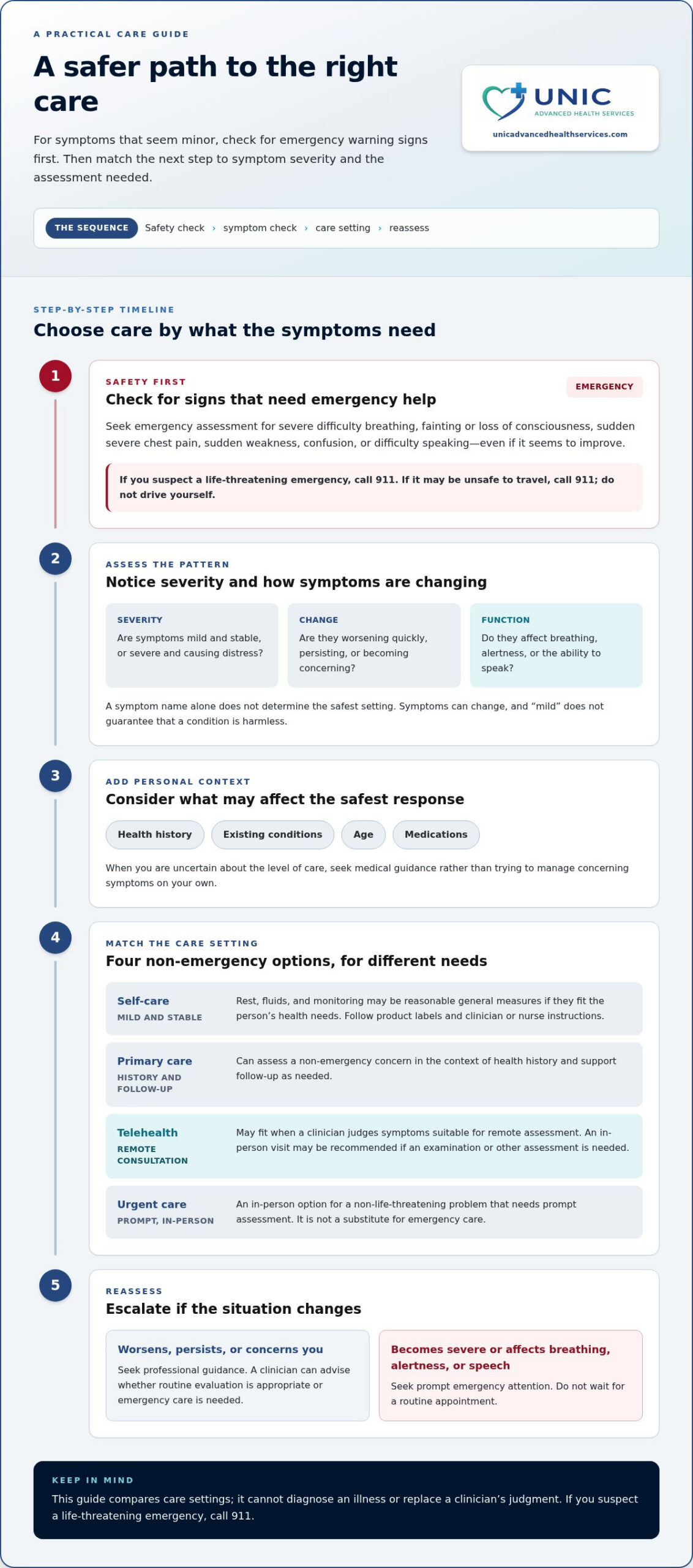
A safe step-by-step plan when an illness seems minor
A clear plan can help you choose among alternatives to the emergency room for minor illness while staying alert to changes. Use these steps as a guide, not as a diagnosis or a substitute for medical advice.
- Check for emergency signs. If the person may be experiencing a life-threatening emergency, call 911 rather than waiting for routine care, telehealth, or a clinic visit. If they may have taken too much medication or been exposed to poison, contact U.S. Poison Control at 1-800-222-1222 for guidance. Call 911 if the person is in immediate danger or seriously unwell.
- Write down what’s happening. Note when symptoms began, how severe they are, and what has changed. Record relevant medical conditions, allergies, and current medications. If available and safe to obtain, note temperature or other measurements, but don’t delay urgent care to collect them.
- Choose a care setting. Consider whether symptoms are stable, whether an examination or testing may be needed, and whether health history or follow-up matters. A clinician can help determine whether primary care, telehealth, urgent care, or another level of care fits the situation.
- Reassess and adjust. Pay attention to new symptoms and changes in how the person looks or feels. A higher-risk health situation, such as a significant underlying condition, may affect the safest next step. Follow clinical guidance and seek care promptly if concerns increase.
What information should you prepare before seeking care?
A concise timeline can help a clinician understand the concern: when it started, whether it is improving or worsening, and how it affects daily activities. Include medical conditions, allergies, and medications, including any recent changes. Share measurements only if you already have them or can obtain them safely. Clear details support an assessment, but they can’t guarantee a diagnosis.
What should you do if symptoms change?
Reassess promptly if symptoms worsen, new warning signs appear, or the person seems seriously unwell. Don’t rely on a fixed waiting period to decide whether to escalate. If you suspect a life-threatening emergency, call 911 instead of waiting for a routine appointment or remote consultation. For a concerning but non-emergency change, seek professional guidance and follow the clinician’s advice about whether in-person assessment is needed.
In Fort Lauderdale and surrounding communities, Unic Advanced Health Services provides primary care and telehealth for non-emergency evaluation and follow-up.
Fort Lauderdale primary care and telehealth for non-emergency guidance
For Fort Lauderdale residents, primary care and telehealth can be alternatives to the emergency room for minor illness when symptoms aren’t life-threatening. Unic Advanced Health Services provides both services in Fort Lauderdale and surrounding communities. The appropriate format depends on the concern: a remote consultation may suit some needs, while others call for an in-person assessment.
How can primary care support follow-up beyond one illness?
Primary care considers a concern within the context of your broader health, including medical history, current medications, and ongoing conditions. For example, a clinician managing diabetes or hypertension can consider how a new concern relates to that person’s overall care and recommend appropriate follow-up. This continuity can be useful beyond a single episode of illness, but it doesn’t replace emergency assessment when symptoms are severe or potentially life-threatening.
If a remote consultation may fit your non-emergency concern, read the Fort Lauderdale telehealth guide to learn more about this care format.
What is a practical next step for Fort Lauderdale residents?
For a stable, non-emergency concern, consider whether you need ongoing follow-up, a broader review of your health, or an assessment that may require an in-person visit. Unic Advanced Health Services provides primary care and telehealth, and a clinician can help determine which approach is appropriate. If symptoms point to a possible emergency, call 911 rather than waiting for routine care.
Primary care also includes preventive care, which supports health beyond an immediate illness. If you’re planning routine wellness care, explore the annual physical exam guide for an overview of that visit.
For non-emergency guidance in Fort Lauderdale and surrounding communities, explore primary care and telehealth options with Unic Advanced Health Services.
Choose the Next Step That Fits Your Symptoms
The safest care setting depends on symptom severity, how quickly symptoms are changing, and whether an in-person examination may be needed. Self-care, primary care, telehealth, and urgent care each have a different role. A clinician can help determine which option fits a non-emergency concern. If symptoms suggest a life-threatening emergency, call 911 rather than waiting for routine care.
Keep track of when symptoms began, how they change, and any relevant conditions or medications. This information can help a clinician assess your needs and guide the next step. The right choice can shift if symptoms worsen, so reassess rather than relying on convenience alone.
For non-emergency primary care and telehealth in Fort Lauderdale and surrounding communities, explore primary care and telehealth options with Unic Advanced Health Services. Understanding alternatives to the emergency room for minor illness can help you approach care with greater confidence. If you’re unsure, seeking appropriate medical guidance is a practical next step.
Frequently Asked Questions
What are alternatives to the emergency room for minor illness?
Alternatives to the emergency room for minor illness include self-care, primary care, telehealth, and urgent care, depending on symptoms and the assessment needed. Self-care may suit mild, stable symptoms, while primary care can consider your health history and follow-up needs. Telehealth offers remote consultation when appropriate, and urgent care provides in-person assessment for some non-life-threatening concerns. These options aren’t interchangeable. Call 911 for a suspected life-threatening emergency.
Can telehealth help with a minor illness?
Yes, telehealth may help assess a non-emergency concern if a clinician determines remote evaluation is appropriate. You can discuss symptoms, when they began, and how they have changed. A clinician may then recommend next steps, including an in-person visit if the situation requires it. Telehealth can’t provide a hands-on examination or every type of testing, so it isn’t suitable for every illness. Unic Advanced Health Services provides telehealth services in Fort Lauderdale and surrounding communities.
When should I go to urgent care instead of the emergency room?
Urgent care may be appropriate for a non-life-threatening problem that needs in-person assessment, while the emergency room is for potentially life-threatening or severe symptoms. The right setting depends on how serious the symptoms are, how quickly they’re changing, and what evaluation may be needed. If there’s severe breathing difficulty, fainting, sudden severe chest pain, sudden weakness, confusion, or difficulty speaking, call 911 rather than going to urgent care.
How do I know if an illness is serious enough for the emergency room?
Seek emergency care if symptoms are severe, rapidly worsening, or affect breathing or consciousness. Examples include severe difficulty breathing, fainting, sudden severe chest pain, sudden weakness, confusion, or difficulty speaking. Call 911 if you suspect a life-threatening emergency, and don’t drive yourself if it may be unsafe. Symptoms don’t always reveal their cause, so this guidance can’t diagnose an illness. If you’re uncertain and the person seems seriously unwell, seek emergency help.
Can a primary care provider assess a sudden illness?
Yes, a primary care provider can assess some sudden illnesses when they aren’t emergencies and the provider determines primary care is appropriate. The evaluation can take your health history, current conditions, and medications into account, which may help guide follow-up. Unic Advanced Health Services provides primary care in Fort Lauderdale and surrounding communities. If symptoms are severe or may be life-threatening, don’t wait for a primary care visit. Call 911.
What should I do if mild symptoms get worse?
Reassess promptly if symptoms worsen, new warning signs develop, or the person appears seriously unwell. Contact a clinician for guidance about the appropriate next step if the change is concerning but doesn’t seem life-threatening. Don’t rely on a fixed waiting period; the response depends on the symptoms and clinical advice. For severe breathing difficulty, fainting, confusion, or another suspected emergency, call 911 instead of waiting for routine care.
Is telehealth appropriate if I need a physical examination or testing?
Telehealth may not be enough if your concern requires a hands-on examination, vital signs, or testing. A clinician can discuss your symptoms remotely and determine whether an in-person assessment is needed. The decision depends on the illness and the information available during the consultation. Don’t use telehealth as a substitute for emergency care if symptoms may be life-threatening. For non-emergency concerns, a clinician can help identify a suitable care setting.