A medical waiver isn’t a loophole or a way to cheat the system; it’s a clinical pathway that proves your health is managed well enough for safe driving. For many commercial drivers, the thought of failing an exam feels like a career-ending event. You’ve likely felt the weight of anxiety when a new diagnosis or a chronic condition threatens your livelihood. The process of getting a medical waiver for DOT physical requirements can feel like an endless maze of federal paperwork and shifting regulations. However, your health doesn’t have to be a barrier to your career.
We understand that the confusion over federal versus state rules and the slow pace of government offices can be incredibly frustrating. This 2026 guide is designed to replace that uncertainty with a clear, step-by-step roadmap for navigating the FMCSA medical exemption programs. You’ll learn exactly how to document your stability, what specific documents the medical examiner needs, and how to approach your physical with total confidence. By the end of this article, you’ll have the tools to keep your CDL and stay on the road safely.
Key Takeaways
- Learn the difference between long-term federal exemptions and state-specific waivers to identify which pathway fits your specific health situation.
- Understand the specific requirements for common exemptions, including how to navigate failures in the forced whisper test or vision standards.
- Follow a clear, step-by-step roadmap for getting a medical waiver for DOT physical requirements, starting with a professional evaluation from a certified medical examiner.
- Discover how to use on-site lab work and clinical documentation to prove condition stability, ensuring you meet the strict FMCSA standards for safety.
- See how partnering with an experienced healthcare provider can help you manage chronic conditions like diabetes while maintaining your commercial driving status.
What is a DOT Medical Waiver vs. a Federal Exemption?
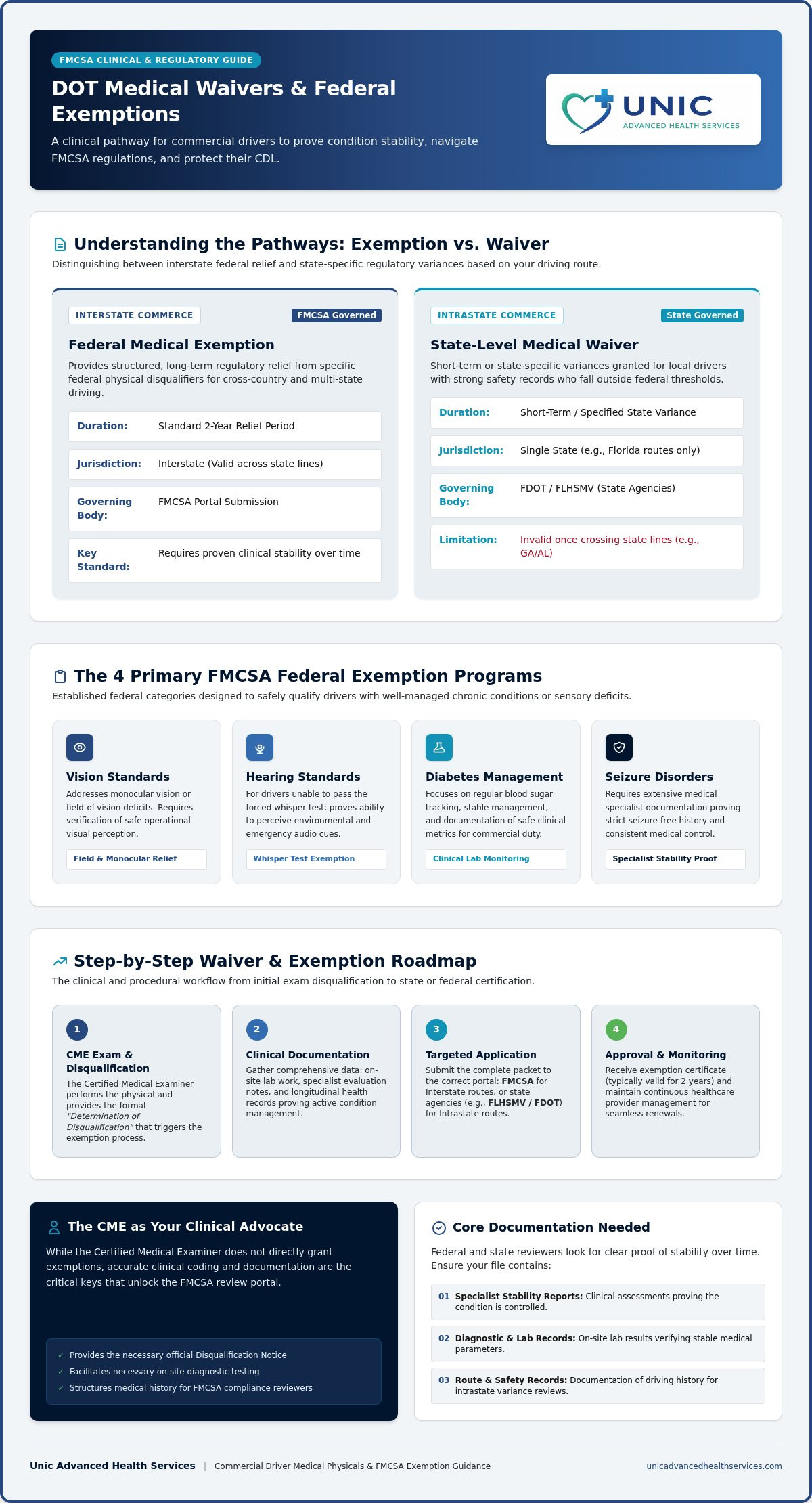
Understanding the difference between a waiver and an exemption is the first step toward securing your livelihood. Many drivers use these terms interchangeably, but the FMCSA makes a specific distinction based on duration and jurisdiction. A Federal Medical Exemption provides long-term relief from specific physical standards, usually for a period of two years. Conversely, a medical waiver is typically a short-term or state-specific variance granted for very specific circumstances. These nuances are governed by commercial driver’s license regulations, which ensure that every driver on the road meets a baseline safety standard.
When you’re getting a medical waiver for DOT physical requirements, your Certified Medical Examiner (CME) acts as your clinical advocate. While the CME doesn’t personally approve the waiver, they provide the essential “Determination of Disqualification” that triggers the application process. This document is the key that opens the door to the FMCSA portal. Without a thorough exam and the correct clinical coding from your examiner, your application will stall before it even begins.
To better understand how these evaluations work in practice, watch this helpful video:
Federal Exemption Programs (Interstate)
The FMCSA manages four primary federal exemption programs: Vision, Hearing, Seizure, and Diabetes. These programs are designed for drivers who operate in interstate commerce, meaning they cross state lines. If you have a stable medical history and can prove that your condition doesn’t compromise road safety, these programs allow you to bypass standard disqualifiers. It’s a structured path for those who are otherwise healthy but fall just outside the standard metrics.
The agency looks for “proven stability” above all else. This means you must show consistent management of your health over a set period, often through clinical data and specialist reports. At Unic Advanced Health Services, we focus on gathering this data accurately. We help you document that your condition is controlled, which is the most critical factor for federal approval. A steady hand during the documentation phase makes the difference between a rejection and a successful certification.
State-Level Waivers (Intrastate)
If your driving is limited to one state, you might look into state-level variances. In Florida, the Department of Transportation (FDOT) manages rules for intrastate drivers that can differ from federal mandates. These waivers are often helpful for drivers who don’t meet the strict federal hearing or vision thresholds but have a safe local driving record. They recognize that short-haul, local routes carry different risk profiles than cross-country trips.
However, these waivers have significant limitations. They are only valid within Florida state lines. If you’re a long-haul driver, a state-level waiver won’t keep you legal once you cross into Georgia or Alabama. For these cases, you must contact the Florida Department of Highway Safety and Motor Vehicles (FLHSMV) rather than the federal portal. Understanding where you intend to drive is vital before you start the paperwork. We help you weigh these options so you don’t waste time on a waiver that doesn’t fit your route.
Common Conditions Eligible for FMCSA Medical Exemptions
Not every medical diagnosis is a stop sign for your career. The FMCSA recognizes that many drivers manage chronic conditions with high levels of safety and professional discipline. If you’re getting a medical waiver for DOT physical requirements, it’s usually because you fall into one of several specific categories. The FMCSA driver exemption programs provide clear criteria for vision, hearing, and seizure disorders. These programs exist to ensure that medical conditions don’t automatically disqualify skilled professionals who are otherwise fit for duty.
Vision exemptions often address monocular vision or field of vision deficits. Drivers must demonstrate they can operate safely despite these challenges. For hearing, failing the forced whisper test doesn’t mean you’re off the road. You can apply for an exemption by proving your ability to perceive necessary environmental sounds. Seizure and epilepsy requirements are particularly strict; drivers must typically remain seizure free for a significant period while off anti-seizure medication to qualify. For those with Insulin-Treated Diabetes Mellitus (ITDM), the 2018 rule change was a major win. It replaced the old, cumbersome waiver process with a more streamlined clinical evaluation by your treating clinician, provided your condition is well controlled.
The Skill Performance Evaluation (SPE) Certificate
This specialized certificate is designed for drivers with missing or impaired limbs. It focuses on your ability to physically operate a commercial motor vehicle safely. To qualify, you must undergo a practical road test using any specialized equipment or vehicle modifications you require. It’s a functional assessment that proves your skill outweighs your physical limitation. Remember that an SPE certificate requires renewal every two years. Keeping up with these renewals is essential for staying compliant with federal law.
Diabetes and Heart Health Management
Stability is the cornerstone of any medical certification. For drivers with diabetes or cardiovascular issues, maintaining consistent A1C levels and blood pressure readings is vital. Our team at Unic Advanced Health Services focuses on how chronic care management helps you qualify for your certificate. We work closely with you to document medication compliance and lifestyle adjustments. This proactive approach ensures your clinical data reflects the well controlled status that examiners look for. If you’re worried about how your health history might affect your certification, a professional DOT physical evaluation can help you identify the right path forward.
Step-by-Step Guide: Applying for a Medical Waiver
The process of getting a medical waiver for DOT physical requirements requires a methodical approach and clinical precision. It isn’t a task you should rush; it requires careful coordination between your medical examiner and your specialists. Following a structured roadmap ensures that your application is complete and ready for federal review without unnecessary delays.
- Step 1: Schedule your DOT physical exam in Fort Lauderdale with a provider who understands the nuances of the waiver landscape.
- Step 2: Obtain the ‘Determination of Disqualification’ from your Certified Medical Examiner (CME). This document is the formal trigger for the exemption process.
- Step 3: Gather comprehensive specialist records. This includes detailed reports from your cardiologist, ophthalmologist, or neurologist, depending on your condition.
- Step 4: Complete the FMCSA Exemption Application specific to your health needs. For those with physical impairments, this often involves the Skill Performance Evaluation Certificate Program.
- Step 5: Submit the entire package to the FMCSA and monitor the Federal Register. Your name will be published there for a public comment period before final approval is granted.
Gathering Your Medical Evidence
The FMCSA demands a deep look into your clinical history to ensure long-term safety. For most exemptions, you must provide 3 to 5 years of medical records to establish a clear pattern of stability. Your specialists must write specific clearance letters that address your ability to operate a heavy vehicle. These records must prove you have had no “adverse events,” such as severe hypoglycemia or syncopal episodes. Accurate documentation is your strongest advocate during the review process.
Submission and The Waiting Game
Once you submit your package, you enter the federal review period. This phase typically lasts between 45 and 180 days, depending on the complexity of your medical file and the current agency volume. If the FMCSA requests more information, you must respond promptly with the exact data they require to keep the process moving. While your application is pending, you can often continue working in non-driving roles or within intrastate limits if you hold a valid state variance. Maintaining open communication with your employer during this time helps preserve your professional relationship while you wait for your federal certification.
Preparing Your Documentation: What Your Examiner Needs to See
Clinical documentation is the bedrock of a successful application. In the regulatory environment of the FMCSA, the “Golden Rule” is absolute: if it isn’t documented, it didn’t happen. When you are getting a medical waiver for DOT physical requirements, your file must tell a story of consistent, proactive health management. Providing a stack of disorganized papers isn’t enough. You need precise clinical data that proves your condition is stable and well controlled. Your medical examiner relies on these records to advocate for your safety on the road.
One of the most effective ways to build this proof is through on-site lab work. Immediate data on your A1C levels or kidney function provides the objective evidence an examiner needs to sign off on your stability. Additionally, your specialist must provide a clearance letter with very specific phrasing. Statements like “the patient is doing better” are too vague for federal review. The FMCSA requires specialists to state clearly that you are “safe to operate a commercial motor vehicle” and that your condition does not interfere with your physical ability to drive. For those managing hypertension or diabetes, bringing at least 90 days of blood pressure or glucose logs to your appointment is a standard requirement to demonstrate control.
The Role of Your Primary Care Provider
A provider who understands your long-term medical history is a significant asset compared to a high-volume walk-in clinic. At Unic Advanced Health Services, we act as a “steady hand” to coordinate between your specialists and the DOT requirements. We ensure that the specialist’s clinical findings align with federal standards. We also utilize telehealth to help you manage follow-up documentation or review lab results without needing to disrupt your driving schedule. This partnership ensures your medical file remains current and compliant while respecting your time as a professional driver.
Avoiding Common Documentation Errors
Small clerical mistakes often lead to significant delays in the waiver process. A missing signature or an incorrect date can cause the FMCSA to reject your entire package. To ensure a smooth review, avoid these common pitfalls:
- Vague Language: Ensure your doctor uses clinical terms like “clinically stable” rather than subjective terms like “improving.”
- Incomplete Medication Lists: You must disclose every medication, including dosages and any potential side effects like drowsiness or dizziness.
- Missing Specialist Credentials: Ensure your specialist’s contact information and medical license number are clearly visible on all letters.
If you are ready to organize your medical history and secure your certification, schedule your comprehensive DOT physical evaluation with our expert team today.
Navigating Your DOT Physical with Unic Advanced Health Services
Marc Joseph, NP, understands that your CDL is more than just a license; it’s your livelihood. When you face the challenge of getting a medical waiver for DOT physical requirements, you need a provider who views you as a partner rather than just another appointment. At Unic Advanced Health Services, we provide the steady hand necessary for complex certifications. We specialize in chronic disease management, ensuring that conditions like hypertension or diabetes are documented with the clinical precision federal reviewers demand. Our approach combines professional authority with empathetic care to reduce the anxiety often associated with medical evaluations.
We offer on-site diagnostics to streamline your visit, allowing for immediate data collection that supports your stability claims. If your schedule is tight, our Saturday appointments provide the flexibility you need to stay on the road without missing work. This modern efficiency is balanced with traditional values of thoroughness, making us a reliable advocate for your long-term health and career. We focus on the proactive management of your health to ensure you meet all regulatory standards before you even sit for your exam.
Why Choose Unic in Fort Lauderdale?
Our expertise extends across both FMCSA and U.S. Coast Guard (USCG) Boat Captain Physicals. This comprehensive scope means we understand the specific “what-ifs” that commercial drivers and maritime professionals encounter. We maintain direct communication with you throughout the process, helping you prepare for every clinical requirement. Our supportive environment prioritizes your safety and your career. We don’t just look for reasons to disqualify; we look for the clinical pathways that keep you driving safely within the bounds of federal law.
Booking Your Exam and Next Steps
Scheduling your evaluation is straightforward and designed for your convenience. You can book your appointment through our online portal or by calling our Fort Lauderdale office directly. To ensure a smooth process, please bring your current medical examiner’s certificate, a complete list of medications, and any specialist clearance letters you’ve gathered. If you have logs for blood sugar or blood pressure, having these ready will significantly speed up your evaluation. By choosing a provider who specializes in both primary care and regulatory exams, you ensure that your health management aligns with federal standards year-round. Don’t leave your career to chance with a provider who doesn’t understand the waiver process. Book your DOT Physical in Fort Lauderdale today to secure your professional future with a team that cares.
Securing Your Future on the Road
Navigating the federal exemption landscape requires clinical precision and a thorough understanding of FMCSA standards. Success often depends on your ability to prove medical stability through specialist documentation and consistent health logs. By distinguishing between state variances and federal programs, you can ensure your certification matches your driving route perfectly. The process of getting a medical waiver for DOT physical requirements is manageable when you have an expert guide to help you organize your clinical history.
At Unic Advanced Health Services, we specialize in bridging the gap between complex health conditions and regulatory compliance. Our autonomous NP-led clinic in Fort Lauderdale offers a supportive environment where chronic disease management is the priority. With on-site diagnostics and convenient Saturday hours, we make it easy to maintain your health while protecting your career. We’re dedicated to providing the steady hand you need to stay compliant and confident behind the wheel.
Schedule Your DOT Physical with Marc Joseph, NP today and take the next step toward a stable, successful career on the road. You’ve worked hard for your CDL, and we’re here to help you keep it.
Frequently Asked Questions
Can I drive while my DOT medical waiver application is pending?
You cannot drive a commercial motor vehicle in interstate commerce if your current medical certificate has expired or if you’ve been disqualified by an examiner. The pending application does not grant temporary driving privileges. If you are a driver in Fort Lauderdale, you might still operate within Florida state lines if you hold a valid state-specific variance. However, you must wait for formal federal approval before crossing state borders.
How long does it take for the FMCSA to approve a medical exemption?
The federal review process typically ranges from 45 to 180 days. This timeline includes a mandatory 30-day public comment period where your application is published in the Federal Register. The exact duration depends on the complexity of your medical history and the current volume of agency requests. Providing thorough clinical documentation from our Fort Lauderdale clinic can help you avoid delays caused by requests for more information.
Do I need a lawyer to apply for a DOT medical waiver?
You don’t need a lawyer to navigate the application process. Most drivers successfully manage their applications by working directly with their Certified Medical Examiner and their treating specialists. Our team at Unic Advanced Health Services assists you by organizing the clinical data and specialist letters required for a complete package. Focus your energy on gathering accurate medical evidence rather than seeking legal representation to meet federal standards.
What happens if my medical waiver application is denied?
If your application is denied, the FMCSA will provide a written explanation detailing the specific safety or clinical reasons for the decision. You can often reapply once you address the underlying health concerns or provide better evidence of condition stability. We work with drivers in Fort Lauderdale to improve chronic disease management, such as stabilizing A1C or blood pressure levels, to increase the likelihood of success in future applications.
How often do I need to renew my DOT medical exemption?
Most federal medical exemptions are valid for two years from the date of issuance. You should submit your renewal application at least 60 days before your current exemption expires to prevent a lapse in your driving status. Maintaining regular check-ups at our clinic ensures your medical evidence remains current. This proactive approach makes the process of getting a medical waiver for DOT physical requirements much smoother during the renewal cycle.
Can a nurse practitioner sign off on my medical waiver documentation?
An autonomous nurse practitioner like Marc Joseph can perform your DOT physical and provide the formal “Determination of Disqualification” required for your waiver application. While specific specialists must provide clearance letters for conditions like vision loss or heart disease, your primary medical examiner coordinates the overall certification process. We ensure that all clinical documentation meets the high level of seriousness and regulatory compliance required by federal authorities.
Is there a fee to apply for a federal medical exemption?
The FMCSA does not charge a fee to process your federal medical exemption application. However, you are responsible for the costs associated with the underlying medical evaluations, specialist consultations, and diagnostic tests. Our Fort Lauderdale practice provides on-site lab services and comprehensive exams to gather this necessary clinical data efficiently. These professional evaluations are essential for proving the stability required for getting a medical waiver for DOT physical standards.
What is the difference between an SPE certificate and a vision waiver?
An SPE certificate is specifically for drivers with missing or impaired limbs and requires a functional road test to prove driving ability. A vision waiver addresses deficits in monocular vision or field of vision through clinical documentation and specialist reports. Both programs provide a pathway for drivers who don’t meet standard physical requirements, but they utilize different evaluation methods and target distinct medical conditions under federal law.