What if a single missed word in a quiet room could suddenly put your livelihood at risk? For many experienced drivers, the anxiety of facing DOT hearing test standards is a heavy burden, especially as years on the road start to affect your natural hearing. It’s completely normal to feel a knot in your stomach when you think about the whisper test or the potential for a failed audiogram. You’ve worked hard for your CDL; the thought of losing it because of age-related changes is a significant source of stress.
The good news is that hearing loss doesn’t have to mean the end of your driving career. This guide will help you navigate the 2026 FMCSA requirements with confidence, ensuring you understand exactly how the two-test system works. We’ll explore the step-by-step process for using hearing aids during your exam and how to manage the federal hearing exemption if it becomes necessary. By the end, you’ll have a clear path to maintain compliance and know where to find a fair, professional evaluation in Fort Lauderdale to keep your medical card current.
Key Takeaways
- Understand the two-tier evaluation system used to meet DOT hearing test standards, focusing on functional safety and siren perception.
- Learn the specific decibel thresholds and frequencies used in audiometric testing to calculate your average hearing loss accurately.
- Discover the requirements for testing with hearing aids and how the federal exemption process supports drivers with significant hearing loss.
- Prepare for your appointment with a clear walkthrough of the forced whisper test and the 5-foot distance requirement.
- Find out how choosing a patient-first examiner in Fort Lauderdale can help you navigate these complex regulations with confidence and peace of mind.
Understanding the 2026 DOT Hearing Test Standards
The Federal Motor Carrier Safety Administration (FMCSA) maintains rigorous DOT hearing test standards to ensure every driver can safely interact with their environment. These requirements aren’t designed to be a barrier to your career; they’re a safety protocol meant to verify that you can hear emergency sirens, air brake leaks, and verbal instructions from law enforcement. Safety on the road depends on your ability to perceive these sounds clearly over the hum of the engine and the noise of traffic.
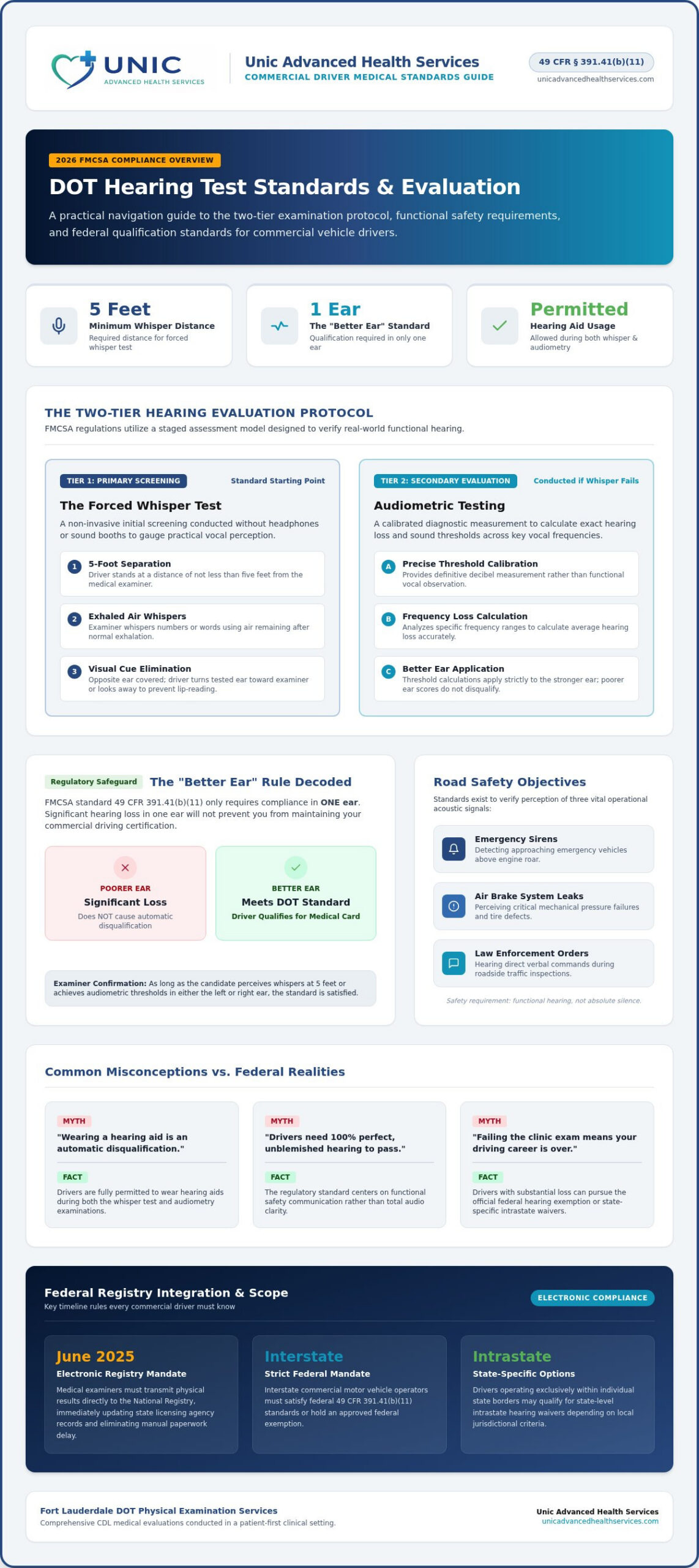
The evaluation follows a logical, two-tier approach. Most drivers start with the forced whisper test, which measures functional hearing at a distance of five feet. If you don’t pass this initial screening, the examiner will move to audiometric testing to get a precise measurement of your hearing thresholds across specific frequencies. A vital detail that many drivers miss is the “Better Ear” rule. FMCSA regulations only require you to meet the standard in one ear. If you have significant loss in your left ear but your right ear is strong, you still qualify for your medical card.
To better understand how these evaluations are performed, watch this helpful video:
The Legal Framework: 49 CFR 391.41(b)(11)
Federal regulation 49 CFR 391.41(b)(11) provides the specific criteria for these exams. For 2026, these standards remain a cornerstone of road safety. While interstate drivers must adhere strictly to these federal rules, some states offer specific intrastate waivers for drivers who only operate within state lines. It’s essential to understand which category you fall into before your appointment. Since June 2025, medical examiners must transmit your results directly to the National Registry. This electronic integration ensures your certification status is updated instantly with state licensing agencies, reducing paperwork errors.
Common Misconceptions About DOT Hearing Standards
Many drivers believe that wearing a hearing aid is an automatic disqualification. This is a myth. You’re permitted to wear your device during both the whisper and audiometry tests. Another common fear is that you need “perfect” hearing to pass. In reality, the standard is focused on functional hearing, not total silence. When you visit us for a DOT Physical Exam Fort Lauderdale, we act as your professional guide. We provide a supportive environment that prioritizes your health and your career. Our goal is to ensure you meet all regulatory requirements while feeling respected throughout the process.
The Forced Whisper Test: The First Line of Defense
The forced whisper test serves as the primary screening method for most commercial drivers. It’s a practical, real-world assessment designed to verify that you can hear essential communications, such as emergency instructions or sirens, while on the road. According to the 49 CFR § 391.41 physical qualification standards, you must be able to perceive a forced whisper in your better ear at a distance of not less than five feet. This test is often preferred by drivers because it’s quick, non-invasive, and doesn’t require the use of headphones or specialized booths.
During the procedure, the examiner will ask you to stand exactly five feet away. You’ll cover the ear not being tested while the examiner whispers a series of numbers or words using the air remaining after a normal exhalation. If you can repeat these sounds accurately in at least one ear, you’ve successfully met the DOT hearing test standards. If you’re feeling anxious about the process, our team at Unic Advanced Health Services provides a calm and professional environment for your DOT physical.
Exam Room Conditions and Best Practices
Accuracy depends on a controlled environment. A quiet room is essential so that background noise doesn’t interfere with your ability to hear the examiner’s voice. To ensure the test measures hearing rather than visual cues, you’ll be asked to turn your tested ear toward the examiner or look away to prevent lip-reading. Drivers can take proactive steps to improve their results. Clearing excessive earwax or managing sinus congestion before your visit can make a significant difference in your performance.
What Happens During a Failed Whisper Test?
Don’t panic if you struggle with the whisper test. A failure at this stage isn’t an automatic disqualification; it’s simply a signal that the examiner needs more precise data. We’ll then transition to an audiogram, which uses calibrated electronic equipment to measure your hearing thresholds at specific frequencies. This secondary evaluation provides a more detailed “second chance” to prove your eligibility. Many drivers who find the whisper test subjective find that the audiogram offers the clinical clarity required to satisfy federal safety regulations.
Audiometric Testing: Decibels and Frequencies
Audiometry is the electronic measurement of hearing sensitivity across specific pitches. While the whisper test is a functional screening, audiometric testing provides a clinical baseline using calibrated equipment. This secondary assessment is mandatory if you’re unable to pass the initial whisper test. For the purposes of meeting DOT hearing test standards, the examiner focuses exclusively on the “Big Three” frequencies: 500 Hz, 1,000 Hz, and 2,000 Hz. These specific pitches represent the range most critical for perceiving human speech and environmental safety cues like sirens or air leaks.
Regulations exclude higher frequencies, such as 4,000 Hz or 8,000 Hz, from the final calculation. This is beneficial for veteran drivers, as age-related hearing loss often strikes higher pitches first. By focusing on the lower-to-mid range, the FMCSA ensures that drivers with minor high-frequency deficits aren’t unfairly disqualified. If your hearing in these three core frequencies falls outside the acceptable range even with assistance, you may need to explore the FMCSA hearing exemption program to maintain your interstate driving privileges.
Calculating Your 40dB Average
Compliance is determined by a simple mathematical average. To pass, the average hearing loss in your better ear must not exceed 40 decibels (dB). For example, if your test results show a loss of 30dB at 500Hz, 40dB at 1,000Hz, and 50dB at 2,000Hz, your total is 120. When divided by three, your average is exactly 40dB, which satisfies the requirement. Examiners calibrate their equipment to the American National Standard Z24.5-1951 to ensure consistency across all testing sites. This precise measurement provides a reliable “second chance” for drivers who might struggle with the subjective nature of a whisper test in a busy clinic.
The Role of Specialized Occupational Exams
These hearing standards are a key component of comprehensive occupational health exams in Fort Lauderdale. Maintaining diagnostic accuracy is vital because your livelihood depends on the results recorded in the National Registry. We use modern, calibrated audiometers to ensure every decibel is accounted for correctly. Choosing an examiner who understands the nuances of occupational safety helps bridge the gap between strict regulatory compliance and your long-term career goals. Our patient-first approach ensures you receive a fair, accurate evaluation that respects the reality of life on the road.
Passing with Hearing Aids and the Exemption Process
Meeting DOT hearing test standards using corrective devices is a routine part of the certification process for many experienced drivers. If you require a hearing aid to pass either the whisper test or the audiometric exam, your Medical Examiner’s Certificate (MCSA-5876) will include a “Wearing hearing aid” restriction. This designation isn’t a mark against your professional skill; it’s a safety measure that ensures you remain fully aware of your surroundings while operating a commercial vehicle. It’s important to remember that once this box is checked, you’re legally required to wear your device at all times while on duty.
Drivers who cannot meet the minimum requirements even with the help of hearing aids aren’t necessarily out of options. The FMCSA provides a federal hearing exemption program for interstate drivers who can demonstrate they operate safely despite significant hearing loss. This waiver serves as a bridge, allowing dedicated professionals to stay behind the wheel when they otherwise wouldn’t meet the standard clinical thresholds. If you’re concerned about how your hearing status might affect your medical card, book your appointment with our supportive team for a thorough and fair evaluation.
Navigating the Hearing Aid Requirement
Success during your exam starts with proper device maintenance. We strongly recommend installing fresh batteries on the morning of your physical to ensure your hearing aids are performing at their peak capacity. During the audiogram, testing with hearing aids is often conducted via sound field testing rather than through traditional headphones. This method evaluates how well you perceive sound in an open environment, which more accurately reflects your experience in the cab. To stay compliant during roadside inspections, you must carry a spare set of batteries or a backup device at all times.
Applying for the FMCSA Federal Hearing Exemption
The application for a federal hearing waiver is a structured process that requires specific documentation and patience. First, you must obtain a comprehensive evaluation from an audiologist or an ENT specialist, which includes an audiogram performed without the use of hearing aids. You’ll also need to provide a copy of your 3-year state motor vehicle record (MVR) showing no disqualifying infractions. Once submitted, the FMCSA publishes your application in the Federal Register for a mandatory 30-day public comment period. While the typical timeline for a final decision can take up to 180 days, this pathway has allowed thousands of deaf and hard-of-hearing drivers to maintain their livelihoods legally in 2026.
Completing Your DOT Physical in Fort Lauderdale
Choosing the right location for your medical certification is about more than just proximity; it’s about finding a provider who understands the high-stakes nature of your profession. At Unic Advanced Health Services, we recognize that meeting DOT hearing test standards can be a source of significant stress for even the most seasoned drivers. Our practice, led by Marc Joseph, NP, offers a patient-first environment where your concerns are heard and your career is respected. As an autonomous nurse practitioner, Marc provides the expert oversight you need with a compassionate perspective that helps alleviate exam-related anxiety.
To ensure your visit goes as smoothly as possible, you should come prepared with your full medical history and specific hearing aid information. If you’ve been prescribed a device, bringing your most recent audiologist report or ENT evaluation helps us document your compliance accurately. We also provide the convenience of on-site lab services if your physical requires additional screenings. This integrated approach saves you time and ensures that every aspect of your health is managed under one roof with a focus on long-term reliability.
The Unic Advanced Health Services Advantage
Marc Joseph’s clinical style is built on the values of thoroughness and individualized care. We understand the regulatory pressure of maintaining FMCSA compliance in 2026, and we act as your steady hand throughout the process. Our Fort Lauderdale office is strategically located for easy access, and we offer Saturday appointments to accommodate the unpredictable schedules of long-haul drivers. We’re dedicated to keeping Florida’s workforce safe and compliant through reliable, specialized evaluations that prioritize your peace of mind.
Next Steps for Drivers with Hearing Concerns
Drivers who feel uncertain about their hearing acuity can benefit from a pre-exam consultation. This proactive step allows us to address potential issues before they impact your formal certification. We also encourage you to view your DOT physical as a gateway to annual physicals and preventive wellness. Managing chronic conditions like hypertension or diabetes is essential for passing your physical and maintaining your health for years to come. Secure your 2026 medical certification by booking your appointment with our expert team today.
Protecting Your Livelihood and Road Safety
Understanding the DOT hearing test standards is the first step toward a stress-free certification process. Whether you pass via the initial whisper test or require a detailed audiometric evaluation, the focus remains on your ability to operate safely while preserving your career. It’s important to remember that the “better ear” rule and the availability of federal exemptions ensure that hearing loss doesn’t have to be a roadblock to your professional success in 2026.
At Unic Advanced Health Services, we provide the steady hand you need to navigate these complex federal requirements. Our facility features an FMCSA Certified Medical Examiner on-site, and Marc Joseph, NP, is dedicated to providing compassionate, patient-first care that prioritizes your well-being. We understand the unique pressures of the trucking industry, which is why we offer convenient Saturday appointments in Fort Lauderdale to fit your busy driving schedule.
Don’t let exam anxiety keep you off the road. Schedule Your DOT Physical at Unic Advanced Health Services Today and secure your medical card with a healthcare partner you can trust. We look forward to supporting your long-term health and your continued journey on the road.
Frequently Asked Questions
Can I pass the DOT hearing test with a hearing aid?
Yes, you can pass the exam while using a hearing aid. If you meet the DOT hearing test standards with the assistance of your device, the medical examiner will note this on your certificate. You’re then legally required to wear the hearing aid whenever you’re operating a commercial vehicle. It’s also a best practice to carry spare batteries in your cab to ensure you remain compliant during roadside inspections in Fort Lauderdale.
What happens if I fail the whisper test but pass the audiogram?
You’ll be qualified for your medical card if you pass the audiogram. The forced whisper test is simply the first screening tool we use at our Fort Lauderdale clinic. If background noise or other factors lead to a failed whisper test, the audiogram provides a precise, electronic measurement of your hearing. As long as your average loss in the better ear is 40 decibels or less across the core frequencies, you’ve met the federal requirement.
Do I need to pass the hearing test in both ears?
No, you only need to meet the requirement in your better ear. FMCSA regulations specify that as long as one ear passes the whisper test at five feet or meets the 40-decibel audiometric standard, you’re physically qualified. This “better ear” rule is helpful for drivers with unilateral hearing loss. Our team in Fort Lauderdale ensures your results are recorded accurately in the National Registry to reflect this compliance.
How long does a DOT hearing exemption last?
A federal hearing exemption is typically valid for up to two years. Drivers must apply for a renewal 30 to 90 days before the current exemption expires to avoid a lapse in their driving status. This timeline matches the standard duration of a DOT medical certificate. If you’re operating in Fort Lauderdale with an exemption, you must keep the waiver paperwork with you and ensure your medical card specifically mentions the hearing exemption.
Will my CDL be suspended immediately if I fail the hearing portion?
Your CDL won’t be suspended the moment you fail, but you won’t receive a valid medical certificate. Without a current certificate, your CDL will eventually be downgraded to a standard Class E license by the state of Florida. If you’re struggling with the exam, we recommend discussing your options with our Fort Lauderdale staff. We can help you understand if a hearing aid or a federal exemption is the right path for your situation.
Can I use an amplifier instead of a hearing aid for the test?
You should use a medically prescribed hearing aid rather than a simple sound amplifier. The FMCSA regulations are designed around calibrated medical devices that address specific hearing loss. While over-the-counter amplifiers exist, they often don’t provide the precision needed to pass a clinical audiogram. If you rely on hearing assistance, ensure your device is professionally fitted and functioning properly before visiting our Fort Lauderdale office for your physical.
What frequencies are tested during the DOT audiogram?
The audiogram focuses on three specific frequencies: 500 Hz, 1,000 Hz, and 2,000 Hz. These are the core pitches used to calculate your average hearing loss. To meet the DOT hearing test standards, your average loss across these three frequencies in your better ear must be 40 decibels or less. Higher frequencies are not included in this calculation, which helps many drivers who experience high-pitch hearing loss as they age.
Is there a specific form my audiologist needs to fill out for a waiver?
Yes, the FMCSA requires a specific federal hearing exemption application. This package includes a medical release form and a requirement for a full audiogram report from your audiologist or ENT. The report must show your hearing thresholds without the use of hearing aids. Once completed, this documentation is submitted to the FMCSA for review. Our team in Fort Lauderdale can guide you on how to present these results to the medical examiner during your visit.