
Imagine sitting in a quiet exam room, staring at the Snellen eye chart, and realizing the bottom line is just a bit blurrier than it was during your last renewal. For a commercial driver, that slight haze isn’t just a medical observation. It’s a direct threat to your CDL and your livelihood. We understand that the pressure to meet DOT vision requirements for drivers can create significant anxiety, especially as you navigate the complex regulatory updates effective in 2026. It’s natural to feel concerned about how a chronic condition like diabetes or a change in your peripheral vision might impact your medical certification.
The good news is that these standards are manageable hurdles rather than dead ends. We’re here to provide a steady hand and clear guidance so you can maintain your career with confidence. You’ll learn exactly how to master the federal 20/40 acuity standards and how the Alternative Vision Standard has simplified the path for monocular drivers. We’ll also explain the critical 45-day deadline for Form MCSA-5871 and the annual requirements for maintaining your status. By the time you finish reading, you’ll have the knowledge needed to approach your Fort Lauderdale DOT physical with peace of mind and a clear plan for your future on the road.
Key Takeaways
- Understand the specific 20/40 distant visual acuity and 70-degree horizontal field standards required to meet federal safety benchmarks.
- Learn how the Alternative Vision Standard and Form MCSA-5871 provide a streamlined certification path for drivers with monocular vision.
- Discover how to properly document your use of corrective lenses to satisfy the latest DOT vision requirements for drivers during your physical.
- Identify how managing chronic conditions like diabetes can prevent vision-related complications that might otherwise jeopardize your medical certificate.
- Prepare for your exam with a clear understanding of the 45-day window for specialist reports and the importance of choosing an FMCSA-compliant examiner.
Understanding the 2026 DOT Vision Standards for Commercial Drivers
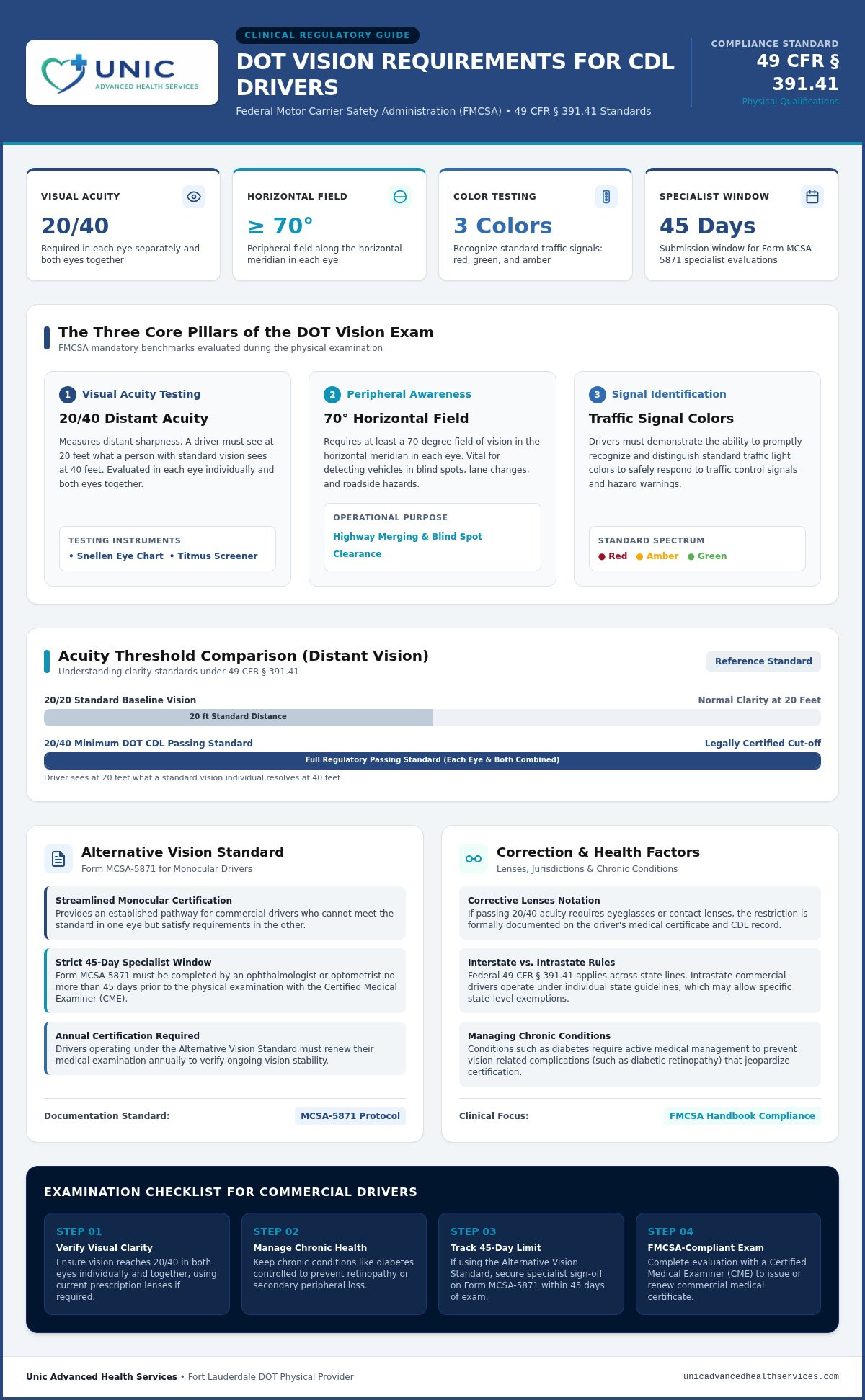
The Federal Motor Carrier Safety Administration (FMCSA) establishes national safety benchmarks to ensure every commercial driver can operate safely on public roads. Among these benchmarks, the DOT vision requirements for drivers serve as a critical gatekeeper because visual information accounts for the vast majority of a driver’s sensory input. The standard is officially defined as a three-part assessment evaluating distant visual acuity, horizontal field of vision, and the ability to recognize standard traffic signal colors.
It’s important to distinguish between interstate and intrastate requirements. Federal standards apply to interstate commerce, which involves crossing state lines or handling cargo intended for out-of-state delivery. Intrastate requirements are governed by individual states. While many states adopt federal guidelines entirely, some offer specific exemptions for drivers who stay within state borders. Understanding which rules apply to your specific CDL is the first step toward a successful medical certification.
To better understand the examination process and what to expect, watch this helpful video:
The Clinical Importance of Visual Acuity in Trucking
Reaction times are directly tied to how quickly your brain processes what your eyes see. At highway speeds, a fraction of a second can mean the difference between a safe stop and a collision. High-quality visual acuity testing ensures that drivers can read road signs and identify hazards from a safe distance. Beyond simple clarity, depth perception is vital for maneuvering long trailers into tight docking bays or merging into heavy traffic. Nighttime driving presents additional challenges. Glare from oncoming headlights and low-visibility weather conditions can severely strain eyes that don’t meet the 20/40 standard, making professional oversight essential for your safety.
Regulatory Oversight: Who Sets the Rules?
Federal law, specifically 49 CFR § 391.41, provides the legal foundation for these standards. The FMCSA Medical Examiner’s Handbook offers the clinical guidance used by providers during your exam. These rules have evolved to be more inclusive in recent years. They recognize that modern corrective lenses and surgical advancements allow many drivers to remain on the road safely. Your Certified Medical Examiner (CME) acts as a bridge between these complex regulations and your personal health. They ensure you meet the DOT vision requirements for drivers while helping you understand any necessary steps for long-term compliance. This professional partnership helps protect your career and the safety of everyone on the road.
The Three Core Pillars of the DOT Vision Test
The physical examination breaks down into three specific medical benchmarks. These pillars ensure you have the clarity to read signs, the awareness to spot hazards in your periphery, and the ability to distinguish traffic signals. Understanding these 49 CFR 391.41 vision requirements helps demystify the physical and reduces the stress of the appointment. During the exam, your provider typically uses a Snellen wall chart or a Titmus vision screener to verify each of these metrics in a controlled clinical environment.
Deconstructing the 20/40 Acuity Standard
Visual acuity measures the sharpness of your vision at a distance. To pass, you must demonstrate at least 20/40 vision in each eye individually and 20/40 when using both eyes together. If you’re wondering what 20/40 means, it’s simple. It means you can see at 20 feet what a person with standard vision can see at 40 feet. This level of clarity is vital for reading overhead highway signs and identifying brake lights well in advance.
If you meet the standard only while wearing glasses or contacts, that’s perfectly fine. We’ll simply note that you require corrective lenses on your medical certificate. For those who can’t meet the 20/40 mark in one eye even with correction, the Alternative Vision Standard offers a secondary pathway. This ensures that capable drivers aren’t sidelined by a single eye’s performance as long as the other eye is strong and healthy. It’s a supportive shift in policy that keeps experienced drivers where they belong: behind the wheel.
Peripheral Vision and Color Recognition
The second pillar focuses on your horizontal field of vision. You must have at least a 70-degree field of vision in the horizontal meridian for each eye. This peripheral awareness is what allows you to spot a vehicle merging from an on-ramp or a pedestrian stepping off a curb before they enter your direct line of sight. Examiners often test this by having you look straight ahead while they move an object into your field of view from the side, ensuring your “side vision” is adequate for highway safety.
Finally, the examiner checks your color recognition. Many drivers worry about being “color blind,” but the FMCSA doesn’t require you to pass complex hidden-number tests like the Ishihara plate test. Instead, you must be able to recognize the standard colors used in traffic control: red, green, and amber. As long as you can distinguish these specific signals, you meet the requirement. If you’re due for a renewal, scheduling a professional DOT physical with an experienced provider can help you navigate these DOT vision requirements for drivers with ease.
Navigating Vision Correction and the Alternative Vision Standard
Many drivers worry that needing glasses might complicate their medical certification. In reality, modern DOT vision requirements for drivers are designed to accommodate correction as long as it’s stable and effective. If you use glasses or contacts to reach the 20/40 benchmark, your Medical Examiner will simply mark the appropriate box on your certificate. This ensures you can continue your career safely while utilizing the tools that keep your vision sharp.
Corrective Lenses and Your Medical Certificate
When you pass the exam using correction, your certificate includes the “Qualified by Wearing Corrective Lenses” restriction. This is a standard designation, but it carries a legal responsibility to wear those lenses every time you’re behind the wheel. Driving without them is a federal violation and can lead to out-of-service orders during inspections. We strongly recommend bringing a backup pair of glasses to your appointment and keeping them in your cab at all times. For long-haulers using contacts, maintaining strict hygiene is essential to prevent infections. A simple eye irritation can quickly become a compliance issue if you don’t have a reliable pair of glasses ready to use immediately.
The Alternative Vision Standard (MCSA-5871)
The most significant recent shift in federal policy is the retirement of the old Federal Vision Exemption Program. It has been replaced by the Alternative Vision Standard, a more efficient process that empowers clinicians to make certification decisions rather than waiting on a multi-month federal waiver application. Under this standard, drivers with monocular vision or those who only meet the 20/40 rule in one eye can still qualify for interstate commerce.
The process begins with an evaluation by a licensed ophthalmologist or optometrist. They must complete the FMCSA Vision Evaluation Report (Form MCSA-5871), which documents that your vision is stable and that you meet the 20/40 and 70-degree requirements in your better eye. Once signed, you have exactly 45 calendar days to present this report to your Certified Medical Examiner to begin your physical.
For drivers seeking this certification for the first time, you must complete a road test administered by your employer unless you possess at least 3 years of valid commercial driving experience with the impairment. This new system removes months of bureaucratic waiting, allowing you to return to work much faster while maintaining high safety standards. Our role is to act as your steady hand, ensuring all documentation is handled precisely so your career remains on track and your DOT vision requirements for drivers are fully satisfied.
Common Eye Conditions and Preparing for Your Exam
Chronic conditions often play a silent but significant role in ocular health. Diabetes and hypertension are two of the most common factors that can impact your ability to meet DOT vision requirements for drivers over the long term. High blood sugar levels can cause the lens of the eye to swell, which leads to temporary but noticeable blurred vision that might fluctuate throughout the day. Similarly, uncontrolled high blood pressure can damage the delicate blood vessels in the retina, potentially leading to permanent vision loss if left unmanaged.
Managing Chronic Health for Better Vision
Stabilizing your health before your appointment is the best way to ensure your vision remains sharp. This is where annual physical exam Fort Lauderdale become a vital tool for commercial drivers. These wellness visits allow us to monitor your A1c levels and blood pressure, helping you avoid the sudden spikes that cause visual distortion. Working closely with a nurse practitioner ensures you have a steady hand guiding your treatment plan, making it much easier to maintain your medical certification year after year. Conditions like cataracts and glaucoma also require early detection. While cataracts can be surgically corrected, glaucoma requires ongoing management to protect your peripheral field, another core pillar of the DOT exam.
Practical Tips for Exam Day
How you treat your eyes in the 48 hours leading up to your test can influence your results. We recommend following a simple preparation checklist to give yourself the best chance of success. First, prioritize rest; your eyes need recovery time to function at their peak. Second, stay hydrated, as dehydration can affect ocular pressure and focus. Finally, limit your exposure to digital screens and blue light, which can cause significant eye strain and temporary fatigue.
- Rest your eyes: Avoid long-distance driving or heavy screen use the night before your exam.
- Hydrate: Drink plenty of water to maintain healthy eye moisture and pressure.
- Bring documentation: If you have had LASIK or other eye surgeries, bring the clinical release or clearance letters from your specialist.
- Clean your lenses: Ensure your glasses or contacts are clean and your prescription is current.
If you don’t pass the initial vision screening, don’t panic. A failed test usually leads to a referral to an optometrist or ophthalmologist for a more detailed evaluation. They can provide a new prescription or help you complete the necessary paperwork for the Alternative Vision Standard. If you’re ready to move forward with a provider who understands these nuances, you can book your DOT physical examination with our team today. We’re here to support your health and your career every step of the way.
Professional DOT Physicals in Fort Lauderdale
Understanding the technical side of DOT vision requirements for drivers is only half the battle. The other half is finding a clinical partner who treats your certification with the seriousness it deserves. At Unic Advanced Health Services, we recognize that your medical card is more than just a piece of paper; it’s your permission to earn a living. We’ve designed our DOT physical exam Fort Lauderdale process to be thorough, transparent, and supportive, ensuring you leave our clinic with a clear understanding of your health status and regulatory standing.
Why Experience Matters for Your Certification
Marc Joseph, NP, leads our clinic with a “steady hand” approach that balances clinical rigor with empathetic care. As an autonomous nurse practitioner, he provides a level of individualized attention that’s often missing in high-volume urgent care settings. This expertise is especially vital when navigating complex cases involving the Alternative Vision Standard or chronic condition management. We don’t just check boxes. We look at your long-term health strategy to ensure you remain compliant with FMCSA standards for years to come. Once your evaluation is complete, we handle the critical task of uploading your results to the National Registry of Certified Medical Examiners, preventing any administrative delays that could impact your CDL status.
Schedule Your Appointment Today
We know that a driver’s schedule is rarely predictable. To support the South Florida trucking community, we offer convenient Monday through Saturday hours. Saturday appointments are particularly popular for long-haul drivers who need to complete their occupational health exam Fort Lauderdale during their home time without disrupting their mid-week routes. Our central location makes it easy to get in, get out, and get back on the road with minimal stress.
To ensure your visit is as efficient as possible, please come prepared with the following items:
- Identification: A valid government-issued photo ID or your current CDL.
- Vision Correction: Any glasses or contact lenses you use while driving.
- Medical Documentation: A list of current medications and any specialist reports, such as Form MCSA-5871 if you’re using the Alternative Vision Standard.
- Health History: Information regarding recent surgeries or chronic conditions like diabetes or hypertension.
Our commitment is to keep Fort Lauderdale’s drivers safe, healthy, and fully compliant with all DOT vision requirements for drivers. We’re here to act as your advocate and guide through the medical certification process. Whether you’re a local delivery driver or an interstate veteran, you can trust our team to provide the professional oversight you need to maintain your livelihood with confidence.
Securing Your Career and Road Safety for 2026
Meeting the DOT vision requirements for drivers is about more than passing a single test; it’s about establishing a foundation for a long and safe career. We’ve explored how the three pillars of vision, acuity, field, and color, work together to keep you safe. We’ve also seen how the Alternative Vision Standard has simplified the certification process for drivers with specific visual impairments, removing old bureaucratic barriers. Your health is your most valuable asset on the road. By managing chronic conditions and preparing for your exam with rest and hydration, you can approach your physical with absolute confidence.
Our team is here to provide the expert oversight and steady guidance you need to navigate these regulations. As an FMCSA-certified medical examiner, Marc Joseph, NP, offers a supportive environment with on-site lab work for your convenience. We understand the demands of your profession, which is why we offer Saturday appointments to fit your busy schedule. Schedule your DOT Physical with our Fort Lauderdale experts today and take the next step toward your 2026 compliance goals. We look forward to being your trusted healthcare partner for many miles ahead.
Frequently Asked Questions
Can I pass a DOT physical if I am color blind?
Yes, you can pass if you can distinguish the standard colors of traffic signals. FMCSA regulations specifically require the recognition of red, green, and amber. You aren’t required to pass the complex hidden-number plate tests often used in standard eye exams. Our Fort Lauderdale clinic focuses on your ability to safely identify signals on the road, ensuring your color perception meets the necessary safety benchmarks for commercial operation.
What is the 20/40 rule for DOT vision requirements?
The 20/40 rule is a fundamental part of the DOT vision requirements for drivers. It means you must be able to see at 20 feet what a person with standard vision sees at 40 feet. This standard must be met in each eye individually and in both eyes together. You can use glasses or contacts to reach this mark, which ensures you can clearly read road signs and identify hazards at highway speeds.
Can I use a vision waiver for a CDL in 2026?
No, the traditional federal vision waiver program has been retired. It was replaced by the Alternative Vision Standard under 49 CFR § 391.44. Drivers who don’t meet standard requirements in one eye now use Form MCSA-5871. This clinical process is much faster than the old waiver system. It allows our Fort Lauderdale medical examiner to certify you once a specialist confirms your vision is stable and your better eye is strong.
Do I need to see an eye doctor before my DOT physical?
You only need to see an eye specialist if you’re unable to meet the 20/40 acuity or 70-degree peripheral standards during a standard screening. If you have a known vision impairment in one eye, you must visit an ophthalmologist or optometrist first. They need to complete the MCSA-5871 form. This report must be signed within 45 days of your scheduled physical at our Fort Lauderdale office to be valid.
What happens if I only have vision in one eye?
Drivers with vision in only one eye can still maintain their livelihood through the Alternative Vision Standard. Your functional eye must meet the 20/40 acuity and 70-degree horizontal field requirements. You’ll also need a stable driving history. Marc Joseph and our team provide a steady hand for monocular drivers in Fort Lauderdale, guiding you through the specific documentation needed to stay compliant with federal safety laws.
Can I wear contacts for my DOT vision test?
You can certainly wear contact lenses during your examination. If you use them to pass the test, your medical examiner will note this on your certificate. It’s important to remember that monovision lenses, where one eye is corrected for distance and the other for reading, are strictly prohibited by the FMCSA. Always bring your backup glasses to your Fort Lauderdale appointment to ensure a smooth and successful evaluation process.
How often is the vision portion of the DOT physical required?
Vision testing is a mandatory part of every DOT physical, typically occurring every two years. However, if you’re certified under the Alternative Vision Standard, you must undergo an evaluation every 12 months. This annual requirement ensures that your vision remains stable and safe for interstate commerce. Our clinic offers convenient Saturday hours in Fort Lauderdale to help you stay current with these frequent renewal cycles without missing time on the road.
Will LASIK surgery disqualify me from driving commercially?
LASIK surgery does not disqualify you from commercial driving. In fact, many drivers choose LASIK to meet DOT vision requirements for drivers without needing corrective lenses. Once your eyes have healed and your vision has stabilized at 20/40 or better, you can be certified. We recommend bringing a release from your eye surgeon to your Fort Lauderdale physical to document the successful outcome of the procedure and your current visual status.