
A medical diagnosis is rarely a dead end for your maritime career; it’s simply a documentation requirement that needs a strategic partner. It’s natural to feel a surge of anxiety when reviewing the list of USCG medical certificate disqualifying conditions, especially when your livelihood depends on a clear fit for duty status. You’ve likely heard stories about long delays at the National Maritime Center or felt overwhelmed by the complex requirements on the CG-719K form. We understand that your career on the water is more than just a job, and the fear of a medical denial can be paralyzing.
This guide will help you understand that most health challenges are manageable. You’ll learn the exact steps to secure your medical certificate despite existing health challenges. We’ll provide a clear breakdown of waivable versus disqualifying conditions, offer a practical checklist for your physical exam appointment, and explain how specialized documentation can help you navigate the 2026 regulatory landscape with confidence. By the end of this article, you’ll have a reliable roadmap to manage your medical history and keep your career moving forward.
Key Takeaways
- Understand that a medical diagnosis is typically a request for more information rather than an automatic career exit.
- Differentiate between permanent disqualifiers and the many USCG medical certificate disqualifying conditions that are eligible for a waiver with proper documentation.
- Learn how to manage chronic conditions like hypertension and diabetes to meet the Coast Guard’s 2026 fitness standards.
- Use our step-by-step checklist to prepare for your exam, starting with the accurate completion of your CG-719K form.
- Recognize the value of partnering with a maritime-focused examiner who understands the specific physical requirements and stressors of your career.
Understanding the USCG Medical Certificate & The Disqualification Myth
The USCG Medical Certificate is a distinct credential from your Merchant Mariner Credential (MMC) that validates your physical fitness for sea duty. While the MMC tracks your professional qualifications and service time, the medical certificate is a separate document focusing entirely on your health status. The USCG Medical Certificate is the primary document ensuring a mariner can safely perform emergency duties. It acts as a safeguard for you, your crew, and the vessel by confirming you are physically capable of handling the unique demands of the maritime environment.
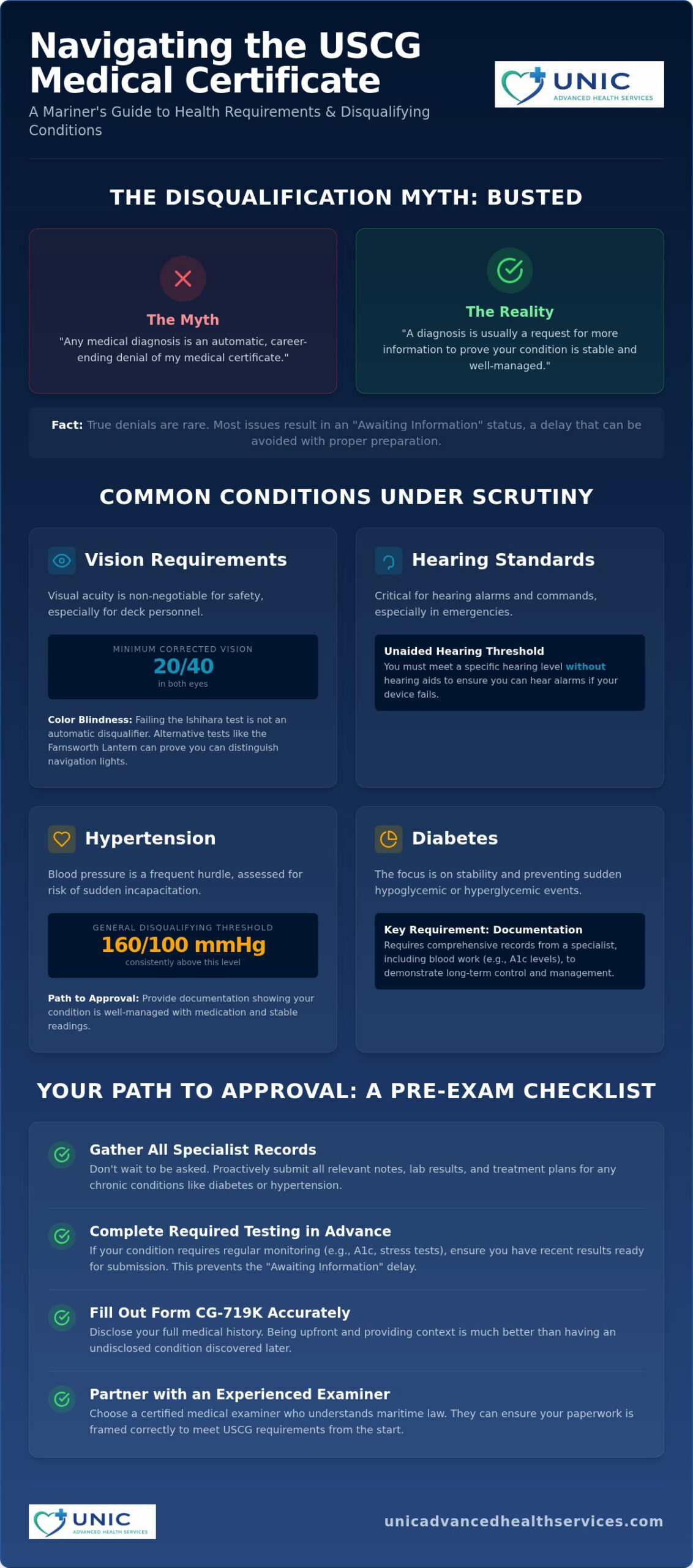
A common source of stress for captains and crew members is the fear of USCG medical certificate disqualifying conditions. Many believe that a diagnosis like sleep apnea or high blood pressure is an automatic “no” from the National Maritime Center (NMC). This is largely a myth. When the NMC reviews your CG-719K form, they aren’t searching for reasons to end your career. Instead, they are looking for evidence that your health is stable enough for the rigors of life at sea. A medical condition is usually a request for more information, not a final door closing on your livelihood.
The Purpose of 46 CFR 10.302 Standards
The Coast Guard uses the standards found in 46 CFR 10.302 to define “physical competence” for shipboard duties. These duties include more than just steering a vessel; they involve the ability to respond to fires, climb ladders, and assist in abandon-ship drills. The primary focus is on the risk of sudden incapacitation. If a condition could lead to a sudden loss of consciousness or mobility while you are miles from a hospital, the Coast Guard requires a deeper look. The review process recognizes that experienced, “Qualified” ratings have a different risk profile than “Entry Level” applicants, often allowing for more flexibility based on a proven track record of safety while managing a condition.
Delay vs. Denial: What the Numbers Actually Show
Industry data suggests that actual denials are rare compared to administrative delays. The NMC often places applications in an “Awaiting Information” status because the medical records provided are vague or incomplete. You can avoid months of back-and-forth by practicing proactive disclosure. This means providing specialist letters and treatment history for any chronic issues at the time of your exam. Having a certified medical examiner who understands the specific nuances of USCG medical certificate disqualifying conditions makes a significant difference. They act as a steady hand, ensuring your paperwork meets the regulatory requirements before it ever reaches the NMC’s desk.
Top USCG Medical Certificate Disqualifying Conditions in 2026
The 2026 standards for maritime fitness prioritize your functional ability to handle emergencies over a simple list of diagnoses. While the National Maritime Center (NMC) maintains a comprehensive list of Common Disqualifying Medical Conditions, most of these are only problematic if they are poorly managed or pose a risk of sudden incapacitation. Cardiovascular health remains a primary focus during the exam. If your blood pressure consistently exceeds 160/100 mmHg, it will likely be flagged as one of the USCG medical certificate disqualifying conditions that requires additional documentation and stabilization before approval.
Neurological and psychiatric conditions also receive significant scrutiny. Sleep apnea is a common hurdle, but it’s rarely a reason for denial if you can provide a compliance report from your CPAP machine showing consistent use. Similarly, a history of seizures or the use of certain medications for depression and anxiety doesn’t mean your career is over. The NMC simply needs to see that your condition is stable, your medications don’t cause sedating side effects, and your treating physician supports your ability to work safely on a vessel.
Vision and Hearing Requirements
Vision and hearing standards vary slightly depending on your role. Deck department personnel generally must meet a 20/40 vision standard in each eye, while engine department requirements are often set at 20/50. If you fail the standard Ishihara plate test for color vision, don’t panic. You can often take alternative tests, such as the Farnsworth Lantern or Optec 900, to prove you can distinguish between red, green, and amber navigation lights. Hearing is typically tested “unaided” first; however, if you require a hearing aid to meet the standard, the USCG may issue a certificate with a limitation requiring you to wear it while on watch.
Chronic Conditions: Diabetes and Hypertension
Managing chronic illnesses like Type 1 or Type 2 diabetes is a routine part of modern maritime medicine. The Coast Guard isn’t looking to disqualify every mariner with high blood sugar. They specifically want to see that your A1C levels are stable and that you aren’t at risk for hypoglycemic episodes while on duty. For those with insulin-treated diabetes, your medical provider must provide detailed logs and a specialist’s evaluation. Our team at Unic Advanced Health Services specializes in chronic condition management to help mariners navigate these requirements. We focus on stabilizing your health metrics so your physical exam results are clear, accurate, and ready for NMC approval without unnecessary delays.
Automatic Denials vs. Waiver-Eligible Conditions
Distinguishing between an absolute disqualification and a condition that simply requires a waiver is the most critical part of your application strategy. While many mariners fear that any health issue is a career-ender, the list of permanent USCG medical certificate disqualifying conditions is actually quite short. True automatic denials are typically reserved for conditions that present an immediate, unmanageable risk to maritime safety. These include active psychosis, severe uncorrected vision that falls below 20/200, or uncontrolled epilepsy. Most other health challenges fall into a “grey area” where the National Maritime Center (NMC) seeks more data before making a determination.
When a case is borderline, it may be referred to the Medical Advisory Board. This group of specialists evaluates whether a mariner’s specific health profile allows them to perform their duties without endangering the vessel. If they grant an approval, it often comes with waiver limitations. You might receive a certificate restricted to “Daytime Only” steaming or “Near Coastal” routes. In some cases, the USCG may issue a time-restricted certificate valid for only one or two years instead of the standard five-year term, requiring more frequent medical oversight. Coordinating the specialist letters required for these waivers can be a logistical burden. Our clinic in Fort Lauderdale acts as a dedicated partner for mariners, helping you organize your medical history so the NMC has exactly what they need to say “yes.”
The USCG Medical Waiver Process
A successful waiver application begins with a robust “Statement of Fitness” from your treating physician. This letter must do more than state you are “fine” to work; it must specifically address the physical demands of your rating and confirm that your condition is stable and well-managed. Given the high volume of applications in 2026, the NMC is currently experiencing significant processing delays. Submitting a complete, well-documented package the first time is essential to avoid being stuck in a months-long queue. If you do receive a denial, remember that it isn’t final. You have the right to appeal the decision by providing new clinical evidence or seeking a formal reconsideration from the NMC’s medical evaluation division.
Common Medication Restrictions
The medications you take are scrutinized just as closely as your underlying conditions. The Coast Guard maintains a strict “No-Go” list for medications that cause sedation or impaired judgment, such as chronic narcotics or certain benzodiazepines. If you’ve recently started a new prescription, the USCG generally requires a 90-day stability period. This ensures you can tolerate the medication without side effects before you return to watch-standing duties. It’s also vital to ensure your prescriptions don’t conflict with the USCG drug testing program. When we manage your physical, we review your entire medication profile to identify potential hurdles before they cause a failure at the NMC level.
How to Prepare for Your USCG Physical: A Step-by-Step Checklist
Preparing for your examination is just as critical as the clinical findings themselves. A well-organized mariner can often bypass the administrative hurdles that lead to months of “Awaiting Information” status at the National Maritime Center. By following a structured approach, you ensure that your medical history is presented clearly, reducing the likelihood that stable health issues are misidentified as USCG medical certificate disqualifying conditions. Use the following steps to streamline your appointment and protect your credentialing timeline.
- Step 1: Pre-fill the CG-719K Form. Download the current version of the CG-719K and complete Sections 1 through 4 before you arrive. This ensures your personal data and medical history are legible and accurate, preventing simple clerical errors that could trigger a review.
- Step 2: Consolidate Specialist Records. If you manage chronic conditions like diabetes, heart disease, or sleep apnea, gather your most recent treatment records. The NMC requires specific data, such as your latest A1C levels or CPAP compliance reports, to validate that your condition is stable.
- Step 3: Conduct a Personal Baseline Check. Visit a local pharmacy to check your blood pressure or use a home kit. Knowing your numbers in advance allows you to address any spikes with your primary doctor before the official exam. Similarly, ensure your vision is at its best; if your prescription is old, update it before the physical.
- Step 4: Select an Experienced Examiner. Choose a provider who understands maritime standards. An examiner unfamiliar with the Merchant Mariner Medical Manual may inadvertently flag a manageable condition as a disqualifier.
What to Bring to Your Fort Lauderdale Appointment
Having the right documentation on hand allows your nurse practitioner to advocate for your fitness more effectively. You should arrive with a comprehensive list of all current medications, including the exact dosages and the reasons for their use. It is also helpful to have the contact information for any specialists you have consulted within the last five years. If you require corrective lenses or hearing aids to perform your duties, you must bring them to the appointment. The exam requires testing your vision and hearing both with and without these aids to meet the USCG standards.
The Day of the Exam: Tips for Success
Your habits on the morning of the exam can influence your results. We recommend avoiding caffeine and nicotine for at least two hours before your appointment, as these stimulants can artificially inflate your blood pressure. Proper hydration is equally important; it ensures that your urinalysis results for protein and glucose are accurate. When discussing your history, aim for clarity rather than just honesty. Instead of saying you “sometimes have chest pain,” be precise about diagnosed conditions and the treatments that have successfully managed them. If you are ready to book your exam, you can schedule your USCG Boat Captain Physical with our expert team today to ensure your paperwork is handled with professional care.
Why Choose a Certified Examiner in Fort Lauderdale for Your USCG Physical
Fort Lauderdale serves as a critical hub for the maritime industry, making local expertise indispensable for active mariners. Choosing a provider in this major maritime center ensures that your examiner understands the specific regional demands and the high stakes of license renewals. At Unic Advanced Health Services, we provide NP-led care designed to support the unique lifestyle of boat captains and crew members. Our approach goes beyond a simple check-box exercise. We focus on long-term health management to ensure that potential USCG medical certificate disqualifying conditions are identified and stabilized well before they impact your career.
Our clinic provides significant advantages for busy professionals, including on-site lab services and Saturday appointments. These features eliminate the need for multiple trips to different facilities, allowing you to complete your requirements efficiently. Our team is well-versed in the Merchant Mariner Medical Manual, allowing us to help you mitigate the impact of common USCG medical certificate disqualifying conditions through proper documentation and clinical oversight. By managing chronic conditions like hypertension or diabetes year-round, we help you maintain a health profile that meets the National Maritime Center’s standards for every renewal cycle.
NP-Led Care: A Holistic Approach to Mariner Health
Marc Joseph, an autonomous nurse practitioner, provides the steady hand and clinical expertise required to navigate complex certifications. He understands that mariners often face irregular schedules and high-stress environments. By integrating your annual wellness exam with your USCG boat captain physical Florida requirements, we provide a comprehensive view of your health. This holistic perspective allows us to address the root causes of health issues rather than just treating symptoms. We act as your advocate, ensuring you remain fit for duty throughout the year while maintaining professional transparency with the Coast Guard.
Booking Your 2026 Maritime Physical
Scheduling your visit at our Fort Lauderdale clinic is a straightforward process designed to value your time and peace of mind. We are committed to clear communication and thorough documentation to minimize the risk of NMC delays. Our team ensures that every section of your CG-719K form is completed with precision, providing the clinical evidence that regulators often require for approval. This proactive partnership transforms the medical exam from a source of anxiety into a routine part of your professional maintenance. Don’t let health challenges or administrative confusion stall your progress. Schedule your USCG Physical Exam in Fort Lauderdale today and partner with a healthcare team that is dedicated to your long-term success on the water.
Secure Your Maritime Future with Proactive Health Management
Navigating the requirements for your credential doesn’t have to be a source of constant stress. We’ve established that the majority of USCG medical certificate disqualifying conditions are manageable through thorough documentation and stable clinical oversight. By preparing your CG-719K form in advance and partnering with an examiner who understands the specific physical demands of your rating, you can avoid the common pitfalls that lead to lengthy National Maritime Center delays. Your health history is a narrative of your resilience; with the right support, it won’t stand in the way of your career.
Unic Advanced Health Services offers the specialized expertise you need to move forward. As an autonomous, NP-led practice, we provide a steady hand for mariners facing complex certification hurdles. We offer the convenience of Saturday appointments at our Fort Lauderdale clinic and specialized experience as a USCG and DOT examiner. Our goal is to ensure your physical exam is a smooth, transparent process that supports your long-term wellness. Schedule your USCG Physical Exam in Fort Lauderdale today to protect your livelihood. We look forward to being your trusted healthcare partner as you return to the water with confidence.
Frequently Asked Questions
Can I get a USCG medical certificate if I have sleep apnea?
Yes, you can obtain a medical certificate with sleep apnea provided the condition is well-managed and documented. The USCG requires evidence of treatment compliance, which typically involves a CPAP usage report covering the last 90 days. This report must demonstrate that you use the device for at least four hours per night on 70% of nights. Providing this data during your exam prevents your application from being flagged under USCG medical certificate disqualifying conditions.
What is the maximum blood pressure allowed for a USCG physical?
The Coast Guard generally sets the threshold for further medical evaluation at 160/100 mmHg. If your blood pressure readings consistently exceed this limit during your physical, the National Maritime Center will require you to demonstrate that the condition is under control. We work with mariners to manage hypertension through specialized care, ensuring your readings meet the required standards before your paperwork is submitted for review.
Will I be disqualified for color blindness?
Color blindness is not an automatic disqualification for most maritime roles. If you don’t pass the standard Ishihara plate test, the USCG allows you to take approved alternative tests, such as the Farnsworth Lantern or Optec 900. Successfully passing one of these alternatives proves you can distinguish between red, green, and amber navigation lights, allowing you to secure your certificate without color-related restrictions.
How long is a USCG medical certificate valid in 2026?
A standard USCG medical certificate for national mariners is issued for a maximum of five years. However, if you have certain chronic health conditions, the Coast Guard may issue a time-restricted certificate valid for only one or two years to ensure more frequent monitoring. Due to high application volumes in 2026, the National Maritime Center has granted temporary extensions for certificates expiring through July 31, 2026.
Can I use a VA doctor for my USCG physical exam?
You can use a VA doctor for your physical, but they must complete the official CG-719K form and follow all USCG medical standards. Many mariners prefer using a dedicated maritime medical examiner because we specialize in the specific documentation the Coast Guard requires. This familiarity reduces the likelihood of administrative errors that often lead to frustrating delays in the credentialing process.
What happens if my USCG medical certificate is denied?
A denial is not a permanent end to your career; it’s often an invitation to provide more clinical evidence. You have the right to appeal the decision by submitting a formal request for reconsideration along with new specialist letters or test results. Partnering with a medical provider who understands the appeal process can help you address the specific concerns raised by the National Maritime Center and secure a waiver.
Do I need a USCG physical if I only have a 6-pack OUPV license?
Yes, all mariners holding a Merchant Mariner Credential, including those with a 6-pack OUPV license, must possess a valid medical certificate. The physical fitness requirements ensure that every operator is capable of handling emergency duties and safely navigating a vessel. This standard is mandatory regardless of whether you’re operating a small charter boat or a large commercial ship.
Can I take antidepressants and still get a USCG medical certificate?
You can typically continue taking antidepressants and remain eligible for a medical certificate if your condition is stable and well-documented. The USCG usually requires a 90-day period of stability on your current medication and dosage to ensure you don’t experience sedating side effects. It’s vital to disclose these medications on your CG-719K form to ensure your certification remains valid and compliant with federal regulations.