Imagine pulling into a weigh station only to find your commercial license has been automatically downgraded because of a digital reporting error you didn’t even know existed. With the full implementation of the National Registry II system, the days of relying solely on a paper medical card are over. Mastering the DOT physical requirements for truck drivers 2026 is no longer just about passing a health check; it’s about navigating a fully electronic landscape where your medical data is transmitted directly to state agencies in real time. This shift to digital transparency means that any oversight in your health management or documentation can lead to immediate administrative hurdles.
We understand that the transition to electronic reporting, combined with the pressure of managing blood pressure or blood sugar, often creates unnecessary anxiety. You deserve a partner who views your health as a long-term asset rather than a simple pass or fail gatekeeper. This article provides a comprehensive checklist to help you prepare for your 2026 exam with confidence. We will cover the temporary paper waivers active through October 11, 2026, the specific documents needed for chronic condition compliance, and how to ensure your digital record stays clear so you can stay on the road.
Key Takeaways
- Understand how the National Registry II (NRII) system makes digital records the primary legal proof of your medical certification instead of traditional paper cards.
- Master the updated DOT physical requirements for truck drivers 2026, including the specific vision, hearing, and cardiovascular benchmarks necessary for safe operation.
- Learn which specialist clearance letters and medication details you must bring to your appointment to prevent certification delays or license downgrades.
- Discover how proactive management of hypertension and diabetes can help you maintain compliance and protect your career longevity.
- Identify the advantages of working with a certified medical examiner who provides on-site lab services and flexible Saturday availability to accommodate your schedule.
DOT Physical Requirements for Truck Drivers: 2026 Standards Overview
The regulatory focus in 2026 has shifted significantly toward continuous health management rather than just a “point-in-time” exam every two years. This modern methodology encourages drivers to maintain ongoing partnerships with healthcare providers to manage chronic conditions like hypertension or diabetes. You must pass this physical if you operate any of the following:
- Vehicles with a gross combination weight rating of over 10,001 pounds.
- Vehicles designed to transport 16 or more passengers (including the driver).
- Vehicles used to transport hazardous materials that require placards.
To better understand how these medical standards affect your daily operations, watch this helpful overview of the examination process:
Who is Required to Maintain DOT Certification?
Most drivers involved in interstate commerce must maintain a valid medical certificate to meet federal Commercial Driver’s License requirements. This includes heavy machinery operators, long-haul truckers, and specialized logistics professionals. In Florida, intrastate drivers must also follow state-specific adoptions of these federal rules to ensure safety on local highways. When you renew your license or self-certify with the state, you’ll choose a category. Most commercial drivers fall under “Non-Excepted Interstate,” which means you operate across state lines and must meet all DOT physical requirements for truck drivers 2026 to keep your license active.
The Consequences of Non-Compliance in 2026
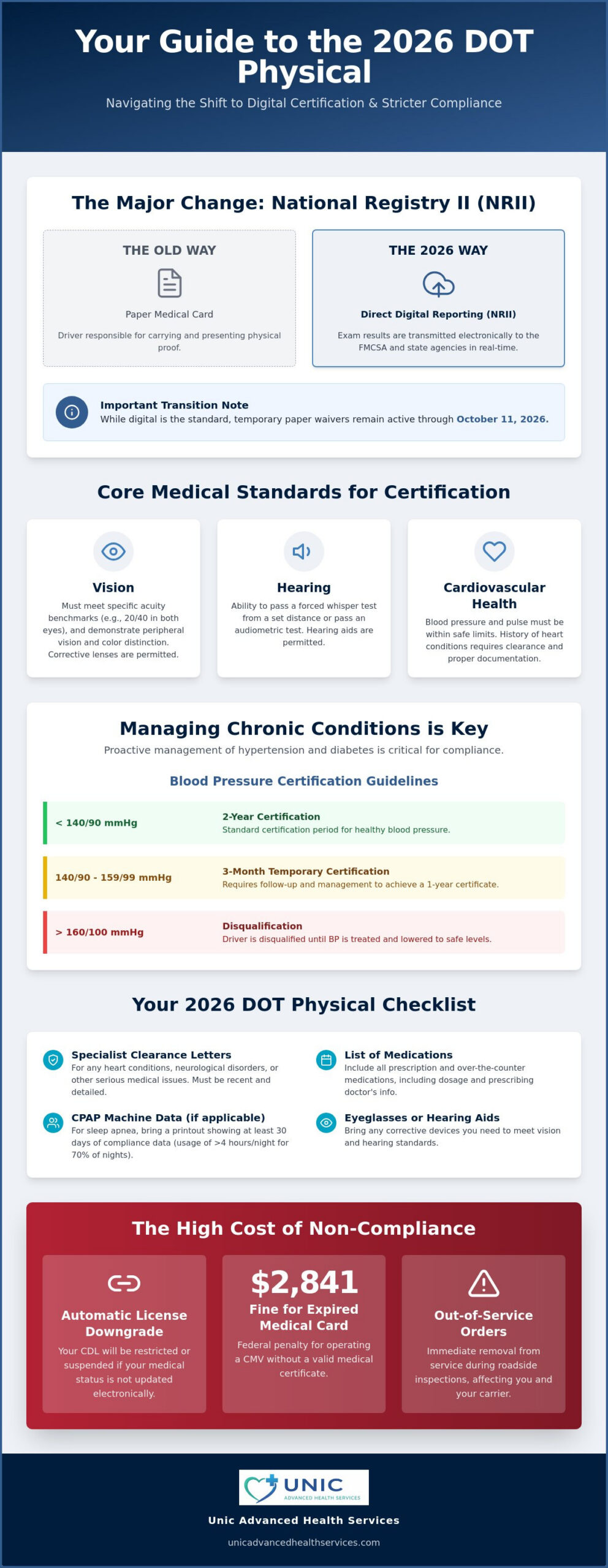
Neglecting your medical certification in 2026 carries heavy professional and financial risks. If your medical status isn’t updated electronically in the National Registry, your state agency will trigger an automatic license downgrade to a “K” restriction or a full suspension. This restriction limits you to intrastate travel only, which can severely impact your earning potential. According to 2026 regulatory data, the fine for driving with an expired medical card is $2,841. Beyond these costs, a “Not-Certified” status on your driving record leads to immediate vehicle out-of-service orders during roadside inspections. This affects both your personal record and your carrier’s safety rating, making compliance a top priority for career stability.
Major 2026 FMCSA Updates: Electronic Reporting and National Registry II
The most significant administrative shift in 2026 is the full integration of the National Registry II (NRII) system. This platform transforms how FMCSA medical certification data is handled. Medical examiners now transmit exam results directly to the FMCSA through a secure portal. This digital record serves as the “Source of Truth” for federal authorities, effectively replacing the traditional paper card for CDL and CLP holders. While the underlying DOT physical requirements for truck drivers 2026 remain consistent, the reporting process is now entirely electronic. This change ensures that your medical status is visible to law enforcement and state agencies in real time.
Drivers must stay informed about the specific regulatory timeline regarding paper certificates. The FMCSA issued a temporary waiver that allowed drivers to use a paper Medical Examiner’s Certificate (MEC) as proof of certification through April 10, 2026. A subsequent extension now stretches this allowance through October 11, 2026. This grace period exists because state licensing agencies often require up to 60 days to synchronize their records with the federal database. If you’re stopped for an inspection during this window, your digital record might not yet reflect your most recent exam. Carrying your paper certificate remains a vital safeguard during this transition period.
The End of the “Paper-Only” Era
The NRII system is a proactive solution to reduce fraud and ensure that every medical examiner is properly certified and listed on the National Registry. Drivers can use the FMCSA Portal to monitor their own health data and certification status. Even with this digital shift, you should still keep a paper MEC copy as a backup during the 2026 rollout to avoid confusion at weigh stations. Maintaining a clear record is easier when you work with a certified medical examiner who understands these administrative nuances and can ensure your data is transmitted accurately.
What Drivers Need to Check on Their Record
Verification is your best defense against an automatic license downgrade. First, confirm that your examiner is active on the National Registry before your appointment. After your exam, log into the Florida FLHSMV portal to verify your “Medically Certified” status. Discrepancies between your exam date and your state record are common during this transition. If your status hasn’t updated after several weeks, contact your examiner to ensure the electronic transmission was successful. Being proactive about these digital checks prevents the anxiety of a sudden, unexpected suspension of your driving privileges.
Core Medical Standards: Vision, Hearing, and Cardiovascular Health
Mastering the physical exam requires more than just showing up; you need to understand the clinical benchmarks that examiners use to evaluate your fitness. The DOT physical qualification standards define the exact parameters for vision, hearing, and cardiovascular health. For the 2026 cycle, these standards remain the baseline for safety on the road. You must have at least 20/40 visual acuity in each eye and both eyes together, either with or without corrective lenses. Additionally, your peripheral vision must span at least 70 degrees in the horizontal meridian of each eye. These vision rules ensure you can identify hazards across multiple lanes of traffic while meeting the DOT physical requirements for truck drivers 2026.
Hearing standards are equally strict to ensure you can detect sirens or shifting loads. You’ll need to perceive a “forced whisper” from a distance of five feet in your better ear. If you fail the whisper test, an audiometry test is the next step. During the physical, you’ll also undergo a urinalysis. It’s vital to remember that this specific test isn’t the 5-panel drug screen. Instead, we use it to look for protein, blood, and sugar; these markers can indicate underlying issues like kidney disease or undiagnosed diabetes that might otherwise go unnoticed.
2026 Vision and Hearing Exemptions
Drivers who have lost vision in one eye can still maintain compliance through the simplified Vision Evaluation Report (Form MCSA-5871). This update streamlines the process for monocular drivers to stay behind the wheel without the lengthy waiver processes of the past. If you use a hearing aid, you can pass the exam as long as the device allows you to meet the whisper test threshold. We recommend always carrying spare batteries in your cab to ensure you remain compliant during any roadside inspections or unexpected delays.
Blood Pressure Categories and Certification Length
Blood pressure is often the biggest source of anxiety for drivers. Maintaining a reading under 140/90 is the goal for a standard two-year certification. If your reading falls between 140/159 systolic or 90/99 diastolic, you’re in Stage 1. This results in a one-year certificate, giving you time to implement management strategies with your provider. Stage 2 (160/179 systolic or 100/109 diastolic) yields a one-time, three-month certificate to stabilize your health. A reading of 180/110 or higher is Stage 3, which causes immediate disqualification until your pressure is managed under 140/90. To learn more about managing these numbers, read our guide on DOT Physical Blood Pressure Requirements: Stay on the Road.
Your 2026 DOT Physical Preparation Checklist
Preparation is the bridge between anxiety and a successful certification. When you arrive organized, you help your medical examiner verify your health status quickly and accurately. Following a structured approach ensures you meet all DOT physical requirements for truck drivers 2026 without the need for unnecessary return visits or administrative delays. Use this five-step checklist to organize your documents and aids before you arrive at the clinic.
- Step 1: Gather Medical Documentation. Collect specialist clearance letters if you manage heart conditions, diabetes, or neurological issues.
- Step 2: List Your Medications. Create a complete record of current prescriptions, including the specific dosage and the prescribing physician’s contact information.
- Step 3: Prepare Your Aids. Bring your corrective lenses, contacts, or hearing aids. We need to test your vision and hearing with the tools you use on the road.
- Step 4: CPAP Compliance Data. If you’ve been diagnosed with sleep apnea, provide a 90-day usage report from your machine to demonstrate consistent treatment.
- Step 5: Identity Verification. Bring a valid driver’s license and your FMCSA Driver ID. While some systems are digital, having your ID number ready ensures your record syncs correctly with the National Registry.
Organizing these details in advance allows us to focus on your health rather than paperwork. For a more detailed breakdown of these steps, you can review our guide on how to prepare for your DOT physical: a checklist.
Documentation for Chronic Conditions
Managing a chronic condition doesn’t automatically disqualify you, but it does require specific paperwork. Drivers with insulin-treated diabetes must bring a completed Insulin-Treated Diabetes Mellitus (ITDM) Assessment Form, also known as MCSA-5870. If you have a history of heart bypass surgery or stents, bring your most recent stress test results and a cardiologist’s clearance letter. For seizure disorders, 2026 standards require specific neurological clearance and a documented period of being seizure-free while off medication. Having these forms ready prevents the examiner from having to “pend” your application while waiting for outside records.
Day-of-Exam Tips for Success
Your habits on the morning of the exam can significantly impact your results. Avoid caffeine and nicotine for at least two hours before your appointment. These stimulants can cause temporary spikes in blood pressure that might result in a shorter certification period. Drink plenty of water to ensure you can provide a sample for the urinalysis, but stay away from sugary sodas or energy drinks. High sugar intake right before the test can trigger a glucose flag in your urine, which may require further diagnostic testing. If you’re ready to complete your certification with a team that values your time and career, book your DOT physical today at our Fort Lauderdale clinic.
Navigating Compliance with Unic Advanced Health Services in Fort Lauderdale
Unic Advanced Health Services provides FMCSA certified DOT physicals designed specifically for the South Florida trucking community. We understand that meeting the DOT physical requirements for truck drivers 2026 involves more than just a quick checkup; it requires a provider who understands your lifestyle and the unique pressures of the road. Led by Marc Joseph, an autonomous nurse practitioner, our clinic specializes in chronic condition management. We focus on the specific health markers, such as hypertension and diabetes, that frequently cause drivers to lose their certification. By choosing a provider who understands these hurdles, you gain a partner dedicated to protecting your career longevity.
Efficiency is a core value of our practice because we know your time is your livelihood. We provide on-site lab services for required urinalysis during your visit. This eliminates the need for you to travel to a secondary testing facility or wait days for results. This streamlined process ensures that your certification data is processed and transmitted to the National Registry without administrative friction. We also offer Saturday morning availability to accommodate drivers who are on the road during the week. This flexibility allows you to complete your exam without sacrificing a day of hauling or missing critical deadlines.
Why Choose an Autonomous Nurse Practitioner?
Working with an autonomous nurse practitioner offers a more personalized and compassionate level of care than typical high volume clinics. We move beyond the standard exam to provide a comprehensive primary care approach that prioritizes your well being. This perspective looks at your long term health, ensuring that your chronic conditions are managed for compliance well before your certificate expires. You’ll benefit from direct communication with a professional who understands the physical demands and regulatory pressures of the trucking industry. Our goal is to act as a steady hand, guiding you through complex medical standards with clarity and clinical expertise.
Booking Your DOT Physical in Fort Lauderdale
We’ve simplified the scheduling process to respect your time and provide peace of mind. Our clinic offers easy online scheduling and telehealth consultations for pre-exam health reviews. These consultations allow you to discuss potential health concerns or medication questions before your official physical begins. We proudly serve drivers throughout Fort Lauderdale and the surrounding Broward County area, providing local expertise for Florida specific licensing needs. For more localized information on staying compliant in our region, read our DOT Physical Exam Fort Lauderdale: The 2026 Guide for Commercial Drivers. Our team is ready to help you meet all DOT physical requirements for truck drivers 2026 while ensuring you feel supported at every step of your health journey.
Secure Your Career with Proactive Health Management
The transition to a digital-first environment means your medical certification is now more transparent and immediate than ever before. Success in 2026 requires a shift from viewing the physical as a biennial chore to seeing it as a vital part of your professional longevity. By organizing your documentation and working with integrative health specialists like Dr. Philip Boamah | Natural Medicine & Physical Therapy to manage chronic conditions proactively, you can avoid the administrative delays that lead to automatic license downgrades and costly fines.
Staying ahead of the DOT physical requirements for truck drivers 2026 is the best way to ensure you never miss a day of work due to a preventable health or paperwork issue. Our clinic provides the expertise of a certified FMCSA Medical Examiner on-site, along with the convenience of on-site lab services and Saturday appointments to fit your busy schedule. We’re here to be your long-term partner in health and compliance, helping you navigate these new electronic standards with confidence.
Schedule Your 2026 DOT Physical in Fort Lauderdale Today
Your health is your most important piece of equipment. We look forward to helping you stay safe, compliant, and successful on the road.
Frequently Asked Questions
What happens if I fail my DOT physical in 2026?
If you don’t meet the medical standards, the examiner will mark your status as disqualified in the National Registry. However, an examiner can often pend your application for up to 45 days if they simply need more documentation from your specialist. This temporary status allows you to gather the necessary clearance letters without an immediate failure on your record. If a disqualification is finalized, you must resolve the underlying health issue before you can be re-examined for certification.
How long is a DOT medical card valid under the new 2026 rules?
A medical certificate is valid for a maximum of 24 months from the date of your exam. The examiner may issue a shorter certificate, such as for three months or one year, if you have a health condition that requires more frequent monitoring. Following the DOT physical requirements for truck drivers 2026 ensures that conditions like high blood pressure or diabetes are managed closely. Your digital record will reflect the specific expiration date assigned by your medical examiner.
Do I need a drug test during my DOT physical exam?
The standard DOT physical does not include a 5-panel drug screen. The urinalysis performed during the exam is a clinical screening used to detect protein, blood, and glucose levels which might indicate kidney issues or diabetes. While many employers schedule drug tests to coincide with your physical, they’re separate regulatory requirements with different laboratory protocols. You should confirm with your carrier if they require a drug test in addition to your medical certification.
Can I drive while my vision exemption is being processed?
You cannot legally operate a commercial vehicle if you don’t have a currently valid medical certificate and a finalized exemption. If your certification has expired and you’re waiting for the FMCSA to approve a vision or hearing waiver, you must wait until that approval is officially granted and recorded. Operating a vehicle during this processing period can lead to significant fines and an immediate out-of-service order during a roadside inspection.
What medications are disqualifying for truck drivers in 2026?
Disqualifying medications typically include Schedule I controlled substances, methadone, and habit-forming narcotics. Certain anti-seizure medications and drugs that cause significant drowsiness or impaired reflexes are also prohibited for safety reasons. It’s vital to provide a full list of your prescriptions to your examiner. They’ll evaluate if your specific dosage or medication type interferes with your ability to safely operate a heavy vehicle according to federal guidelines.
Is a sleep apnea study required for all drivers?
A sleep study is not a mandatory requirement for every driver during a DOT physical. The examiner will evaluate your risk factors, such as a high body mass index (BMI), large neck circumference, or reports of excessive daytime sleepiness. If these screening tools suggest a high probability of obstructive sleep apnea, the examiner will refer you for a formal sleep study. Drivers already diagnosed with the condition must provide 90 days of CPAP compliance data to maintain their certification.
How do I update my medical certificate with the Florida DMV (FLHSMV)?
Under the National Registry II system, your medical examiner transmits your results directly to the FMCSA, which then shares that data with the Florida FLHSMV. While this electronic sync is the primary method of reporting, you can still manually upload a copy of your certificate to the Florida driver license portal. This manual step provides an extra layer of security to ensure your CDL status remains certified while the federal and state systems synchronize.