
What if a failed medical exam was actually a temporary pause in your career rather than a permanent stop sign? It’s natural to feel a surge of anxiety when you wonder what happens if you fail a DOT physical and leave a clinic without a medical card in hand. You’ve worked hard for your CDL, and the fear of losing your livelihood or getting tangled in confusing FMCSA regulations can be overwhelming. We understand that your health is your career, and a single high blood pressure reading shouldn’t define your future on the road.
This guide provides a clear, legal path to getting back behind the wheel. You don’t have to navigate these federal requirements alone. We’ll show you how to manage a Determination Pending status, how the 2026 National Registry II transition affects your digital records, and the correct way to seek a second opinion without risking penalties. By focusing on proactive health management and understanding the latest 2026 standards, you can secure your medical certificate and protect your professional longevity.
Key Takeaways
- Understanding what happens if you fail a DOT physical is the first step toward recovery, as many disqualifications are temporary and manageable with proper clinical care.
- Learn to distinguish between a “Determination Pending” status and a full disqualification to understand your immediate standing and next legal steps with the FMCSA.
- Identify how chronic conditions like hypertension and diabetes are evaluated under 2026 standards to better prepare your health for a successful re-evaluation.
- Discover the legal process for securing a second opinion while avoiding “doctor shopping” penalties through the National Registry’s integrated tracking system.
- Follow a structured recovery plan that utilizes chronic condition management to address underlying health issues and regain your medical certification.
Failing vs. Deferral: Understanding Your DOT Medical Status
Failing a medical exam doesn’t always mean your career is over; it’s often a clinical pause. Under federal law, specifically 49 CFR 391.41, a failed physical occurs when an examiner identifies a condition that prevents you from safely operating a commercial vehicle. However, understanding what happens if you fail a DOT physical requires looking closely at the specific status your examiner assigns. Not every hurdle is a permanent disqualification. Most medical examiners prefer to work with you to find a path toward compliance rather than issuing an immediate denial.
To better understand the implications of specific disqualifying factors, watch this helpful overview:
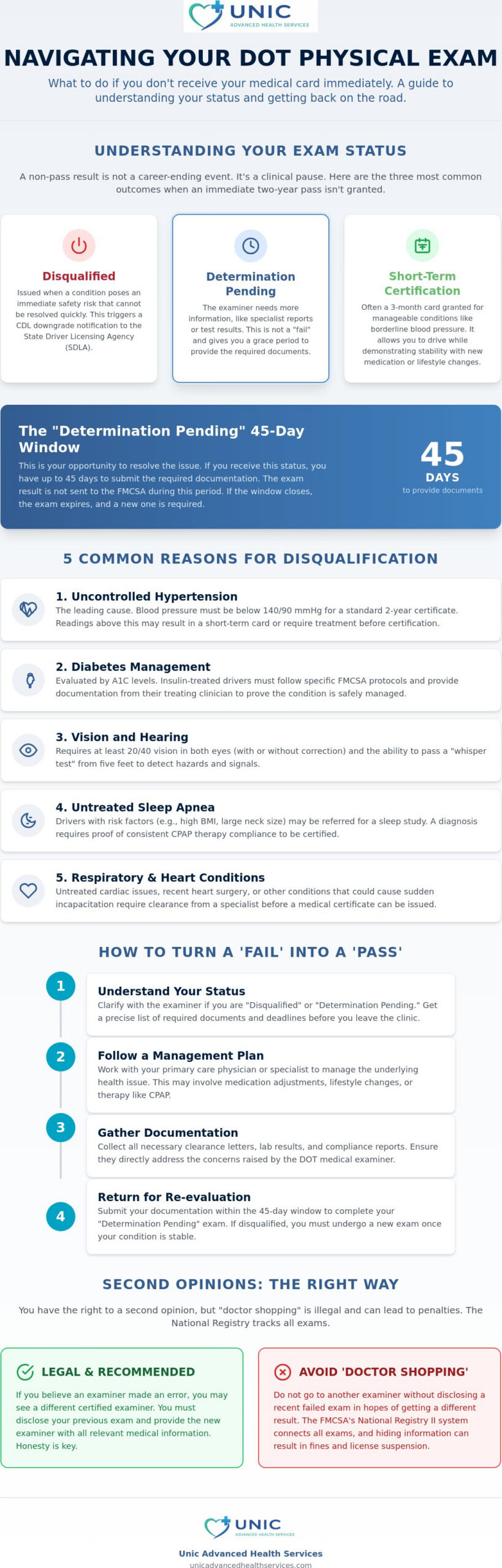
There are three primary outcomes when an exam isn’t an immediate two-year pass. The first is “Disqualified,” which applies when a condition poses an immediate safety risk that cannot be resolved quickly. The second is “Determination Pending,” a status used when the examiner requires additional medical records or a specialist’s clearance before making a final decision. Finally, you might receive a “Short-term Certification.” This is common for drivers managing blood pressure near the 140/90 threshold, granting a 3-month card to monitor how well a driver manages their health with new medications or lifestyle changes.
The ‘Determination Pending’ Grace Period
The “Determination Pending” status is a critical tool for drivers. It provides a 45-day window to submit required documentation, such as a cardiologist’s report or sleep study results. This status is vital because it prevents an immediate “fail” from being uploaded to the FMCSA portal. You should never leave the clinic without a precise list of the documents needed to satisfy the examiner’s requirements. If the 45-day window closes without the necessary information, the exam expires, and you’ll need to pay for a new evaluation.
CDL Downgrade: What Happens at the DMV?
In 2026, the transition to the National Registry II (NRII) system has changed how results move from the clinic to the state. Your CDL medical certification requirements are monitored closely by the State Driver Licensing Agency (SDLA). If a disqualification is finalized, the SDLA is notified electronically, triggering a downgrade of your commercial license to a standard non-commercial status. To protect your employment, communicate with your motor carrier if you’re placed in a pending status. While you can’t drive commercially until the status is resolved, showing a proactive plan to manage your condition often preserves professional trust.
The 5 Most Common Reasons for DOT Physical Disqualification
Most drivers who leave an exam without a two-year certificate fall into one of five clinical categories. These official FMCSA medical standards are designed to ensure that chronic conditions don’t interfere with the safe operation of a commercial vehicle. If you’re worried about what happens if you fail a DOT physical, reviewing these common disqualifiers can help you prepare your documentation in advance. Knowing your numbers before you walk into the clinic is the best way to stay in the driver’s seat.
- Uncontrolled Hypertension: High blood pressure is the leading cause of short-term certifications and disqualifications. Examiners look for stability over time, not just a single good reading.
- Diabetes Management: Examiners evaluate your A1C levels and, for insulin users, require specific federal documentation to prove your condition is under control.
- Vision and Hearing: You must meet the 20/40 vision standard in both eyes and pass a “whisper test” from a distance of five feet to ensure you can detect road hazards and emergency signals.
- Sleep Apnea: Drivers with high-risk indicators, such as a high BMI or large neck circumference, must prove they’re compliant with CPAP therapy if they’ve been diagnosed.
- Respiratory and Heart Conditions: Untreated cardiac issues or recent major surgeries require a specialist’s clearance and often a stress test before you can return to work.
Blood Pressure Thresholds and Temporary Cards
The blood pressure limit for a full two-year medical certificate is 140/90 mmHg. If your reading exceeds this, the examiner follows a tiered system. Stage 1 hypertension (140-159/90-99) typically results in a one-year certificate. Stage 2 (160-179/100-109) may lead to a one-time, three-month “warning” card to allow you time to begin medication or lifestyle changes. Stage 3, where readings reach 180/110 or higher, is an immediate disqualification until the pressure is lowered and stabilized. Proactive chronic condition management can help you avoid these stressful clinical surprises and keep your certification valid.
The New Insulin-Treated Diabetes Mellitus (ITDM) Rules
The days of complex federal waivers for insulin-dependent drivers have been replaced by a more streamlined ITDM process. Drivers must now provide form MCSA-5870, which is completed by their treating physician. This form confirms the driver has a stable insulin regimen and no history of severe hypoglycemic episodes. Often, what looks like a “fail” for diabetes is actually just missing paperwork. Ensuring your specialist signs this form within 45 days of your DOT exam is the most effective way to maintain your certification without administrative delays.
Can You Get a Second Opinion? The FMCSA Rules on ‘Doctor Shopping’
Drivers often ask if they’re allowed to visit a different clinic after a difficult exam. The short answer is yes. You have a legal right to seek a second opinion from any provider listed on the National Registry of Certified Medical Examiners (NRCME). However, this process must be handled with complete transparency. In the past, some drivers tried to visit multiple doctors until they found one who would pass them, but the modern digital system has made this practice highly visible to federal regulators.
Knowing what happens if you fail a DOT physical includes understanding that the FMCSA now tracks every exam attempt electronically. When you visit a new examiner, they can see your recent history in the NRCME portal. Attempting to hide a previous failure or a “pending” status is known as “doctor shopping,” and it’s considered a form of medical fraud. The consequences are severe. Fraudulent entries can lead to heavy fines, permanent revocation of your CDL, and even potential criminal charges. The system is designed to reward honesty and clinical compliance rather than evasion.
Transparency with Your Second Examiner
Being honest about your medical history is your best defense during a second evaluation. When you disclose a previous “Determination Pending” status or a disqualification, it allows the new examiner to focus on the specific clinical issue that caused the delay. This honesty builds professional trust and ensures the examiner has the full context of your health. If the FMCSA detects conflicting medical reports submitted within a short timeframe without explanation, it triggers an automatic flag. By being upfront, you ensure your evaluation is viewed as a legitimate medical review rather than an attempt to bypass safety regulations.
When a Second Opinion is Most Effective
A second opinion isn’t about finding a “lax” doctor; it’s about finding an expert who understands your specific health profile. This approach is most effective after you’ve taken steps to correct the underlying health issue. For example, if you’ve stabilized your blood pressure with medication or completed a required sleep study, a second opinion can document those improvements. Choosing a provider with specialized expertise, such as Unic Advanced Health Services, ensures your evaluation is handled by professionals who understand the nuances of driver health. A specialist can often provide a more nuanced assessment of “judgment call” issues that a general practitioner might miss, helping you return to the road safely and legally.
How to Turn a ‘Fail’ into a ‘Pass’: A Step-by-Step Recovery Plan
Discovering what happens if you fail a DOT physical can be a stressful experience, but it is rarely the final word on your career. The path to recovery requires a methodical approach that addresses the specific clinical concerns raised by your examiner. By following a structured plan, you can transform a disqualification into a successful certification. We recommend this five-step strategy to regain your medical card and protect your professional future.
- Step 1: Request a detailed written explanation. You have the right to know the exact clinical reason for your disqualification. This document serves as the roadmap for your recovery.
- Step 2: Visit a primary care provider. Schedule an appointment to address the underlying health issue, whether it’s uncontrolled blood pressure or a blood sugar imbalance.
- Step 3: Gather all necessary documentation. This includes specialist clearance letters, stress test results, or CPAP compliance logs that prove your condition is stable and managed.
- Step 4: Apply for federal exemptions. If your condition is permanent but stable, such as a vision or hearing impairment, you may need to apply for an FMCSA waiver.
- Step 5: Schedule your re-evaluation. Once your medical stability is documented and your treatment plan is established, you can retake the exam with confidence.
Managing Chronic Conditions for Compliance
Proactive chronic care management is often the most effective way to prevent a failed physical from happening again. This specialized oversight helps stabilize critical metrics like blood pressure and A1C levels through consistent monitoring and medication adherence. Many drivers find that a “fail” serves as a necessary wake-up call to prioritize their long-term health—you may even want to check out Testosterone.Doctor to see how their weight loss and TRT programs can support your metabolic recovery. When you commit to a clinical management plan, you aren’t just passing a test; you’re ensuring you can stay on the road for years to come.
To see how spinal health and physical therapy can be integrated into your wellness plan, click here to visit Boundless Full Body Chiropractic & Rehab.
Applying for FMCSA Exemptions
Some drivers face permanent physical challenges that don’t necessarily compromise road safety. The FMCSA provides specific exemptions for vision, hearing, seizures, and physical impairments. It’s important to understand that these federal waivers take time to process, typically ranging from 60 to 180 days. While you wait for this paperwork, your examiner may be able to maintain your “pending” status to keep your file active. Preparing these applications early is essential for minimizing your time away from work.
If you’re ready to address the health hurdles standing between you and your medical card, schedule an evaluation at Unic Advanced Health Services to begin your personalized recovery plan.
Navigating Your DOT Medical Certification in Fort Lauderdale
Local drivers need a healthcare partner who understands the high stakes of their professional life. Unic Advanced Health Services offers specialized evaluations led by autonomous nurse practitioners who possess the clinical expertise to navigate complex FMCSA regulations. Our Fort Lauderdale clinic operates as a “steady hand,” providing the professional authority required for federal compliance alongside a compassionate, patient-first perspective. If you are concerned about what happens if you fail a DOT physical, our team acts as a dedicated advocate, guiding you through the corrective steps rather than simply issuing a denial.
We handle “Determination Pending” cases with clinical seriousness and empathy. We know that any delay in certification impacts your livelihood and creates unnecessary anxiety. Our goal is to provide a methodical path back to full certification through clear communication and thorough documentation. Understanding what happens if you fail a DOT physical is much easier when you have a local partner who prioritizes your long-term health and career stability. To ensure a smooth visit, we recommend arriving with the following items:
- Medication Lists: A complete record of all current prescriptions, including dosages and the prescribing physician’s contact information.
- Specialist Clearance: Recent letters from your cardiologist or neurologist if you manage heart conditions or neurological issues.
- Compliance Logs: CPAP usage reports for at least the last 30 days if you have a sleep apnea diagnosis.
- Vision Aids: Your current eyeglasses or contact lenses to ensure you meet the 20/40 acuity standard.
Comprehensive Driver Support in South Florida
Our facility is designed to be an efficient resource for the busy commercial driver. We provide on-site lab services for immediate A1C and urinalysis results, which prevents the need for multiple appointments at different locations. We also believe in a holistic approach to health, often coordinating care between your mandatory DOT exam and your annual physical wellness. By identifying potential health issues early, we can manage chronic conditions before they become disqualifying factors. For those on tight hauling schedules, our convenient Saturday hours ensure you don’t have to sacrifice a workday to maintain your medical card.
Next Steps: Booking Your Consultation
Securing your medical certificate should be a proactive step in your professional journey. You can easily schedule your DOT physical exam in Fort Lauderdale through our streamlined booking system. We also offer pre-exam phone consultations to review potential red flags and ensure you have the correct documentation before you arrive. This intentional preparation reduces the risk of a deferral and gives you peace of mind. Your career is a significant investment; protecting it with expert clinical oversight is the most reliable way to stay on the road. We are here to serve as your long-term healthcare partner, helping you meet federal standards while improving your overall well-being.
Securing Your Future on the Road
A failed medical exam is a manageable clinical challenge rather than a permanent career end. We have explored the critical differences between a temporary deferral and a disqualification, providing you with the tools to navigate the 45-day “Determination Pending” window. By following a structured recovery plan and focusing on chronic condition management, you can meet the 2026 FMCSA digital standards with confidence. Understanding what happens if you fail a DOT physical allows you to transition from initial anxiety to a proactive health strategy that keeps you behind the wheel.
Our clinic is led by an experienced autonomous nurse practitioner who specializes in FMCSA and USCG compliance. We offer convenient Monday through Saturday office hours to accommodate your demanding hauling schedule and ensure you receive the dedicated attention you deserve. Don’t let a health hurdle keep you sidelined when a clear path to certification is available through expert clinical guidance. Your professional longevity is worth the investment in your well-being.
Schedule your DOT Physical Exam with our Fort Lauderdale experts today to secure your medical card and protect your livelihood. We are ready to serve as your steady hand and reliable partner in maintaining peak driver health.
Frequently Asked Questions
Can I drive while my DOT physical is in ‘Determination Pending’ status?
You can only drive if you have a current, unexpired medical certificate on file. If your previous card has already expired or you are a new applicant, you must wait for the examiner to clear the pending status before getting behind the wheel. It’s important to understand what happens if you fail a DOT physical or get placed in pending status to avoid accidental regulatory violations that could lead to heavy fines.
What happens if I fail the drug test portion of the DOT physical?
Failing a drug test triggers an immediate removal from all safety-sensitive duties. You must enter the formal Return-to-Duty process, which requires an evaluation by a Substance Abuse Professional (SAP) and completion of a prescribed education or treatment program. Only after a successful return-to-duty drug test and a follow-up evaluation can you be considered for a new medical certificate and return to your driving career.
How long does a failed DOT physical stay on my record in 2026?
In 2026, the National Registry II system maintains a digital record of all exam outcomes for at least three years. While a single failure isn’t a permanent career end, it provides a clinical history that subsequent examiners will review during future evaluations. Resolving the underlying health issue and documenting your clinical stability is the best way to move past a recorded disqualification and show you understand what happens if you fail a DOT physical.
Will my employer find out if I fail my DOT physical?
Your employer will be notified of your certification status because they are legally required to verify that you are medically qualified. If your medical card is not renewed or is changed to a “Disqualified” status, your company will see this change in the FMCSA portal or on your driving record. Open communication with your motor carrier is often the best strategy to protect your job while you resolve a pending status.
Can I get a DOT medical card if I take blood pressure medication?
You can definitely receive a medical card while on blood pressure medication, provided your blood pressure remains at or below 140/90 mmHg. Because you are managing a chronic condition, your certification will usually be issued for one year instead of two. This annual review ensures your medication remains effective and your cardiovascular health stays stable enough for the rigorous demands of the road.
What if my DOT medical card expires before I can fix my health issues?
If your card expires before your health issues are resolved, your State Driver Licensing Agency will downgrade your CDL to a standard non-commercial license. You must stop all commercial driving activities immediately to avoid significant legal penalties and license suspension. Once you address your health concerns and pass a new DOT physical, you can coordinate with the DMV to have your commercial status reinstated.
Is there a specific A1C limit to pass the DOT physical?
The FMCSA does not mandate a specific A1C number, but most medical examiners look for a reading below 8% or 10% to ensure long-term stability. If your A1C is elevated, the examiner will likely require a letter from your treating physician. This documentation must confirm that you are following a treatment plan and haven’t experienced severe hypoglycemic episodes that could impair your ability to drive safely.
Can I use a different doctor for my second opinion in a different state?
You have the right to seek a second opinion from any certified examiner in the country, provided they are listed on the National Registry. The 2026 digital system allows examiners in different states to access your recent medical certification history instantly. You must be honest about your previous results to ensure the new evaluation is legally valid and doesn’t trigger a fraud investigation by the FMCSA.