
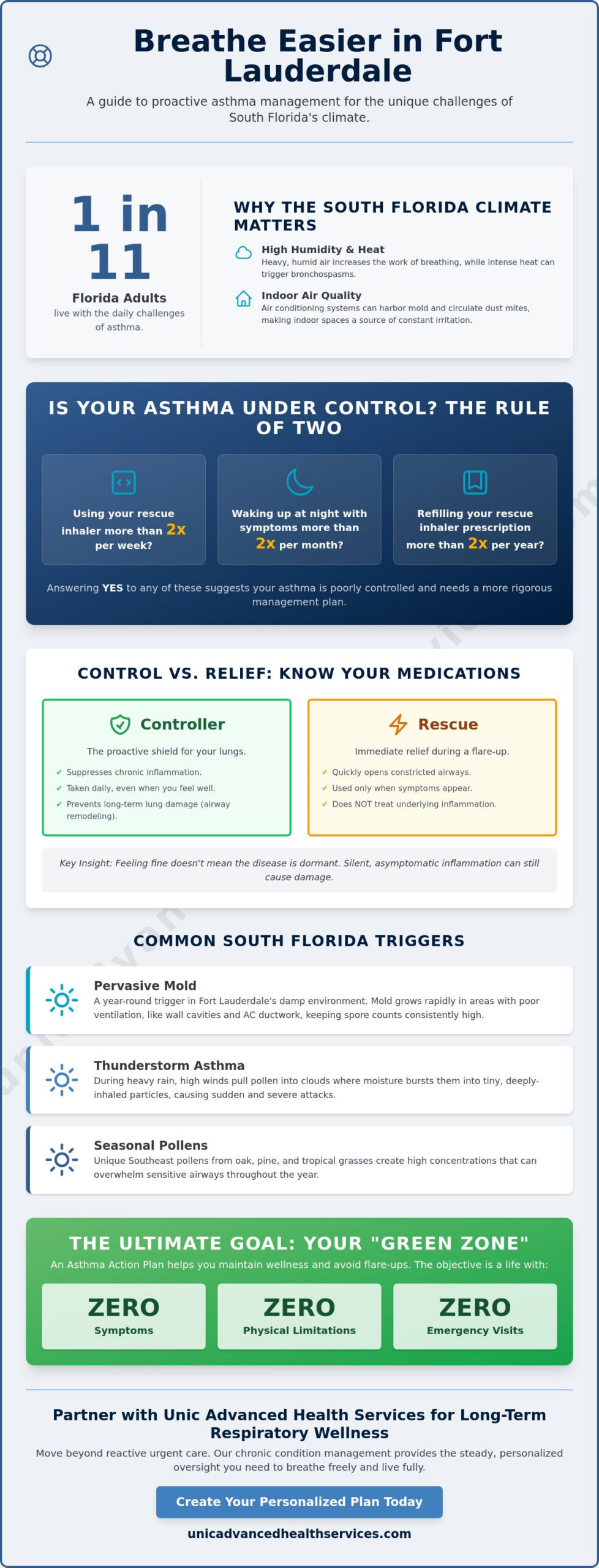
Did you know that approximately 1 in 11 adults in Florida currently live with the daily challenges of asthma? In a city where the salt air meets thick subtropical humidity, finding effective asthma management Fort Lauderdale residents can trust is more than a clinical necessity; it’s the key to reclaiming your lifestyle. You shouldn’t have to choose between enjoying a walk along the Riverwalk and being able to take a full, deep breath without hesitation.
We understand that the heavy South Florida air often makes every breath feel like a struggle, especially when you’re confused about which inhaler to use or worried about a flare-up during outdoor activities. It’s normal to feel anxious when the weather shifts or pollen counts spike. This guide provides the expert strategies you need to master your respiratory health by identifying local triggers like mold and humidity. You’ll learn how a structured chronic condition management plan can help you avoid the sudden attacks that lead to emergency room visits, supporting the state’s goal to reduce these incidents by the end of 2026. By the end of this article, you’ll have a clear path to breathing easier and staying active in our beautiful coastal environment.
Key Takeaways
- Learn to apply the “Rule of Two” to determine if your current symptoms indicate a need for more robust clinical oversight.
- Identify how South Florida’s specific environmental triggers, like persistent mold and “thunderstorm asthma,” affect your airway inflammation.
- Master effective asthma management Fort Lauderdale techniques, including the proper use of spacers and the distinction between maintenance and rescue medications.
- Create a structured Asthma Action Plan that defines your “Green Zone” for wellness and provides clear steps for managing early flare-up symptoms.
- Understand how a partnership for chronic condition management offers a steady, long-term approach to respiratory health compared to reactive urgent care.
What is Asthma Management and Why is it Essential in Fort Lauderdale?
Asthma management is a structured, proactive strategy designed to minimize airway inflammation before it leads to a respiratory crisis. For residents seeking effective asthma management Fort Lauderdale offers unique environmental challenges that require a specialized, consistent approach. Instead of merely reacting to symptoms when they arise, we focus on maintaining optimal lung function through regular oversight and personalized care plans. Understanding the underlying pathophysiology of the condition is essential for long-term health. You can find a comprehensive overview of asthma to learn more about how these triggers affect the body and why daily vigilance is necessary. Our ultimate objective for every patient is to achieve a life with zero symptoms, zero physical limitations, and zero emergency department visits.
Many individuals believe their condition is stable because they always have a rescue inhaler nearby. However, clinicians often use the “Rule of Two” to identify when a patient’s asthma is actually poorly controlled. You should consider a more rigorous chronic condition management plan if you meet any of the following criteria:
- You use your quick-relief rescue inhaler more than twice a week.
- You wake up at night with asthma symptoms more than twice a month.
- You refill your quick-relief inhaler prescription more than twice a year.
The Difference Between Control and Relief
Relying on a rescue inhaler provides immediate relief by opening the airways, but it does not treat the underlying cause of the flare-up. Frequent use of these medications suggests that the bronchial tubes are chronically inflamed. Long-term controller medications are vital because they suppress this inflammation and prevent permanent lung tissue scarring, also known as airway remodeling. It’s a common misconception that feeling fine means the disease is dormant. Even during periods of wellness, asymptomatic inflammation can silently damage the lungs. This makes proactive management essential for long-term respiratory health and the prevention of irreversible damage.
Why South Florida Climate Matters
Since South Floridians spend a vast majority of their time indoors to escape the heat, indoor air quality is a primary focus. Air conditioning systems can harbor mold and circulate dust mites if they aren’t properly maintained; for those in the Southwest Florida region, Ultra Air Heating and Cooling provides the specialized HVAC maintenance necessary to keep indoor environments healthy. This means your home or office could be a hidden source of constant irritation. Robust asthma management Fort Lauderdale residents can trust must account for these specific local environmental factors to be truly effective.
Identifying and Avoiding Local South Florida Triggers
Environmental triggers are external substances that provoke an immune response in the airways. In the context of asthma management Fort Lauderdale residents must recognize that our subtropical climate creates a unique profile of these irritants. Unlike northern regions where allergens follow a predictable seasonal cycle, South Florida’s warmth and moisture create a persistent environment for triggers to thrive. Understanding these local factors is the first step toward reducing your reliance on rescue medications and preventing sudden flare-ups.
Mold is a major year-round trigger in Fort Lauderdale’s damp environment. It grows rapidly in areas with poor ventilation, such as wall cavities, crawl spaces, and even within air conditioning ductwork. Because our humidity levels rarely drop significantly, mold spores remain a constant presence in the air we breathe. Additionally, Florida’s rapid weather changes often lead to “thunderstorm asthma.” During heavy rain events, high winds can pull pollen grains into the clouds where they absorb moisture and burst into much smaller particles. These tiny fragments are easily inhaled deep into the lungs, which can cause sudden and severe bronchial constriction even in individuals with well-controlled symptoms.
Seasonal pollens unique to the Southeast United States also play a significant role. Oak, pine, and various tropical grasses release high concentrations of pollen that can overwhelm a sensitive immune system. When these natural allergens combine with urban pollutants like vehicle exhaust, the impact on your respiratory system is compounded. Identifying which of these specific substances affect you is a cornerstone of a successful health plan.
Navigating Humidity and Air Quality
Monitoring the Air Quality Index (AQI) is a practical habit for anyone exercising outdoors in Fort Lauderdale. On days when the AQI is high or the heat index is extreme, moving your physical activity to a climate-controlled indoor space can prevent heat-induced bronchospasm. Inside your home, you should use dehumidifiers effectively to keep indoor humidity below 50%. This specific threshold is vital because high humidity is directly linked to increased dust mite populations. By keeping the air dry, you create an environment where these microscopic pests cannot survive, significantly improving your indoor air quality.
Managing Triggers at Home and Work
Effective mold remediation in high-moisture areas like bathrooms and kitchens requires consistent effort. You should check for leaks regularly and ensure that exhaust fans are vented to the exterior of the building. For professionals like commercial drivers and mariners, the work environment presents specialized challenges. Cabs and boat cabins often trap allergens and outdoor pollutants within a small space. We recommend using high-quality air filtration systems and replacing filters more frequently than the manufacturer suggests. If your career requires a medical clearance, you can find specific guidance in our article on the DOT Physical Exam Fort Lauderdale. Partnering with a provider for personalized health strategies can help you maintain your professional certifications while keeping your asthma under control.
Modern Treatment Strategies: From Inhalers to Biologics
Effective asthma management Fort Lauderdale residents can depend on involves a sophisticated understanding of pharmacology and consistent application. We categorize the primary medications into three distinct groups to address different aspects of the disease. Short-Acting Beta-Agonists (SABA) provide immediate rescue by relaxing the muscles around the airways. Long-Acting Beta-Agonists (LABA) are used in combination with other drugs to keep the airways open over a longer period. Finally, Inhaled Corticosteroids (ICS) target the underlying inflammation that makes the lungs sensitive to triggers. In 2026, the emergence of SMART therapy, or Single Maintenance and Relief Therapy, has simplified these routines. This protocol uses a single inhaler for both daily control and symptom relief, ensuring that you receive a dose of anti-inflammatory medication every time you feel chest tightness.
Proper technique is just as critical as the medication itself. Many patients lose a significant portion of their dose because the medicine hits the back of the throat instead of reaching the bronchial tubes. Using a spacer is a simple, effective way to ensure the medication is properly inhaled. Additionally, rinsing your mouth after using maintenance inhalers is a vital step to prevent local side effects. To ensure these strategies are working for your specific needs, we utilize on-site lab services to monitor your respiratory health and tailor your treatment with clinical precision.
The Role of Inhaled Corticosteroids (ICS)
ICS medications are the gold standard for long-term asthma stabilization. A common concern among patients involves the potential for steroid side effects. It is vital to distinguish between systemic oral steroids and the inhaled versions used for asthma. Inhaled corticosteroids deliver micro-doses directly to the lung tissue, which results in minimal absorption into the rest of the body. These medications act as a protective shield for the airways by keeping inflammation at bay even when environmental triggers are present. Avoiding these medications based on myths about side effects leaves the lungs vulnerable to permanent damage and frequent flare-ups.
Quick-Relief Medications: Use and Abuse
Quick-relief medications like Albuterol are designed for immediate rescue, not daily maintenance. There is a profound physiological difference between opening an airway and treating the underlying swelling. While a SABA inhaler provides instant comfort, it does nothing to stop the immune response that caused the constriction in the first place. If you find yourself reaching for your rescue inhaler more than twice a week, it is a signal that your asthma management Fort Lauderdale plan requires a professional review. Over-the-counter asthma relief products are often insufficient for true management because they lack the anti-inflammatory components necessary to prevent future attacks. Relying solely on these products can mask a worsening condition and delay the necessary chronic condition management required for long-term safety.
Creating Your Personalized Asthma Action Plan
A Personalized Asthma Action Plan is a living document that translates clinical goals into clear, daily instructions. It serves as your roadmap for maintaining stability and responding effectively to changes in your respiratory health. For successful asthma management Fort Lauderdale residents find that having a written plan reduces the anxiety of “what if” scenarios. This structured approach ensures that you, your family, and your healthcare provider are in complete alignment regarding your treatment protocols.
Your plan is typically divided into three color-coded zones that correspond to the severity of your symptoms:
- Green Zone (Wellness): You feel good, have no cough or wheeze, and can perform all your usual activities. You continue your daily controller medications as prescribed to maintain this baseline.
- Yellow Zone (Caution): You notice early warning signs like chest tightness, increased coughing, or a drop in your peak flow readings. Your plan will specify how to adjust your medications to prevent a full-blown attack.
- Red Zone (Danger): Your symptoms are severe, and your quick-relief medication is not providing lasting relief. This zone outlines the emergency steps you must take and when you need to seek immediate medical attention.
Effective management also requires regular monitoring and scheduled reviews. By keeping a symptom diary or using digital tracking tools, you provide your provider with the data needed to make informed adjustments to your medication. This collaborative process ensures your treatment remains effective as environmental conditions or your lifestyle changes.
Monitoring Your Lung Function
A Peak Flow Meter is a simple, handheld device that measures how well air moves out of your lungs. By establishing your “personal best” reading during a period of wellness, you create a baseline for comparison. Monitoring these numbers daily can help you predict an attack hours or even days before you feel physical symptoms. Modern digital health tools now allow you to integrate these readings with local air quality data. This provides a comprehensive view of how the South Florida climate impacts your breathing in real-time.
Asthma in the Workplace
For many professionals in South Florida, managing a respiratory condition is essential for career longevity. If your job requires a DOT Physical Examination or a U.S. Coast Guard (USCG) Boat Captain Physical, you must demonstrate that your asthma is well-controlled and does not interfere with your ability to operate safely. Accurate documentation of your management plan is vital for vocational compliance. We help you meet these requirements by providing the thorough evaluations and clear records needed for your professional standing. If you are ready to take control of your health, we invite you to explore our Chronic Condition Management services to build a plan that works for your life and your career.
Partnering with Unic Advanced Health Services for Respiratory Wellness
Achieving lasting respiratory wellness requires more than a temporary fix from an urgent care clinic. At Unic Advanced Health Services, we believe that effective asthma management Fort Lauderdale residents can rely on depends on a dedicated, long-term partnership. Led by Marc Joseph, our autonomous nurse practitioner model of care prioritizes individualized attention and clinical thoroughness. Instead of treating symptoms in isolation, we focus on comprehensive chronic condition management to stabilize your health and prevent future flare-ups. This approach provides a level of oversight that episodic care simply cannot match.
Our facility is equipped with on-site lab services and diagnostic testing capabilities, which allows us to streamline your treatment and monitor your progress with high precision. We understand that busy professionals and families need flexible healthcare options. To accommodate your schedule, we offer Saturday appointments and telehealth services for routine follow-ups and medication adjustments. This modern efficiency ensures that your respiratory health remains a priority without disrupting your professional or personal commitments.
Comprehensive Primary Care in Fort Lauderdale
Managing asthma often involves a steady hand approach, particularly when you’re also dealing with overlapping conditions like hypertension. Our clinical perspective is grounded in the local lifestyle of South Florida, where environmental factors and daily stressors intersect with your health. If you are navigating both respiratory and cardiovascular concerns, our guide on high blood pressure management primary care offers a comprehensive roadmap for stabilizing your readings alongside your asthma treatment. By choosing a provider who understands these nuances, you gain a reliable advocate for your well-being. We encourage a proactive partnership mindset. Our goal is to move beyond reactive treatments and toward a future where your health is optimized and predictable. This commitment to longevity is what defines our role as your healthcare partner in the community.
Next Steps for Better Breathing
Preparing for your first consultation at Unic Advanced Health Services is a straightforward process that sets the stage for success. To help us build the most accurate profile of your respiratory health, please bring your current medications, any logs of recent triggers, and previous testing results. During this initial visit, we’ll review your history and perform any necessary diagnostic evaluations to refine your treatment plan. Identifying the specific drivers of your symptoms is the first step toward a more active, unrestricted life. Taking this step is an investment in your longevity and peace of mind. We invite you to schedule your appointment for chronic condition management today and experience the difference of expert, patient-first care.
Take Control of Your Respiratory Health Today
Mastering your respiratory health in South Florida requires a combination of environmental awareness and clinical precision. You now understand how to navigate local triggers like high humidity and mold while using a structured action plan to monitor your lung function. By distinguishing between daily controller medications and rescue inhalers, you can significantly reduce the risk of sudden flare-ups and reclaim your active lifestyle. Effective asthma management Fort Lauderdale residents can trust depends on this proactive and comprehensive approach.
Professional guidance is the most reliable way to ensure your plan remains accurate and compliant with your lifestyle or vocational needs. Led by Marc Joseph, an experienced autonomous nurse practitioner, our team provides the steady hand you need for long-term wellness. We offer convenient Saturday hours and telehealth options to fit your busy schedule; we also specialize in both primary care and occupational health compliance for those requiring specialized physicals. Schedule your asthma management consultation at Unic Advanced Health Services today. You deserve to breathe with confidence and enjoy everything our beautiful coastal community has to offer.
Frequently Asked Questions
Can I manage my asthma with just over-the-counter medications?
Over-the-counter medications are generally insufficient for the effective long-term management of respiratory conditions. While these products might provide temporary relief of minor symptoms, they don’t address the underlying airway inflammation that can lead to permanent lung damage. Relying solely on these options often delays necessary chronic condition management and may leave you vulnerable to more frequent and severe flare-ups.
Does Fort Lauderdale’s humidity make asthma symptoms worse?
High humidity is a significant factor that often makes asthma symptoms worse for those living in South Florida. The moisture-rich air is physically heavier to breathe and creates an ideal environment for the growth of dust mites and mold. These are primary triggers for anyone pursuing asthma management Fort Lauderdale residents can trust. Maintaining your indoor humidity below 50% is an essential strategy for stabilizing your breathing.
How often should I review my Asthma Action Plan with my provider?
You should review your Asthma Action Plan with your provider at least once every six to twelve months. It’s also vital to schedule a review immediately following any major flare-up or if you find yourself using your rescue inhaler more than twice a week. Regular adjustments to your plan ensure that your medication dosages remain appropriate for your current respiratory health and lifestyle needs.
Will having asthma prevent me from passing a DOT physical exam?
Having asthma will not necessarily prevent you from passing a DOT physical exam or a USCG boat captain physical. The primary requirement is that your condition is well-controlled and doesn’t pose a safety risk while operating a vehicle or vessel. Providing thorough documentation of your management plan and recent stable evaluations can help you meet the necessary medical standards for your vocational certifications.
What is the difference between a rescue inhaler and a controller inhaler?
The fundamental difference lies in the purpose of the medication: immediate relief versus long-term prevention. A rescue inhaler contains short-acting bronchodilators that quickly open the airways during a flare-up. In contrast, a controller inhaler typically contains corticosteroids that you take daily to reduce underlying swelling. Understanding this distinction is a cornerstone of effective asthma management Fort Lauderdale patients must master for safety.
Is it safe to exercise outdoors in Florida if I have asthma?
It’s safe to exercise outdoors if you take proactive steps to monitor environmental conditions. We recommend checking the local Air Quality Index (AQI) daily and avoiding high-intensity activities when pollen counts or humidity levels are extreme. Following the pre-exercise medication protocol outlined in your personalized action plan can help you stay active without triggering heat-induced bronchospasm or sudden chest tightness.
Can adult-onset asthma develop if I never had it as a child?
Adult-onset asthma can certainly develop even if you never experienced respiratory issues as a child. Factors such as prolonged exposure to environmental irritants, severe viral infections, or significant hormonal changes can trigger the condition later in life. If you notice persistent coughing or shortness of breath, it’s important to seek a professional evaluation to establish a proper management strategy regardless of your medical history.
What should I do if my rescue inhaler isn’t providing relief?
If your rescue inhaler fails to provide relief, you are likely experiencing a severe flare-up that requires immediate medical attention. You should follow the “Red Zone” instructions in your Action Plan, which typically involve seeking the nearest emergency care facility. A lack of response to rescue medication is a clinical warning sign that your airways are significantly obstructed and require more intensive intervention than home-based care can provide.