
What if the most effective way to stop persistent symptom panic isn’t another late-night urgent care visit, but partnering with a clinician who knows when not to order an extra test? When sudden palpitations or muscle twitches trigger instant dread, managing health anxiety with a primary care doctor offers a reliable, grounded path out of the spiral.
Few experiences feel more isolating than having genuine, uncomfortable physical sensations dismissed as purely psychological by providers who lack the time to listen. Your symptoms are physically real, driven by autonomic nervous system responses, and they deserve careful, respectful evaluation. In this clinical guide, you’ll discover how establishing a structured primary care partnership breaks the health anxiety cycle through objective diagnostics, empathetic monitoring, and evidence-based management. We examine the exact clinical frameworks providers use to differentiate true medical red flags from somatic hyperarousal, eliminate redundant testing, and restore long-term peace of mind.
Key Takeaways
- Understand how autonomic hyperarousal creates real physical sensations like heart palpitations and dizziness without underlying organ damage.
- Learn how clinicians apply structured diagnostic evaluations to safely rule out pathology while preventing low-value, repetitive screenings.
- Discover why urgent care hopping fuels the reassurance trap and how managing health anxiety with a primary care doctor provides a stabilizing clinical anchor.
- Follow an actionable framework to disclose anxiety transparently, log somatic symptoms functionally, and establish symptom-independent check-ins.
- Implement a collaborative wellness plan that integrates routine preventive monitoring with targeted lifestyle medicine to calm nervous system reactivity.
Understanding Health Anxiety and the Role of Primary Care
Persistent worry that benign bodily sensations signal an imminent catastrophe is the hallmark of severe health anxiety. While psychiatric discussions often treat this state purely as an emotional disorder, the physical symptoms are rarely imagined. When adrenaline surges, the autonomic nervous system triggers very real cardiovascular, neurological, and muscular shifts. Without an experienced medical professional to evaluate these sensations, patients often fall into an exhaustive cycle of unmonitored internet searches and symptom checking. Successfully managing health anxiety with a primary care doctor bridges the gap between biological symptoms and mental reassurance.
To see how this cycle develops and how targeted behavioral boundaries disrupt it, watch this brief clinical breakdown:
Somatic Symptoms vs. Underlying Illness
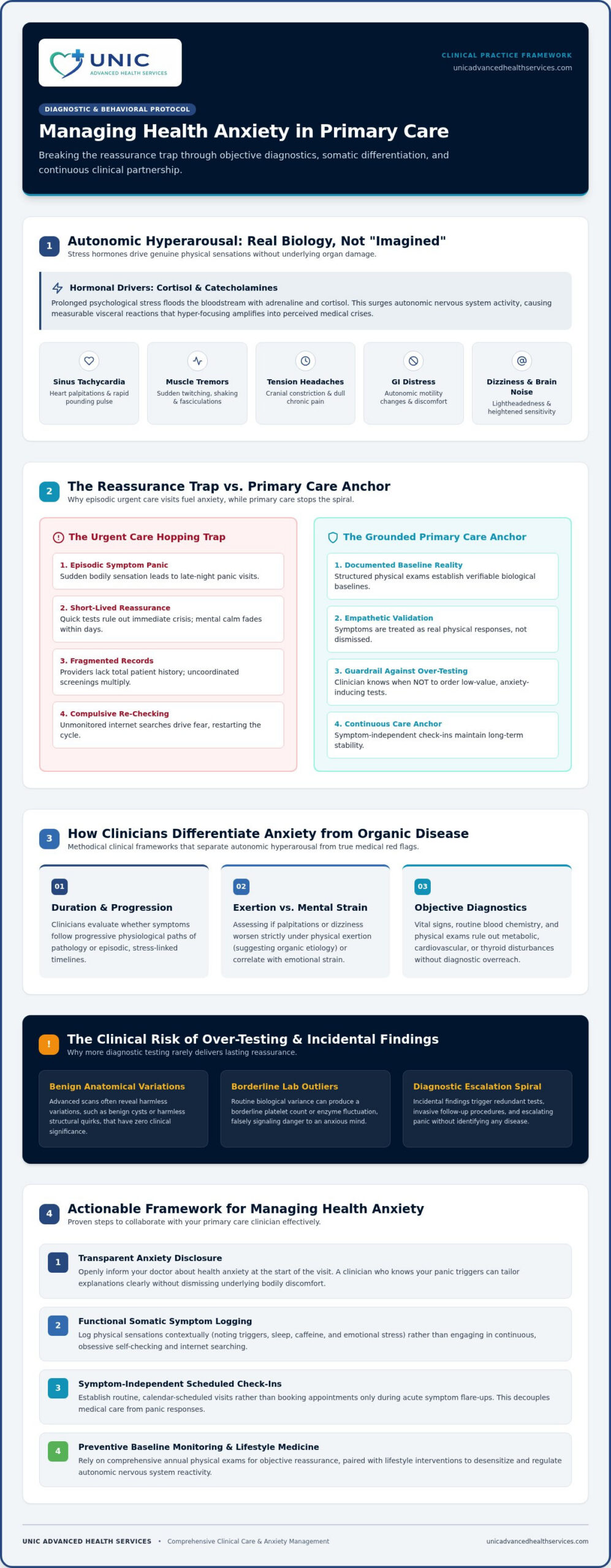
Prolonged stress floods the bloodstream with cortisol and catecholamines, driving measurable physical responses such as sinus tachycardia, muscle tremors, tension headaches, and gastrointestinal distress. Hyper-focusing on these routine autonomic fluctuations heightens visceral sensitivity, amplifying normal bodily noise into perceived medical crises. Clinically, illness anxiety disorder involves an excessive preoccupation with acquiring or harboring a serious medical condition, even when physical indicators are absent or mild. Understanding the historical clinical classification of health anxiety and hypochondriasis helps illustrate why short-lived reassurance from repeated urgent checks fails to calm an overactive nervous system.
Why Primary Care is the Safest Starting Point
Specialists focus on isolated organ systems, but a primary care clinician evaluates total systemic health. Routine preventive evaluations and physical examinations establish an objective, documented baseline for future reference. Rather than dismissing discomfort as psychological, an attentive clinician first performs comprehensive evaluations to rule out genuine organic pathology. Initiating your care with a dedicated primary care provider prevents fragmented diagnostic pathways and provides a steady anchor for long-term health tracking. Managing health anxiety with a primary care doctor ensures every physical symptom receives proper clinical validation without exposing you to unnecessary diagnostic escalation.
How Primary Care Clinicians Differentiate Anxiety from Organic Disease
Primary care clinicians don’t simply guess whether a symptom stems from illness or stress. They rely on methodical diagnostic protocols to separate genuine organic pathology from autonomic arousal. When evaluating concerns like unexplained fatigue, localized pain, or erratic heart rhythms, your clinician evaluates symptom duration, clinical progression, and whether sensations correlate with periods of mental strain or physical exertion. Managing health anxiety with a primary care doctor creates a safe, objective framework where physical complaints are neither dismissed nor subjected to reckless diagnostic overreach.
The Role of Objective Clinical Screenings
Clear baseline data is essential. Routine vital signs, targeted blood chemistry, and hands-on physical exams offer concrete reference points that ground clinical assessments in measurable reality. Reviewing objective biological markers helps quiet the internal alarm system when catastrophic interpretations spike. Scheduling a thorough annual physical exam Fort Lauderdale patients rely on provides structured, unhurried baseline screenings that confirm systemic stability while ruling out underlying metabolic, cardiovascular, or thyroid disturbances.
The Clinical Risk of Over-Testing
More diagnostic testing rarely delivers lasting reassurance. Repeated blood draws, advanced imaging, and unnecessary specialty consults frequently reveal benign anatomical variations or harmless lab outliers known as incidental findings. In an anxious mind, a harmless cyst or a borderline platelet count immediately fuels panic and leads to invasive follow-up procedures. This is why diagnostic stewardship is critical.
A disciplined practitioner sets clear boundaries around diagnostic workups, adhering to an evidence-based collaborative care plan for illness anxiety that prioritizes watchful waiting over impulsive scans. By managing health anxiety with a primary care doctor who understands the hazards of over-investigation, you protect both your physical safety and your emotional resilience. If you need a grounded clinical ally to establish reliable baseline metrics, consider connecting with Unic Advanced Health Services for steady, attentive primary care.
The Reassurance Trap: Why Urgent Care Hopping Worsens Health Anxiety
Seeking fast answers at a walk-in clinic feels like the only sensible choice when somatic symptoms surge after hours. Yet hopping between urgent care clinics and emergency departments rarely produces lasting peace. Acute episodic clinicians evaluate immediate life threats, not longitudinal trends. Because they lack your medical history, they often order repetitive blood work or defensive imaging just to be safe. Managing health anxiety with a primary care doctor breaks this reactive loop, replacing fragmented reassurance checks with structured, consistent clinical oversight.
The Mechanics of the Reassurance Cycle
Medical reassurance functions like a fast-acting sedative that wears off almost immediately. When an unfamiliar bodily sensation appears, acute panic prompts a visit to an emergency room or walk-in facility. A clean electrocardiogram or clear blood draw delivers immediate emotional relief, but psychological studies show this calm typically decays within 24 to 48 hours. Soon after, second-guessing sets in: Did the provider miss something? Was the test outdated? According to the clinical overview of illness anxiety disorder, this cycle of symptom fixation followed by compulsive clinical validation reinforces the brain’s belief that genuine danger was narrowly avoided, deepening anxiety over time.
Why Care Continuity Protects Your Health
A consistent primary care relationship fundamentally alters this dynamic. When you see the same provider across months and years, they develop an intricate understanding of your physiology and stress patterns. This clinical familiarity protects you in several tangible ways:
- Eliminating redundant diagnostics: Your clinician cross-references current complaints against your established baseline, preventing unnecessary radiation and blood draws.
- Balancing validation with caution: A trusted practitioner validates uncomfortable physical sensations without reflexively escalating care, remaining alert for genuine medical changes while safely filtering out benign somatic noise.
- Removing the burden of proof: You no longer need to convince an unfamiliar doctor that your physical symptoms are real; your provider already knows your medical history and takes your concerns seriously.
Managing health anxiety with a primary care doctor transforms medical visits from emergency rescue missions into collaborative, scheduled check-ins that preserve both your physical safety and your mental equilibrium.
A Step-by-Step Strategy for Managing Health Anxiety with Your Doctor
Transforming your primary care relationship into a stabilizing partnership requires an intentional approach. Rather than showing up only when distress peaks, approaching clinical appointments with structured boundaries ensures your concerns are heard, evaluated, and resolved systematically. Successfully managing health anxiety with a primary care doctor relies on four practical steps:
- Disclose early: Tell your provider about your health worries within the first two minutes of your consultation.
- Track function, not fear: Keep a concise log recording how physical sensations affect your daily activities, sleep, and appetite rather than cataloging hourly bodily checks.
- Schedule on the calendar: Book routine follow-ups every four to six weeks regardless of how you feel, replacing symptom-driven emergency appointments with predictable check-ins.
- Agree on diagnostic thresholds: Decide in advance which objective clinical signs truly warrant laboratory work or specialist referrals.
Communicating Transparently About Health Fears
Direct communication changes how your provider explains test results and physical findings. State your primary concerns clearly: “I’ve been experiencing chest tightness, and while I know anxiety plays a role, I’m worried about cardiovascular disease.” Naming the specific condition you fear allows your practitioner to tailor the examination to that exact worry. Ask your clinician to define objective red flags, such as unintentional weight loss or high fever, so you know precisely what justifies urgent medical attention versus what can wait for your next visit.
Utilizing Virtual Care for Routine Accountability
Leaving the house during a spike in distress can feel daunting. Scheduled telehealth check-ins offer a low-friction way to maintain clinical continuity without the anxiety-inducing environment of a waiting room. Regular virtual touchpoints allow your clinician to review your symptom log, assess medication tolerance if prescribed, and provide objective reassurance before catastrophic misinterpretations gain momentum. Booking structured telehealth Fort Lauderdale appointments preserves consistent oversight right from home. When you are ready to build a lasting, collaborative care strategy, schedule an appointment with Unic Advanced Health Services to secure an unhurried, attentive healthcare partner.
Building a Long-Term Collaborative Wellness Plan
Aiming for the complete absence of physical sensations is an unrealistic standard. Human bodies naturally produce noise, from harmless muscle twitches to brief digestive cramps. Shifting your clinical focus from eliminating every somatic signal to optimizing daily functional vitality creates sustainable relief. Managing health anxiety with a primary care doctor aligns routine medical surveillance with long-term lifestyle stabilization, helping your nervous system gradually recalibrate.
Integrating Lifestyle Medicine and Chronic Care
Underlying metabolic fluctuations, poor sleep, and erratic blood glucose often provoke autonomic surges that mimic serious illness. When chronic conditions are systematically monitored, you experience fewer ambiguous physical alarms that trigger catastrophic thinking. For instance, seeking targeted medical guidance from an obesity management nurse practitioner Fort Lauderdale patients trust helps stabilize metabolic metrics, directly lowering baseline physiological strain. Pairing active medical management with restorative sleep routines, balanced nutrition, and consistent physical movement builds biological resilience against panic spirals.
Establishing Your Primary Care Anchor in Fort Lauderdale
Successful long-term management requires a clinical partner who listens without checking the clock. Autonomous nurse practitioners deliver attentive, patient-first care designed to explore complex concerns thoroughly rather than rushing through high-volume appointments. This dedicated approach ensures your concerns are evaluated with empathy and rigorous clinical discipline.
Access to flexible Monday through Saturday appointments and comprehensive on-site lab testing simplifies ongoing oversight, allowing you to establish baselines and review health trends in one familiar location. Managing health anxiety with a primary care doctor replaces urgent care dependency with a structured, reassuring anchor for lifelong wellness.
Take Control of Your Health with a Dedicated Clinical Partner
Breaking the persistent cycle of bodily worry doesn’t happen through isolation, midnight symptom searches, or reactive walk-in clinic visits. It begins with establishing a steady, trusting clinical partnership. Managing health anxiety with a primary care doctor provides the objective diagnostics, clear investigative boundaries, and continuous monitoring needed to quiet autonomic hyperarousal and permanently dismantle the reassurance trap.
At Unic Advanced Health Services in Fort Lauderdale, care led by an experienced autonomous nurse practitioner offers unhurried, personalized consultations where your physical sensations receive thorough evaluation without dismissive assumptions or unnecessary diagnostic escalation. With comprehensive on-site lab testing providing prompt diagnostic clarity, alongside flexible Monday through Saturday appointments and integrated telehealth options, our practice delivers dependable care designed around your daily life.
You don’t have to navigate distressing physical sensations alone or wonder whether your concerns will be heard. Schedule a Comprehensive Consultation today to anchor your long-term wellness in structured, compassionate medical guidance.
Frequently Asked Questions
Can a primary care doctor officially diagnose health anxiety?
Yes, primary care clinicians regularly diagnose illness anxiety disorder and related anxiety conditions. Using validated clinical screening tools like the GAD-7 and standardized diagnostic criteria, your provider evaluates your symptoms during regular visits. They conduct thorough physical examinations and baseline testing to rule out organic medical conditions first. In Fort Lauderdale, an experienced primary care provider assesses both physiological and psychological markers to establish a formal diagnosis and structured management plan.
Will my doctor take my physical symptoms seriously if they know I have anxiety?
Yes, a dedicated primary care clinician understands that anxiety generates authentic, measurable physical sensations. Disclosing health worries doesn’t invalidate your physical complaints. Instead, it equips your clinician to evaluate your symptoms with greater precision, screening for genuine red flags while explaining autonomic reactions clearly. Managing health anxiety with a primary care doctor ensures physical sensations like palpitations or gastrointestinal pain are medically investigated rather than dismissed as purely psychological.
How often should I see my primary care provider for health anxiety check-ins?
Clinical protocols generally recommend scheduling follow-up consultations every four to six weeks during active periods of distress. Consistent, calendar-based appointments detach medical visits from acute symptom spikes, breaking the habit of booking visits only during panic. As your symptoms stabilize, visits often transition to quarterly or biannual wellness consultations. Practices offering flexible schedules and integrated telehealth make maintaining regular, unhurried contact manageable and predictable.
Can primary care doctors prescribe medication for severe health anxiety?
Yes, primary care providers and autonomous nurse practitioners frequently prescribe evidence-based medications for health anxiety. First-line pharmacotherapies include SSRIs and SNRIs, which help regulate neurotransmitters to lower autonomic nervous system reactivity. Clinicians typically begin at conservative starting doses to minimize transient sensory side effects. Routine follow-up visits allow your provider to monitor medication tolerance, track clinical progress, and make adjustments collaboratively alongside non-pharmacological coping strategies.
What should I do when I feel an overwhelming urge to visit urgent care?
Implement a predetermined 48-hour delay rule for non-emergent somatic sensations before seeking walk-in care. Unless you experience clear medical red flags like sudden severe chest pressure, slurred speech, or persistent high fever, wait two days. Benign autonomic spikes usually subside naturally within that window. Instead of visiting urgent care, contact your primary care office or schedule a telehealth visit to discuss the flare-up calmly with a clinician who knows your history.
How do I stop searching my symptoms online before my appointment?
Designate your primary care clinician as your sole medical information source and establish firm digital boundaries. Search engines lack diagnostic context and consistently surface worst-case medical scenarios, amplifying physiological panic. When an impulse to search arises, write the sensation in your functional symptom log instead. Bring that log to your consultation so your clinician can address the concern directly. Managing health anxiety with a primary care doctor replaces algorithmic dread with tailored, objective clinical guidance.
Is health anxiety the same thing as somatic symptom disorder or hypochondria?
Health anxiety is a broad term for medical worry, while modern diagnostic manuals classify it specifically into illness anxiety disorder and somatic symptom disorder. The outdated term “hypochondria” is clinically retired. Illness anxiety disorder involves persistent catastrophic fear of disease with minimal physical symptoms. Somatic symptom disorder occurs when authentic physical symptoms cause disproportionate distress and functional impairment. Primary care clinicians assess these nuances to personalize your long-term monitoring plan.