
A flagged blood test result can look alarming, but one number rarely tells the whole story. If you’re learning how to read lab results for blood work, start by checking the result against its reference range, then consider related test values and your health history. Results may appear in a patient portal before your healthcare provider has reviewed them, which can leave you with questions and little context.
It’s understandable to want a clear answer right away. An out-of-range flag doesn’t automatically mean something is wrong, just as a result within range doesn’t always explain symptoms. Reference ranges can differ between laboratories, and your provider can help connect the findings to your individual health.
This step-by-step guide explains the main parts of a lab report, common abbreviations and units, and what flagged values can and cannot tell you. You’ll also learn why patterns matter more than isolated numbers, what questions to bring to your healthcare provider, and when to seek timely medical advice.
Key Takeaways
- Learn how to read lab results for blood work by checking the report details and using the reference interval shown beside each result.
- Understand what an out-of-range flag can and cannot tell you before drawing conclusions about your health.
- Compare current results with prior tests to spot changes that may be useful to discuss with your clinician.
- Prepare for follow-up by saving your report and noting symptoms, medications, supplements, and recent health changes.
- See how a primary care clinician can connect lab findings with your health history and help clarify next steps.
How to Read Lab Results for Blood Work: Start With the Report
A blood work report gives your healthcare provider information to guide care. It is not a diagnosis by itself. Each result is a measured finding, such as the amount of a substance in your blood or a count of certain cells. To understand how to read lab results for blood work, consider each number alongside your health history, symptoms, medications, and other findings instead of treating it as a verdict.
Start by locating the test name, your result, its units, the laboratory’s reference interval, and any flag. These details show what was measured and how the result compares with that lab’s range. A flag is a prompt to review the result, not proof that you have a health condition.
For a visual overview, watch this explanation of routine blood work results:
What do the numbers, units, and flags on a lab report mean?
The test name identifies what was measured. The result is the reported value, and the unit explains how that measurement is expressed. Units vary by test: a result may be shown in milligrams per deciliter (mg/dL), millimoles per liter (mmol/L), or another format. Check the units before comparing numbers. The same test can be reported using different measurement systems.
An “H” or “L” commonly marks a result above or below that laboratory’s interval; “abnormal” may serve the same purpose. Before comparing reports, check the date, test name, and laboratory. Different labs or methods may use different units and intervals, so a change in the printed number does not necessarily mean the result has changed in the same way.
Why does a blood test report include a reference range?
A reference interval gives a comparison point based on results from a defined healthy population. It is not a universal boundary between health and disease. The reference ranges for blood tests are commonly based on the central portion of values observed in a healthy population. A result just outside the interval can occur without automatically indicating illness.
A reference interval is a laboratory comparison range, not a diagnosis or a complete judgment of your health. Laboratories may use different testing methods and establish different intervals, so use the range printed beside your result rather than a general online chart. Age, health history, medications, and other personal circumstances can also affect interpretation. Your healthcare provider can consider these factors and explain what the result means for you.
How to Read Blood Work Results Step by Step
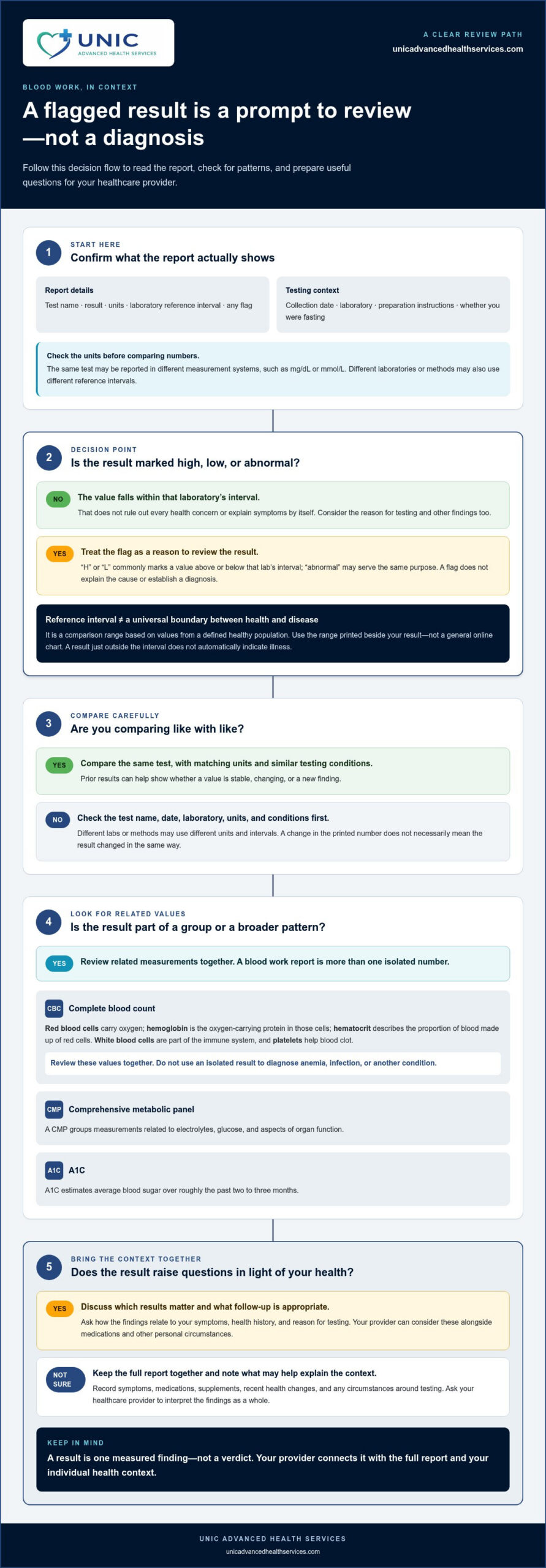
A consistent review process can make a dense report easier to discuss with your healthcare provider. These steps for how to read lab results for blood work help you organize what you see without trying to diagnose yourself from individual numbers.
- 1. Confirm the details. Check the test name, collection date, laboratory, and any preparation instructions. Note whether you were fasting or had other circumstances that may matter to the test.
- 2. Review each value with its units. Read the result alongside the reference interval printed on that report. Don’t substitute a range from a general online chart, since laboratories may use different methods and intervals.
- 3. Note flags, then look at the pattern. Record which results are marked high, low, or abnormal. A flag identifies a value outside that laboratory’s interval; it does not explain the cause or establish a diagnosis.
- 4. Compare prior results carefully. Compare the same test, with matching units, and consider whether the testing conditions were similar. A prior result can show whether a current value is stable, changing, or a new finding.
- 5. Follow up with focused questions. Ask your healthcare provider which results matter in light of your symptoms, health history, and reason for testing. MedlinePlus offers a patient-friendly guide to understanding your lab results.
How should you review a complete blood count (CBC)?
A CBC is a group of measurements, not one standalone result. Red blood cells carry oxygen; hemoglobin is the oxygen-carrying protein in those cells; hematocrit describes the proportion of blood made up of red cells. White blood cells are part of the immune system, and platelets help blood clot. Review these values together, and don’t use an isolated result to diagnose anemia, infection, or another condition.
How should you review a comprehensive metabolic panel (CMP) or A1C?
A CMP groups measurements related to electrolytes, glucose, and aspects of organ function. A1C provides an estimate of average blood sugar over roughly the past two to three months. The reason for testing and your personal health context help determine which findings need follow-up. Ask how the results relate to your care rather than focusing only on a flag.
For help putting results in context, primary care support for lab results is available through Unic Advanced Health Services in Fort Lauderdale.
What Out-of-Range Blood Work Results Can, and Cannot, Tell You
A high, low, or abnormal flag tells you that a result falls outside the laboratory’s reference interval. It does not identify the cause or confirm a condition. As you consider how to read lab results for blood work, treat a flag as a reason to review the full report and follow-up guidance, not as a diagnosis on its own.
| Result pattern | What it may tell you | What to do with it |
|---|---|---|
| In range | The value falls within that lab’s comparison interval. This does not rule out every health concern or explain symptoms by itself. | Consider it alongside your reason for testing and other findings. |
| Slightly out of range | A small difference from the interval can occur for various reasons and may not signal a health problem. | Ask whether it needs follow-up, especially if you have symptoms or related results are also flagged. |
| Significantly concerning | The result may need timely clinical review, depending on the test and your situation. | Follow any instructions that came with the report and contact your healthcare provider for guidance. |
Only a qualified clinician can interpret blood test results for an individual’s health situation. They can assess results alongside symptoms, medical history, medications, and related findings. The common types of blood tests, such as a CBC or metabolic panel, include multiple measurements that may be considered together.
Can a result outside the reference range still be normal for you?
Yes. Some healthy people have results just outside a reference interval. A result may also be affected by circumstances such as a recent illness or how the test was prepared and collected. These possibilities provide context, but they are not a reason to dismiss a flagged value. Share relevant changes, symptoms, and medications with your healthcare provider, and ask whether the finding needs monitoring or further review.
Why do patterns and trends matter more than one flagged value?
Related results can help clarify what a single number cannot. For example, a clinician may assess several CBC measurements together or review multiple components of a metabolic panel instead of focusing on one flag. Patterns across related tests, symptoms, and health history can help identify findings that deserve attention.
Prior results add another layer of context. A change over time may be more informative than one measurement, provided the same test was used and units and testing conditions are comparable. If results differ, your clinician can help determine whether the difference reflects a meaningful trend, testing variation, or a reason to repeat the test. Don’t make that decision from the numbers alone.
What to Do After Reviewing Your Blood Test Results
Once you’ve reviewed the report, organize the information so your healthcare provider can interpret it in context. Save the complete report, including test names, dates, units, and reference intervals. Note any symptoms and when they began, along with medications, supplements, recent illness, or other health changes that may be relevant.
Understanding how to read lab results for blood work can help you prepare for a useful conversation, but it cannot replace an individualized clinical review. Bring your questions and ask what the findings mean for your health and what action, if any, is appropriate.
What questions should you ask about blood work results?
Keep your questions focused on the reason for testing and what happens next. You might ask:
- Which results are most relevant to why the test was ordered?
- Could symptoms, medications, supplements, or an existing condition affect these findings?
- Should any result be repeated, or interpreted alongside other tests?
- What changes or follow-up steps do you recommend, and when should I check back?
If you’re unsure what a flag means, ask your provider to explain its significance for your situation instead of relying on a general interpretation found online.
When should you seek urgent medical advice about a lab result?
Follow through promptly if the laboratory or your healthcare provider contacts you about a critical result or gives specific instructions. Don’t wait for a routine appointment to clarify an urgent notification. If you have severe or rapidly worsening symptoms, seek urgent or emergency medical care. A flag alone doesn’t tell you how quickly you need care, so follow the guidance provided by your healthcare team and describe your symptoms clearly.
For results without an urgent notification or severe symptoms, contact your healthcare provider to understand the recommended timing for review. Avoid changing prescribed medication or starting supplements based only on a lab value without discussing it with a qualified professional.
At Unic Advanced Health Services in Fort Lauderdale, primary care includes reviewing lab findings alongside symptoms and health history. The practice also provides chronic condition management and on-site lab services. Arrange a primary care visit to review your lab results.
Review Blood Work With a Primary Care Clinician in Fort Lauderdale
Understanding how to read lab results for blood work can help you prepare for a conversation, but a clinician can connect the numbers to your individual health needs. In primary care, results are considered alongside why the test was ordered, your symptoms, medical history, medications, and prior testing. This broader view can help clarify which findings need attention and what questions remain.
How can a clinician put blood work into your health context?
A clinician can review how each result relates to the reason for testing and to other information in your record. For example, a finding may be considered alongside a symptom, a medication, or a previous result rather than on its own. Depending on the findings and your circumstances, follow-up may involve monitoring, repeat testing, or a care plan. The appropriate next step is individualized, and no single report can guarantee a particular diagnosis or outcome.
Bring the complete report and a brief list of questions. Mention recent health changes, symptoms, and any medicines or supplements you take. This information helps make the discussion specific and supports a clearer understanding of what the results may mean for you.
How can ongoing care help with results over time?
Some health concerns are followed through more than one appointment or test. In chronic condition management for conditions such as diabetes or hypertension, organized follow-up can help you understand how results relate to your care recommendations over time. Comparing prior and current tests may be useful when the same tests, units, and similar testing conditions are involved.
Unic Advanced Health Services provides primary care, chronic condition management, and on-site lab services in Fort Lauderdale. A clinician’s review can put findings in context and help discuss appropriate next steps, while ongoing care offers a place to revisit questions as your health needs change.
To discuss your results and how they fit your health history, connect with Unic Advanced Health Services.
Turn Your Lab Report Into a Clear Next Step
Learning how to read lab results for blood work can make your report easier to discuss, but the numbers are most useful when viewed as a pattern. Check each result against the reference interval printed on the report, compare only like-for-like tests, and remember that an out-of-range flag is not a diagnosis. Your symptoms, health history, medications, and prior results all help shape what a finding means.
Save the full report and bring your questions to a healthcare provider. Ask which results matter most, whether follow-up testing is appropriate, and what to do next. A clinician can connect the findings to your health needs and explain recommendations in context.
Unic Advanced Health Services provides primary care, chronic condition management, and on-site laboratory services to support diagnostic testing during care. Discuss your blood work with Unic Advanced Health Services.
You don’t have to interpret every result alone. A thoughtful conversation can help turn uncertainty into a practical plan for your health.
Frequently Asked Questions
What does it mean when a blood test result is flagged high or low?
A high or low flag means the result falls above or below the reference interval used by that laboratory. It doesn’t explain why the value is outside the interval or confirm a diagnosis. Check the test name, units, and range printed on your report, then discuss the result with your healthcare provider, especially if you have symptoms or other related results are also flagged.
Can a blood test result be abnormal without meaning I have a disease?
Yes. A result outside the reference interval doesn’t automatically mean you have a disease. Reference intervals typically cover about 95% of a healthy population, so some healthy people will have a value outside the range. Temporary circumstances may also affect certain results. Don’t dismiss a flagged value, though. Your provider can assess it alongside your symptoms, health history, medications, and other test findings.
How do I find the normal range on my blood test report?
Look beside each result for a column or label called “reference range,” “reference interval,” or similar wording. Use the range on your own report rather than a general online chart, because laboratories may use different testing methods, units, and intervals. Check the units, too. A number reported in one unit can’t be compared directly with a number expressed in another.
Why are my blood work results different from last time?
Results can vary because of changes in health, medications, testing conditions, or the laboratory method and units used. First check that you’re comparing the same test and that the units and conditions are comparable. A difference doesn’t automatically mean your health has changed. Share both reports with your healthcare provider, who can assess the pattern alongside your history and the reason for testing.
Should I fast before blood work, and can it affect my results?
Fasting is needed for some blood tests, but not all. Follow the instructions from the clinician who ordered the test or the laboratory, and ask if you’re unsure whether food, drinks, or regular medications could affect your preparation. Don’t assume you need to fast, and don’t change prescribed medication without medical guidance. If you didn’t follow the instructions, mention that when discussing the results.
When should I call a doctor about abnormal blood work results?
Contact your healthcare provider to ask what an abnormal result means and whether follow-up is recommended. If the laboratory or clinician gives you a critical-result notification or specific instructions, follow through promptly. Seek urgent or emergency care for severe or rapidly worsening symptoms. A flag alone can’t determine how quickly you need care, so use clinical guidance rather than trying to triage yourself from the report.
Can I interpret blood test results without a healthcare provider?
You can review the test names, values, units, and reference intervals to prepare questions, but you can’t reliably determine what results mean for your health on your own. To understand how to read lab results for blood work, consider the full pattern and your symptoms, health history, and medications. In Fort Lauderdale, Unic Advanced Health Services provides primary care, chronic condition management, and on-site laboratory services.