
A medical diagnosis doesn’t automatically rule out an MMC medical certificate. Getting a medical waiver for a USCG license may be possible under 46 CFR Part 10.303, which covers waivers, limitations, and restrictions. The Coast Guard may grant a waiver when special circumstances support consideration despite a mariner not meeting standard medical requirements.
It’s understandable to worry that a health condition or medication history could affect your plans to work at sea. The review considers how the condition affects your ability to work safely and what medical evidence supports your application. This guide explains what an MMC medical waiver may cover, how health conditions and medications can affect eligibility, and what to do if the Coast Guard requests more information or denies your application. You’ll also learn how reconsideration and formal appeals work, so you can better understand the decisions and documentation involved.
Key Takeaways
- A medical waiver can allow consideration of an MMC applicant who doesn’t meet standard medical requirements, with the decision shaped by the circumstances and supporting evidence.
- Organize relevant medical records and specialist opinions to explain how a condition is managed and how it may affect safe maritime work.
- Understand how psychiatric conditions and medication history may be assessed, including whether the condition is controlled and medication effects pose a safety risk.
- Learn how the CG-719K and required medical examination fit into the captain’s license process.
- If a waiver is denied, a mariner may request reconsideration through the NMC online application portal within 30 days of the denial letter date, according to the U.S. Coast Guard National Maritime Center.
What is a Merchant Mariner Credential (MMC) Medical Waiver?
Under 46 CFR Part 10.303, the Coast Guard may grant medical waivers and set limitations or restrictions. The review considers documented medical circumstances, including vision, hearing, and general physical condition.
The waiver framework does not set out separate procedures for deck, engine, and entry-level credentials. For each application, connect the medical evidence to the relevant requirements and the mariner’s ability to work safely.
-
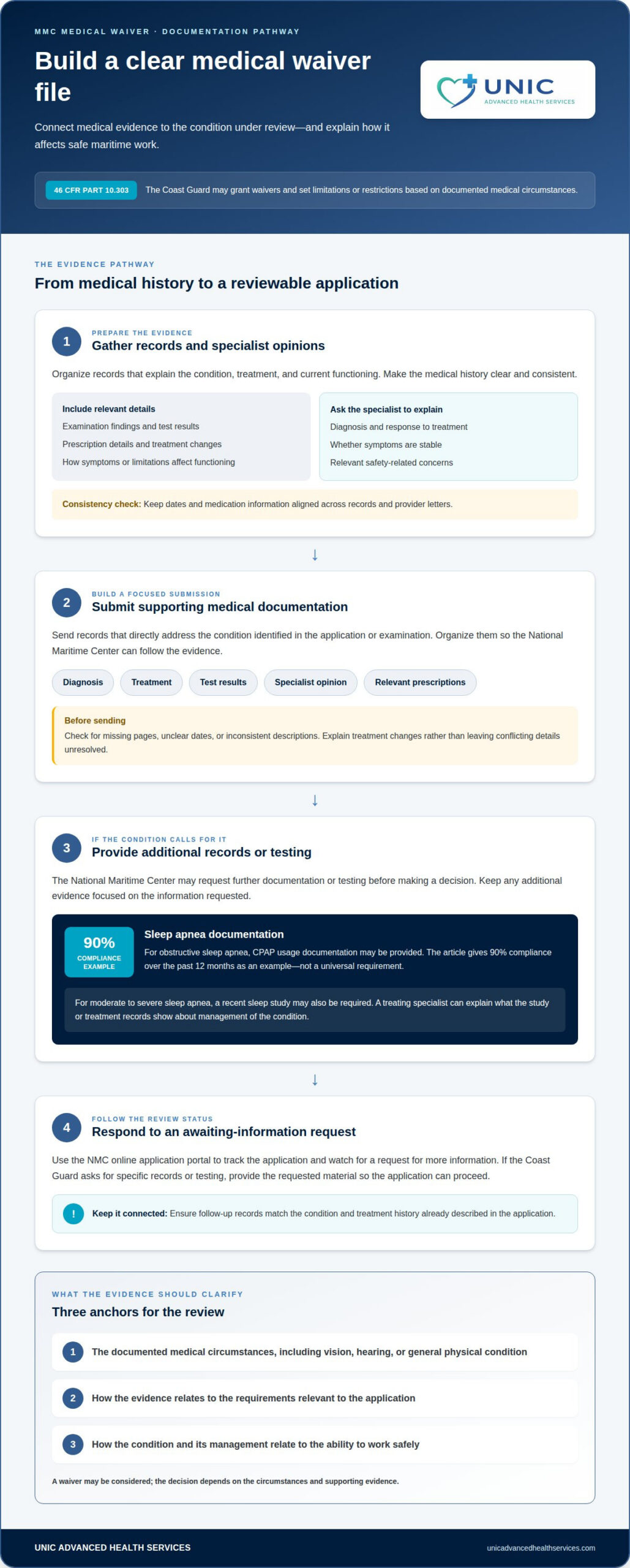
Gather Medical Documentation and Specialist Opinions
Start by organizing records that explain the condition, treatment, and current functioning. Include relevant examination findings, test results, and prescription details so the medical history is clear and consistent. For example, records about a hearing condition should describe its current status, while records about physical limitations should explain how they affect daily functioning.
Ask the treating specialist for a letter describing the diagnosis, response to treatment, and any safety-related concerns. The specialist can explain how the condition is managed and whether symptoms are stable. Avoid relying on a brief note that names a diagnosis without explaining its current impact. Keep dates and medication information consistent across the letter and records.
-
Submit Supporting Medical Documentation
Submit records that directly address the condition identified in the application or examination. Organize them by topic, such as diagnosis, treatment, test results, and specialist opinion, so the National Maritime Center can follow the evidence. Include relevant prescription information, and use the medical records to explain treatment changes rather than leaving conflicting details unresolved.
Before submitting, review the documents for missing pages, unclear dates, or inconsistent descriptions. A complete file helps explain why special consideration may be appropriate under 46 CFR Part 10.303. The Coast Guard may issue an awaiting-information request when it needs additional documentation before deciding. Respond to that request with the specific records or testing requested.
-
Provide Additional Documentation and Testing
Prepare to provide further records or testing if the National Maritime Center requests them. For sleep apnea, treatment-compliance records may be needed; moderate to severe cases may also require a recent sleep study. A mariner seeking a waiver for obstructive sleep apnea may provide CPAP usage documentation, with 90% compliance over the past 12 months given as an example.
Ask the treating specialist to explain what the sleep study or treatment records show about the condition and its management. Keep the evidence focused on the information requested. If a request names a particular test or record, submit it and make sure it relates to the same condition and treatment history described in the application.
- To track an application, use the NMC online application portal and watch for an awaiting-information request. The National Maritime Center may need more documentation before making a decision. Respond with the requested medical records or testing so the application can proceed.
Psychiatric conditions and medication history
Under 46 CFR 10.303, the Coast Guard may grant a waiver when medical evidence shows a condition is sufficiently controlled and medication effects pose no significant risk to maritime or public safety. Organize the history, current treatment, and supporting documentation around those factors.
- Gather a clear psychiatric treatment history, including the diagnosis, current status, treatment plan, and relevant changes over time. Ask the treating provider to explain how the condition is managed and whether symptoms affect safe work. Include prescription names and current use, along with documented effects relevant to the assessment. Make sure the history and the provider’s account are consistent.
- Explain medication effects with clinical documentation. The Coast Guard considers whether medication effects pose a significant safety risk, not simply whether a prescription exists. Ask the treating provider to describe the medication’s purpose, response, and relevant effects. Do not stop or change prescribed treatment to influence an application. Provide accurate records of the current treatment plan.
- Include evidence of stability when a condition has improved or treatment has changed. A provider’s opinion should connect the current clinical picture with the applicant’s ability to perform maritime duties safely. For cardiovascular conditions, the available criteria describe heart conditions as usually manageable when the mariner has been free of heart-related events for more than 18 months and a cardiologist documents stability. Include the cardiologist’s assessment and relevant event history.
- Document respiratory conditions and other health issues with records relevant to the condition under review. For example, include the treating provider’s assessment and current treatment information rather than relying only on a diagnosis label. A condition may undergo waiver review if it affects medical standards or requires individual consideration. The Coast Guard may also set waiver conditions or restrictions, so read the decision and accompanying instructions carefully.
- Plan for review time and possible follow-up. A Coast Guard medical waiver review may take from weeks to several months, particularly when paperwork is missing or testing is incomplete. If the National Maritime Center requests additional information, provide the requested documentation or testing to address the outstanding issue. For ongoing conditions, chronic condition management can support continued care and organized medical records.
What Counts as a Medical Disqualifier for a Captain’s License?
Medical and physical requirements may affect whether a mariner can qualify for a credential. Vision standards are addressed in 46 CFR 10.305; the review considers whether a condition affects the applicant’s ability to serve safely.
For an OUPV or Master’s captain’s license, applicants use Form CG-719K, not CG-719K/E. A licensed practitioner documents medical fitness on CG-719K, and the Coast Guard examination and form must be completed within 12 months of the application date.
- Complete the correct medical examination and form. Use CG-719K for an OUPV or Master’s application, and ensure the licensed practitioner documents the medical evaluation on that form. The Coast Guard medical examination and CG-719K must fall within 12 months of the application date. The CG-719K and CG-719K/E serve as medical certificate applications; a CG-719B is not required.
- Review medical records against the applicable standards. Under 46 CFR 10.302, merchant mariner medical and physical requirements include assessment of vision, hearing, and general physical condition. The Coast Guard may consider conditions such as diabetes during waiver review. A diagnosis alone does not explain functional impact, so include relevant records that describe treatment, current status, and any complications.
- Address vision findings with specific testing and documentation. The vision standards are set out in 46 CFR 10.305. Color vision limitations may lead to a daylight-only restriction for professional use. Include the vision evaluation and any relevant specialist report with the paperwork, so the Coast Guard can assess the limitation and its operational implications.
- Separate merchant mariner dental concerns from Coast Guard Academy admission rules. The Academy identifies eight or more teeth with untreated multi-surface cavities as a potential disqualification if not corrected before arrival. That Academy criterion concerns admission, not the merchant mariner credential standards in 46 CFR 10.302. Do not treat the Academy example as an MMC dental rule.
- Document drug testing when chronic narcotics use applies. Under 46 CFR 16.220, the stated requirement is a DOT 5-panel drug screen within 185 days of a U.S. Coast Guard application. Keep the testing record with the medical paperwork and ensure it corresponds to the application timeline. Include relevant prescription information and medical records so the evaluation reflects the applicant’s history accurately.
Allergy and emergency medication disqualifications
Under 46 CFR 10.303, the Coast Guard may consider a waiver when medical evidence shows a condition is controlled and medication effects pose no significant risk to maritime or public safety. An allergy or emergency prescription should therefore be explained through relevant medical records, not treated as an automatic disqualification.
- Document the allergy history with the treating provider. Describe the known trigger, symptoms, treatment, and any changes over time. For example, records can clarify whether exposure caused a reaction and what care followed. Keep the condition and treatment details consistent across the physical exam paperwork and supporting records.
Ask the provider to explain how the medical condition is managed now. A focused letter can connect the history to the current treatment plan and describe relevant limitations. Avoid submitting only a diagnosis label, which may not explain the condition’s current status or the reason for an emergency prescription.
- List each prescribed emergency medication accurately. Include its name, intended use, current instructions, and any documented effects. The Coast Guard considers whether medication effects pose a significant safety risk. Do not stop or change a prescription to affect the examination. Instead, provide an accurate account of treatment.
If an emergency medication has been used, include the date and relevant medical follow-up in the records. If it has not been used, the provider can explain its purpose and how the condition is managed. This distinction helps the National Maritime Center understand the prescription in the context of the applicant’s medical history.
- Prepare for the physical exam by organizing allergy and medication records together. Arrange the provider’s letter, relevant visit notes, and prescription information in a clear sequence. For example, place the treatment plan alongside records describing the condition it addresses. This makes the relationship between the allergy, emergency medication, and ongoing care easier to understand.
Before the exam, review the paperwork for differences in medication names, instructions, or dates. Ask the treating provider to clarify discrepancies in the medical record. A consistent history helps explain how the condition is managed and whether treatment affects safe maritime work.
- Respond directly if the Coast Guard requests more information. The National Maritime Center may need additional documentation before deciding an application. Provide records that answer the specific question, such as the provider’s explanation of allergy treatment or a prescription. Keep a copy of your response with the application materials.
- Read any decision letter carefully for waiver conditions or restrictions. A waiver may include limitations, so follow the terms in the Coast Guard’s decision. If the letter identifies a condition requiring follow-up, discuss the requested medical information with the treating provider and keep the resulting documentation with the mariner’s records.
Formal appeals of waiver decisions
If you’re getting a medical waiver for a USCG license, keep each review stage and its deadline distinct. The process moves from reconsideration of the denial to a formal appeal if reconsideration is denied.
- Read the denial letter and identify the medical issue behind the decision. Note the date, the evidence discussed, and any records that may clarify the issue. This gives your reconsideration request a clear purpose and keeps it separate from the original credential application.
- Submit a written reconsideration request through the NMC online application portal within the deadline. According to the U.S. Coast Guard National Maritime Center, a mariner may request reconsideration of a Coast Guard medical waiver denial within 30 days of the denial letter date. Keep a copy of your request and its submission record.
- Explain why the decision should be reconsidered, addressing the specific medical findings or documentation cited. For a mariner getting a medical waiver for a USCG license, relevant new clinical evidence can clarify the issue under review. Organize supporting information around that issue instead of repeating the entire application.
- Track the reconsideration decision date. Under 46 CFR 1.03-15, the U.S. Coast Guard requires a formal appeal of a denied Coast Guard medical waiver reconsideration to be received within 30 days of the reconsideration decision unless an extension is granted. The appeal may be submitted to the Director of Commercial Regulations and Standards (CG-5PS) at Coast Guard Headquarters.
- Keep documents for both stages together, but label them separately. File the denial letter, reconsideration request and decision, formal appeal, and supporting medical records in date order. This clear record helps explain the appeal history without confusing reconsideration with the initial waiver application.
For a medical examination related to a captain’s credential, schedule a U.S. Coast Guard Boat Captain Physical.
Unic Advanced Health Services: U.S. Coast Guard (USCG) Boat Captain Physical
Unic Advanced Health Services provides U.S. Coast Guard (USCG) Boat Captain Physical examinations in Fort Lauderdale for mariners preparing their medical paperwork. If a health condition is part of your waiver application, the examination can assess your current medical status and document relevant findings. Bring your medical records and current medication information so the evaluation reflects your health history.
For ongoing conditions such as diabetes or hypertension, Chronic Condition Management can support your continuing care alongside the credential process. A physical examination does not determine whether the Coast Guard grants a waiver. The National Maritime Center reviews the application and supporting evidence.
Contact Unic Advanced Health Services to discuss scheduling a U.S. Coast Guard Boat Captain Physical.
Take the Next Step With a Clear Medical Plan
Getting a medical waiver for a USCG license is a process you can approach with organized records and a clear plan for your next medical evaluation. Keep your health information current and make sure your examination accurately reflects your condition and treatment.
Unic Advanced Health Services offers U.S. Coast Guard (USCG) Boat Captain Physical examinations, DOT Physical Examinations, and Chronic Condition Management in Fort Lauderdale. These services can support your medical care as you prepare for a credential examination or manage an ongoing health condition. The Coast Guard makes waiver decisions; a medical examination helps document your health information for the application.
Contact Unic Advanced Health Services to discuss your medical examination needs. A steady, well-organized next step can help you move forward with greater confidence.
Frequently Asked Questions
What is the medical certificate, and what does it authorize?
A U.S. Coast Guard medical certificate records a mariner’s medical qualification for credential-related work. It is distinct from the Merchant Mariner Credential itself and does not replace the required credential or endorsement. Mariners must carry a valid medical certificate when sailing under the authority of an MMC. For example, the certificate and credential serve separate roles: one concerns medical qualification, while the other establishes the mariner’s credentialed authority.
Can I get a captain’s license if I have sleep apnea?
Sleep apnea does not automatically prevent a captain’s license, but the Coast Guard may review treatment and supporting records. Applicants may need to provide treatment-compliance documentation; moderate to severe cases may require a recent sleep study. For obstructive sleep apnea, 90% CPAP compliance over the past 12 months is an example of usage documentation. Include records that show how treatment is followed and the condition is managed.
Can I get a captain’s license with type 1 or type 2 diabetes?
Diabetes may be considered during a captain’s license medical review, and a diagnosis alone does not determine the outcome. The Coast Guard typically looks for an A1C under 8 and no serious complications, such as insulin shock, in the past 18 months. Keep records that describe diabetes management and relevant complications. These details help explain the condition’s current status during the medical review.
Can You Still Work While Waiting for a Waiver?
No. A mariner with a pending waiver application cannot legally work while the medical certificate is on hold. The credential does not replace the current medical certificate required for work. For example, if the Coast Guard places the certificate on hold during waiver review, the mariner must wait until the certificate status permits work. Plan around the certificate status, not only the MMC expiration date.
Does the Coast Guard offer medical waivers?
Yes. Under 46 CFR Part 10.303, the Coast Guard may grant a medical waiver when circumstances warrant special consideration, even if standard medical requirements aren’t met. The review may consider vision, hearing, or general physical condition. A waiver can also include operational limitations, such as daylight-only operation or restrictions to certain waters. Read the decision letter carefully because any listed conditions govern how the mariner may serve.
What blood pressure do I need for a captain’s license?
The Coast Guard typically looks for blood pressure under 150/90 for a captain’s license. A single reading is only part of the medical picture; the evaluation may consider the health history and treatment information documented for the applicant. If you manage hypertension, bring relevant records that show current care and help explain your readings. Consistent documentation gives the medical review context for interpreting the measurement.
Which medical conditions can disqualify someone from a USCG license or medical certificate?
Conditions affecting vision, hearing, or general physical condition may require closer review, as may diabetes or heart conditions. The condition’s impact and management matter; a diagnosis alone does not tell the full story. Mild issues such as seasonal allergies or old injuries generally do not require a waiver. For example, color vision limitations may lead to a daylight-only restriction rather than an outright denial.
How do you apply for a USCG medical waiver or waiver of a medical condition?
Start with the required medical examination and application, then include records that address the condition under review. OUPV and Master applicants use Form CG-719K, and the examination and form must be completed within 12 months of the application date. Organize relevant test results, treatment records, and a treating specialist’s opinion. If the National Maritime Center requests more information, respond with the specific documentation or testing requested.