
A single high reading in the clinic should never derail your livelihood, yet elevated blood pressure remains the most common reason commercial drivers face unexpected delays or medical disqualification. Implementing a consistent blood pressure monitoring log for DOT physical evaluations transforms borderline or erratic numbers into verifiable evidence of clinical control. If you’ve ever watched your pulse climb the moment the cuff inflates, you know how frustrating it is when white coat hypertension threatens to downgrade your status to a temporary three-month certificate.
You don’t have to leave your commercial driving career to chance on exam day. By mastering your daily tracking with an FMCSA-compliant log template, you provide certified medical examiners with the objective history they need to clear you with confidence. Ahead, you’ll discover how to format an examiner-accepted monitoring log, understand the current blood pressure stages, and apply practical routines to stabilize your readings so you can retain your standard one-year or two-year CDL medical card.
Key Takeaways
- Understanding FMCSA blood pressure stages helps you anticipate certification limits and protect against avoidable downgrades to a temporary card.
- Maintaining an FMCSA-compliant blood pressure monitoring log for DOT physical exams provides certified examiners with 14 to 30 days of verifiable clinical data.
- Applying proper home-measurement techniques, including seated posture and validated cuff placement, prevents artificial spikes from skewing your tracking records.
- Troubleshooting elevated readings with structured clinical oversight ensures you don’t rely on risky, last-minute medication adjustments before your appointment.
- Assembling a complete documentation package with your log and medical history streamlines your exam day and supports long-term commercial driving compliance.
FMCSA Blood Pressure Requirements and Why Examiners Request a Log
Federal Motor Carrier Safety Administration (FMCSA) regulations enforce strict cardiovascular safety thresholds for commercial operators. When exam numbers land near a threshold, a certified medical examiner frequently requests a multi-week blood pressure monitoring log for DOT physical clearance. Clinical evaluations do not exist to pull drivers off the road, but examiners need verified historical evidence when an in-office reading appears unusually high. If you want to review all requirements before your appointment, explore the comprehensive DOT physical exam Fort Lauderdale certification standards.
To better understand common evaluation hurdles and practical methods to manage exam-day stress, watch this helpful overview:
FMCSA Blood Pressure Stages and Certification Windows
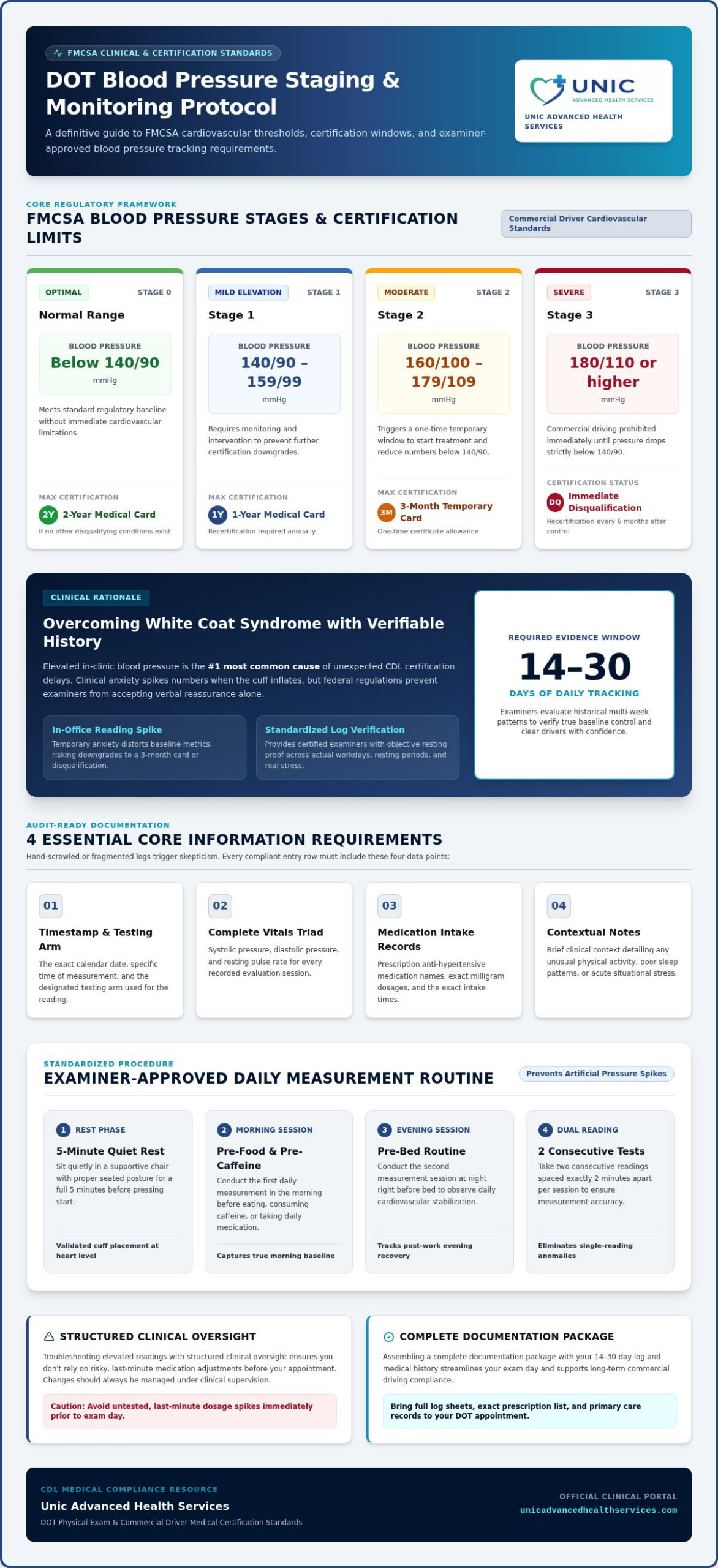
The FMCSA establishes clear operational brackets based on clinical staging for hypertension. Each bracket directly governs how long your medical certificate remains valid:
- Normal (Below 140/90 mmHg): Qualifies you for a standard two-year medical certificate, provided no other disqualifying conditions are present.
- Stage 1 (140/90 to 159/99 mmHg): Limits your medical card to a one-year certification period.
- Stage 2 (160/100 to 179/109 mmHg): Results in a one-time, temporary three-month certificate to allow you to initiate medical treatment and bring numbers below 140/90 mmHg.
- Stage 3 (180/110 mmHg or higher): Causes immediate disqualification. You cannot drive commercially until levels fall below 140/90 mmHg, after which recertification is required every six months.
The Role of Documentation in Overcoming White Coat Syndrome
Clinical anxiety often drives blood pressure up inside an examination room. This temporary spike, known as white coat syndrome, distorts an otherwise healthy cardiovascular profile. By law, an examiner cannot simply ignore an elevated reading based on verbal reassurance. Bringing an organized blood pressure monitoring log for DOT physical review provides the concrete clinical data required to demonstrate that isolated spikes do not reflect your true resting baseline.
Essential Elements of an FMCSA-Compliant Blood Pressure Log
Medical examiners evaluate historical patterns, not just isolated numbers. Submitting a sporadic, hand-scrawled list on a scrap of paper often triggers clinical skepticism rather than confidence. Maintaining a standardized blood pressure monitoring log for DOT physical clearance provides the objective verification required under current FMCSA guidelines. Tracking your numbers consistently for 14 to 30 days before your appointment offers examiners an undeniable baseline. This timeframe demonstrates that your cardiovascular health remains stable across genuine workdays, resting periods, and real-life stress.
Core Information Required in Every Entry
To satisfy an occupational examiner, each measurement entry must follow a standardized structure. Fragmented entries without context won’t hold up during an audit. Ensure every row in your log includes:
- The exact calendar date, time of measurement, and designated testing arm.
- Systolic pressure, diastolic pressure, and resting pulse rate.
- Prescription anti-hypertensive medication names, exact dosages, and intake times.
- Brief notes detailing any unusual physical activity, poor sleep, or acute stress.
Establishing an Examiner-Approved Morning and Evening Routine
Consistency creates clinical credibility. Take readings twice daily: once in the morning before eating, drinking caffeine, or taking daily medication, and once at night before bed. Clinical guidelines on how to measure blood pressure at home emphasize sitting quietly in a chair for five full minutes before pressing start. Take two consecutive readings spaced two minutes apart, then record the mathematical average. This routine eliminates momentary physiological fluctuations and shows genuine resting control.
Paper Tracking Sheets Versus Digital Healthcare Applications
Both physical forms and modern mobile health applications capture essential trends. Digital platforms generate clean visual charts, time stamps, and exportable PDF summaries. However, occupational examiners must place a tangible record into your physical qualification file. If you utilize an app, you don’t want to rely solely on showing a phone screen; always print out the formatted summary pages before your evaluation appointment. For commercial drivers seeking expert guidance to stabilize borderline readings, partnering with Unic Advanced Health Services provides professional oversight alongside specialized chronic condition management.
Clinical Guidelines for Taking Accurate Home Blood Pressure Readings
Flawed measurement technique produces artificial spikes that distort your tracking history. When recording entries for a blood pressure monitoring log for DOT physical qualification, accuracy depends entirely on clinical precision at home. An incorrect cuff size or poor posture can easily push an otherwise controlled reading past the official FMCSA hypertension stages, jeopardizing your driving credentials. Drivers managing complex cardiovascular baselines can also utilize tailored telehealth consultations to review measurement habits and maintain long-term stability while on the road.
Selecting and Calibrating an Upper-Arm Monitor
The type of device you select determines whether an examiner accepts your data. Never rely on wrist or finger monitors; they fluctuate wildly based on subtle wrist angles and produce unreliable records. Choose an automated upper-arm monitor verified by clinical cardiovascular validation protocols. Cuff sizing is equally vital. A cuff that is too small falsely elevates systolic readings by up to 10 mmHg. Bring your home monitor to your primary clinic visit to verify that its digital gauge matches manual clinical readings.
Physical Preparation Before Pressing the Start Button
Your physiological state directly impacts every entry on your log. Small daily habits can dramatically skew readings before the cuff even inflates. Follow these preparation rules before taking any measurement:
- Empty your bladder completely: A full bladder places pressure on internal vessels, adding 10 to 15 mmHg to your systolic measurement.
- Rest quietly for five minutes: Sit in an upright chair with your back fully supported and both feet flat on the floor. Do not cross your legs or speak.
- Position your arm correctly: Rest your testing arm on a firm table so the cuff sits level with your heart. An unsupported arm requires muscle tension that elevates diastolic pressure.
- Eliminate stimulants early: Avoid tobacco, vaping, caffeine, and energy drinks for at least thirty minutes before checking your vitals.
Mastering this protocol protects the integrity of your blood pressure monitoring log for DOT physical certification. By eliminating preventable errors, your log reflects your true physiological resting state rather than temporary, technique-driven spikes.
Troubleshooting High Readings and Managing Elevated Blood Pressure
Discovering numbers consistently above the 140/90 threshold on your tracking sheet can feel overwhelming. Panicking only drives those numbers higher. When your blood pressure monitoring log for DOT physical qualification shows steady elevation, treating it as an early warning signal allows you to take corrective action before your medical card lapses. Rather than waiting until the day of your examination, scheduling an occupational health exam with ample lead time gives you the runway needed to stabilize your cardiovascular readings under clinical supervision.
Collaborating With Your Healthcare Provider on Medication
Abruptly altering medication dosages right before a physical exam introduces major regulatory and physical hazards. Medical examiners watch for sudden pharmacological changes that might trigger dizziness, lethargy, or rapid heart rate drops while operating heavy machinery. Prescriptions typically require two to four weeks to demonstrate true hemodynamic stability. Your treating clinician must provide documentation confirming you tolerate your dosage without adverse reactions. Never skip morning doses hoping to “trick” the cuff; rebound hypertension often triggers severe spikes that lead directly to disqualification.
Practical Lifestyle Modifications for Long-Haul Drivers
Occupational conditions on long routes inherently challenge vascular health. Research from the American College of Cardiology found that sitting for ten hours or more each day significantly increases the risk for serious cardiovascular issues. You can counteract these seated risks through targeted daily habits:
- Cut hidden sodium: Avoid processed deli meats, canned soups, and fried truck stop meals. Choose grilled proteins, whole fruits, and unsalted nuts instead.
- Incorporate brief walking intervals: Take three brisk ten-minute walks during mandatory driving breaks to stimulate peripheral vascular return and lower resting tension.
- Screen for obstructive sleep apnea: Untreated airway collapse deprives the brain of oxygen and drives therapy-resistant hypertension that medication alone cannot fix.
Working directly with an autonomous nurse practitioner provides you with personalized chronic condition management tailored to the demanding realities of commercial transportation. If your recent home records remain borderline, schedule a clinical consultation with Unic Advanced Health Services to build a customized plan that keeps your blood pressure monitoring log for DOT physical clearance firmly within safe limits.
Completing Your DOT Physical Certification in Fort Lauderdale
Walking into your appointment fully prepared removes uncertainty and eliminates delays. Certified examiners review your medical history alongside immediate vital signs to ensure you meet federal safety standards. When you present an organized documentation package, the evaluation shifts from a stressful interrogation into a straightforward administrative verification. Aligning your occupational requirements with routine preventive care, such as an annual physical exam Fort Lauderdale commercial drivers rely on, protects both your health and your livelihood over the long haul.
Checklist for DOT Physical Day
Exam day should run smoothly without missing paperwork or administrative setbacks. Gathering your clinical records beforehand ensures your examiner has everything required to issue your medical card promptly. Make sure to bring:
- Your completed tracking documentation: Carry a printed, legible blood pressure monitoring log for DOT physical review spanning 14 to 30 consecutive days.
- Original medication containers: Bring all current prescription bottles with intact pharmacy labels detailing your exact dosage, prescriber details, and refill frequency.
- Clinical clearance letters: If you take cardiovascular or blood pressure medications, include a brief signed note from your prescribing provider stating that your regimen is stable and free from adverse side effects.
- Comfortable, practical attire: Wear loose, short-sleeved clothing that allows the medical assistant to position the cuff directly on bare skin without rolling up tight sleeves.
During the screening portion, your examiner will seat you quietly before taking your vitals. If an initial reading appears elevated, examiners often allow a brief resting period before re-checking your numbers.
The Unic Advanced Health Services Advantage for Drivers
Navigating commercial driving certifications requires a healthcare provider who understands both federal regulations and real-world occupational challenges. Led by Marc Joseph, an experienced autonomous nurse practitioner, Unic Advanced Health Services offers dedicated medical oversight tailored specifically to commercial operators. Rather than treating physicals as transactional checkups, the clinic delivers comprehensive chronic condition management for hypertension, diabetes, and related cardiovascular risks. With convenient Monday through Saturday appointments in Fort Lauderdale, drivers can easily coordinate certifications, submit their blood pressure monitoring log for DOT physical validation, and secure ongoing clinical support without taking unpaid days off the road.
Take Control of Your Cardiovascular Health and Protect Your CDL
Consistently tracking your numbers removes the guesswork from medical clearance. A well-maintained blood pressure monitoring log for DOT physical evaluation shows examiners that your resting baseline is steady, controlled, and compliant with federal regulations. You don’t have to let white coat anxiety or isolated spikes threaten your livelihood when reliable documentation speaks for your health.
At Unic Advanced Health Services, an experienced autonomous nurse practitioner provides compassionate, patient-first care designed to keep commercial operators safely behind the wheel. We combine specialized chronic condition management with certified occupational exams, giving you the clinical support needed to manage hypertension effectively. Take advantage of convenient Monday through Saturday appointments tailored to driver schedules. Schedule Your DOT Physical in Fort Lauderdale with Unic Advanced Health Services today and protect your career with confidence.
Frequently Asked Questions
Can I pass a DOT physical if I take blood pressure medication?
Yes, you can pass your physical while taking anti-hypertensive medication. If your prescription successfully maintains your blood pressure below 140/90 mmHg and causes no adverse side effects, you qualify for certification. Under federal regulations, drivers managing hypertension with medication receive a maximum one-year medical certificate rather than a standard two-year card. You must undergo recertification annually to verify continuous cardiovascular stability and ongoing treatment compliance.
What blood pressure reading instantly disqualifies a commercial driver?
A blood pressure reading of 180/110 mmHg or higher results in immediate medical disqualification. The FMCSA classifies this reading as Stage 3 hypertension, which poses an unacceptable risk for sudden cardiovascular events on the road. You cannot drive commercially until medical intervention lowers your numbers below 140/90 mmHg. Once your pressure is controlled, you may receive certification for six-month intervals, requiring routine clinical re-evaluation.
How many days should I track in my blood pressure monitoring log for a DOT physical?
You should track your daily readings for 14 to 30 consecutive days prior to your evaluation. Maintaining a blood pressure monitoring log for DOT physical review over this multi-week window provides undeniable proof of cardiovascular control. Examiners look for consistent twice-daily entries taken under resting conditions. This verifiable timeline gives clinicians the objective evidence needed to validate borderline readings and counter clinic-induced white coat spikes.
Will a DOT medical examiner accept readings taken from a home blood pressure monitor?
Yes, examiners accept home tracking records if you capture them using a clinically validated device. You must use an automated upper-arm cuff rather than an inaccurate wrist or finger model. Bring your completed log alongside your physical monitor to your Fort Lauderdale appointment. Your medical provider can test your device against clinical clinic gauges, confirming that your home tracking reflects accurate, dependable cardiovascular data.
What should I do if my blood pressure spikes during my physical exam?
Remain calm and request a brief resting period before the assistant checks your vitals again. Occupational providers understand that clinic stress and heavy traffic elevate numbers temporarily. Sit quietly, breathe deeply, keep your feet flat, and avoid talking during the re-test. Presenting your completed blood pressure monitoring log for DOT physical clearance provides vital context, proving that the spike was an isolated event rather than unmanaged hypertension.
Can white coat hypertension disqualify me from getting my CDL medical card?
Yes, white coat hypertension can lead to certification downgrades or delays if you lack supporting documentation. Examiners must legally base their decisions on the physical numbers recorded in the clinic. If your in-office reading exceeds federal limits, the clinician cannot certify you based on verbal explanations alone. Bringing an organized monitoring log and a treating provider’s clearance letter proves your resting baseline is controlled during everyday routines.
How often must I renew my DOT medical certificate if I have hypertension?
Drivers diagnosed with high blood pressure must renew their medical certificate at least once every 12 months. If your pressure is safely maintained below 140/90 mmHg with prescription medication, federal rules require annual recertification. A reading in the Stage 2 range results in a one-time, three-month temporary card to achieve control. Drivers with a history of Stage 3 hypertension must recertify every six months.