
A lipid panel test in Fort Lauderdale measures four key blood fats: total cholesterol, LDL cholesterol, HDL cholesterol, and triglycerides. LDL is often called “bad” cholesterol, but it is only one part of the picture. The cost and insurance coverage depend on the testing arrangement and your plan. Knowing what the panel includes can help you understand what to expect before scheduling.
It is reasonable to want clear answers about both your results and the bill. This guide explains what LDL cholesterol means, how the four measurements are interpreted, and what can affect pricing and insurance coverage. You will also learn what to ask about preparation and scheduling, so you can understand the process and discuss your results with a healthcare professional.
Key Takeaways
- Learn what LDL cholesterol indicates and how it fits alongside the other measurements in a standard lipid panel.
- Find out why fasting instructions can differ and what to clarify before your blood draw.
- Understand which details of your health plan can affect coverage for testing.
- See what factors can shape testing costs and what to ask about before scheduling.
- Explore how a clinic visit can connect lab testing with ongoing care for cholesterol and other chronic conditions.
What is the cost of a clinical lab test in Fort Lauderdale, FL?
The price of a lipid panel depends on the test ordered, where the blood is collected, and how billing is arranged. The price depends on your case and is provided after a quote request. Factors include the panel type, collection location, and insurance arrangements. A standard panel and an advanced panel may measure different things, so confirm which test the order specifies before comparing costs. The test name on the order helps connect the quote to the service you need.
A blood test begins with confirming the order and preparing for collection. At a clinic or laboratory, a trained professional verifies identifying details, selects a suitable vein, cleans the skin, and draws a blood sample. The sample is labeled and sent for laboratory processing. This allows the laboratory to assess substances in the bloodstream, including cholesterol and triglycerides.
Fort Lauderdale blood draws may take place at a clinic with collection services or at a laboratory. The right location depends on where the order can be processed and how the appointment is arranged. For example, a clinician may collect a lipid panel sample at the clinic, while another order may direct you to a separate collection site. Location can affect convenience and billing arrangements.
Fasting instructions depend on the specific blood test. A fasting test may require you to avoid food and drink for several hours or overnight, depending on the test. Some advanced lipid testing may not require fasting. Because requirements differ, follow the ordering clinician’s instructions. Ask whether fasting applies, when to begin, and whether any other preparation is needed.
Before the blood draw, make sure the collection team has the correct test order and knows about any preparation instructions you received. If fasting is required, follow the timing carefully. Eating or drinking outside the permitted instructions could affect whether the sample is collected as planned. If instructions are unclear, ask the clinic before your appointment instead of relying on someone else’s experience.
To understand the likely charge, identify whether the order is for a standard or advanced panel, where collection will take place, and how the test will be billed. Insurance coverage and your share of the cost vary by plan, so include those details when discussing pricing. Knowing the test and collection location helps clarify the process and the factors that shape the final cost.
Standard lipid panel measurements
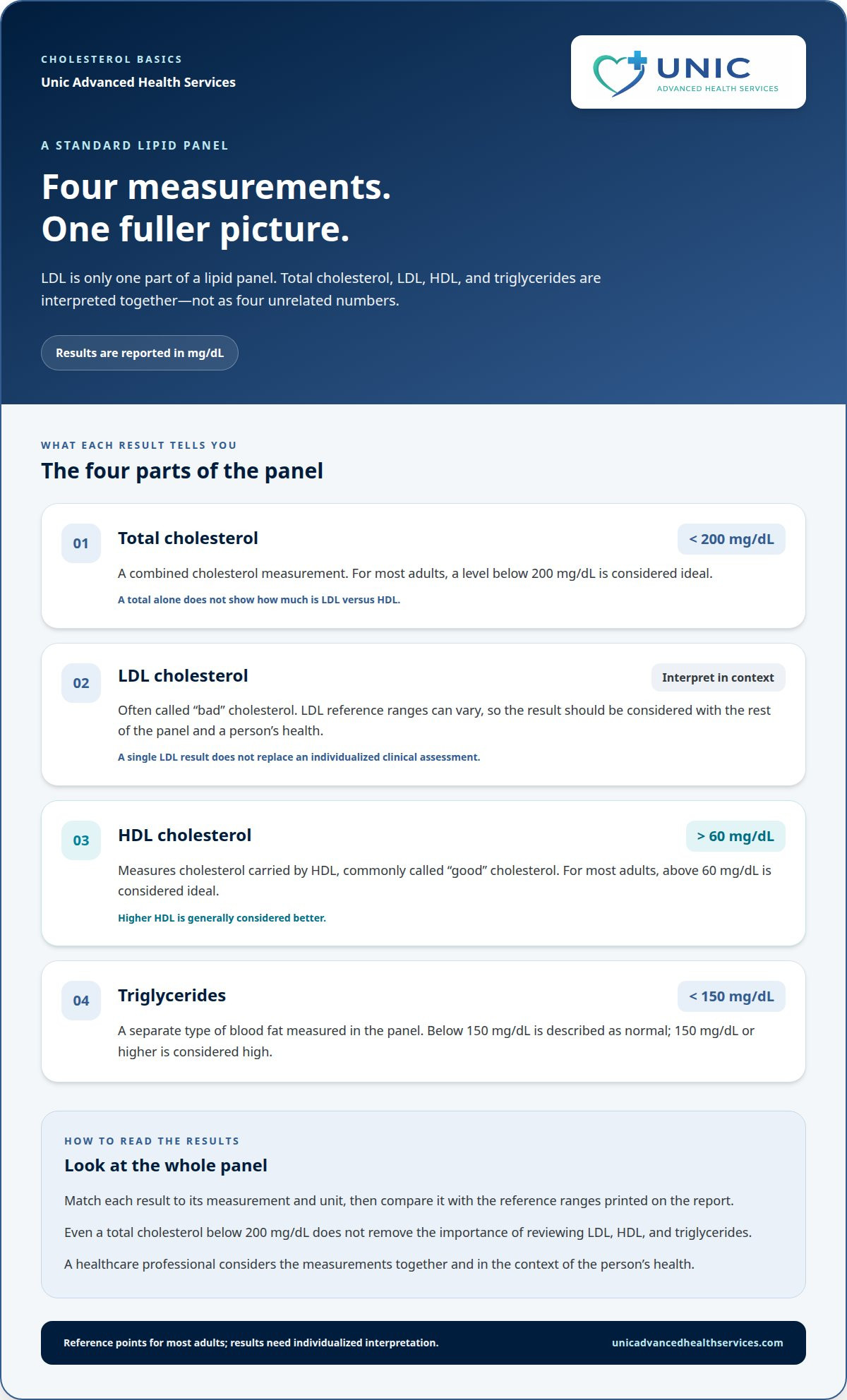
A standard lipid panel measures four parts of blood cholesterol and fats: total cholesterol, LDL, HDL, and triglycerides. Results are reported in milligrams per deciliter, written as mg/dL. Together, these measurements provide a snapshot of different blood lipid levels. They are interpreted as a group, not as four unrelated numbers.
Total cholesterol combines cholesterol carried in different forms. For most adults, an ideal total cholesterol level is below 200 mg/dL, according to the National Heart, Lung, and Blood Institute. That number is useful context, but it doesn’t show how much is LDL versus HDL. For example, two results with the same total can have different LDL and HDL values.
LDL cholesterol is often called “bad” cholesterol. LDL reference ranges can vary, so a result should be interpreted in the context of the rest of the panel and a person’s health. Those values help orient a reader, but a single result doesn’t replace an individualized clinical assessment. The healthcare professional considers LDL alongside the other panel measurements and the person’s health context.
HDL cholesterol is commonly called “good” cholesterol, and higher HDL is generally considered better. An ideal HDL level for most adults is above 60 mg/dL. Unlike total cholesterol, this result focuses on cholesterol carried by HDL. Reviewing it with LDL can help clarify why the total number alone may not tell the full story.
Triglycerides are another type of fat measured in the panel. A level below 150 mg/DL is described as normal by the National Heart, Lung, and Blood Institute. Levels of 150 mg/DL or higher are considered high by the National Heart, Lung, and Blood Institute. These cutoffs help identify a result that may need closer review with the rest of the panel.
- Total cholesterol: the combined cholesterol measurement.
- LDL: the measurement often called “bad” cholesterol.
- HDL: the measurement for cholesterol carried by HDL.
- Triglycerides: a separate blood fat measurement.
When reviewing a report, first match each result to its measurement and unit. Then compare the numbers with the reference ranges printed on the report and discuss questions with a healthcare professional. For example, a total below 200 mg/dL doesn’t erase the importance of reviewing LDL, HDL, and triglycerides. Looking at all four results together gives a clearer starting point for a conversation about cholesterol.
How to schedule a lab test through a Fort Lauderdale clinic
Start by identifying why testing is being considered: routine screening, follow-up, or an existing concern. A lipid panel measures cholesterol and triglyceride levels, while the reason for testing helps the clinician decide whether it fits your care plan. Share relevant health details, such as diabetes or a history of high cholesterol, so the clinician can consider them when reviewing the request.
Scheduling typically involves a few practical steps. The clinic reviews the reason for testing, confirms which lab test is needed, and explains how the blood draw will be arranged. If a clinician has already ordered a lipid panel, provide the order details when scheduling. If you do not have an order, describe your concern and health history so the clinic can determine the appropriate next step.
- Explain the purpose. Tell the clinic whether the test is for routine screening, monitoring, or follow-up.
- Share relevant history. Mention conditions such as diabetes or high cholesterol and any current treatment.
- Confirm the test. Clarify whether the order is for a standard lipid panel or another type of testing.
- Arrange collection. Follow the clinic’s instructions for the blood draw location and appointment.
Preparation depends on the requested test. A fasting blood test may require fasting for several hours or overnight, while some advanced lipid tests do not require fasting. Follow the clinic’s instructions for your specific order. Do not assume that preparation instructions for someone else’s test apply to your appointment. Ask the clinic to explain anything that is unclear.
Testing frequency can also guide the conversation. Most healthy adults should have cholesterol checked every 4 to 6 years. Annual cholesterol testing is routine for people diagnosed with diabetes, cardiovascular disease, high blood pressure, or high cholesterol requiring medication. These intervals provide context, but your health history and reason for follow-up remain relevant when arranging a test.
After collection, results need to be interpreted in context. A result outside the expected range does not, by itself, explain the cause or establish a disease. The clinician considers the measured levels alongside your medical history, risk factors, and previous results. If the panel is part of ongoing care, explain whether the purpose is to establish a starting point or assess changes over time.
Before your appointment, make sure the clinic has the correct order and your preferred contact details for scheduling and follow-up. Clear information about the test, collection instructions, and reason for testing helps distinguish routine screening from monitoring. It also gives the clinician a useful starting point for reviewing your lipid levels and deciding what follow-up may be appropriate.
Insurance coverage
Coverage for a lipid panel depends on your health plan and how the test is billed. The reason for testing, the ordering clinician, and the laboratory location can affect how a claim is processed. A routine screening order and a test related to an existing health concern may be handled differently. Your plan documents explain the applicable benefits and patient costs.
Before scheduling, contact your insurer using the member services number on your card. Ask how your plan processes a lipid panel for the reason you give. Provide the ordering clinician’s name and the laboratory or clinic location, if known. Record the representative’s name, the date, and any reference number for the call.
Ask specific questions that connect the order with your plan:
- Is the ordering clinician in the plan’s network?
- Is the blood collection location in the network?
- How does the plan classify the test for this appointment?
- Does the plan require authorization or a referral?
- What deductible, copayment, or coinsurance applies?
- Will the laboratory bill separately from the clinic?
These details can clarify possible charges before the blood draw. An in-network clinician does not automatically mean a separate laboratory claim will be processed the same way. Confirm the collection site as well as the clinician. If the laboratory is selected after your appointment is arranged, ask which location will process the sample and share its name with your insurer.
The medical reason for the test matters when discussing coverage. Tell the insurer whether the order is for routine screening, follow-up, or a condition such as diabetes or high cholesterol. The wording on the order and the information submitted with the claim help the plan evaluate the service. Avoid relying on a general answer about cholesterol tests when you are asking about a specific order.
A normal result does not determine how the plan will process the claim. Coverage is based on plan terms and submitted billing details, not only on whether LDL cholesterol or another measurement falls within a reference range. If the explanation of benefits differs from your expectations, compare its service description with the test order and the information recorded during your call.
Keep the order, appointment details, insurance response, and any explanation of benefits together. If you need help understanding a claim, contact your insurer with the service date and claim information. To request an estimate before testing, ask the clinic how billing is arranged and share the insurer’s guidance. This preparation gives you a clearer view of coverage without assuming every plan handles the same test identically.
Lipid panel pricing in Fort Lauderdale
Lipid panel results are available after the laboratory processes the sample and the clinician reviews it. Timing depends on the test ordered, laboratory workflow, and any follow-up needed to interpret the findings.
The price of a lipid panel depends on your case and is provided after a quote request. The main cost factors are the specific panel, blood collection location, and insurance arrangements. A standard panel measures total cholesterol, LDL, HDL, and triglycerides. An advanced panel can include additional measurements, so confirm the test named on the order before discussing its cost.
To understand a quote, connect it to the exact service and collection arrangement. These details can shape the estimate:
- Panel type: A standard panel differs from an advanced one in the measurements included.
- Collection location: A clinic and a separate laboratory can have different billing arrangements.
- Insurance: Plan benefits and network status affect the amount a patient may owe.
- Order details: The test name and reason for testing help clarify how it is billed.
Insurance affects your out-of-pocket costs. A plan may process routine screening differently from testing related to an existing condition. The network status of both the provider and laboratory also matters. Ask your insurer how it handles the specific order and collection location, then compare that guidance with the quote details.
The reason for testing also helps determine which panel is appropriate. A standard panel provides four familiar measurements, while advanced testing can offer additional detail for cardiovascular risk assessment. The choice should reflect the clinical question, such as routine monitoring or evaluating a more complex risk profile. Measurements unrelated to that question may not provide useful information.
Ask what the quote includes, such as the test and blood collection. Clarify whether the clinic and laboratory bill separately. These questions help distinguish the test charge from other billing responsibilities. Keep the quote and insurance guidance with the order so you can refer to the same panel name and collection details throughout scheduling.
For result timing, ask how the laboratory’s processing and clinician review fit into the process. The turnaround depends on those steps, not simply on the time of the blood draw. To discuss a lipid panel quote and testing arrangements, request information about lipid testing.
Results are available after the laboratory processes the sample and the clinician reviews it. Timing varies with the test ordered, laboratory workflow, and any follow-up needed.
Unic Advanced Health Services
Unic Advanced Health Services provides on-site lab services, annual physicals, and preventive care in Fort Lauderdale. These services can support conversations about cholesterol testing and how results relate to your broader health needs.
For people managing diabetes, hypertension, or obesity, chronic condition management can provide continuity as health needs change. A lipid result may be one part of that discussion, alongside your medical history and other concerns. Telehealth services are also available as an option for care conversations when appropriate.
Unic Advanced Health Services also provides DOT Physical Examinations and U.S. Coast Guard (USCG) Boat Captain Physicals. To discuss lipid testing and your care needs in Fort Lauderdale, contact Unic Advanced Health Services.
Make your next testing decision with confidence
Before scheduling, consider what you want the test to clarify. A lipid panel is most useful when its results connect to a health question, such as understanding your cholesterol profile or discussing ongoing monitoring. For a lipid panel test in Fort Lauderdale, bring questions about how the results may inform your care. This can help keep the appointment focused on what matters to you.
Results are one part of a broader health picture, not a standalone plan. Your next step may be a discussion about personal risk factors, follow-up, or how testing fits with other care priorities. Understanding the purpose of testing can make it easier to have a thoughtful conversation and decide how to proceed.
If you’re ready to discuss your needs, contact Unic Advanced Health Services. A clear next step can help you move forward with greater confidence.
Frequently Asked Questions
What is LDL Cholesterol?
LDL stands for low-density lipoprotein, a particle that carries cholesterol through the bloodstream. It is commonly called “bad” cholesterol because elevated LDL is associated with fatty plaque buildup in arteries. A result is most useful when considered alongside HDL, triglycerides, and your health history. For example, a clinician may review LDL differently when assessing someone with diabetes than when reviewing routine screening results.
Do I need a physician referral for the lab test?
A referral and a laboratory order serve different purposes. The order identifies the test, while a referral may direct you to another clinician or service. For a clinic-based blood test, bring any existing order and your insurance card, if applicable. If you do not have an order, a clinical appointment can help establish the appropriate testing pathway and whether a referral is relevant.
How do I read cholesterol test results?
Start by matching each reported value with its label and unit, then review the laboratory’s reference range. LDL, HDL, total cholesterol, and triglycerides describe different parts of the lipid profile, so one result does not explain the whole picture. For example, total cholesterol alone does not show how much is carried by LDL versus HDL. Discuss patterns and follow-up with a clinician.
What is Advanced Lipid Panel testing?
Advanced lipid testing adds measurements beyond standard cholesterol and triglyceride results. Depending on the panel, it may include apolipoprotein B (apoB) or LDL particle number (LDL-P). These measures can provide additional detail for cardiovascular risk assessment, including for people with diabetes or insulin resistance. The specific tests depend on the panel ordered, so review its listed measurements with the clinician.
Where can I get a lipid panel test in Fort Lauderdale?
Unic Advanced Health Services provides on-site lab services in Fort Lauderdale. Its annual physicals and preventive care offer an opportunity to discuss whether cholesterol testing fits your health needs. For example, you can raise lipid testing during a preventive-care appointment. The clinician can consider your concerns and medical history as part of the discussion.
How much does a lipid panel test cost in Fort Lauderdale without insurance?
The price of a lipid panel depends on your case and is provided after a quote request. Cost factors include the specific panel, blood collection location, and billing arrangement. If you do not have insurance, ask for a quote tied to the exact test order and collection site. This helps distinguish the laboratory test charge from any separate clinic or visit charges.
Which Fort Lauderdale labs offer walk-in lipid panel testing?
Unic Advanced Health Services arranges lab testing through scheduled appointments. To discuss an appointment, call the main office at (954) 767-0228. Having the test name or existing order available helps clarify what testing you need and how the collection will be arranged. Walk-in availability varies by location, so a scheduled appointment is the practical route for this clinic.
Do I need a doctor’s order for a lipid panel in Florida?
For testing through a clinic, arrange care so the test can be ordered in context. A referral from another physician and the lab order itself are not interchangeable. If you already have an order, bring its details to the appointment. Otherwise, discuss the reason for testing with the clinician, who can determine the appropriate next step for your care.