
They may both happen yearly, but an annual wellness visit and an annual physical serve different purposes. The key distinction in the annual wellness visit vs annual physical comparison is that Medicare’s yearly Wellness visit focuses on prevention and a personalized plan, while a physical evaluates your current health and may include a hands-on exam. According to the Centers for Medicare & Medicaid Services, you’re eligible for the Medicare Wellness Visit benefit after having Part B for at least 12 months, and Medicare covers a yearly Wellness visit once every 12 months.
It’s understandable to expect these appointments to include the same checks or coverage. They don’t: Original Medicare doesn’t cover routine physical exams, while an eligible Wellness Visit can have no cost-sharing when the provider accepts assignment. Additional services or tests may involve separate costs.
This guide explains how the visits differ in purpose, examination, eligibility, timing, and coverage, and how to decide which fits your needs. You’ll also learn why a Wellness Visit may not replace care for new symptoms or ongoing conditions, so you can prepare for the appointment that best supports your health.
Key Takeaways
- Understand which appointment is designed for prevention and which evaluates your current health through a physical exam.
- Learn how Medicare eligibility and the timing rules affect when you can schedule a yearly Wellness visit.
- See why added tests or services can have separate costs even when the Wellness visit itself is covered.
- Find out how coverage for a routine physical may differ between Original Medicare and other insurance plans.
- Use the decision guide to choose an appointment that fits your preventive care needs, symptoms, and ongoing health concerns.
What is the difference between a physical exam and a Medicare Wellness Visit?
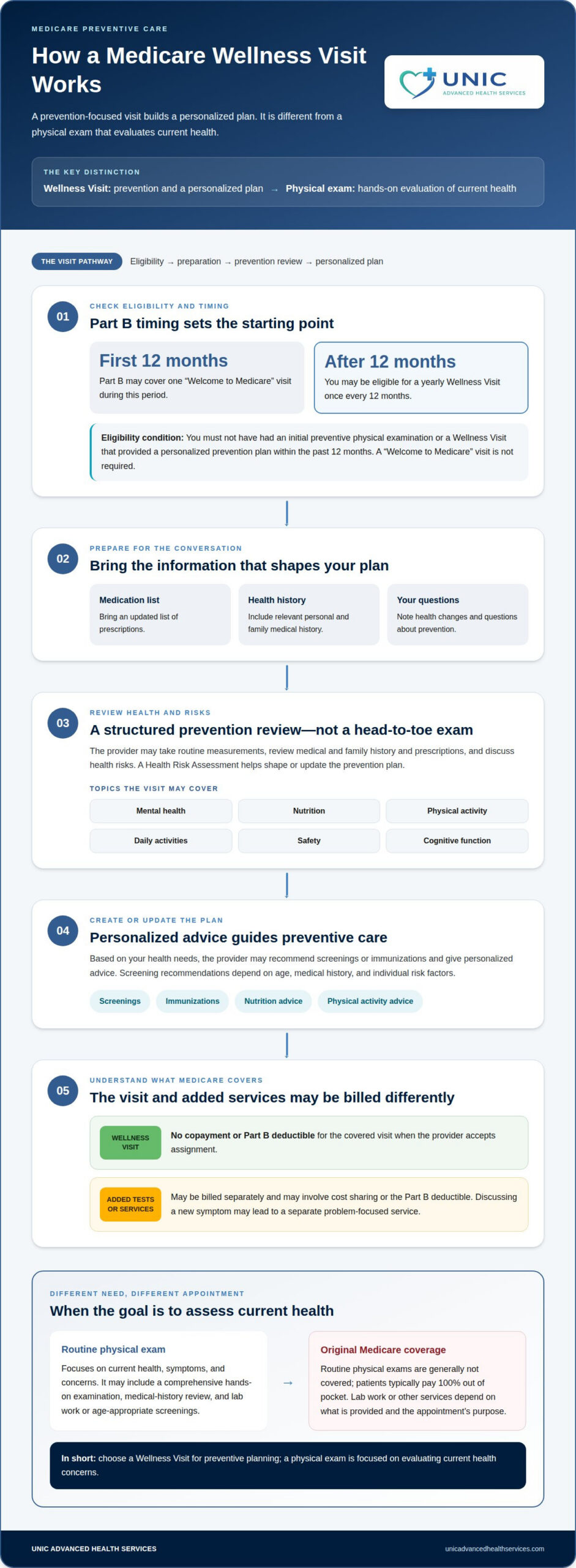
The main difference is purpose: a Medicare Wellness Visit focuses on prevention and a personalized prevention plan, while a routine physical exam assesses current health through a hands-on examination. The visits also differ in Medicare eligibility, timing, and coverage.
Medicare Wellness Visit Eligibility and Frequency
According to the Centers for Medicare & Medicaid Services, an individual is eligible for an annual wellness visit after the first 12 months of Part B coverage, provided they have not received an initial preventive physical examination or an annual wellness visit providing a personalized prevention plan in the past year. According to the Centers for Medicare & Medicaid Services, an individual is eligible for an annual wellness visit after the first 12 months of Part B coverage, provided they have not received an initial preventive physical examination or an annual wellness visit providing a personalized prevention plan in the past year.
The Centers for Medicare & Medicaid Services says an individual is eligible for an annual wellness visit after the first 12 months of Part B coverage, provided they have not received an initial preventive physical examination or an annual wellness visit providing a personalized prevention plan in the past year. Part B covers a “Welcome to Medicare” visit once within the first 12 months of Part B enrollment, according to the Centers for Medicare & Medicaid Services.
The Centers for Medicare & Medicaid Services defines an eligible beneficiary as someone no longer within 12 months after the effective date of their first Part B coverage period, who has not received an initial preventive physical examination or an annual wellness visit providing a personalized prevention plan within the past 12 months. A Welcome to Medicare visit is not required to qualify.
Wellness Visit Measurements and Health Advice
A Medicare Wellness Visit focuses on prevention, not a head-to-toe physical exam. The provider may take routine measurements, review medical and family history and prescriptions, and discuss health risks. A Health Risk Assessment helps shape or update the prevention plan, with personalized advice and recommended preventive services.
The visit may also cover mental health, nutrition, physical activity, daily activities, safety, and cognitive function. For example, the provider can consider which screenings or immunizations suit your health needs. This structured review differs from a physical exam, which focuses more directly on current health and concerns raised during the appointment.
Routine Physical Exam Procedures
A routine physical exam assesses current health and addresses symptoms or other concerns. It may include a comprehensive hands-on examination of different areas of the body. The provider may also review medical history, discuss symptoms, and assess your healthcare needs.
Lab work and age-appropriate screening recommendations may be part of the evaluation. For example, cholesterol or blood sugar testing may be considered alongside the examination. Unlike the Wellness Visit’s focus on a prevention plan, these services help assess current health and address specific concerns.
Medicare Coverage for Visits and Physicals
Under Original Medicare, the covered Wellness Visit has no copayment or Part B deductible when the provider accepts assignment. Routine physical exams are different: Original Medicare generally doesn’t cover them, so patients typically pay 100% out of pocket.
Tests or services added during a Wellness Visit may be billed separately and involve cost sharing or the Part B deductible. For instance, discussing a new symptom may lead to a separate problem-focused service. Coverage depends on the appointment’s purpose and the services provided.
| Appointment | Main purpose | Typical focus | Original Medicare coverage |
|---|---|---|---|
| Medicare Wellness Visit | Prevention planning | Health risks, history, measurements, recommended services | Covered visit, subject to assignment rules |
| Routine physical exam | Evaluate current health | Hands-on examination, symptoms, possible tests | Routine exam generally not covered |
Choose a Wellness Visit for preventive planning, or a physical exam to evaluate current health concerns.
Differences between an annual physical and a wellness exam
A Wellness Visit organizes preventive care around health risks and a personalized plan. A physical exam focuses on current health, symptoms, and hands-on evaluation. The annual wellness visit vs annual physical distinction comes down to prevention planning versus assessing current health.
Annual Wellness Visit Purpose
The Annual Wellness Visit helps identify health risks and plan preventive care. Rather than serving as a full physical exam, it gives the provider time to review your health history, prescriptions, and daily habits. That context can guide advice about screenings, immunizations, nutrition, and physical activity.
To prepare, bring an updated medication list and relevant personal or family medical history. Note changes in your health and questions about prevention. This helps the provider tailor the prevention plan to your needs, rather than focusing on an examination of every body system.
Recommended screenings depend on age, medical history, and individual risk factors. Examples may include colonoscopies, mammograms, bone density testing, lung cancer screenings, and routine laboratory work. The provider considers which preventive services suit your circumstances; the same test is not automatically appropriate for everyone.
A Wellness Visit may review how you manage daily activities, safety, mental health, and cognitive function. These topics can reveal prevention needs beyond a measurement or lab result. For example, discussing physical activity may help identify a practical health-planning goal.
Physical Exam Purpose and Procedures
A physical exam assesses current health and addresses symptoms or concerns. The provider may perform a comprehensive hands-on examination, review your medical history, and evaluate your healthcare needs. Height and other routine measurements can contribute to the assessment, alongside a discussion of symptoms.
Depending on the visit, the examination may include lab work and age-appropriate screening recommendations. Cholesterol and blood sugar tests are examples of laboratory work that may be considered. These services support an assessment of current health, while a Wellness Visit primarily organizes preventive advice and recommended services.
Before a physical, prepare a list of symptoms, medications, and questions. Note when each concern began and how it affects daily activities. These details help the provider focus the examination and discuss relevant next steps. A physical can address new concerns; a preventive appointment alone may not include a separate problem-focused evaluation.
For a hands-on preventive checkup, annual physical and preventive care can bring examination needs and preventive recommendations into the same care discussion. The annual wellness visit vs annual physical comparison can help you decide whether you need current-health assessment, prevention planning, or both.
Costs for wellness visits and added services
A covered Medicare Wellness Visit and services performed during it can be billed differently. Under Original Medicare, the yearly Wellness Visit itself has no copayment or Part B deductible when the provider accepts assignment. That coverage applies to the visit, not automatically to every test, lab service, or clinical evaluation provided alongside it.
This distinction matters when prevention planning leads to another service. A provider might review recommended screenings during the Wellness Visit, then order a test or lab work. That additional service may involve separate cost sharing, and the Part B deductible may apply. The test’s coverage and billing determine your share, not the appointment’s preventive purpose alone.
For example, discussing weight management as part of prevention planning differs from receiving a separate evaluation for a health concern. If an appointment also addresses a new symptom or ongoing condition, that work may be billed as problem-focused or chronic care. The Wellness Visit benefit does not automatically include these additional services.
How added services can affect out-of-pocket costs
Costs depend on what service is provided and how the patient’s Medicare plan covers it. For a covered service subject to coinsurance, 20% is an example of a typical share, but it is not a set fee for every test. The Part B deductible may also apply to services outside the covered Wellness Visit.
Consider a visit that includes preventive planning and a discussion of a new concern. The preventive portion may qualify as the covered Wellness Visit, while the separate assessment or testing may result in additional charges. A lab test or screening is not automatically included just because it is recommended during the same appointment.
Practical steps to understand the bill
Before the appointment, identify whether your main goal is prevention, evaluation of current health, or both. Bring a concise list of concerns, such as a change in weight or a question about a screening. This helps the provider distinguish preventive planning from care for a specific problem.
- Ask which parts of the appointment are preventive and which involve separate evaluation or testing.
- Find out whether a recommended screening or lab service is billed separately.
- Review how your Medicare plan treats the added service, including any deductible or coinsurance.
These distinctions clarify what the Wellness Visit covers and why a separate charge might appear. Preventive recommendations can help you stay healthy, but each screening or service follows its own coverage rules. Focus on the service provided, your plan’s coverage, and whether the provider accepts assignment. This is the clearest way to anticipate costs without assuming every service is part of the preventive benefit.
Coverage of routine physical exams
Coverage depends on whether the appointment is a Medicare preventive visit or a routine physical exam. Original Medicare Part B covers the yearly Wellness Visit, but generally doesn’t cover a routine physical. The appointment’s name alone doesn’t make these services equivalent. The key distinction is whether the care involves preventive planning or a physical assessment of current health.
With Original Medicare, a routine physical exam is typically paid out of pocket. This differs from the covered Wellness Visit, which follows Medicare’s preventive-service rules. If a visit includes a physical exam alongside preventive care, the services may be treated separately. That can affect which parts Medicare covers and which costs you pay.
Medicare Advantage plans must cover the same preventive visits as Original Medicare. Some plans may offer benefits beyond Original Medicare, but that does not mean every routine physical is covered. Coverage depends on the plan and the service. A Wellness Visit benefit and a routine examination are distinct categories, even when discussed during related care.
Coverage also varies outside Medicare. Many commercial insurance plans cover one preventive physical each year. That may make a routine checkup a covered benefit for some patients, but exact coverage depends on the plan’s terms. Some plans may require preventive visits to take place in person, which can affect scheduling.
Before arranging care, identify the appointment’s purpose and coverage category. A prevention-focused visit may include a personalized prevention plan; an exam for current health concerns is a different service. For example, an appointment to review recommended preventive screenings isn’t automatically the same as a routine physical that evaluates symptoms. Your plan’s benefits and the services provided determine the distinction.
- Original Medicare: Covers the yearly Wellness Visit, but generally not a routine physical exam.
- Medicare Advantage: Covers the same preventive visits as Original Medicare; plans may offer additional benefits.
- Commercial insurance: Many plans cover one preventive physical each year, and some require an in-person visit.
Use these steps to understand the coverage category before an appointment:
- Determine whether the visit is for preventive planning or a routine physical assessment.
- Review your plan’s preventive-care benefits and any in-person requirements.
- Separate any additional evaluation or service from the preventive visit when considering coverage.
For example, a preventive appointment focused on screenings and risk factors may qualify under a plan’s preventive benefit. A separate physical exam may be treated differently, particularly under Original Medicare. Knowing which service is planned helps set clear expectations about coverage. It also gives you a practical basis for understanding how your provider’s assessment fits your insurance benefits.
Eligibility and timing for yearly Wellness Visits
Medicare Part B eligibility and the date of your last preventive visit affect when you can schedule a Wellness Visit. These rules differ from arranging a routine physical, which depends on your health needs and insurance coverage.
The Centers for Medicare & Medicaid Services says an individual is eligible for an annual wellness visit after the first 12 months of Part B coverage, provided they have not received an initial preventive physical examination or an annual wellness visit providing a personalized prevention plan in the past year. According to the Centers for Medicare & Medicaid Services, an individual is eligible for an annual wellness visit after the first 12 months of Part B coverage, provided they have not received an initial preventive physical examination or an annual wellness visit providing a personalized prevention plan in the past year. For repeat visits, 11 full months must have passed since the previous visit.
Your first yearly Wellness Visit also has a timing restriction. According to the Centers for Medicare & Medicaid Services, it cannot take place within 12 months of Part B enrollment or a Welcome to Medicare preventive visit. Part B covers a “Welcome to Medicare” visit once within the first 12 months of Part B enrollment. A Welcome visit is not required to qualify for a yearly Wellness Visit.
At the appointment, the provider can review a Health Risk Assessment and develop a personalized prevention plan. The discussion may cover medical and family history, prescriptions, and preventive services. Routine measurements can support the review. The plan can identify recommended screenings and organize them around your health needs, rather than treating every service as automatic.
Yes, you can have a Medicare Wellness Visit and a routine physical in the same year. They serve different purposes, so if you want both, schedule them separately and understand that the physical may involve costs. An appointment that addresses new symptoms or ongoing conditions may also include separately billed, problem-focused care.
To plan your Wellness Visit date, use the previous visit date as a reference point. Count the full months between appointments, then consider whether the first-visit restriction applies. For example, a recent Welcome to Medicare visit affects the timing of your first yearly Wellness Visit. A routine physical does not replace the Wellness Visit benefit or change its eligibility timing.
During the visit, discussions about health risks can lead to tailored advice on blood pressure, physical activity, or other preventive needs. The provider may review which preventive services suit your history and risk factors. A written plan can help you track recommended screenings and follow-up steps throughout the year.
For preventive care planning and an exam tailored to your needs, schedule annual physical and preventive care.
Unic Advanced Health Services: Annual Physicals and Preventive Care
Unic Advanced Health Services offers annual physicals and preventive care in Fort Lauderdale for people seeking an assessment of current health and guidance on prevention. If you’re managing an ongoing condition, chronic condition management can support your care alongside preventive appointments. These services address different needs, so a Medicare Wellness Visit and a physical exam shouldn’t be treated as interchangeable.
Unic Advanced Health Services also provides DOT Physical Examinations and U.S. Coast Guard (USCG) Boat Captain Physicals for people who need those specific evaluations. Choose care based on your appointment’s purpose, whether that’s a routine physical, preventive care, or ongoing condition management.
Contact Unic Advanced Health Services to discuss annual physicals and preventive care.
Make your next visit part of a clear care plan
Think beyond a single appointment: the most useful next step connects your current concerns with the care you want to maintain. Before booking, decide what you hope to address, such as a new health concern, ongoing care, or preventive planning. That purpose can guide a focused conversation with your healthcare provider.
Understanding the difference between an annual wellness visit and an annual physical can also help you explain what you need. Bring your unresolved questions, changes you’ve noticed, and priorities for future care. A clear starting point makes it easier to discuss the right appointment and keep your health goals in view.
When you’re ready to discuss your care needs, contact Unic Advanced Health Services. Taking a thoughtful next step can help you approach your care with greater clarity and confidence.
Frequently Asked Questions
How Are These Visits Covered by Insurance?
Coverage depends on your plan and the services provided. Original Medicare covers the eligible Wellness Visit, but generally doesn’t cover a routine physical exam. Medicare Advantage plans cover the same preventive visits as Original Medicare and may include additional benefits. Many commercial insurance plans cover one preventive physical each year. A lab test or separate assessment may follow different coverage rules from the appointment itself.
Which Appointment Is Right for You?
Choose a Wellness Visit when your priority is reviewing prevention needs and developing a health plan. A physical exam is more appropriate for assessing current health or discussing symptoms. If you need both forms of care, they may be scheduled separately and have different coverage considerations. For example, someone planning preventive screenings and seeking an assessment of a new concern may need both preventive planning and a separate evaluation.
What is included in a Medicare annual wellness visit?
A Medicare Wellness Visit can include a Health Risk Assessment, review of your medical and family history, prescriptions, and routine measurements. The provider may discuss daily activities, safety, nutrition, physical activity, mental health, and cognitive function. The visit can also produce a personalized prevention plan with recommended screenings, immunizations, and other preventive services. Bring an up-to-date medication list to support a useful review.
What is included in an annual physical exam?
A routine physical exam assesses current health and addresses concerns raised during the appointment. It may include a medical history review, discussion of symptoms, and a hands-on examination. Depending on your needs, the provider may recommend lab work or age-appropriate screenings. For instance, you can use the visit to discuss a symptom and understand which evaluation steps may suit that concern.
Is a Medicare annual wellness visit the same as a preventive physical exam?
No. A Medicare Wellness Visit focuses on prevention planning and is distinct from a routine physical exam. A person is eligible for an annual wellness visit after the first 12 months of Part B enrollment, provided they have not received an initial preventive physical examination or an annual wellness visit providing a personalized prevention plan in the past year. That introductory benefit is not the same as a comprehensive physical examination. Knowing which appointment is intended helps clarify what the provider will focus on and how Medicare categorizes the visit.
Does Medicare cover an annual wellness visit, and how often can you get one?
Medicare Part B covers a “Welcome to Medicare” visit once within the first 12 months of Part B enrollment. Eligibility begins after having Part B for at least 12 months, and 11 full months must pass since the previous Wellness Visit. A first yearly visit also has timing restrictions related to Part B enrollment and the Welcome to Medicare visit. These timing rules determine when the preventive benefit can be used.
Will Medicare charge a copay if additional tests or problems are addressed during a wellness visit?
Additional services may involve cost sharing even when the covered Wellness Visit itself has no copayment or Part B deductible when the provider accepts assignment. A test, lab service, or evaluation of a new problem may be billed separately, and the Part B deductible may apply. The service provided and its coverage category determine whether you owe a share, not simply the fact that it occurred during one appointment.