
A CMP can reveal patterns across several body systems, but an out-of-range result isn’t a diagnosis by itself. If you’re asking what a comprehensive metabolic panel can show, it measures 14 substances in a blood sample, including indicators related to liver and kidney health, blood glucose, protein levels, fluid and electrolyte balance, and metabolism. Those results provide useful clues, not a complete explanation on their own.
It’s natural to want clear answers when a test result is flagged. This guide explains what each group of measurements can indicate, how to compare results with the laboratory’s reference ranges, and why an abnormal value may need context or follow-up testing. You’ll also learn how medicines and other factors can affect CMP results, so you can better understand what the test may show and what it cannot establish on its own.
Key Takeaways
- A CMP brings together measurements that can offer clues about liver and kidney function, blood sugar, proteins, and the body’s fluid and electrolyte balance.
- Reference ranges help put individual results in context, but a flagged value alone doesn’t establish a diagnosis.
- Medications, diet, and health conditions can affect results, so their context matters when interpreting a CMP.
- Additional testing may help clarify an abnormal result or guide decisions about treatment and ongoing care.
- Understanding how the measurements relate can make it easier to discuss your results and next steps with a healthcare provider.
Can medications affect CMP results?
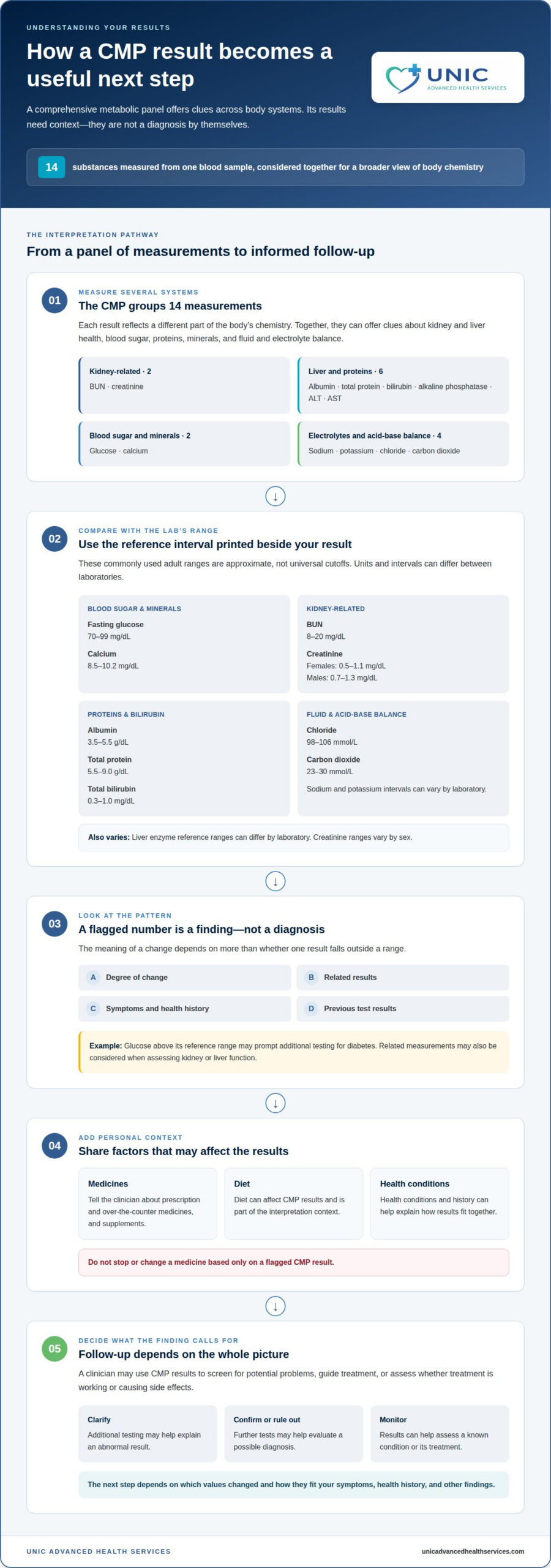
Yes. Certain medicines, diet, and health conditions can affect CMP results. Tell the clinician reviewing your test about prescription and over-the-counter medicines, as well as supplements. This context helps with interpretation and deciding whether follow-up is useful. Don’t stop or change a medicine based only on a flagged result.
Interpretation starts with the laboratory’s reference range beside each measurement. A value outside that range is a finding, not a diagnosis. An abnormal CMP result doesn’t necessarily mean you have a disease. The degree of change, related results, symptoms, health history, and previous tests can all shape its meaning.
Common adult reference ranges include:
- Fasting glucose: 70 to 99 mg/dL, according to the National Library of Medicine.
- Calcium: 8.5 to 10.2 mg/dL; albumin: 3.5 to 5.5 g/dL.
- BUN: 8 to 20 mg/dL; creatinine: 0.5 to 1.1 mg/dL for females and 0.7 to 1.3 mg/dL for males.
- Reference ranges for liver enzymes can vary by laboratory.
- Total bilirubin: 0.3 to 1.0 mg/dL; total protein: 5.5 to 9.0 g/dL.
- Sodium and potassium reference intervals can vary by laboratory.
- Chloride: 98 to 106 mmol/L; carbon dioxide: 23 to 30 mmol/L.
These are commonly used or approximate ranges, not universal cutoffs. Compare your result with the reference interval printed by the testing laboratory. Units and intervals can differ, and creatinine ranges vary by sex. A result within range also doesn’t rule out every disease or explain every symptom.
Consider the pattern, not just one number. For example, glucose above its reference range may prompt additional testing for diabetes. A clinician may also compare related measurements to assess kidney or liver function. Previous results can show whether a value is stable or changing.
A CMP may help screen for potential problems, guide treatment, or assess whether treatment is working or causing side effects. An out-of-range result may lead to additional tests to confirm or rule out a diagnosis. The next step depends on which values changed and how they fit your health history.
In the United States, CMP costs depend on the care and testing involved. Insurance coverage depends on your plan and the reason for testing. Review your plan’s benefits for details about coverage and potential costs.
What is a comprehensive metabolic panel (CMP)?
A CMP is a blood test that measures 14 substances to give a broad view of several body functions. The tests included are albumin, alkaline phosphatase, ALT, AST, BUN, calcium, carbon dioxide, chloride, creatinine, glucose, potassium, sodium, total bilirubin, and total protein.
What the Panel Measures
Each measurement reflects a different part of the body’s chemistry, including blood sugar, proteins, minerals, and waste products. Together, the results can help assess liver and kidney health, metabolism, and fluid and electrolyte balance. This broader view gives a clinician useful context when reviewing symptoms or monitoring a health concern.
The results are connected rather than independent. Albumin and total protein, for example, provide information about proteins in the blood, while creatinine and blood urea nitrogen relate to kidney function. Glucose measures blood sugar. No single measurement explains every symptom, but several results considered together can help guide further evaluation.
Tests Included in the Panel
A CMP combines 14 individual measurements in one ordered panel. The listed tests include albumin, alkaline phosphatase, alanine aminotransferase (ALT), aspartate aminotransferase (AST), blood urea nitrogen (BUN), calcium, carbon dioxide, chloride, creatinine, glucose, potassium, sodium, total bilirubin, and total protein.
A basic metabolic panel (BMP) includes 8 of the 14 CMP tests. Compared with a BMP, a CMP adds six liver enzyme and protein tests, providing additional information about liver-related measurements and blood proteins. That difference may matter when a clinician needs a broader set of results than the basic panel provides.
The 14 measurements fall into practical groups:
- Kidney-related measurements: BUN and creatinine.
- Liver and protein measurements: albumin, total protein, bilirubin, alkaline phosphatase, ALT, and AST.
- Blood sugar and minerals: glucose and calcium.
- Electrolytes and acid-base balance: sodium, potassium, chloride, and carbon dioxide.
These groupings help explain how a CMP can support assessment across several body systems. They don’t mean the panel directly measures every aspect of organ function. Instead, the measured substances offer clues that clinicians interpret alongside medical history, symptoms, and other findings.
A CMP may be ordered during a routine physical, to evaluate symptoms, or to monitor a known health condition or treatment. The reason for testing shapes which results receive closer attention. For example, glucose may be especially relevant when checking blood sugar, while kidney-related values may matter during ongoing monitoring.
Because the panel gathers multiple measurements from one blood sample, it offers a useful overview, not a standalone diagnosis. Its value comes from interpreting the results as a set, including how the liver, kidneys, proteins, and electrolytes relate to the reason for testing.
What do the results mean?
A CMP uses a blood sample drawn from a vein in your arm or hand. Most people don’t need to avoid food or drink unless their clinician gives fasting instructions. Some tests require fasting for several hours.
Preparation depends on why the test was ordered and which measurements need review. If fasting is requested, follow the specific instructions provided, including how long to avoid food and whether water is allowed. One set of instructions calls for fasting for 12 hours while allowing water, but fasting isn’t required for every CMP.
Fasting matters most when the clinician needs to interpret glucose in relation to recent food. The approximate adult reference range for fasting glucose is 70 to 99 mg/dL, according to the National Library of Medicine. A glucose result outside that range can prompt further evaluation, but it doesn’t establish diabetes on its own.
Use the laboratory’s printed reference intervals when reviewing results. “Normal” means a measurement falls within that lab’s stated range; “abnormal” means it falls outside. Reference ranges can vary between laboratories, so read a result alongside its unit, the relevant interval, and the reason for testing.
Albumin shows why context matters. A value outside the laboratory’s range is a finding to interpret alongside other CMP measurements and health information, not a diagnosis by itself. The same applies when one result is flagged but related measurements remain within range.
To understand the result, consider these points together:
- Preparation: Note whether you fasted and follow any specific instructions given for your test.
- Reference interval: Compare each result with the range printed beside it, including the measurement unit.
- Related values: Review connected findings, such as glucose and other measurements, as a pattern.
- Earlier blood tests: Compare previous results when available to see whether a value has changed.
An out-of-range result may lead to additional blood tests or other evaluation. For example, high blood glucose on a CMP may prompt further testing to confirm or rule out diabetes. A healthcare provider may also consider symptoms, medical history, and whether preparation could have affected the sample.
Fasting instructions support accurate interpretation. They aren’t a reason to change medicines or skip prescribed treatment on your own. Share relevant medicines and supplements with the clinician reviewing your CMP, and explain whether you followed the requested preparation. These details can help determine whether the result needs follow-up, repeat testing, or no immediate action.
Electrolytes and fluid balance
A CMP measures sodium, potassium, chloride, and carbon dioxide, which help assess electrolyte and acid-base balance. These results add context to other measurements, including creatinine.
Electrolyte and Mineral Levels
Electrolytes are minerals in the blood that support fluid balance and normal body function. CMP results show their measured levels, giving a provider information to interpret alongside other values and the reason for testing.
Common adult reference ranges include sodium at 136 to 145 mEq/L and potassium at 3.5 to 5.0 mEq/L. Chloride is commonly 98 to 106 mmol/L. These ranges provide a comparison point, not a diagnosis of a medical condition. The lab’s own reference intervals give the relevant context for each result.
Electrolytes work in relation to one another. For example, sodium and potassium results can be considered together when assessing the body’s fluid and mineral balance. A value outside its range is a reason to interpret the full CMP pattern, not a conclusion about the cause. Symptoms, medical history, and related measurements also inform that interpretation.
Fluid and Acid-Base Balance
Carbon dioxide on a CMP is reported as a measurement related to the body’s acid-base balance. Its commonly used reference range is 23 to 30 mmol/L. Alongside chloride and other electrolytes, this result helps a provider assess the chemical balance reflected in the blood sample.
A CMP doesn’t directly measure total body fluid. Instead, sodium, chloride, potassium, and carbon dioxide results offer information that can help frame questions about fluid and acid-base balance. Creatinine adds context about kidney function, which is relevant when interpreting electrolyte results together.
When a result falls outside its reference interval, its significance depends on the value and the surrounding pattern. For example, a provider can review whether one electrolyte is out of range or several related CMP measurements have changed together. That distinction helps guide decisions about whether further evaluation is appropriate.
In practical terms, CMP electrolyte and mineral measurements show the levels of sodium, potassium, chloride, calcium, and carbon dioxide. Together, they help assess fluid and acid-base balance, while the full set of results puts those measurements in context.
- Sodium: Commonly 136 to 145 mEq/L.
- Potassium: Commonly 3.5 to 5.0 mEq/L.
- Chloride: Commonly 98 to 106 mmol/L.
- Carbon dioxide: Commonly 23 to 30 mmol/L.
Calcium is also included in a CMP, with an approximate adult reference range of 8.5 to 10.2 mg/dL. A provider interprets calcium alongside the other measurements, rather than treating one mineral result as a complete account of health.
Conditions a CMP may help identify
A common question is, “What does a comprehensive metabolic panel show?” It can reveal patterns that prompt evaluation for diabetes, kidney disease, liver disease, or other health concerns. The panel doesn’t diagnose these conditions by itself. A care provider interprets its findings alongside symptoms, medical history, and other clinical information.
Blood sugar and diabetes: Glucose is the CMP measurement most directly related to blood sugar. A high result may prompt additional testing to confirm or rule out diabetes. Fasting status, the laboratory’s reference range, and the reason for testing all shape how a care provider interprets the finding.
Kidney health: Blood urea nitrogen and creatinine provide clues about kidney function. Results outside their reference ranges may lead a provider to consider related measurements, symptoms, medical history, and earlier test results. These findings can support an evaluation for kidney disease, but they don’t establish its cause on their own.
Liver health: ALT, AST, alkaline phosphatase, and bilirubin are considered when evaluating liver-related concerns. A change in one measurement may lead a provider to review the others for a broader pattern. The results, symptoms, and health history help determine whether further evaluation is appropriate.
Electrolyte and protein concerns: Sodium, potassium, chloride, and carbon dioxide provide information about electrolyte and acid-base balance. Albumin and total protein add information about proteins in the blood. When one or more values fall outside their reference ranges, a provider considers the complete set rather than treating an isolated result as proof of a medical condition.
A CMP may also be used during routine physicals or to monitor existing conditions and treatment. Comparing current results with previous measurements can show whether a finding is stable or changing. That comparison may help a care provider decide whether additional tests or a treatment review could be useful.
The panel has limits. It measures substances in blood, not red blood cells, so it doesn’t provide a red blood cell count or replace a complete blood count. For anyone asking, “What does a comprehensive metabolic panel show?”, the key is that results can point to issues for evaluation but cannot identify every cause of symptoms or provide a diagnosis on their own.
If you’re managing diabetes, hypertension, obesity, or another ongoing concern, chronic condition management can support continued attention to your health needs. Explore chronic condition management to learn about ongoing care.
Unic Advanced Health Services
Unic Advanced Health Services helps patients connect lab findings with broader health needs through primary care, preventive care, and chronic condition management in Fort Lauderdale. If a CMP result raises questions about blood sugar, kidney function, or liver measurements, a healthcare provider can consider those findings alongside symptoms, health history, and ongoing conditions.
For people managing conditions such as diabetes or hypertension, chronic condition management can support ongoing attention to health needs. Annual physicals and preventive care also provide an opportunity to discuss screening and test results in the context of overall health. Telehealth services offer another way to discuss care needs.
Contact Unic Advanced Health Services to discuss your health questions and next steps.
Make your results part of a broader care plan
Understanding what a comprehensive metabolic panel shows is a starting point, not the whole conversation. Your results become more useful when considered alongside your health goals, current medicines, and ongoing conditions. Bring your questions and relevant lab information to a clinical discussion to focus on what the findings mean for your care.
Unic Advanced Health Services supports patients through chronic condition management, annual physicals and preventive care, as well as DOT Physical Examinations and U.S. Coast Guard Boat Captain Physicals. The right next step depends on the reason for your test and the care you need.
If you’d like to discuss your health needs, contact Unic Advanced Health Services. A thoughtful conversation can help you move forward with greater clarity and confidence.
Frequently Asked Questions
What happens during a CMP?
A clinician or lab professional collects a blood sample from a vein, usually in your arm or hand. They clean the area, place a band around your upper arm, insert a small needle, and collect blood into a tube. You may feel a brief pinch. Afterward, pressure and a small bandage help protect the site. Tenderness or bruising usually clears within a few days to a week.
Will I need to do anything to prepare for the test?
Preparation depends on your clinician’s instructions and the reason for testing. Some CMPs require fasting for several hours, while others don’t. If you’re told to fast, clarify the start time and whether water is allowed. Don’t stop prescribed medicines unless your clinician directs you to. Mention supplements or recent changes in your routine, as these details can help interpret your results.
Are there any risks to the test?
A CMP uses a routine blood draw, so the main effects are usually brief discomfort, tenderness, or bruising where the needle entered. Bruising or tenderness generally clears within a few days to a week. If you’ve previously felt faint during blood tests, tell the person collecting your sample before the draw. They can take that history into account as they prepare to collect the sample.
What other names does the CMP go by?
CMP is the common abbreviation for comprehensive metabolic panel. You may also see the test described generally as a metabolic blood panel, but the exact label can vary across lab reports and medical records. Check the listed components if you’re comparing orders: a CMP refers to a panel of measurements, not one individual test such as glucose or creatinine.
Does the CMP include eGFR?
Creatinine is one of the measurements in a CMP, while eGFR is not one of the panel’s 14 named substances. A lab report may show eGFR as a separate calculated result alongside creatinine. If your report includes both, consider them together with the laboratory’s units and reference information. Your clinician can explain how the results relate to your kidney assessment.
Does the CMP test for diabetes?
A CMP measures glucose, so an elevated result can raise a question about diabetes. The panel alone doesn’t confirm the condition; additional testing may be needed to confirm or rule out a diagnosis. A clinician may interpret the glucose result alongside fasting status, symptoms, and other clinical information before deciding what follow-up is appropriate.
How do you get ready for this test?
Follow the preparation instructions provided for your appointment. If fasting is required, confirm how long to fast and whether you may drink water. Keep taking prescribed medicines unless your clinician tells you otherwise. Before the blood draw, share a current list of medicines and supplements and mention whether you followed the fasting instructions. These details can help explain the result.
What do CMP results measure about kidney and liver function?
For kidney assessment, a CMP includes blood urea nitrogen and creatinine. Liver-related measurements include ALT, AST, alkaline phosphatase, and bilirubin. These results provide clues rather than a complete measure of organ function. A clinician may consider whether several related liver results changed together and compare kidney measurements with earlier results before deciding whether further evaluation is needed.