
A respectful doctor makes space for you to speak openly and takes your preferences seriously. Knowing how to find a non-judgmental doctor starts with looking for privacy, attentive listening, compassionate communication, and shared decision-making.
It’s reasonable to want care without blame, especially when discussing sensitive concerns or choices that affect your health. You should be able to ask questions, explain what matters to you, and understand the reasoning behind a recommendation.
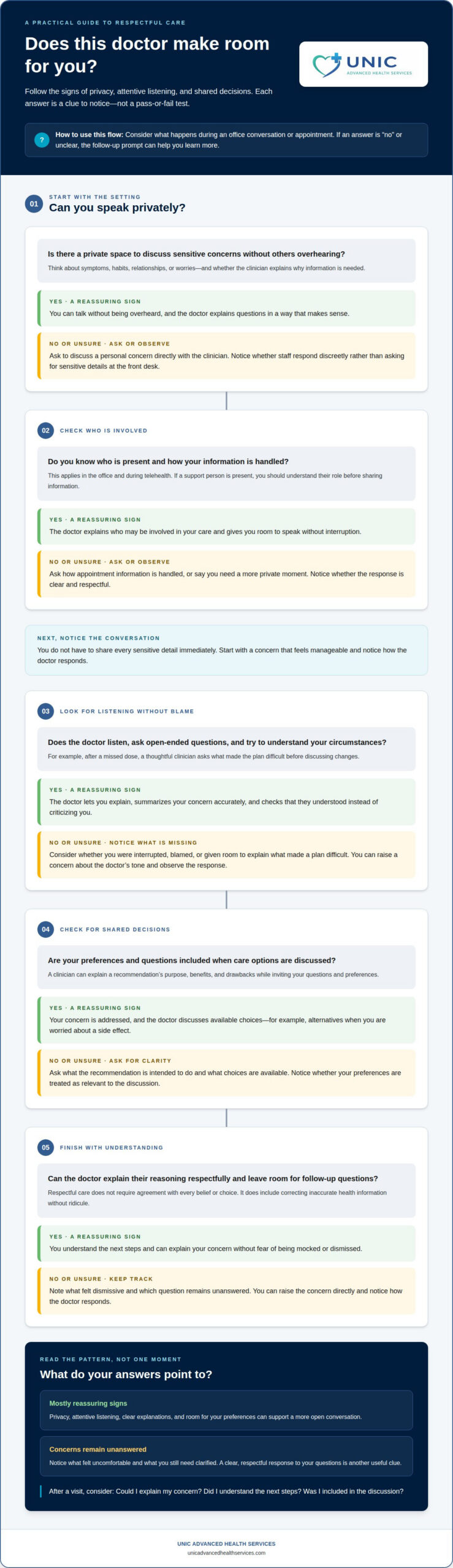
This guide explains how to find a non-judgmental doctor by assessing privacy and communication, and noticing whether your choices are respected. These signs can help you approach care with greater confidence and build a more open partnership with your doctor.
Key Takeaways
- Look for a care setting where sensitive concerns can be discussed privately and confidentiality is treated with care.
- Notice whether the doctor listens without blame, asks open-ended questions, and explains recommendations clearly.
- Assess whether a provider makes room for your preferences and includes you in decisions about your care.
- Use review patterns and a conversation with the office to get a clearer sense of its communication style before booking.
- Explore Unic Advanced Health Services for primary care support, chronic condition management, or telehealth services.
1. Confidentiality and privacy
Privacy affects whether you can describe symptoms, habits, relationships, or worries accurately. A doctor should provide a private space to discuss sensitive issues and help protect confidentiality. The room should allow you to talk without others overhearing personal details. If a staff member or support person is present, you should understand their role before sharing information.
That privacy matters because people may hesitate to share details with their doctors. Someone might avoid mentioning alcohol use, missed medication, sexual health, or a change in mood. A non-judgmental appointment can make it easier to raise these details without expecting blame. When information stays unspoken, the doctor may not understand the full concern or the choices affecting your care.
Notice how the office handles conversations from the moment you arrive. A receptionist may need basic information, but sensitive details deserve a more private conversation. For example, you could ask to discuss a personal concern directly with the clinician rather than at the front desk. The response can show whether staff distinguish routine logistics from confidential health discussions.
Ask the doctor how information from your appointment is handled and who may be involved in your care. You can also ask how to raise a concern privately if someone accompanies you. A clear answer should explain the office’s process in plain language, without making you feel unreasonable for asking. Notice whether the doctor listens and answers your specific concern.
Privacy matters during telehealth appointments, too. Before discussing a sensitive subject, clarify who is participating and whether you can speak without interruption. If someone nearby makes it difficult to talk, tell the clinician you need a more private moment. A respectful response helps you stay in control of what you share and when.
Look for consistent practices, not just reassuring words. Does the clinician avoid discussing personal details where others can hear? Do staff respond discreetly when you request a private conversation? Does the doctor explain why information is needed before asking follow-up questions? These moments offer practical clues about how confidentiality is handled in everyday care.
Use your first appointment to assess whether you can speak openly. You don’t have to share every sensitive detail immediately; start with a concern that feels manageable. A doctor who listens without pressing for unnecessary disclosure gives you room to build trust. If privacy concerns remain unanswered, note what feels uncomfortable before deciding whether the relationship supports honest care.
2. Empathetic communication
Empathy shows in how a doctor responds when your experience differs from their assumptions. For example, after you describe a missed dose, a thoughtful clinician asks what made the plan difficult. They explore practical barriers before discussing changes. A blaming response, such as calling you careless, can make it harder to explain what happened or consider next steps together.
One practical way to find a non-judgmental doctor is to notice whether the clinician asks open-ended questions. “What concerns you most about this plan?” gives you room to explain your priorities. If a doctor asks about diet, for instance, they can acknowledge that changes are difficult and ask what feels realistic. That exchange treats your circumstances as relevant, not as grounds for criticism.
Notice whether the clinician listens without interrupting, summarizes your concern accurately, and checks that they understood. If you say a medication routine conflicts with work, a helpful response explores your schedule instead of simply repeating instructions. You can then see whether the doctor adapts the discussion to your circumstances and explains the available choices.
Respect also means keeping you involved in treatment decisions. A clinician can recommend an option and explain its purpose, benefits, and drawbacks while inviting your questions and preferences. For example, you might say you’re concerned about a side effect. Notice whether the doctor addresses that concern and discusses alternatives, rather than treating agreement as the only acceptable response.
Good communication doesn’t require a doctor to endorse every belief or choice. The clinician can correct inaccurate health information respectfully, explain the reasoning behind a recommendation, and welcome follow-up questions. If you mention something you read online, notice whether the doctor asks what you found and helps distinguish reliable guidance from unsupported claims.
After a visit, consider whether you could explain your concern without fear of ridicule and whether you understood the next steps. To assess how to find a non-judgmental doctor, note one moment that felt respectful and one question that remained unanswered. If the doctor’s tone feels dismissive, you can raise that concern directly and observe the response.
Compassionate communication lets doctors offer guidance without blame or criticism. Listening attentively, asking open-ended questions, and showing empathy are useful signs to notice throughout your conversations, not only when discussing a difficult choice. A doctor should focus on understanding and education so you can share your beliefs without fear of being penalized. That approach gives the clinician room to understand the perspective behind a belief and respond with information while keeping the exchange respectful. Notice whether the doctor’s questions help you explain what matters and whether the response aims to understand rather than judge.
Studies in patient-centered care indicate that effective communication and understanding a patient’s perspective can improve health outcomes and patient satisfaction. Empathy is not simply a fixed personal quality: educational interventions have shown that empathy can be taught to doctors. Practicing perspective taking can also increase empathy and patient satisfaction. These findings offer another way to assess a visit: consider whether the doctor tries to see the situation from your point of view, explains guidance in an educational way, and treats your perspective as something worth understanding. A respectful exchange can include disagreement, provided that compassion and learning remain part of the conversation.
Where can I find doctors who provide affirming, inclusive care near me, and what should I look for in a provider?
In Fort Lauderdale, start with your health plan’s provider directory and search for primary care. Try terms such as “LGBTQ+-affirming,” “culturally responsive,” or “weight-inclusive” alongside the location. These phrases can narrow your search, but a directory label alone doesn’t show how a clinician communicates during an appointment.
Community health organizations and local support groups can offer another route to provider names. Their recommendations may point you toward clinicians familiar with specific communities or concerns. Treat a recommendation as a starting point, then review the provider’s stated approach and areas of care. A good match should address both your health needs and your expectations for respectful treatment.
Look beyond broad claims such as “patient-centered” on a clinic profile. More useful details explain how care is delivered. For example, a provider might describe how staff use a patient’s stated name, discuss health goals without assumptions, or adapt conversations to cultural preferences. Specific practices give you a clearer picture than a general promise of inclusivity.
Consider whether the provider’s clinical focus matches the reason you need care. Someone seeking support for a chronic condition may value ongoing follow-up and collaborative planning. A person arranging preventive care may prioritize clear explanations and time to discuss personal concerns. The right fit combines relevant expertise with communication that respects your priorities.
Check how the practice describes patient participation. Language about shared decisions, individualized goals, and questions suggests your perspective has a place in care planning. For instance, a clinician discussing weight-related health may focus on your specific concerns instead of assuming weight explains every symptom. That distinction can help you recognize a more respectful approach.
Provider profiles can also show whether a doctor works with the communities they serve. Look for relevant training, clinical interests, or experience described in concrete terms. A profile that names inclusive care practices offers more useful context than a label alone. Still, the first appointment is your opportunity to see whether the doctor’s actions match those words.
As you compare options in Fort Lauderdale, be specific about your priorities. You might want a clinician who respects your identity, considers cultural context, or discusses health goals without stigma. A short list of these needs can help you evaluate profiles consistently and identify providers whose approach appears aligned.
Choose a provider whose services fit your concern and whose approach makes room for your perspective. If a profile leaves an important question unanswered, note it for your conversation with the office. This keeps your search focused on both practical care needs and the respect you expect.
How can doctor review sites help me assess a provider’s bedside manner and respect?
Doctor reviews can reveal communication patterns that a provider profile may not describe. Search for the clinician’s name on Google, Healthgrades, or Zocdoc, then read individual comments instead of relying on an overall rating. Reviewers sometimes describe whether a doctor listened, explained a diagnosis, or treated a concern respectfully. Those details are more useful than a general statement that the visit was good.
Look for recurring examples across reviews. One person might mention feeling rushed, while others describe careful explanations and follow-up questions. A pattern offers more context than a single strong complaint or glowing account. For example, several reviews describing interruptions may be worth noting before an appointment. Repeated comments about clear explanations may help you identify a communication style that suits you.
Search review text for terms related to your priorities. Words such as “listened,” “respectful,” “judgmental,” “dismissive,” and “explained” can surface relevant experiences. If inclusive care matters, look for comments about how the clinician handled names, pronouns, cultural concerns, or sensitive health topics. A review describing a real interaction offers more insight than a broad label.
Compare reviewers’ comments with the provider’s stated clinical focus. Someone managing a long-term condition might look for details about practical treatment options. A person seeking preventive care might value comments about whether questions were welcomed. This comparison helps you judge whether feedback relates to the kind of appointment you need, rather than a different service or concern.
Read positive and critical reviews carefully. A negative account can point to an issue, but it reflects one person’s experience and may omit context. A positive review may also be too general to show how the clinician responds to disagreement or sensitive topics. Give more weight to specific descriptions of what happened than to conclusions such as “best doctor” or “terrible visit.”
Notice when a review was written and whether newer comments describe a similar experience. Staff, appointment processes, and clinical practices can change over time. Recent feedback adds context, but it cannot predict exactly how your visit will go. Reviews work best as one source of perspective, alongside the provider’s own information and your conversation with the office.
Use reviews to create a practical checklist for your first appointment. You might note whether patients felt heard, received understandable explanations, and had their preferences considered. If reviews repeatedly mention rushed visits, prepare a concise description of your main concern. If comments praise clear discussions, bring the questions you want answered. Look for themes, not a guarantee in online ratings.
Compare review patterns across platforms instead of letting one rating decide. The same provider can receive different feedback from patients with different needs and expectations. Use comments to identify questions worth raising, then assess the clinician’s communication during care. This turns reviews into useful context while keeping your decision grounded in your own experience.
What can a doctor’s office tell me about its approach to sensitive topics before I book?
A brief call or message can show how an office responds before an appointment. You don’t need to share personal details with reception. Describe the general support you’re seeking, such as discussing a mental health concern, identity-related care, or a difficult health habit. Then ask how the clinician handles those conversations.
Ask directly: “How does the clinician help patients discuss sensitive concerns without feeling blamed?” The answer might describe listening, respectful language, or collaborative care. Notice whether the staff member responds clearly or offers only a general phrase such as “we treat everyone well.” A concrete explanation gives you more to consider.
You can also ask how the doctor approaches a topic relevant to your needs. For example: “If a patient is worried about weight-related comments, how does the clinician discuss health goals?” Or, “How does the practice support patients who want their name and pronouns used consistently?” These questions focus on care practices rather than asking staff to judge a hypothetical patient.
If you have a cultural or language preference, ask how the appointment can accommodate it. You might say, “I want to make sure my health choices are understood in their cultural context. How does the clinician approach that?” The response can help clarify whether the practice recognizes that personal background may shape health priorities and treatment decisions.
Ask who will be present during the appointment and how sensitive questions are handled. For instance, you could ask whether you can speak directly with the clinician about a personal concern. The office’s answer may clarify how to raise the subject and whether the appointment format supports a focused conversation.
Keep questions focused on observable actions. “Will the doctor explain recommendations and discuss my preferences?” is more useful than asking whether the doctor is “nice.” You can also ask what happens if you disagree with a recommendation. An answer that describes listening, explanation, and discussion offers a clearer picture of the conversation to expect.
Pay attention to the manner of the reply as well as its content. Does the staff member let you finish, answer without making assumptions, and explain what the clinician can discuss? A rushed or vague answer doesn’t establish how the doctor will behave, but it can help you decide what to clarify before scheduling.
Before you call, choose a priority and prepare a short question. You can keep details private until you speak with the clinician. Afterward, note whether the answer addressed your concern and whether you felt comfortable continuing the conversation. That check gives you a practical basis for deciding whether to book.
Unic Advanced Health Services
If you’re looking for primary care in Fort Lauderdale that makes room to discuss your health concerns and preferences, Unic Advanced Health Services offers primary care and Chronic Condition Management. Telehealth Services are also available as an option. The clinic provides DOT Physical Examinations and U.S. Coast Guard (USCG) Boat Captain Physicals as separate occupational services.
Before an appointment, consider what you want the clinician to understand, such as a concern about treatment options or a health goal. Sharing that priority can help focus the conversation. Contact Unic Advanced Health Services to discuss your care needs.
Make your next care conversation count
Choosing a doctor is not a one-time decision. Your health needs and priorities can change, so you can reassess whether the relationship still feels right. Before your next appointment, identify what you want from the conversation, such as discussing a concern openly or understanding the options before making a decision.
Knowing how to find a non-judgmental doctor can help you approach that conversation with clearer expectations. You can share what matters to you, ask questions, and notice whether the discussion supports your participation. A respectful partnership develops through the care you experience, not simply through a profile or rating.
If you’re considering primary care or ongoing support for a chronic condition, Unic Advanced Health Services may be a next step. Contact Unic Advanced Health Services to discuss your care needs. You deserve to feel heard as you make decisions about your health.
Frequently Asked Questions
How can I tell if a doctor is nonjudgmental and respectful?
Notice how the doctor responds when you correct a misunderstanding or clarify a goal. For example, if you explain that your priority is managing energy rather than changing weight, a respectful clinician adjusts the discussion instead of insisting on an assumed goal. They should also make sure you understand the plan and leave room for questions. You can assess respect through these interactions, not just a friendly manner.
What are signs a doctor is dismissive or judgmental during an appointment?
Repeated interruptions, mocking comments, or labels applied without asking about your circumstances can signal disrespect. So can pressure to accept a plan without an explanation or a chance to voice your concerns. If this happens, you might say, “I don’t feel we’ve addressed my concern. Can we return to it?” The doctor’s response can help you decide whether the conversation can improve or whether you’d prefer another care relationship.