
What if your next primary-care visit connected your health goals, ongoing conditions, and preventive care instead of treating each as a separate concern? A personalized healthcare plan Fort Lauderdale patients can use starts with a practical conversation about health history, priorities, and the care that makes sense now and over time. It’s reasonable to want attentive care, not a generic checklist, and to understand how follow-up can fit into your routine.
This article explains what an individualized plan may include and how a primary-care clinician can tailor care to your needs. You’ll learn how annual physicals, preventive screenings, on-site lab services, and chronic condition management for concerns such as diabetes, hypertension, or obesity can work together. We’ll also cover how telehealth may support care and follow-up when an in-person visit isn’t the right fit.
At Unic Advanced Health Services in Fort Lauderdale, primary care is led by nurse practitioner Marc Joseph, with in-person and telehealth services for local patients. Understanding the options can help you identify a useful next step and build a more connected relationship with your primary-care provider.
Key Takeaways
- A clinical care plan connects your health history, priorities, and needs. It’s different from an insurance policy, which explains coverage and costs.
- A personalized healthcare plan Fort Lauderdale patients discuss with a clinician can bring preventive care, ongoing condition management, and follow-up into one approach.
- Consider your preventive-care needs, condition-management priorities, and convenience when discussing whether an in-person or telehealth visit may suit you.
- Prepare for a visit by identifying your main priorities, gathering relevant medical records, and noting your medications and questions.
- Unic Advanced Health Services’ primary care, preventive services, chronic condition management, and telehealth can support an individualized care conversation.
What Does a Personalized Healthcare Plan Mean in Fort Lauderdale?
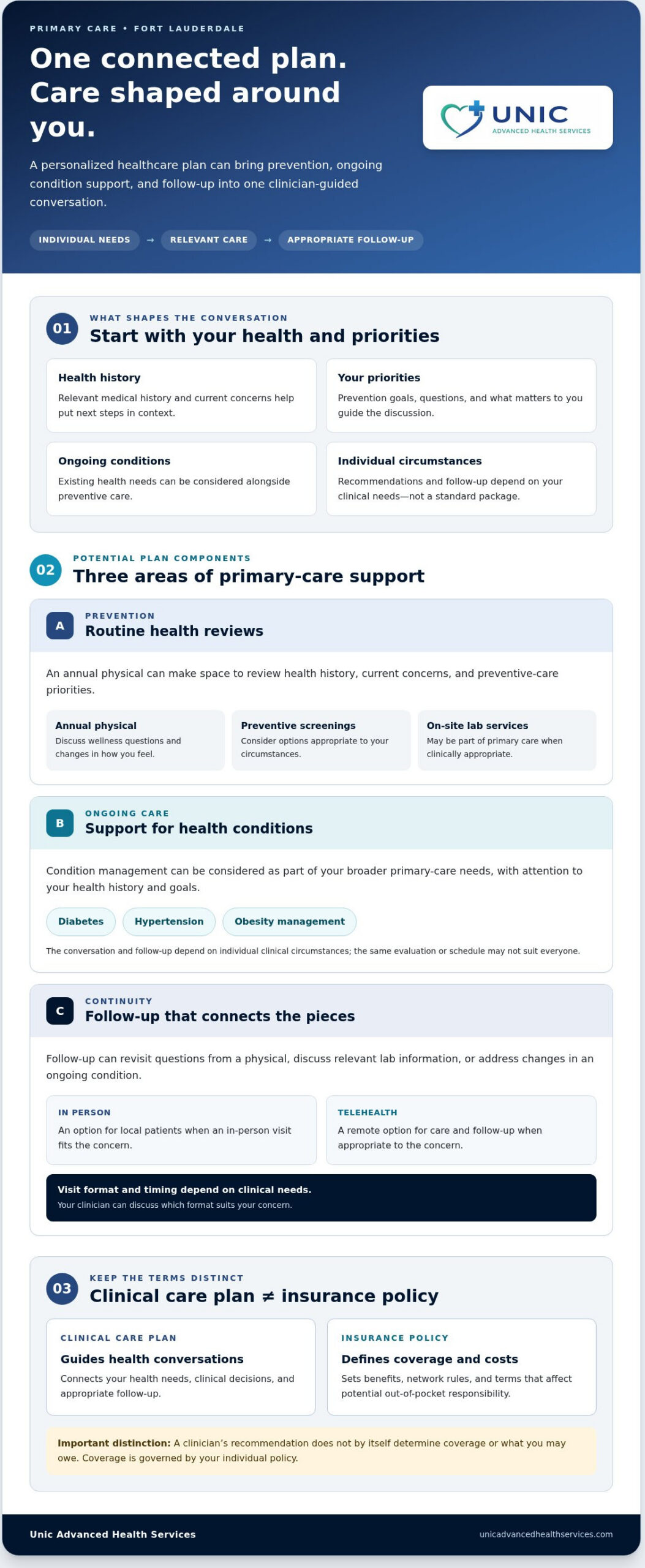
A personalized healthcare plan is a clinician-guided approach that connects your health history, current concerns, and priorities with appropriate care and follow-up. A personalized healthcare plan Fort Lauderdale residents discuss with a primary-care provider is about clinical decisions, not a health insurance product. The plan may focus on preventive goals, an existing condition, or a visit format that fits the circumstances.
A clinical care plan guides health conversations and follow-up; an insurance policy defines coverage, network rules, and potential costs. Keeping the two meanings separate helps you understand what your clinician is addressing and what your policy may pay for. The broader concept of personalized medicine also considers how care can be informed by an individual’s characteristics and health needs.
For a separate perspective on insurance coverage, you can watch this video:
What makes a primary-care plan personal?
Personal planning starts with understanding what matters to you. A clinician may consider your reported concerns, relevant medical history, current health priorities, and any ongoing conditions when discussing next steps. Someone focused on prevention may have different questions from someone seeking continued support for a diagnosed condition. The conversation puts those priorities in context rather than assuming every patient needs the same evaluation.
Recommendations depend on individual clinical circumstances. An evaluation, screening, or follow-up schedule that is appropriate for one person may not suit another. The clinician can explain the reasoning behind recommendations and discuss how primary care, preventive services, or chronic condition management relate to your needs. A plan guides the care relationship; it does not promise a particular test, treatment, or result.
Healthcare plan versus health insurance plan
The phrase “healthcare plan” can mean two different things. A clinical plan concerns your health: the issues discussed with a clinician, decisions made in light of your circumstances, and appropriate follow-up. An insurance plan concerns benefits and payment, including covered services, participating networks, and terms that affect your out-of-pocket responsibility.
These areas can intersect, but one doesn’t replace the other. A clinician’s recommendation does not by itself determine whether a service is covered or what you may owe. Review your policy documents or insurer resources for benefits, network details, and cost-sharing terms. Unic Advanced Health Services provides primary care, preventive care, chronic condition management, and telehealth; insurance coverage is governed by the terms of your individual policy.
What Can a Personalized Healthcare Plan Include?
A care plan can connect different primary-care needs: preventing health concerns where possible, managing conditions that need ongoing attention, and deciding what follow-up is appropriate. For someone considering a personalized healthcare plan Fort Lauderdale, the goal isn’t to add every service at once. It’s to focus on relevant priorities and adjust the discussion as health needs change.
Preventive care and routine health reviews
An annual physical gives you and your clinician time to review current concerns, health history, and preventive-care priorities. You might discuss changes in how you feel, questions about wellness, or whether a preventive screening is appropriate for your circumstances. Screening choices are individual, so a visit doesn’t mean every patient will receive the same tests. The clinician can consider your needs and explain which options may make sense.
Preventive screenings and on-site lab services can be part of primary care when clinically appropriate. Their role depends on the reason for the evaluation and the clinician’s judgment, rather than a standard package for everyone. Preparing questions in advance can help you use the visit well. For a closer look at what a routine review may involve, explore this annual physical exam guide.
Support for ongoing health conditions
People managing diabetes or hypertension may need continuing primary-care attention alongside preventive health discussions. A clinician can review concerns and health history, discuss the condition as part of overall care, and determine appropriate follow-up. Details vary by patient. A plan should reflect individual clinical circumstances, not assume the same evaluation or schedule is right for everyone.
Obesity management is another area of chronic condition care. A respectful conversation can bring your goals and health priorities into the discussion without assuming a particular approach or promising a specific result. Learn more about obesity management care as part of primary care.
Follow-up that connects the pieces
Preventive care and condition management don’t have to be treated as unrelated topics. A follow-up conversation can revisit questions raised at an annual physical, discuss relevant lab information, or address changes in an ongoing condition. Timing and format depend on clinical needs. Unic Advanced Health Services provides primary care and telehealth for Fort Lauderdale patients, with in-person and remote options. Your clinician can discuss which format suits your concern.
Keeping a short list of questions and noting changes since your last visit can help keep follow-up focused. To discuss how preventive care and ongoing condition management may fit your needs, explore primary care with Unic Advanced Health Services.
How to Decide Which Care Approach Fits Your Needs
The right primary-care approach depends on what you want to address, whether you have ongoing health concerns, and what format is practical for the visit. A personalized healthcare plan Fort Lauderdale patients develop with a clinician can account for these factors without assuming every concern calls for the same services or schedule. Use the guide below to frame a conversation, not to diagnose yourself or decide which evaluation you need.
| Your current need | Care topic to discuss | Possible visit format |
|---|---|---|
| Routine preventive review | Annual physicals, preventive priorities, and questions about screening | In-person or telehealth, depending on the purpose of the visit |
| Ongoing condition or recurring concern | Condition management, changes in your health, and appropriate follow-up | In-person or telehealth, as clinically suitable |
| Convenience is a priority | Whether your concern can be addressed remotely or needs an in-person assessment | Telehealth may be an option for appropriate concerns |
When ongoing primary care may be useful
Ongoing primary care may be useful if a concern returns, you’re managing a chronic condition, or you have several health priorities to discuss over time. A continuing care relationship can keep those topics connected: you can revisit concerns, discuss changes, and consider next steps in context. Appropriate services and visit timing depend on your circumstances, not a fixed schedule for everyone.
For example, if you have a recurring concern and a separate preventive-care question, raise both during a primary-care conversation. The clinician can help clarify which topics need attention and whether follow-up is appropriate. That’s a more useful starting point than choosing services from a generic checklist.
When telehealth may suit the visit
Telehealth can be a convenient format for appropriate primary-care concerns, particularly when a conversation can take place remotely. It isn’t suitable for every evaluation. Some concerns may require an in-person assessment or diagnostic services, such as on-site labs, so the right format depends on the issue and the clinician’s judgment. Describe your concern clearly so the visit approach can be considered in context.
Unic Advanced Health Services offers primary care and telehealth in Fort Lauderdale. Learn more about the process and what a remote primary-care visit may involve in this Fort Lauderdale telehealth guide. To discuss a care approach that reflects your health priorities, explore primary care at Unic Advanced Health Services.
How to Prepare for a Personalized Healthcare Visit
A little preparation can help you make the most of a primary-care visit without turning it into a paperwork project. Before discussing a personalized healthcare plan Fort Lauderdale patients can use to organize their care, take a few minutes to identify what you want addressed. You don’t need every answer or record ready. Clear priorities give the clinician a practical place to begin.
- Identify your main priorities. Note the health concern or goal you most want to discuss. This might be a recurring symptom, a question about prevention, or support for an ongoing condition. If you have several priorities, put the most pressing one first so it doesn’t get lost in the conversation.
- Gather useful health information. If available, bring relevant medical records or prior test results, a list of current medications and doses, and details of any known allergies. You can also note relevant medical history, such as past diagnoses or care that may help explain your current concern.
- Write down questions and changes. Record symptoms you’ve noticed, including when they began or what seems to affect them. Add health goals and questions you want answered. A written list can be helpful if you feel unsure what to cover once the visit begins.
Information to bring to the appointment
A concise summary is often easier to use than trying to recall every detail during the visit. Include current medication information, known allergies, relevant medical history, and test results you already have. If you don’t have a particular document, focus on sharing what you know. The conversation can start with your concerns and priorities, then develop as the clinician reviews your circumstances.
Questions to discuss with the clinician
Use your list to guide a focused discussion. You might ask:
- Which preventive-care or screening priorities are relevant to my circumstances?
- What should we discuss about managing my ongoing health concerns?
- What follow-up may be appropriate, and how will we decide when to revisit my concerns?
- Could this concern be addressed by telehealth, or would an in-person visit be more suitable?
These questions help clarify the reasoning behind next steps without presuming which service or visit format you need. The clinician can consider your history and current concerns before discussing appropriate evaluations and follow-up. For questions about visit fees, contact the clinic. For coverage and personal out-of-pocket responsibilities, review your insurance policy or contact your insurer.
Preparing can make it easier to explain what matters to you and understand the options discussed. Schedule a primary-care visit with Unic Advanced Health Services to discuss your health priorities.
Build Your Personalized Healthcare Plan with Unic Advanced Health Services
A useful primary-care plan starts with your health priorities and a conversation about what support may fit them. At Unic Advanced Health Services in Fort Lauderdale, care includes annual physicals and preventive services, chronic condition management, on-site lab services, and telehealth. These options can bring routine health reviews and ongoing care into the same primary-care relationship.
Care is led by Marc Joseph, an experienced autonomous nurse practitioner. Share what you want to focus on, relevant health history, and questions about appropriate next steps. Recommendations depend on your needs and clinical evaluation, rather than a fixed package of services for every patient.
What patients can discuss with the care team
Bring the topics that matter to you, whether that’s preventive care, a condition that needs continuing attention, or questions about accessing care. For example, you might discuss an annual physical alongside a concern about managing diabetes or hypertension. The clinician can review the context, talk through relevant options, and explain whether follow-up or further evaluation may be appropriate.
Visit format can also be part of the conversation. Telehealth offers a remote option for appropriate primary-care concerns, while some needs may call for an in-person assessment or diagnostic services. Your care team can consider the concern and your circumstances when discussing a suitable format. You don’t need to arrive with a complete plan already in mind; identifying your priorities is a helpful first step.
Take the next step in Fort Lauderdale
Unic Advanced Health Services provides primary care and telehealth in Fort Lauderdale and nearby communities. The practice’s office hours are Monday through Saturday. This local setting gives patients a place to discuss preventive priorities, ongoing conditions, and follow-up with a primary-care clinician rather than treating each question as an unrelated task.
Before your visit, consider what you want help addressing and bring medication details or relevant health records if available. You can also note questions about follow-up and whether an in-person or virtual visit may suit your concern. These simple steps can help keep the conversation focused while leaving room for the clinician to guide recommendations based on your health needs.
If you’re ready to discuss a personalized healthcare plan Fort Lauderdale care can support, take the next step with Unic Advanced Health Services primary care. Start with your priorities and discuss appropriate care options and a practical way to follow up.
Make Your Next Health Conversation Count
Your next step doesn’t need to be a complete care strategy. Start with one priority you want to address, then use the visit to discuss how it fits your broader health needs. That first conversation can help turn questions into clear, appropriate next steps.
For a personalized healthcare plan Fort Lauderdale patients can discuss with a clinician, Unic Advanced Health Services offers primary care and telehealth for the local community. Care led by experienced autonomous nurse practitioner Marc Joseph includes support for chronic conditions, preventive care, and on-site lab services. The focus is a thoughtful discussion of your circumstances, not a one-size-fits-all checklist.
Bring your questions and share what matters most to you. Explore primary care with Unic Advanced Health Services and take a considered next step toward care that reflects your needs.
Frequently Asked Questions
What is a personalized healthcare plan?
A personalized healthcare plan is a clinician-guided way to organize care around an individual’s health situation and priorities. Someone who wants to review general wellness may need a different conversation from someone with a recent change in a chronic condition. The plan can connect those concerns with appropriate clinical next steps. It isn’t a fixed checklist, and recommendations depend on the person’s circumstances and the clinician’s assessment.
Is a personalized healthcare plan the same as health insurance?
No. A clinical plan concerns health priorities, care discussions, and follow-up, while health insurance describes benefits, network rules, and financial responsibility under a policy. A clinician may recommend discussing a screening, for example, but your insurance policy determines its coverage terms and any cost-sharing. Check your policy documents or insurer resources for those details. A personalized healthcare plan Fort Lauderdale patients discuss with a clinician is not an insurance policy.
Can a primary-care provider create a plan for diabetes or hypertension?
Yes. A primary-care provider can discuss ongoing management for diabetes or hypertension and consider the patient’s history, current concerns, and health priorities. Bring questions about how a condition fits with your other care goals or share changes you’ve noticed since a prior visit. The clinician can use that context to discuss appropriate evaluation and follow-up. Recommendations are individual and aren’t a substitute for urgent assessment when needed.
How does telehealth fit into a personalized healthcare plan?
Telehealth can be one way to have an appropriate primary-care conversation without attending in person. It may suit a visit focused on discussing a concern or reviewing questions, while an examination or diagnostic service may call for an in-person appointment. The clinician determines whether the format is suitable based on the issue. Fort Lauderdale patients can discuss telehealth as one option within their care, rather than assuming every visit can be remote.
What should I bring to a healthcare planning appointment?
Bring information that helps explain your current health picture, such as medication names and doses, known allergies, relevant records, or prior test results you have available. A brief note about when a concern began and how it has changed can also make the discussion more specific. If you don’t have every document, share what you know and what you’d like help understanding. Missing paperwork doesn’t need to stop you from raising your concerns.
Are on-site lab services part of a personalized healthcare plan?
They can be relevant when lab work is appropriate to the clinical question, but they aren’t automatically needed for every patient or visit. If a clinician determines that laboratory information could help assess a concern, on-site lab services may support the broader care discussion. The type and timing of any testing depend on individual circumstances and clinical judgment. Ask what a recommended test is intended to clarify and how results will be discussed.
How do I start primary care with Unic Advanced Health Services in Fort Lauderdale?
Start by identifying the concern or health goal you want to discuss, then contact Unic Advanced Health Services about beginning primary care. The practice provides care in Fort Lauderdale and surrounding communities, led by experienced autonomous nurse practitioner Marc Joseph. You can discuss whether an in-person or telehealth visit may suit your concern and share relevant health information. The care team can guide the conversation toward appropriate next steps for your circumstances.