
What if an out-of-range liver result is a clue, not a diagnosis? If you’re wondering what does a liver function test show, the answer depends on which markers were measured and how they fit with your overall health. Unfamiliar abbreviations and flagged numbers can feel concerning, but one result rarely tells the whole story.
Liver blood tests measure enzymes and proteins that offer information about liver cell injury, bile flow, and the liver’s production of certain proteins. ALT, AST, ALP, bilirubin, and albumin each add a different piece of the picture. Abnormal results don’t automatically mean liver disease. Medicines, strenuous exercise, and other health factors can affect some levels.
This guide explains what common markers measure, what high or low results may suggest, and why reference ranges and personal health history matter. You’ll also learn how to prepare for testing and what to discuss with a healthcare professional. A clinician can interpret results in context and talk through practical next steps.
Key Takeaways
- Understanding what does a liver function test show starts with recognizing that each marker offers a clue, not a complete diagnosis.
- ALT and AST may rise with cell injury, while other markers provide information about bile flow or protein production.
- An out-of-range result doesn’t automatically mean liver disease. Patterns across results and personal health context matter.
- Follow the instructions provided for your test, since fasting needs depend on the full set of tests ordered.
- Review results with a clinician who can consider your health history, symptoms, and appropriate next steps, including through primary care in Fort Lauderdale.
What does a liver function test show about your health?
Liver function tests are blood tests that measure several markers associated with liver health, including enzymes, bilirubin, and proteins. Considered together, the results can offer clues about liver cell injury, bile-flow problems, and aspects of protein production.
Despite the name, the panel doesn’t directly measure every job the liver performs, and it can’t identify a cause on its own. The markers need to be interpreted together, not as a standalone diagnosis. The Liver function tests overview describes common markers such as ALT, AST, ALP, and bilirubin, and how they can provide information about liver injury.
For a visual overview of how these tests are interpreted, watch this guide:
Why are liver function tests ordered?
A clinician may order these tests when symptoms or other findings call for a closer look, as part of a broader health evaluation, to monitor certain medicines, or to follow a known health condition. The reason for testing matters: results used to track a trend may be viewed differently from results prompted by new symptoms. Liver testing isn’t automatically necessary for everyone; whether it’s appropriate depends on a person’s health and clinical context.
Is a liver function test the same as a liver diagnosis?
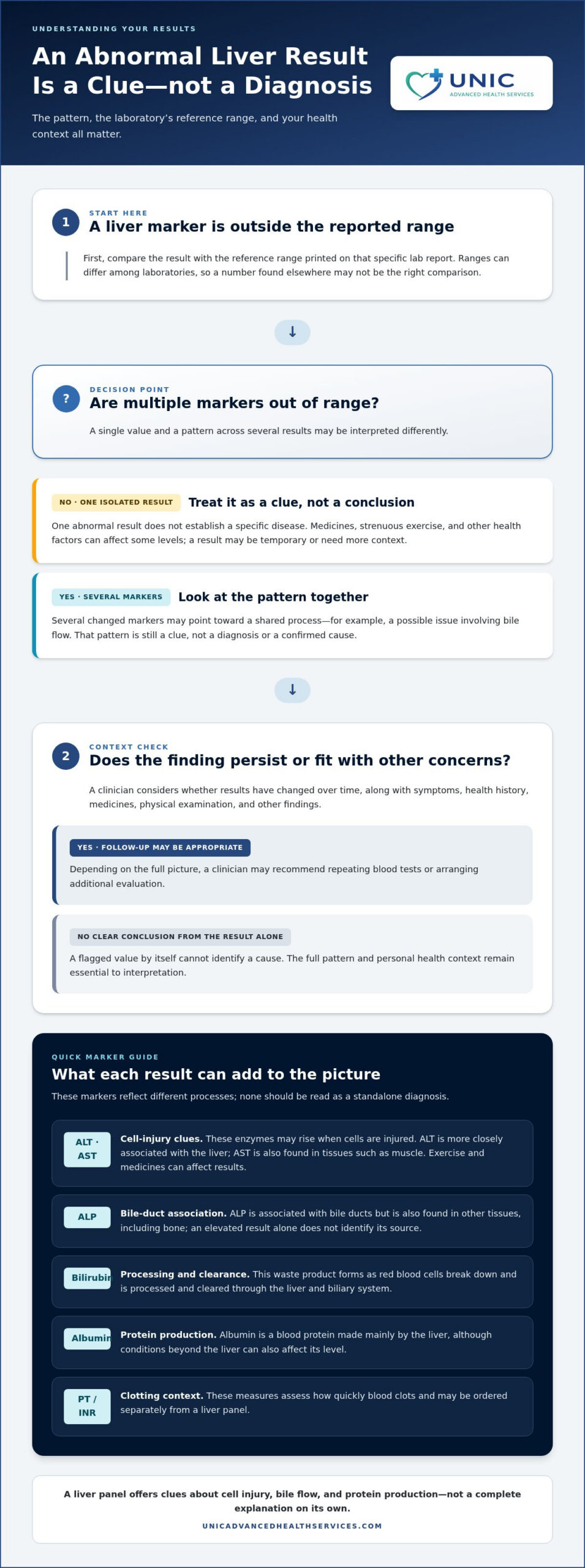
No. A blood panel is one part of an assessment. A clinician considers the results alongside your health history, symptoms, physical examination, medicines, and other relevant information. A flagged value can be unsettling, but one abnormal result doesn’t establish a specific disease. It may be temporary or require more context.
What does a liver function test show, then? It shows patterns that can help guide the next step, not a complete explanation by itself. Depending on the overall picture, a clinician may recommend repeating blood tests or arranging additional evaluation. Discussing the findings with a healthcare professional helps put them in context and determine whether follow-up is needed.
What do ALT, AST, ALP, bilirubin, and albumin measure?
Each result reflects a different process, so a panel is most useful when its markers are considered together. This table is a general guide, not a way to diagnose a condition from one number.
| Marker | What it generally reflects |
|---|---|
| ALT and AST | Enzymes that may rise when cells are injured |
| ALP | An enzyme associated with bile ducts, but also found in other tissues |
| Bilirubin | Processing and clearance of a waste product from red blood cell breakdown |
| Albumin | A blood protein made mainly by the liver |
| PT/INR | Blood clotting time, which may help assess clotting context |
For a broader overview of these tests and their uses, see Liver Function Tests from MedlinePlus.
What do liver enzymes ALT and AST indicate?
ALT means alanine transaminase, and AST means aspartate transaminase. These enzymes are found in cells, and their levels in blood may increase when cells are injured. ALT is more closely associated with the liver, while AST is also present in tissues such as muscle. Exercise, medicines, and other factors can affect results, so clinicians interpret elevations alongside symptoms, health history, and other tests.
ALT and AST levels are clues to possible cell injury, not direct measurements of how well the liver performs.
What do bilirubin, ALP, albumin, and PT/INR add?
Bilirubin forms as red blood cells break down and is processed and cleared through the liver and biliary system. High levels may occur when processing or bile flow is affected, among other causes. ALP is associated with the bile ducts, but it can also come from bone, so an elevated result alone doesn’t identify its source.
Albumin is a blood protein made mainly by the liver, though conditions beyond the liver can also influence its level. Prothrombin time (PT) and its standardized measure, INR, assess how quickly blood clots. They may be ordered separately from a liver panel or considered as part of a broader assessment of protein production and clotting. What does a liver function test show depends on the combination of findings and the person’s clinical context.
For help putting laboratory findings in context, primary care in Fort Lauderdale offers a setting for a personalized discussion.
Do abnormal liver function test results mean liver disease?
No. An out-of-range liver marker doesn’t automatically mean you have liver disease. Results can vary for several reasons, and a flagged value is a signal to interpret, not a diagnosis. One liver test result cannot identify a cause on its own because different health factors can affect the same marker.
The pattern can offer more context than a single value. For example, an isolated enzyme elevation may be assessed differently from several abnormal markers that point to a shared process, such as a possible issue involving bile flow. These are clues, not conclusions. A clinician considers how far a result falls outside the laboratory’s range, whether other markers have changed, and whether the pattern persists over time.
Reference ranges can differ among laboratories, so compare your result with the range printed on that specific report rather than a number found elsewhere. Symptoms, medical history, medicines, and other test findings also matter. The question of what does a liver function test show is best answered by reviewing the full clinical picture, not a flag in isolation.
What can cause liver test results to change?
Medicines, alcohol, infections, metabolic conditions, and other health issues can influence liver-related results. The source may not be the liver: strenuous exercise can affect some enzyme levels, and ALP can come from bone as well as the liver or bile ducts. Possible explanations depend on which marker changed and by how much. A healthcare professional can assess these factors without assuming one cause from a lab value alone.
Can normal liver test results rule out every problem?
Results within the laboratory’s reference ranges can be reassuring, but they don’t exclude every liver condition. Some concerns may not be reflected in the markers measured or may need assessment beyond a blood panel. If symptoms, risk factors, or other findings remain concerning, a clinician may consider further evaluation even when results appear in range.
Likewise, an abnormal result may lead to repeat testing or other follow-up rather than an immediate conclusion. Bring the complete report and a list of medicines and supplements to your appointment. A clinician can explain how the results relate to your history and decide whether monitoring or additional evaluation makes sense. This individualized review helps turn an unexpected result into a clear, measured next step.
How should you prepare for a liver function test and follow up?
Preparation can help you complete the test as instructed and understand what happens next. Requirements depend on the tests ordered, so follow the directions from your clinician or laboratory rather than relying on general advice.
- Step 1: Follow your test instructions. Check whether fasting or any other preparation is required. Tell your clinician about medicines, vitamins, and supplements you take. Don’t stop or change them unless your clinician specifically tells you to.
- Step 2: Complete the blood test as directed. If anything about the instructions is unclear, contact the clinician or laboratory that provided them before your appointment.
- Step 3: Review the results with a clinician. Discuss the report in context instead of treating a flagged value as a diagnosis. Ask what follow-up, if any, is appropriate for your situation.
Do you need to fast before a liver blood test?
Fasting isn’t universally required for every liver panel. It may depend on whether other tests were ordered at the same time and on the instructions for your specific test. Follow the directions from your clinician or laboratory, and ask them if you’re unsure. Don’t fast or change your medication routine based only on general information about liver tests.
What should you ask when reviewing your results?
Bring the full report and note any symptoms or questions you want to cover. A useful conversation can include:
- Which results are outside this laboratory’s reference range, and does the pattern matter?
- Could my symptoms, health history, medicines, supplements, or alcohol use affect how these results are understood?
- Should I repeat any tests, have additional evaluation, or follow up at a particular time?
These questions help clarify what does a liver function test show in your individual context, without drawing conclusions from one number alone. Your clinician can explain the findings and outline next steps based on your overall health.
Seek urgent medical attention for severe symptoms such as confusion or vomiting blood. For a personalized review of laboratory findings, schedule a primary care visit in Fort Lauderdale.
Where can you discuss liver test results in Fort Lauderdale?
A flagged result can raise questions, but interpreting it in isolation may create unnecessary worry. A clinician-led review connects laboratory findings with your symptoms, health history, medicines, and the reason the test was ordered. That context helps clarify what the results may suggest and whether follow-up is appropriate.
If you’re asking what does a liver function test show, a clinician can explain what the specific markers on your report mean together. They can also discuss how the results relate to your current concerns, rather than treating one number as a complete answer. Bring a copy of the report and a list of medicines and supplements to make the conversation more useful.
What happens during a clinician-guided result review?
The clinician reviews your results against the laboratory’s reference ranges and considers how the findings fit with your health history and current symptoms. They may ask about relevant changes in your health, medicines, supplements, and other factors that could help interpret the pattern. If the overall picture calls for it, follow-up could include repeat lab work or further assessment. The appropriate next step varies by person, and no single result promises a particular diagnosis or outcome.
How can local primary care support ongoing health concerns?
Primary care provides a setting to discuss a specific lab report and broader health questions. In Fort Lauderdale, Unic Advanced Health Services provides primary care, preventive care, chronic condition management, and on-site lab services to support diagnostic care.
Continuity can be helpful when results need to be considered alongside other health concerns over time. A clinician can discuss what is relevant to your situation and whether a next step is appropriate, without assuming that an out-of-range marker has one definite explanation.
For a personalized conversation about your health concerns and laboratory findings, learn about primary care in Fort Lauderdale. A clinician can help you understand the context and discuss an appropriate way forward.
Take the Next Step With Confidence
So, what does a liver function test show? Its markers offer clues about liver cell injury, bile flow, and protein production, but they don’t provide a diagnosis on their own. An out-of-range result may have several explanations, while a result within range may not answer every health question. Your symptoms, medical history, and the pattern across results all help guide interpretation.
Follow the preparation instructions for your specific test, and review the report with a healthcare professional. They can explain which results matter in your situation and whether repeat testing or further assessment is appropriate. You don’t have to make sense of unfamiliar abbreviations or flagged values by yourself.
Unic Advanced Health Services provides primary care and preventive care in Fort Lauderdale, with on-site lab services supporting diagnostic care. To learn more about the practice, explore primary care at Unic Advanced Health Services. A conversation with a clinician can help you understand your results and feel more prepared for what comes next.
Frequently Asked Questions
What does a liver function test show?
A liver function test shows levels of blood markers that can offer clues about liver cell injury, bile flow, and protein production. ALT and AST are enzymes, while bilirubin and albumin reflect other processes. The results don’t identify a cause or provide a complete diagnosis by themselves. A clinician interprets them alongside your symptoms, health history, and other findings. In Fort Lauderdale, primary care provides a setting to discuss laboratory results in context.
Which blood test results are included in a liver function panel?
A liver panel commonly includes ALT, AST, alkaline phosphatase (ALP), bilirubin, albumin, and sometimes total protein. The exact group of tests can vary by laboratory and by the clinician’s order. Prothrombin time and INR, which relate to blood clotting, may be assessed separately or included in a broader evaluation. Check the names on your report, and ask your clinician what each result means for your situation.
Is an abnormal liver function test always serious?
No. An out-of-range result doesn’t automatically mean a serious condition or confirm liver disease. Medicines, alcohol, infections, strenuous exercise, and health issues outside the liver can affect some markers. Clinicians look at how far a value is outside the laboratory’s range, whether other markers are also abnormal, and whether the change persists. They may recommend repeat testing or further evaluation based on your overall health and history.
Can liver function tests be normal if you have liver disease?
Yes. Normal liver test results can be reassuring, but they don’t rule out every liver condition. A blood panel measures specific markers, and not every health concern appears in those results. If you have symptoms, relevant risk factors, or other findings that concern you, discuss them with a healthcare professional even if the report is within range. The clinician can decide whether your circumstances call for monitoring or additional assessment.
Do I need to fast before a liver function test?
Not always. Fasting isn’t required for every liver panel, but preparation can depend on other tests ordered at the same time and the instructions for your specific test. Follow the directions from your clinician or laboratory, and ask them if anything is unclear. Don’t stop prescribed medicines or supplements unless your clinician specifically instructs you to. If you’re unsure whether fasting applies, clarify before having your blood drawn.
How long does it take to get liver function test results?
Result timing varies by laboratory, the tests ordered, and how the sample is processed, so there isn’t one reliable timeframe for everyone. The laboratory or clinician who arranged the test can tell you when results are expected and how you’ll receive them. Once available, arrange to review them with a healthcare professional. A clinician can explain which findings matter and whether follow-up is appropriate for your circumstances.
What symptoms should prompt urgent medical attention alongside abnormal liver results?
Seek urgent medical attention for severe symptoms, especially confusion or vomiting blood. Don’t wait for a routine results discussion if these occur. Share other new or worsening symptoms promptly with a healthcare professional, who can advise on the appropriate response. Abnormal results alone don’t establish a diagnosis, but symptoms add important context. If you’re unsure how urgently to act, contact a medical professional for guidance rather than interpreting the report on your own.