
What if preventive care didn’t require clearing an entire day from your calendar? A preventive health plan for busy executives should fit real workdays while still addressing more than the next annual checkup. When appointments, testing, and follow-up compete with demanding schedules, it’s easy for preventive care or ongoing health needs to slip.
The practical challenge is not simply finding a short appointment. It’s organizing the parts around it: gathering relevant health information, discussing priorities, reviewing results, and understanding any recommended next steps. An intensive executive health program and an ongoing primary care relationship may take different approaches, so the right fit depends on your health history, needs, and schedule.
This guide explains how to compare care options using practical, patient-centered criteria. You’ll learn how screenings and lab work can fit into a plan, what to consider if you’re managing a chronic condition, and how to make follow-up more workable. We’ll also look at ongoing primary care in Fort Lauderdale, where Preventive Care, On-Site Lab Services, and Chronic Condition Management can connect through individualized care.
Key Takeaways
- A preventive health plan for busy executives should reflect your health history, risk factors, and schedule, not just a standard annual checklist.
- Compare executive health programs, ongoing primary care, and episodic visits by care scope, continuity, scheduling fit, follow-up, and personal relevance.
- Use a clear sequence to organize care: gather your health history, discuss priorities, review findings, and agree on follow-up steps.
- Screenings and tests should be selected and timed by a clinician using current guidance and your individual health needs.
- In Fort Lauderdale, Preventive Care, On-Site Lab Services, Chronic Condition Management, and care coordination can support an ongoing primary care plan.
What Should a Preventive Health Plan for Busy Executives Actually Do?
A demanding calendar can make it difficult to arrange appointments, prepare for tests, review results, and complete follow-up. That doesn’t mean prevention should be reduced to the shortest possible visit or a standard checklist. A preventive health plan for busy executives should make care manageable while reflecting personal health history, current concerns, risk factors, and clinician guidance.
A preventive health plan is an individualized approach to routine health evaluation, appropriate preventive services, and follow-up over time. It helps organize what needs attention and when, while clinical decisions remain specific to the patient and clinician. The broad idea of Preventive healthcare includes services intended to support health before a problem develops or progresses, but no plan can guarantee that illness will be prevented.
Routine preventive care is distinct from care for a new symptom or a diagnosed condition. An annual physical may be one part of a preventive plan, but a persistent symptom or a change in health deserves attention in its own right. Managing a known condition may also require ongoing assessment and follow-up beyond routine screening. These needs can overlap, but they are not interchangeable.
Screenings and tests should match the person, not an “executive” label. A clinician can consider personal and family history, existing risk factors, prior results, and current clinical guidance when deciding which services are appropriate. Two people with similar schedules may need different plans. One may want to discuss a family health history, while another may need continued attention to a diagnosed condition.
How preventive care differs from an executive physical
An executive physical is an assessment, but completing one doesn’t automatically create an ongoing care plan. Preventive Care may include annual physicals, vaccinations, and appropriate screenings, with recommended services shaped by individual needs and current clinical guidance. The useful question is what happens after the assessment: whether findings are reviewed, concerns are addressed, and any next steps connect to the person’s broader health history.
Why a busy schedule changes the care-planning question
Plan for more than the appointment itself. Consider the time needed to prepare, complete any relevant testing, review results, and arrange follow-up. Convenience can make appropriate care easier to schedule, but it shouldn’t determine which screening or evaluation is clinically suitable. Continuity means follow-up that connects new findings and care decisions to a person’s health history over time.
That definition offers a practical way to assess whether a care arrangement supports more than a single visit. If a result needs discussion or a health concern calls for monitoring, there should be a clear next step. The goal is not to fill a calendar with tests. It’s to make necessary care understandable, relevant, and easier to follow through on alongside work responsibilities.
Which Services Can Form a Practical Executive Preventive Care Plan?
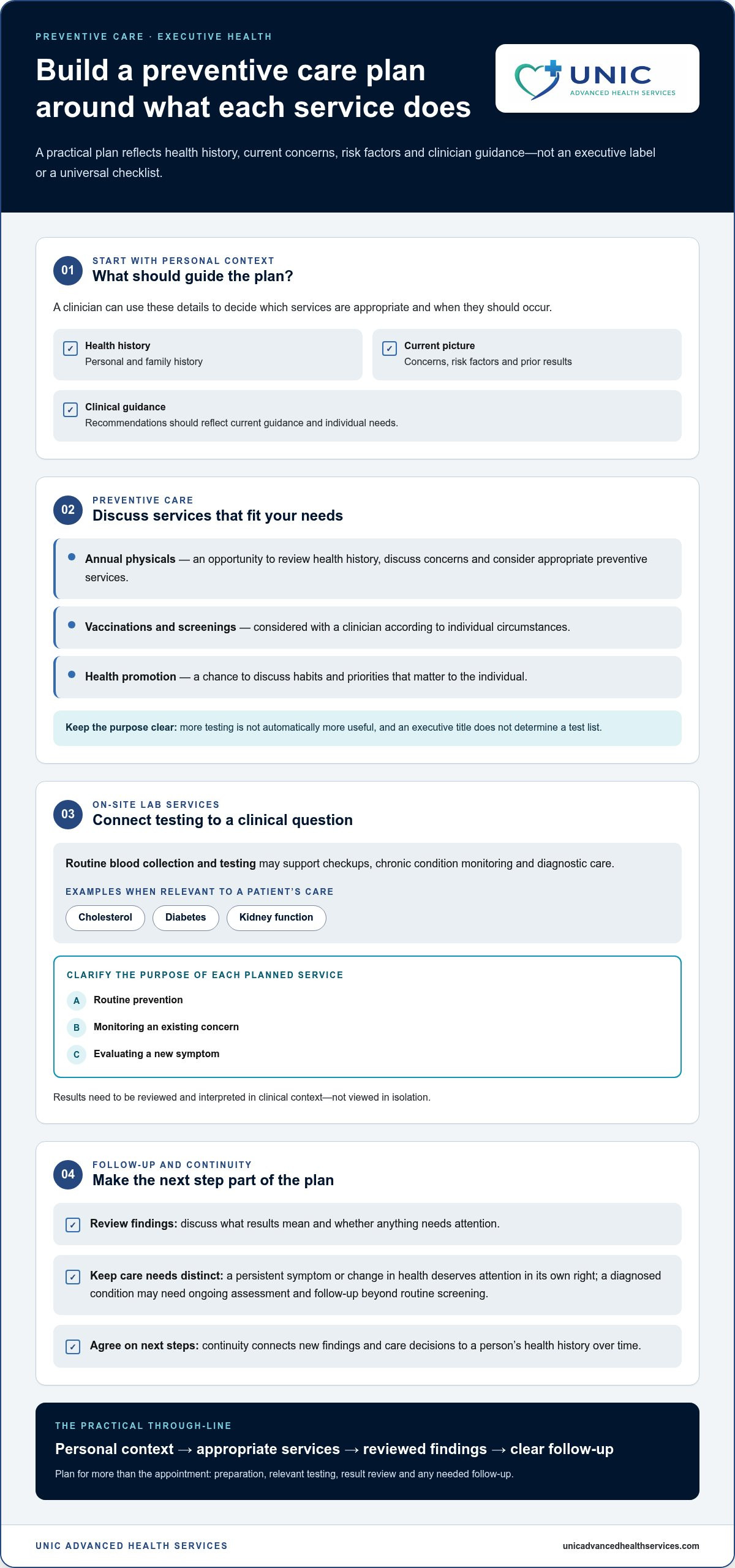
A useful plan connects specific services to a person’s health needs rather than treating testing as a checklist. Annual physicals provide an opportunity to review health history, discuss concerns, and consider appropriate preventive services. Screenings and vaccinations may be part of that care, while health promotion can support conversations about habits and priorities that matter to the individual.
Recommendations vary according to personal risk, medical and family history, prior results, and current clinical guidance. A clinician can use that context to decide which screenings or tests are appropriate and when they should occur. An executive title alone doesn’t determine a test list, and more testing isn’t automatically more useful. A practical plan makes the purpose of each service clear.
Screenings, vaccinations, and On-Site Lab Services
Preventive Care includes annual physicals, vaccinations, and screenings. These services can be considered together during a visit, with the clinician explaining which ones fit the patient’s circumstances. A person with a relevant health history may need a different discussion from someone without the same risk factors. The aim is to make care relevant, not to apply a universal schedule to everyone.
On-Site Lab Services include routine blood collection and testing that can support checkups, chronic condition monitoring, and diagnostic care. For example, lab work may help a clinician monitor cholesterol, diabetes, or kidney function when relevant to a patient’s care. The test itself is only one step. Reviewing the findings gives the patient and clinician a chance to discuss what they mean, whether anything needs attention, and what next steps are appropriate. Results should be interpreted in their clinical context rather than viewed in isolation.
For a busy professional, it can help to clarify the purpose of each planned service: Is it routine prevention, monitoring an existing concern, or evaluating a new symptom? That distinction makes a care plan easier to understand and helps focus appointments on decisions that matter. It also avoids assuming that every patient needs the same labs or screenings.
Connecting prevention with chronic condition management
Preventive visits and Chronic Condition Management are related, but they serve different purposes. A preventive visit reviews health needs and considers appropriate prevention. Ongoing care may be needed for conditions such as diabetes, hypertension, asthma, obesity, or heart disease, with follow-up shaped by the individual’s circumstances. If obesity is a specific concern, obesity management care in Fort Lauderdale is one topic to explore.
These needs can connect. A preventive appointment may identify a concern that warrants continued monitoring, while an existing condition may affect which screenings or preventive steps are appropriate. Keeping the discussion connected helps the clinician consider the whole health picture, coordinate next steps, and determine when additional follow-up or a referral is appropriate. For personalized primary and preventive care in Fort Lauderdale, Unic Advanced Health Services provides care that can support this ongoing conversation.
Executive Health Program or Primary Care: How to Compare Your Options
A dedicated executive health program, an ongoing primary care relationship, and episodic visits can each serve different needs. No model is automatically best for every person. Compare what care includes, how it connects over time, and whether it addresses both preventive needs and any existing conditions. For a preventive health plan for busy executives, clear scope and follow-up may matter as much as the initial assessment.
Care model | Care scope | Continuity and follow-up | Scheduling fit and personal relevance
Executive health program | May center on a more intensive assessment or a defined program of services. The actual scope depends on the program. | Review and next steps may be part of the model; understand how findings connect to ongoing care. | Consider whether its format works with your calendar and whether its services fit your health history and priorities.
Routine primary care relationship | Can bring preventive visits and care for ongoing health needs into an established relationship. | Follow-up can build on health history, review findings, and support referrals or continued condition management. | Consider whether regular care can fit your work and travel patterns, and whether it addresses your individual needs.
Episodic visits | Usually focus on a specific visit or immediate concern rather than an ongoing care relationship. | Follow-up may depend on the issue and how care is arranged after the visit. | May suit a focused need, but consider how preventive care and existing conditions will be addressed over time.
Questions that reveal whether a plan fits
Before choosing a model, consider whether it includes a recurring preventive visit and a clear way to discuss results. Think about how existing conditions and referrals fit into the care relationship, and how follow-up is handled. Then compare the scheduling approach with your actual work and travel patterns. A program’s advertised features are not a substitute for understanding which services are included and how they relate to your needs.
Look for specifics, not broad promises. A description such as “comprehensive” doesn’t by itself explain what an assessment, follow-up, or ongoing care involves. Separate stated services from optional features and promotional claims, then focus on the care you need and how next steps are handled.
When ongoing primary care may be a sensible fit
A dedicated executive-branded program isn’t the only way to receive preventive care. Personalized primary care can connect routine prevention with Chronic Condition Management and care coordination, helping keep health history and follow-up in view. For a closer look at what a routine visit may cover, see this annual physical exam guide for Fort Lauderdale.
In Fort Lauderdale, Unic Advanced Health Services provides Annual Physicals and Preventive Care, Chronic Condition Management, and care coordination. These services support a continuing primary care relationship shaped around individual needs. If that approach aligns with your priorities, explore personalized primary and preventive care as one option for organizing ongoing care.
How to Build a Preventive Health Routine Around a Demanding Schedule
A workable routine starts with what you already know about your health and turns it into a short list of decisions to make with a clinician. Rather than relying on a generic executive calendar, plan around your history, current needs, and realistic openings in your work schedule.
Gather your health history, schedule a preventive visit, discuss priorities with a clinician, review findings, and agree on appropriate follow-up. This sequence gives each step a purpose without assuming that everyone needs the same screenings or timing.
- Gather your health history. Collect relevant prior records and note existing diagnoses, past results, and family health history. Include a current medication list so the clinician has useful context.
- Schedule care with your calendar in mind. Consider work commitments, travel, and the time needed to attend and prepare. If testing or follow-up is recommended, account for those steps too, rather than planning only for the first appointment.
- Discuss your priorities. Bring questions about preventive care, health concerns, and any ongoing conditions. A focused conversation helps the clinician consider what matters most to you alongside your health history.
- Review findings. Ask what results mean in context and whether any next step is appropriate. Some findings may simply be documented or monitored; others may prompt further discussion.
- Plan follow-up. Agree on what happens next and when, based on the clinician’s recommendations. Keep the plan accessible so future visits can build on previous discussions.
Prepare for a focused preventive visit
Before the appointment, bring a valid ID, an insurance card if applicable, a medication list, and relevant health records. Write down questions, concerns, and family history details you don’t want to forget. This preparation can help the clinician understand your context and use visit time thoughtfully, but it doesn’t replace an individual evaluation or determine which services are appropriate.
Screening choices and timing should be based on current clinical guidance and individual history. They may differ according to risk factors, prior findings, and other health needs. A familiar annual date can help you remember to review care, but it shouldn’t dictate when a particular screening is due. The clinician can advise on timing that fits your circumstances.
Turn findings into realistic next steps
Results review is an opportunity to clarify what a finding means, whether it calls for action, and what kind of follow-up is suitable. Not every result requires additional testing or treatment. If specialist input is appropriate, care coordination can help connect that referral with the broader plan. For a chronic condition, follow-up may also address ongoing monitoring separately from routine prevention.
A preventive health plan for busy executives should fit clinical recommendations as well as a demanding schedule. Unic Advanced Health Services provides Preventive Care and Chronic Condition Management in Fort Lauderdale. Explore preventive care options as a next step toward organizing care around your health needs.
Explore Personalized Preventive Care for Fort Lauderdale Executives
A demanding schedule doesn’t make preventive care less personal. It makes a clear, practical way to organize it more important. Unic Advanced Health Services provides primary care in Fort Lauderdale, led by Marc Joseph, an autonomous nurse practitioner. Preventive needs and ongoing health concerns can be discussed as part of an individualized primary care relationship.
A preventive health plan for busy executives may involve more than a single appointment. The relevant services depend on your health history, current needs, and clinician guidance. In a primary care setting, discussions about prevention can connect with ongoing care when follow-up or additional coordination is appropriate.
What local, personalized primary care can address
Preventive Care includes annual physicals, screenings, and vaccinations. These services create opportunities to review health priorities and discuss which preventive steps are suitable for you. On-Site Lab Services support routine testing and monitoring for conditions such as diabetes and cholesterol when relevant to your care. Results can inform a discussion with your clinician, rather than serving as a standalone checklist.
For people managing an ongoing condition, Chronic Condition Management can address needs that extend beyond a preventive visit. Care coordination can also support referrals to specialists when a person’s circumstances call for additional care. These services can work alongside prevention while keeping the purpose of each visit clear: routine prevention, condition management, or a specific follow-up need.
How to take the next step
To schedule an appointment or ask new-patient questions, call (954) 767-0228. New patients may complete forms online or in-office and should bring a valid ID, an insurance card if applicable, a medication list, and any relevant health records. Preparing these items can make the conversation more focused while the clinician considers your individual history and priorities.
The practice accepts most major insurance plans. Call to confirm whether your specific coverage is accepted. Office hours are: Monday through Saturday, 9:00 AM – 5:00 PM; Saturday until 1:00 PM; closed on Sundays.
You don’t need to arrive with every decision already made. Start with the health needs you want to discuss, then work with the clinician to consider appropriate preventive care and follow-up. Schedule an appointment to discuss personalized preventive care in Fort Lauderdale and take a considered next step toward an individualized plan.
Make Your Next Health Decision a Clear One
A preventive health plan for busy executives doesn’t need to begin with a complicated program. It can start with one practical decision: set aside time to discuss your health priorities and what follow-up makes sense for you. From there, you and your clinician can shape a plan around your individual needs and the realities of your schedule.
Consistent attention to your health is built one step at a time. You don’t have to resolve every question before beginning. Bring the concerns you want to address, share relevant health history, and make space for a conversation about appropriate next steps.
If you’re ready to put that conversation on your calendar, schedule a preventive care appointment with Unic Advanced Health Services. A thoughtful discussion can help you identify a realistic place to begin and support a more intentional approach to ongoing care. Your next step can be simple and shaped around you.
Frequently Asked Questions
Is an executive health plan the same as an annual physical?
No. An annual physical is a visit, while an ongoing plan may connect that visit with preventive services and follow-up. Before choosing a program, look beyond its name and identify what the assessment includes, how results are discussed, and what happens if a concern needs attention later. A plan should reflect your health history and clinician guidance, not just a list of features marketed to executives.
Can preventive care help if I already have a chronic condition?
Yes. Preventive care can be considered alongside condition-specific care, but it doesn’t replace it. For example, someone managing diabetes may need ongoing monitoring while also discussing which routine preventive services are appropriate. A preventive health plan for busy executives should account for both needs, with follow-up guided by the clinician’s recommendations and the person’s health history rather than a standard package.
How often should a busy executive have preventive screenings?
There isn’t one screening schedule for every executive. Timing depends on the screening and factors such as age, personal and family history, and existing health conditions. Keep a record of past screening dates and results, then review it with a healthcare professional to discuss what may be due. Don’t assume an advertised package’s schedule applies to you; use current clinical guidance and individual circumstances to guide decisions.
What should I bring to a first preventive care appointment?
Bring a valid ID, an insurance card if applicable, your medication list, and relevant health records. Include medication names and doses when available, and note any recent changes. You can also write down questions or concerns you want to cover. New patients at Unic Advanced Health Services may complete forms online or in-office, so you can choose the option that works for you.
Does Unic Advanced Health Services accept insurance for preventive care?
Unic Advanced Health Services accepts most major insurance plans. Coverage varies by plan and service, so call the practice to confirm your specific coverage before your appointment. Have your insurance information available and ask how your planned visit or service applies to your benefits. For scheduling or new-patient questions, call (954) 767-0228.
Can I get lab work during a preventive care visit?
On-Site Lab Services include routine blood collection and testing that may support checkups or chronic condition monitoring. Whether a particular test is appropriate depends on your health history and the clinician’s assessment. If monitoring a condition is part of your care, discuss what the lab work is intended to evaluate and how the results will inform follow-up. A preventive visit doesn’t automatically require lab testing.
What should I do if a screening result needs follow-up?
Discuss the result with the clinician who ordered or reviewed it, and ask what it means in light of your history. A result alone doesn’t establish a diagnosis; the appropriate next step depends on the finding and clinical context. Unic Advanced Health Services provides care coordination, including referrals to specialists when appropriate. Keep a copy of the result and note any follow-up plan so it can be revisited as needed.